

17
Apr
Pros and cons of trading automation: a practical guide
TL;DR:
- Trading automation enhances consistency and removes emotional biases in trading decisions.
- Risks include flawed strategies, technical failures, and market condition changes that systems can’t adapt to.
- Suitability depends on having a clear strategy, risk tolerance, and ongoing system monitoring.
Most traders come to automation expecting a shortcut. They imagine a bot running silently in the background, stacking profits while they sleep. The reality is more nuanced. Trading automation can genuinely improve consistency, remove emotional noise, and open doors to strategies that are impossible to execute manually. But it can also amplify bad decisions at machine speed. This guide walks through the real advantages and drawbacks of trading automation, so you can make an informed call about whether it belongs in your trading setup.
Table of Contents
- What is trading automation and how does it work?
- Key advantages of trading automation
- Potential drawbacks and risks of trading automation
- How to decide if trading automation is right for you
- Why the real edge in trading automation isn’t just about technology
- Explore the best trading automation tools and get started
- Frequently asked questions
Key Takeaways
| Point | Details |
|---|---|
| Emotion-free execution | Automated trading eliminates emotion-based mistakes by sticking to preset rules. |
| Round-the-clock operation | Automation enables continuous market monitoring and order execution. |
| Not foolproof | Even with automation, poor strategies and technical issues can lead to losses. |
| Evaluate fit | Assess your goals, risk tolerance, and resources to decide if automation supports your trading approach. |
What is trading automation and how does it work?
Trading automation is the use of software to execute trades based on a defined set of rules, without requiring you to click a button each time. Instead of watching charts and placing orders manually, you program your logic into a system that monitors the market and acts on your behalf.
On platforms like MetaTrader 4 and MetaTrader 5, this is done through Expert Advisors (EAs), which are scripts written in the MQL programming language. An EA can be as simple as “buy when the 50-period moving average crosses above the 200-period moving average” or as complex as a multi-condition AI-driven model that adapts to volatility. If you want a deeper look at the reasoning behind this approach, why automate forex trading covers the core motivations in detail.
Here is a quick breakdown of what automation can handle:
- Full automation: The EA opens, manages, and closes trades entirely on its own, based on preset rules.
- Semi-automation: The system generates signals or manages risk, but you confirm or adjust entries manually.
- High-frequency execution: Automation can place dozens of trades per second, something no human trader can replicate.
- Portfolio rebalancing: Systems can monitor multiple currency pairs or instruments simultaneously and adjust exposure dynamically.
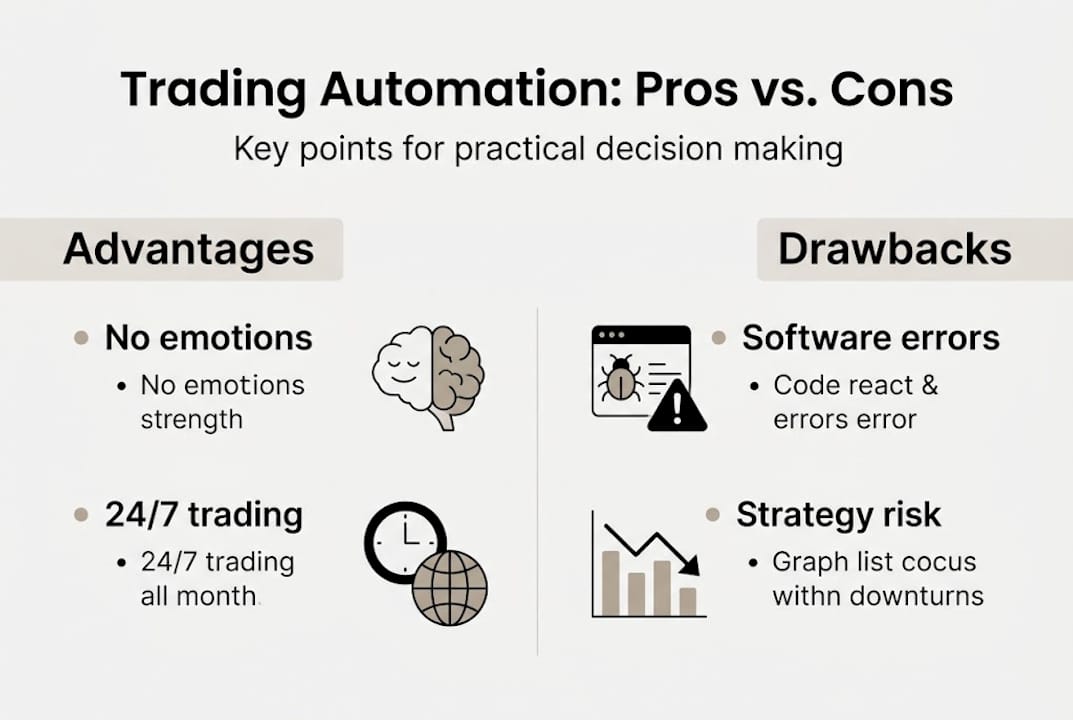
One of the most cited benefits is that automated trading removes emotional bias, enabling consistent rule-based execution without fear or greed influencing decisions. That alone is a significant edge, since most trading mistakes trace back to emotional interference.
Pro Tip: Before choosing between full and semi-automation, honestly assess how much you trust your strategy. Semi-automation keeps you in the loop and is often a smarter starting point for traders still refining their edge.
Key advantages of trading automation
Now that you understand the basics, let’s break down why so many traders are drawn to automation.
The advantages of AI trading bots go beyond just speed. Here are the core strengths:
- Emotion-free execution: Automated systems follow rules precisely. No second-guessing, no revenge trading after a loss.
- 24/5 market coverage: Forex markets run around the clock on weekdays. An EA never sleeps, misses a session, or gets distracted.
- Backtesting capability: You can run your strategy against years of historical price data before risking a single dollar, giving you a realistic picture of potential performance.
- Speed: Automated systems can react to market events in milliseconds, capturing opportunities that disappear before a manual trader can act.
The table below shows how the two approaches stack up across key performance factors:
| Factor | Manual trading | Automated trading |
|---|---|---|
| Emotional control | Vulnerable to fear and greed | Rule-based, no emotional input |
| Execution speed | Limited by human reaction time | Millisecond order placement |
| Market monitoring | Requires active screen time | Continuous 24/5 coverage |
| Strategy consistency | Varies with trader’s mental state | Consistent rule application |
| Backtesting | Difficult to simulate accurately | Fast and data-driven |
| Adaptability | High, based on judgment | Limited to programmed logic |
For a thorough manual vs automated trading comparison, the differences become even clearer when you factor in long-term consistency. A manual trader having a bad week can deviate from their own rules. An EA does not have bad weeks. It executes the same logic every single time, which is both its greatest strength and, as we will see next, one of its risks.
The benefits for serious traders compound over time. Consistent rule application, combined with the ability to monitor multiple instruments at once, means a well-designed automated system can cover more ground than any individual trader working alone.
Potential drawbacks and risks of trading automation
Of course, no solution is perfect. Let’s dig into the challenges you might face with trading automation.
Here are the most significant risks, ranked by how often traders encounter them:
- Flawed strategy amplification: If your rules are wrong, the EA executes those wrong rules faster and more consistently than you ever could manually. Losses scale just as efficiently as profits.
- Over-optimization (curve fitting): Many traders backtest until their system looks perfect on historical data. In live markets, that “perfect” system often falls apart because it was tuned to past noise, not real patterns.
- Technical failures: Server outages, internet disconnections, broker platform issues, and software bugs can all interrupt execution at the worst possible moment.
- Changing market conditions: A strategy that performed well in a trending market may fail completely in a ranging one. Automated systems do not adapt unless you build that adaptability in.
“A system that made money for two years can stop working overnight when market structure shifts. The EA does not know this. You have to.”
Proper automated trading risk management is not optional. Position sizing, drawdown limits, and stop conditions need to be baked into your system from the start. The broader principles of risk management for financial institutions reinforce that even sophisticated automated systems require active oversight and defined risk boundaries.
If you want to stress-test your system before going live, learning how to backtest expert advisors is an essential skill. Backtesting reveals weaknesses before they cost you real money.
Pro Tip: Schedule a weekly review of your EA’s performance metrics. Drawdown creeping upward, win rate dropping, or unusual trade frequency are early warning signs that something has changed.
How to decide if trading automation is right for you
With both strengths and pitfalls clear, here is a practical approach to help you decide your next steps.
Start by asking yourself a few honest questions. What are your trading goals? Are you trying to grow a small account, pass a prop firm challenge, or generate consistent income? Your answer changes what kind of automation makes sense. Then consider your risk tolerance and available capital, since some EAs require specific account sizes to function within safe drawdown limits.
The table below maps common trader profiles to automation suitability:
| Trader profile | Automation fit | Reason |
|---|---|---|
| Full-time manual trader | Moderate | Automation handles overnight sessions |
| Part-time trader with limited screen time | High | Covers market hours you cannot monitor |
| Prop firm challenge participant | High | Consistent rule-following reduces violations |
| Complete beginner with no strategy | Low | Automation needs a solid strategy to execute |
| Experienced trader with tested rules | Very high | Removes execution errors and emotional drift |
Here is a practical checklist of signs that automation might be a strong fit for you:
- You have a clearly defined, rule-based trading strategy
- You struggle with emotional discipline during live trading
- You cannot monitor the markets during key trading sessions
- You want to trade multiple instruments simultaneously
- You are willing to test, monitor, and adjust your system regularly
The manual vs automated trading decision is not permanent. Many successful traders use a hybrid approach, automating execution while retaining discretion over strategy selection. Keeping an eye on trading automation trends can also help you understand where the market is heading and which tools are gaining traction.
Remember, consistent rule-based execution is only valuable if the rules themselves are sound. Automation is a multiplier, not a foundation.
Why the real edge in trading automation isn’t just about technology
Having examined the facts, let’s step back and consider what actually separates success from failure in trading automation.
Here is an uncomfortable truth: most traders who fail with automation do not fail because the technology is bad. They fail because they hand a flawed strategy to a perfectly functional machine. The EA does exactly what it is told. The problem is what it was told.
We have seen traders spend weeks optimizing parameters and almost no time validating whether their core logic holds up in different market conditions. Technology does not fix a bad strategy. It just executes it faster.
The traders who consistently win with automation treat it as a tool for enhancing disciplined behavior, not replacing the need for it. They monitor performance, adjust to market shifts, and never assume the system is handling everything. Staying current with the latest automation trends is part of that ongoing commitment. The edge is not in the software. It is in the trader behind it.
Explore the best trading automation tools and get started
Ready to explore automation resources or take action? Here is how to start.
FxShop24 offers a curated selection of expert-vetted EAs, AI-powered trading robots, and automation tools built specifically for forex and gold trading on MT4 and MT5. Whether you are still figuring out what trading robots are or ready to browse automated futures trading systems, the platform has resources to match where you are in your journey.
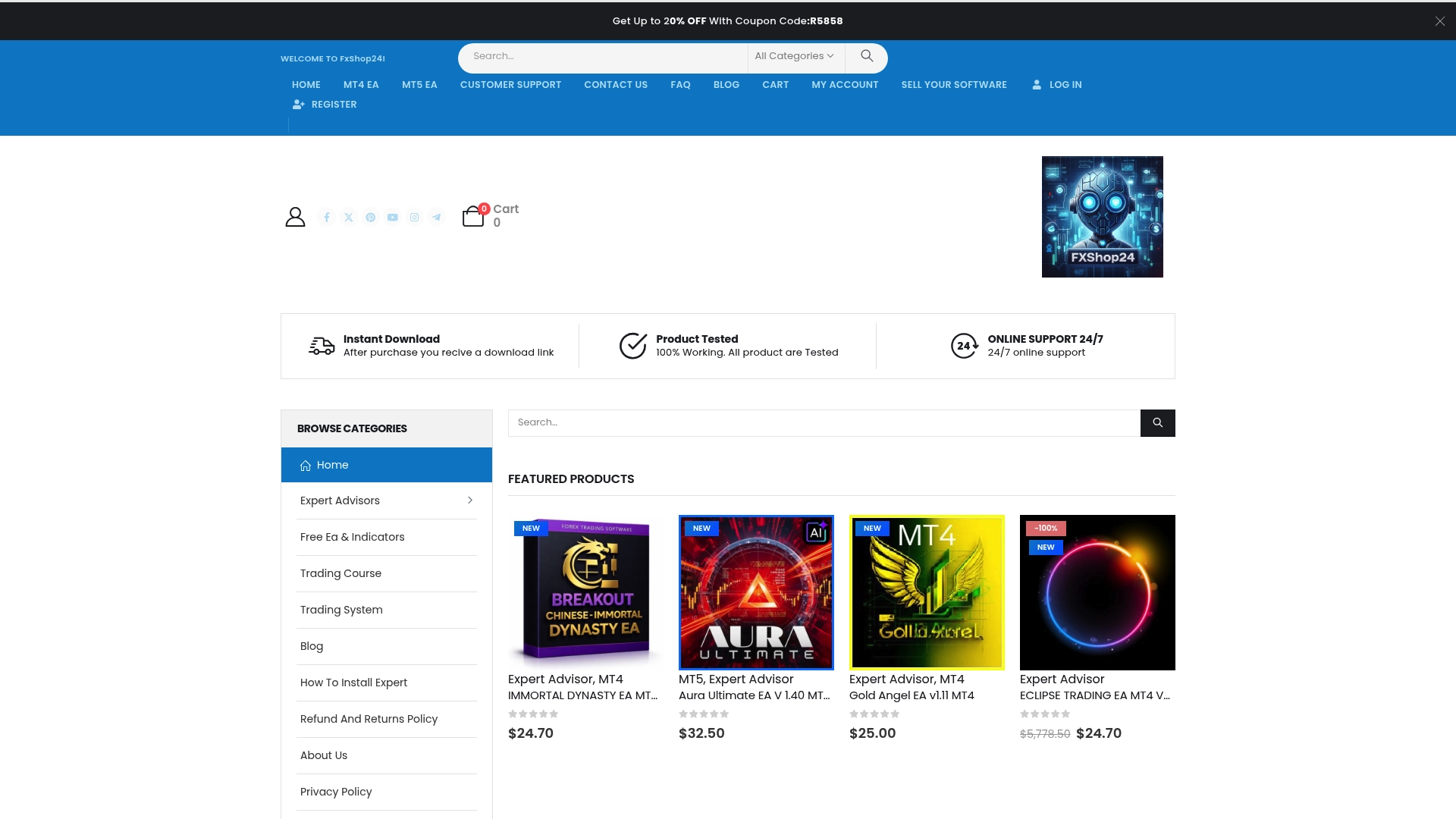
If you already have a system running, the practical guide to optimizing trading robots can help you squeeze more performance out of what you have. Every tool comes with installation support, lifetime updates, and detailed performance documentation so you know exactly what you are getting before you commit.
Frequently asked questions
Can trading automation guarantee profits?
No, automation cannot guarantee profits. Consistent rule-based execution improves discipline, but actual results depend entirely on the quality of your strategy and current market conditions.
Do I need programming skills to use automated trading?
Not necessarily. Many platforms, including MT4 and MT5, offer pre-built EAs and marketplaces where you can deploy automation without writing a single line of code.
What are the biggest risks of automated trading?
The biggest risks are software errors, connectivity failures, and poorly designed strategies that amplify losses just as efficiently as they would gains.
How do I test an automated trading system before using real money?
Run a backtest using historical price data first, then forward-test the system in a demo account for at least several weeks before going live.
Is automated trading suitable for beginners?
It can be a helpful starting point for avoiding emotional errors, but beginners still need a foundational understanding of trading strategy and risk before deploying any automated system.