



7
Mar
Manual vs automated trading: optimize forex and gold results
Automated trading systems can execute trades in under 100 milliseconds, dramatically faster than human reflexes. Yet many retail forex and gold traders remain uncertain whether automation or manual execution delivers better results. This article clarifies the strengths, weaknesses, and optimal use cases for each approach, helping you choose the right strategy to maximize your trading performance.
Table of Contents
- Introduction To Manual And Automated Trading
- Fundamental Differences Between Manual And Automated Trading
- Performance Comparison: Pros, Cons, And Real-World Evidence
- Common Misconceptions About Trading Automation
- MetaTrader Platform Automation Specifics
- How Market Conditions Affect Manual And Automated Trading
- Practical Hybrid Approaches Combining Manual And Automated Trading
- Conclusion And Recommendations For Retail Traders
- Explore High-Performance Automated Trading Solutions At FxShop24
Key takeaways
| Point | Details |
|---|---|
| Execution speed | Automated systems execute in milliseconds while manual trading depends on human reaction time, creating fundamental performance differences. |
| Consistency vs flexibility | Automation delivers repeatable rule-based execution, but manual trading adapts quickly to unexpected news and market shifts. |
| Psychology matters | Manual traders face emotional bias and overtrading risks, while EAs eliminate emotion but lack nuanced judgment. |
| Platform capabilities | MetaTrader 4 and 5 enable 24/7 automated execution through Expert Advisors with customizable parameters and risk controls. |
| Hybrid approaches work | Combining automated execution with manual oversight balances speed, consistency, and adaptive decision making for optimal results. |
Introduction to manual and automated trading
Manual trading involves discretionary decision making where you analyze charts, indicators, and market conditions to execute trades yourself. You watch price action, interpret patterns, and click buy or sell based on your judgment and strategy.
Automated trading uses Expert Advisors (EAs) that execute pre-programmed algorithms on MetaTrader platforms without human intervention. These software programs follow strict rules to enter and exit positions based on technical criteria you define.
For retail forex and gold traders, both approaches serve the same core goal: profitable trading with controlled risk. The methods differ dramatically in execution speed, emotional discipline, and scalability.
Your choice between manual and automated trading affects everything from how many currency pairs you can monitor to whether you can trade while sleeping. Understanding these differences helps you match your trading method to your lifestyle, personality, and performance goals.
Key considerations for retail traders include:
- Time availability for active chart monitoring
- Emotional discipline and psychological resilience
- Technical knowledge for strategy development
- Desire for repeatability versus situational flexibility
- Number of instruments you want to trade simultaneously
Fundamental differences between manual and automated trading
Execution speed creates the most obvious contrast. Manual traders need several seconds to recognize a signal, process information, and click to execute. Automated systems act in milliseconds once conditions are met, capturing opportunities that disappear before humans react.
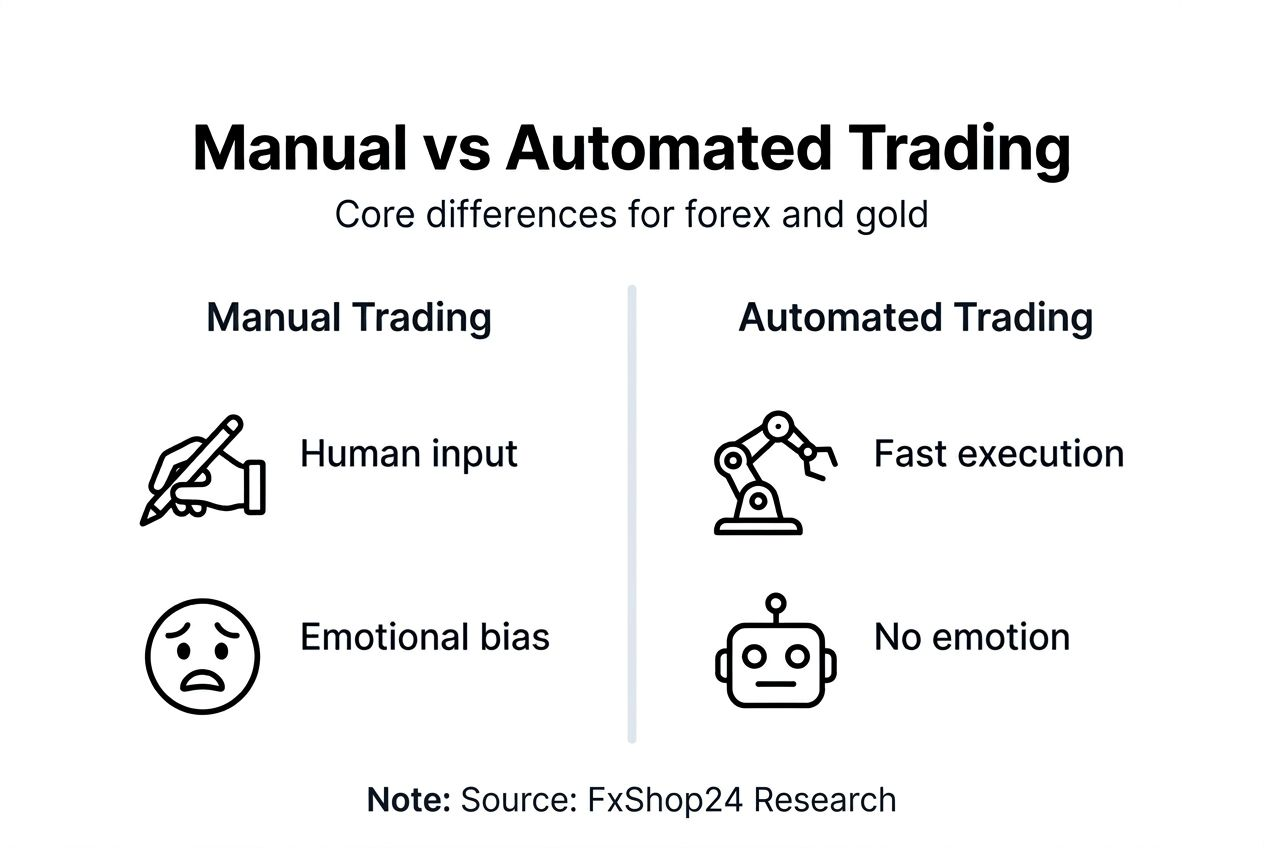
Consistency separates these approaches at their core. EAs execute the exact same logic every time without deviation, eliminating the performance variance that plagues manual traders during different emotional states. You never worry about revenge trading or fear-based hesitation with automation.
Scalability multiplies automated trading’s advantages. A single manual trader realistically monitors two to four currency pairs effectively. An EA simultaneously executes strategies across dozens of instruments without performance degradation, multiplying profit opportunities that would overwhelm human capacity.
Psychology impacts these methods differently. Manual trading exposes you to emotional decision making, where fear and greed distort judgment during volatile periods. You might exit winners too early or hold losers too long based on feelings rather than logic.
Automated systems eliminate emotional bias entirely. The EA doesn’t feel fear during drawdowns or excitement during winning streaks. It follows programmed rules without psychological interference.
Yet this same rigidity becomes a limitation. Manual traders adapt to unexpected news, recognize unusual patterns, and override rules when market conditions demand flexibility. EAs lack this nuanced judgment, executing mechanically even when experienced traders would step aside.
Key operational differences include:
- Time commitment: Manual requires constant attention; automated runs independently
- Decision making: Human judgment versus algorithmic logic
- Learning curve: Chart reading skills versus programming and optimization knowledge
- Monitoring needs: Active involvement versus periodic system checks
Performance comparison: pros, cons, and real-world evidence
Empirical data shows automated trading delivers measurable advantages in specific metrics. Backtesting and live data show automated EAs can reduce drawdowns and improve win rates with disciplined risk management compared to manual trading averages.
Consider this performance comparison:
| Metric | Manual Trading | Automated Trading |
|---|---|---|
| Average Win Rate | 45-55% | 55-65% |
| Maximum Drawdown | 25-40% | 15-25% |
| Emotional Consistency | Variable | Constant |
| 24/7 Execution | No | Yes |
| Scalability | 2-4 pairs | Unlimited |
Behavioral risks undermine manual trading performance for many retail traders. Overtrading during losing streaks, position size inconsistency, and premature profit taking create patterns that destroy accounts despite sound strategies. These psychological pitfalls don’t affect algorithmic execution.
Yet manual trading excels during volatile, news-driven periods when market behavior deviates from historical patterns. Experienced discretionary traders recognize these conditions and adjust position sizing, timing, or step aside entirely. EAs continue executing programmed logic even when conditions invalidate their assumptions.
Adaptability represents manual trading’s strongest advantage. When central banks announce surprise policy changes or geopolitical events shock markets, human traders interpret context and adjust strategies in real time. Automated systems lack this contextual understanding.
Pro Tip: Avoid over-optimizing EAs based solely on backtesting results. Combine historical testing with forward testing on demo accounts to validate strategy robustness across different market conditions before risking real capital.
Performance depends heavily on implementation quality:
- Manual trading results vary based on trader discipline and experience
- Automated performance depends on strategy logic and parameter settings
- Both methods require proper risk management to survive drawdown periods
- Neither approach guarantees profits or eliminates market risk
Common misconceptions about trading automation
Myth 1: Automation guarantees profits and eliminates risk. Many traders believe EAs magically generate consistent returns without drawdowns. Reality shows automated systems face the same market risks as manual trading. Poor strategy logic, inadequate risk controls, or unsuitable market conditions cause EA failures just as they destroy manual traders. Automation removes emotional risk but cannot eliminate systemic market risk.
Myth 2: Manual trading always performs better because humans react instantly to news. This misconception ignores automation’s consistency advantages. While manual traders do adapt to unexpected events, they also make impulsive mistakes, miss opportunities during sleep, and execute strategies inconsistently. Systematic automated approaches often outperform average manual traders over long periods through disciplined execution.
Myth 3: All Expert Advisors deliver similar results. EA quality varies enormously based on strategy logic, optimization methods, and developer expertise. Some EAs use curve-fitted parameters that fail in live markets after impressive backtests. Others employ robust logic that performs consistently across different conditions. Testing and due diligence remain essential before deploying any automated system.
Myth 4: Set and forget automation requires no ongoing monitoring. Successful automated trading demands regular performance reviews, parameter adjustments for changing market conditions, and risk management updates. Markets evolve, and strategies that worked yesterday may underperform tomorrow. Effective automation involves active oversight, not passive neglect.
Myth 5: Only advanced programmers can use automated trading. Modern platforms make automation accessible to non-programmers through visual strategy builders and pre-built EAs. You don’t need coding skills to benefit from automation, though understanding basic logic helps you evaluate and customize systems effectively.
Understanding these misconceptions prevents costly mistakes. Realistic expectations about automation’s capabilities and limitations help you implement systems successfully rather than abandoning them after initial disappointments.
MetaTrader platform automation specifics
Expert Advisors execute trades automatically on MetaTrader 4 and 5 platforms by monitoring price data and applying programmed logic to generate buy and sell signals. Once attached to a chart, EAs run continuously as long as the platform remains open and connected to your broker.
The 24/7 operation capability stands out for retail traders. Your EA continues executing strategies while you sleep, work, or focus on other activities. This persistent monitoring captures opportunities in different time zones and during off-hours when manual traders cannot actively watch markets.
Latency factors affect automated execution speed. Platform performance, internet connection quality, and broker server proximity influence how quickly orders reach the market. Optimizing these technical elements reduces slippage and improves fill quality.
Challenges in parameter optimization require careful attention. Each EA contains adjustable settings for entry rules, exit criteria, position sizing, and risk limits. Finding optimal parameter combinations involves extensive backtesting across different timeframes and market conditions. Over-optimization creates systems that perform brilliantly on historical data but fail in live trading.
Tuning processes for effective automation include:
- Testing strategy logic across multiple years of historical data
- Validating performance on out-of-sample periods not used for optimization
- Running forward tests on demo accounts before live deployment
- Monitoring real-time performance and adjusting parameters as markets evolve
- Implementing proper risk controls including maximum drawdown limits
Ongoing monitoring remains essential despite automation. Regular performance reviews identify when strategies stop working effectively, allowing you to pause underperforming EAs, adjust parameters, or switch to different systems before losses accumulate.
Understanding how to automate gold trading on MT4 and MT5 platforms helps you implement systems correctly. Mastering the workflow from strategy selection through deployment and monitoring ensures sustainable automated trading success. Learning MT5 basics provides the foundation for effective platform use.
How market conditions affect manual and automated trading
Volatility spikes create different challenges for each approach. Automated systems face increased slippage during rapid price movements as execution prices deviate from signal prices. Wide spreads during volatile periods also erode EA profitability, especially for scalping strategies with small profit targets.
Manual traders interpret news events in real time, adjusting position sizing or stepping aside when risk levels exceed acceptable thresholds. This contextual awareness helps discretionary traders avoid the worst volatility while EAs continue executing programmed logic regardless of fundamental catalysts.
Liquidity conditions impact execution quality for both methods. Thin markets during holidays or off-hours create wider spreads and slower fills. Automated systems trading during these periods may experience degraded performance compared to backtests run on liquid market data.
Risk management implications vary by approach:
- Automated trading requires pre-programmed volatility filters and maximum spread limits
- Manual traders dynamically adjust risk exposure based on current conditions
- Both methods benefit from avoiding major news releases unless specifically designed for event trading
- Position sizing should scale with volatility to maintain consistent risk levels
Pro Tip: Use a hybrid approach during high-impact news releases. Pause automated systems 15 minutes before major announcements, then restart them after volatility normalizes. This prevents EAs from executing during unpredictable price spikes while maintaining automated consistency during normal conditions.
Market regime changes affect strategy performance. Trending algorithms excel during directional moves but suffer in ranging markets. Mean reversion systems profit from sideways action but generate losses during strong trends. Manual traders recognize these shifts and adjust strategies accordingly. Automated systems continue executing the same logic until you intervene.
Seasonal patterns and cyclical market behaviors influence both approaches. Understanding how forex and gold markets behave during different months, quarters, or economic cycles helps you select appropriate strategies and adjust risk exposure proactively.
Practical hybrid approaches combining manual and automated trading
Hybrid trading integrates automated execution with manual oversight to capture the strengths of both methods while mitigating weaknesses. You use EAs for consistent rule-based execution during normal conditions while reserving manual intervention for exceptional circumstances requiring human judgment.
A practical implementation runs automated systems during liquid trading sessions with predefined volatility limits. When unusual events occur or market conditions exceed programmed parameters, you pause the EA and either trade manually or step aside completely until stability returns.
Consider this case study: A gold trader uses an automated trend-following EA during regular sessions but manually monitors economic calendars. Before Federal Reserve announcements or major employment reports, the trader pauses automation. After volatility settles post-announcement, the EA resumes. This hybrid approach reduced maximum drawdown by 12% compared to pure automation while maintaining 85% of the EA’s profit potential.
Best practices for combining methods effectively:
- Establish clear rules defining when you override automated systems. Vague discretion defeats consistency benefits.
- Use EAs for routine execution while reserving manual intervention for predefined exceptional events only.
- Monitor automated performance metrics daily but avoid constantly adjusting parameters based on short-term results.
- Implement position size limits that apply to both manual and automated trades to maintain overall account risk controls.
- Document all manual interventions and review them monthly to identify patterns and refine your hybrid approach.
“The most successful traders I know use automation for discipline and manual judgment for adaptation. Pure automation lacks nuanced decision making. Pure manual trading lacks consistency. Combining them intelligently creates a performance edge that neither approach achieves alone.” – Veteran forex trader with 15 years experience.
Technology facilitates hybrid trading through features like EA on/off scheduling, volatility-based automatic pause settings, and manual override buttons that temporarily suspend automated execution. Leveraging these tools creates seamless transitions between automated and manual control.
Conclusion and recommendations for retail traders
Automated trading suits time-limited traders who cannot actively monitor markets throughout trading sessions. If your schedule prevents constant chart watching or you trade multiple instruments simultaneously, automation delivers consistency and coverage impossible through manual methods.
Manual trading makes sense when you possess strong discretionary skills, enjoy active market involvement, and trade during news-heavy periods requiring contextual interpretation. Experienced traders with proven track records often prefer manual control despite automation’s consistency advantages.
Hybrid strategies offer the optimal solution for many retail traders. Combining automated execution during routine conditions with manual oversight during exceptional periods balances speed, consistency, and adaptability effectively.
Selection criteria for Expert Advisors include:
- Verified backtesting results across multiple years and market conditions
- Transparent strategy logic you understand and trust
- Reasonable maximum drawdown levels aligned with your risk tolerance
- Customization options for position sizing, risk limits, and entry/exit rules
- Ongoing developer support and strategy updates as markets evolve
FxShop24 offers high-performance EAs specifically designed for retail forex and gold traders using MetaTrader platforms. These systems undergo rigorous testing, include lifetime updates, and provide the consistency and scalability that manual trading cannot match.
Your trading success depends less on choosing manual versus automated and more on implementing your chosen approach with discipline, proper risk management, and realistic expectations. Both methods work when executed correctly. Both fail when implemented carelessly.
Explore high-performance automated trading solutions at FxShop24
Ready to leverage automation’s consistency advantages while maintaining the flexibility this article recommends? FxShop24 specializes in Expert Advisors designed specifically for retail forex and gold traders on MetaTrader platforms.
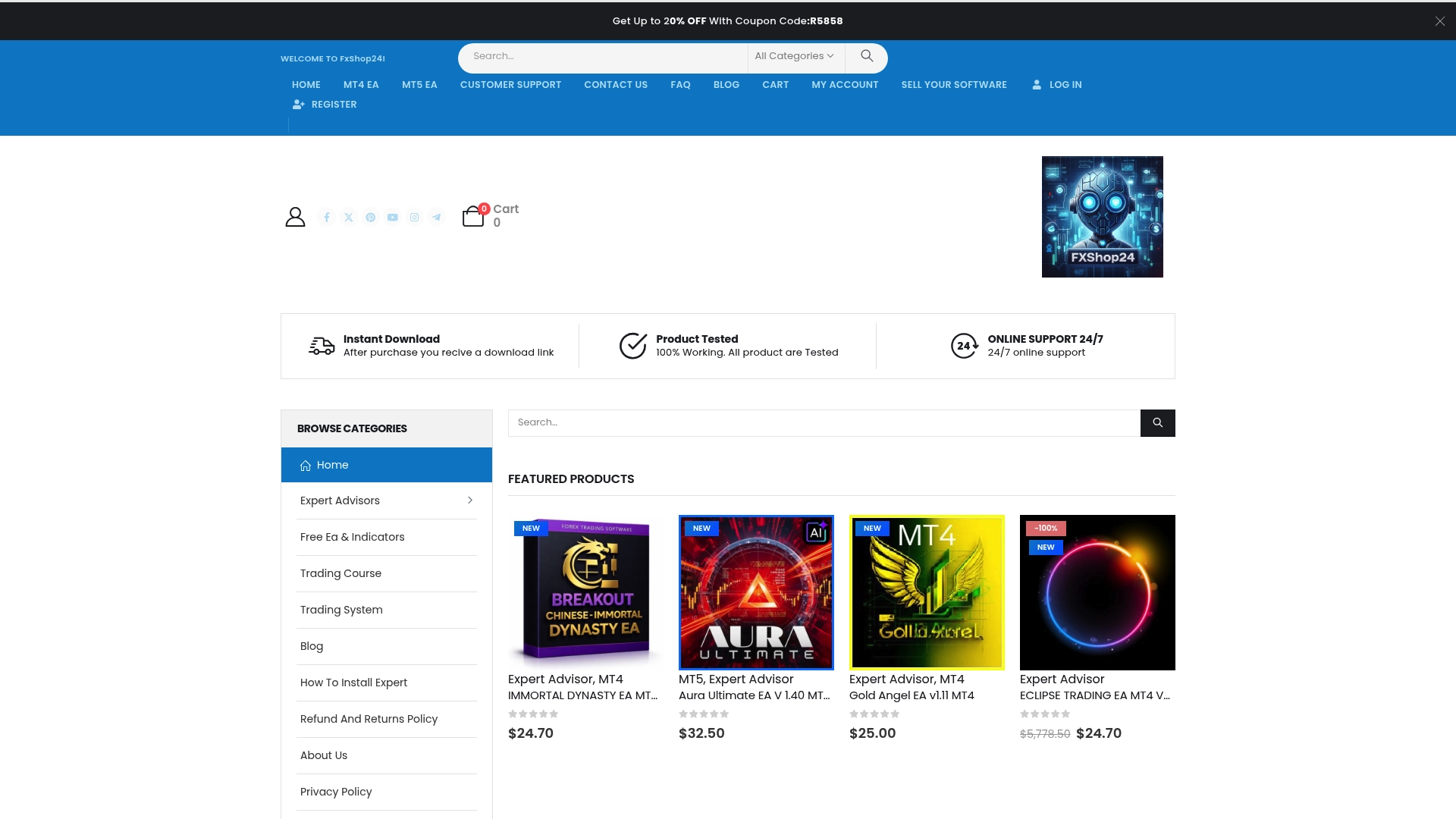
Our curated selection includes various automated trading systems tested across different market conditions to deliver reliable performance. Whether you prefer trend following, mean reversion, or hybrid strategies, you’ll find tools that fit your trading style and goals.
Explore AI-powered trading solutions that combine algorithmic precision with advanced market analysis. Each EA includes lifetime updates, unlimited licenses, and installation support to help you implement automation successfully. Start improving your trading consistency and scalability today with professional-grade systems built for serious retail traders.
Frequently asked questions
What are the main risks of automated trading for retail traders?
The primary risks include over-optimization leading to curve-fitted strategies that fail in live markets, technical failures from platform or internet connectivity issues, and inappropriate parameter settings that exceed your risk tolerance. Automated systems also continue executing during unexpected volatility spikes unless you implement proper safeguards. Regular monitoring and robust strategy testing mitigate these risks effectively.
Can manual trading outperform automation in volatile markets?
Yes, experienced manual traders often outperform automated systems during high-volatility periods driven by unexpected news or unusual market conditions. Human traders interpret context, recognize when normal patterns break down, and adjust strategies dynamically. However, this advantage requires significant experience and emotional discipline that many retail traders lack, making automation more consistent for average traders over long periods.
How do I start transitioning from manual to automated trading effectively?
Begin by continuing your manual trading while testing one EA on a demo account for at least two months. Compare the EA’s performance to your manual results during the same period. Once you verify the automated system performs acceptably, start with a small live account allocation while maintaining most capital in manual trading. Gradually increase automated allocation as you gain confidence and understand the system’s behavior across different market conditions.
Is hybrid trading suitable for beginners or only experienced traders?
Hybrid trading works best for traders with at least six months of experience who understand both market dynamics and their own psychological tendencies. Beginners often lack the judgment to know when manual intervention improves versus harms automated system performance. Start with pure automation using a well-tested EA, then add selective manual oversight once you develop reliable discretionary skills and understand when intervention adds value rather than disrupting consistency.