
16
Mar
Trading automation trends 2026: forex and gold strategies
The idea that retail traders can’t compete with institutional algorithms is dead in 2026. AI-powered co-pilots have demolished the traditional barriers, giving individual traders access to adaptive neural networks and machine learning tools that were once exclusive to hedge funds. This shift isn’t just incremental, it’s transformative. Automated trading systems now dynamically adjust to market conditions in real-time, reducing false signals and capitalizing on volatility with precision. Whether you’re trading forex or gold, understanding these cutting-edge trends is no longer optional. It’s the difference between staying relevant and falling behind.
Table of Contents
- The Evolution Of Trading Automation: Bridging Retail And Institutional Gaps
- Adaptive Neural Networks And Regime Detection: Maximizing Precision In Volatile Markets
- Machine Learning Expert Advisors And Large Language Models: Improving Gold Trading Success
- Market Dynamics And Automation Market Growth: The Bigger Picture In 2026
- Discover Leading Trading Automation Solutions At FXShop24
Key takeaways
| Point | Details |
|---|---|
| AI adaptive networks | Neural networks recalibrate trading parameters dynamically based on live market conditions, replacing static indicators. |
| Market growth surge | The algorithmic trading market reached $25 billion in 2026 and is projected to hit $44.55 billion by 2030. |
| Machine learning EAs | ML-based expert advisors reduce false signals in gold trading by interpreting non-linear price relationships. |
| Retail-institutional parity | Retail traders now deploy automation tools rivaling institutional-grade algorithms, erasing historical advantages. |
The evolution of trading automation: bridging retail and institutional gaps
The line separating retail traders from institutional powerhouses has blurred to the point of invisibility. In 2026, the gap between retail and institutional trading has practically vanished for those using the right AI co-pilots. What changed? Machine learning systems now translate subjective market patterns into precise Boolean logic, enabling retail traders to execute high-frequency tactics that were once the exclusive domain of billion-dollar hedge funds. This democratization stems from AI’s ability to eliminate human inconsistency and emotional bias, two factors that historically crippled retail performance.
Consider the practical implications. A retail trader in 2026 can deploy an AI-powered bot that continuously learns from market data, adapting its strategy as conditions shift. These systems don’t just follow pre-programmed rules. They evolve. The barrier between a retail trader and a high-frequency hedge fund has all but collapsed, thanks to accessible AI frameworks and cloud-based computational power. You no longer need a team of quantitative analysts to compete. You need the right tools and the knowledge to deploy them effectively.
The transformation extends beyond accessibility. AI co-pilots interpret vast datasets, identify patterns invisible to human traders, and execute trades with microsecond precision. They operate without fatigue, fear, or greed. This shift has profound implications for industry trends in automated trading, where adaptability and speed determine success. Static rule-based systems are relics. The future belongs to algorithms that think, learn, and adjust.
“Pro Tip: Prioritize AI-powered bots that continuously learn and self-adapt over rigid rule-based systems. The market punishes inflexibility, and adaptive algorithms offer a measurable edge in volatile conditions.”
Key advantages of AI-driven automation in 2026:
- Elimination of emotional decision-making through algorithmic discipline
- Real-time adaptation to market regime changes without manual intervention
- Access to institutional-grade strategies at a fraction of traditional costs
- Scalability across multiple currency pairs and asset classes simultaneously
Adaptive neural networks and regime detection: maximizing precision in volatile markets
Adaptive neural networks treat indicators as dynamic variables, recalibrating based on market conditions rather than relying on fixed thresholds. This represents a fundamental departure from traditional technical analysis. In older systems, a moving average crossover might trigger a buy signal regardless of broader market context. Adaptive networks, by contrast, assess whether the current environment favors trend-following or mean-reversion strategies before executing trades. This contextual awareness dramatically reduces false signals.

Regime detection models are the backbone of this precision. Markets spend 70% of their time ranging and 30% trending, and modern AI models detect these shifts in real-time. When volatility spikes or liquidity dries up, the system recalibrates its risk parameters, tightening stop losses or pausing trades altogether. This dynamic adjustment prevents the catastrophic losses that plague static systems during unexpected market shocks. For traders focused on gold, where volatility can surge during geopolitical events, regime detection is indispensable.
The table below contrasts traditional and adaptive approaches:
| Indicator Type | Traditional Approach | Adaptive Neural Network Approach |
|---|---|---|
| Moving Average | Fixed period (e.g., 50-day) | Period adjusts based on volatility regime |
| RSI Threshold | Static overbought/oversold levels | Dynamic thresholds recalibrated by AI |
| Breakout Detection | Predefined price levels | Context-aware breakout confirmation using regime data |
| Risk Management | Fixed stop-loss percentage | Variable stops adjusted for current market conditions |
This adaptability translates into measurable performance improvements. A trading automation guide for 2026 would emphasize that systems lacking regime detection struggle to differentiate between consolidation and genuine breakouts. Adaptive networks, however, analyze order flow, volatility clusters, and momentum divergence to validate signals before committing capital. The result? Fewer whipsaws, higher win rates, and smoother equity curves.
“Pro Tip: Prioritize systems with regime detection to avoid false signals during ranging markets and capitalize on genuine breakouts when trends emerge. This single feature can transform your risk-adjusted returns.”
Machine learning expert advisors and large language models: improving gold trading success
Machine learning-based expert advisors are gaining prominence in gold trading due to their adaptability and ability to identify non-linear price relationships. Unlike static rule-based bots that execute the same strategy regardless of market conditions, ML-based EAs continuously refine their approach by analyzing historical performance and adjusting parameters. This self-optimization is particularly valuable in gold markets, where price action is influenced by a complex interplay of dollar strength, inflation expectations, and geopolitical risk.
The integration of large language models adds another layer of sophistication. LLMs process central bank communications, economic reports, and news sentiment to validate trading signals. For example, if an ML-based EA identifies a bullish setup in gold, but an LLM detects hawkish language in a Federal Reserve statement suggesting rate hikes, the system might reduce position size or delay entry. Combined with LLM confirmation layers, false signal rates drop significantly, improving risk-adjusted returns and reducing drawdowns.
Consider a real-world scenario. An ML-based EA detects a potential breakout in gold as prices approach a key resistance level. Traditional systems might enter immediately, risking a false breakout. An LLM-enhanced system, however, scans recent commentary from the European Central Bank and identifies concerns about slowing growth. This context suggests safe-haven demand for gold might strengthen, validating the bullish signal. The EA enters the trade with increased confidence, and the position gains 3.2% over the next 48 hours. This type of contextual validation is the hallmark of 2026’s leading automation tools.
Comparison of traditional versus ML+LLM gold trading EAs:
| Feature | Traditional EA | ML + LLM Enhanced EA |
|---|---|---|
| Adaptability | Fixed rules, no learning | Continuously refines strategy based on data |
| Signal Validation | Technical indicators only | Technical + fundamental + sentiment analysis |
| False Signal Rate | Higher (15-25% typical) | Lower (8-12% with LLM confirmation) |
| Drawdown Management | Static stop-loss rules | Dynamic risk adjustment based on market context |
Key benefits of ML+LLM systems:
- Adaptability to shifting correlations between gold and other assets
- Reduced false signals through multi-layered confirmation processes
- Improved drawdown management via dynamic risk recalibration
- Enhanced performance during high-impact news events
For traders exploring the role of expert advisors in forex and gold automation, the message is clear. Static systems are obsolete. The future belongs to EAs that learn, adapt, and think.
Market dynamics and automation market growth: the bigger picture in 2026
The global algorithmic trading market hit $25.04 billion in 2026 and is projected to reach $44.55 billion by 2030. This explosive growth reflects increasing adoption across retail and institutional segments, driven by advances in AI, cloud computing, and data analytics. The barriers to entry have collapsed. What once required millions in infrastructure investment now costs a few hundred dollars per month in software subscriptions and cloud resources. This accessibility has unleashed a wave of innovation, with new automation tools launching weekly.
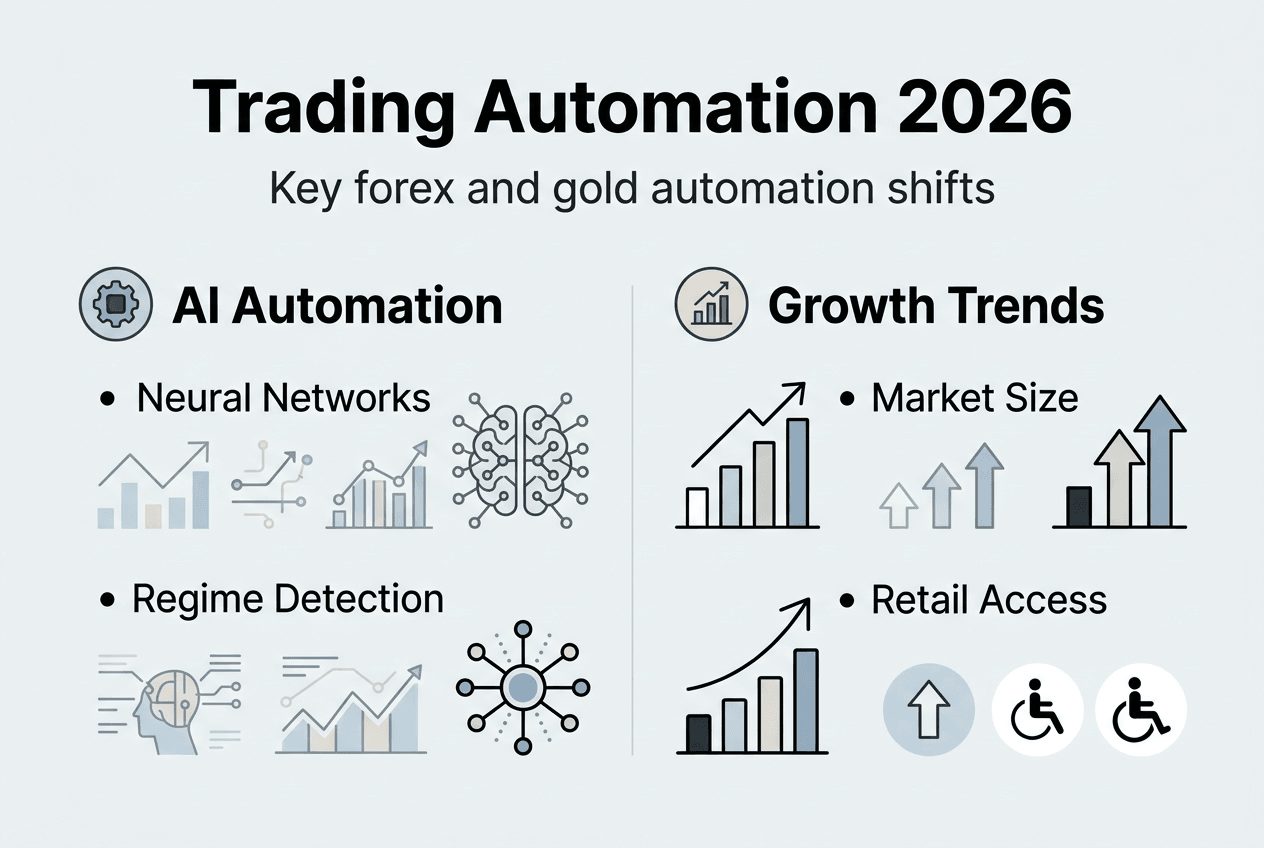
Institutional strategies have also evolved. Rather than focusing solely on trend-following, institutional algorithms dominate the trillion-dollar daily forex turnover by exploiting volatility. They identify micro-inefficiencies, arbitrage opportunities, and liquidity imbalances that exist for mere seconds. Retail traders can now access similar strategies through examples of automated trading strategies on MT4 and MT5, leveling the playing field in ways unimaginable a decade ago.
Market paralysis, a phenomenon where major currency pairs trade in tight ranges for extended periods, has reshaped automation strategy choices in 2026:
- Range-bound strategies gain prominence as traders exploit consolidation rather than chase non-existent trends.
- Volatility-based systems activate only when price movement exceeds predefined thresholds, preserving capital during stagnant periods.
- Multi-timeframe analysis becomes standard, with EAs scanning hourly, daily, and weekly charts to identify the most favorable trading windows.
- Correlation-based strategies diversify risk by trading pairs with low correlation, reducing exposure to single-market movements.
The institutional dominance of forex markets underscores the importance of sophisticated automation:
“Daily forex turnover exceeds $7 trillion, with institutional algorithms accounting for over 70% of volume. These systems exploit volatility and liquidity imbalances with precision that manual traders cannot match.”
This reality doesn’t diminish retail opportunities. It amplifies them. By adopting institutional-grade tools and strategies, retail traders can ride the same waves that propel hedge fund returns. The key is understanding that success in 2026 requires more than technical indicators and gut instinct. It demands automation that thinks, adapts, and executes with machine precision.
Discover leading trading automation solutions at FXShop24
Understanding 2026’s automation trends is one thing. Implementing them effectively is another. FXShop24 provides curated insights and tools that bridge this gap, offering traders access to the latest AI-powered expert advisors and automated systems tailored for forex and gold markets. Whether you’re exploring industry trends in automated trading or seeking proven strategies to enhance consistency, the platform delivers actionable resources designed for real-world application.
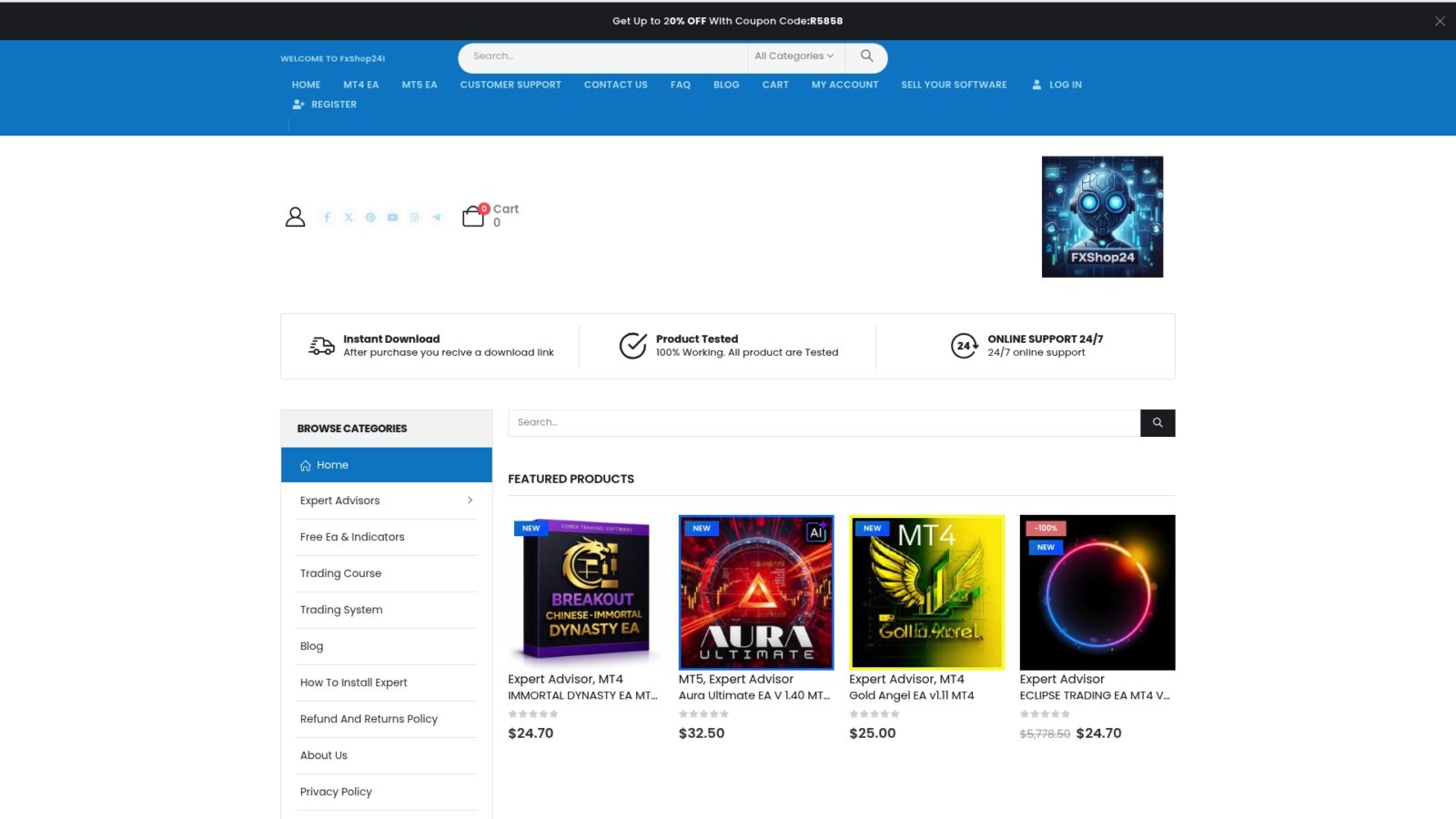
The site features comprehensive guides on deploying automation powered by AI co-pilots, breaking down complex concepts into step-by-step instructions. From selecting the right expert advisors for forex and gold to optimizing parameters for current market conditions, FXShop24 equips traders with the knowledge and tools to stay competitive. In a landscape where adaptability determines success, leveraging trusted resources isn’t optional. It’s essential.
Frequently asked questions
What are the top AI trading automation trends in 2026?
The leading trends include adaptive neural networks that recalibrate indicators dynamically, LLM-powered confirmation layers that validate signals using sentiment analysis, and regime detection models that distinguish between ranging and trending markets. These technologies enable retail traders to deploy institutional-grade strategies with unprecedented precision.
How do machine learning expert advisors improve gold trading?
Machine learning EAs identify non-linear price relationships and adapt to changing market conditions, unlike static rule-based systems. When combined with LLM layers that interpret central bank communications and economic data, these EAs significantly reduce false signals and improve risk-adjusted returns in gold trading.
Has retail trading automation really reached institutional levels?
Yes. In 2026, the gap between retail and institutional automation capabilities has virtually disappeared. Retail traders now access AI co-pilots, adaptive algorithms, and high-frequency strategies that were exclusive to hedge funds just years ago. The democratization stems from cloud computing, accessible AI frameworks, and lower infrastructure costs.
What is the projected growth of the algorithmic trading market?
The global algorithmic trading market reached $25.04 billion in 2026 and is expected to grow to $44.55 billion by 2030. This expansion reflects widespread adoption across retail and institutional segments, driven by advances in AI, machine learning, and data analytics that make sophisticated automation accessible to all traders.
Why is regime detection important for automated trading?
Markets spend approximately 70% of their time in ranging conditions and 30% trending. Regime detection models identify these shifts in real-time, allowing automated systems to adjust strategies accordingly. This prevents false signals during consolidation and capitalizes on genuine breakouts, dramatically improving win rates and reducing drawdowns.