


16
Apr
Top Gold Trading System Tips to Optimize Your Automated Strategies
TL;DR:
- Choosing a gold trading system requires clear criteria focused on trade frequency and risk management.
- Hybrid manual-automated systems offer high consistency and adaptability across different market regimes.
- Regular review and strategic oversight are crucial for long-term performance and resilience.
Picking the right gold trading system feels overwhelming when dozens of expert advisors promise consistent profits and every sales page looks equally convincing. Most traders make the mistake of jumping into automation without defining what they actually need from a system, and that gap between expectation and reality costs real money. Whether you trade XAUUSD on MetaTrader 4 or MetaTrader 5, building a clear framework before you automate is what separates traders who scale from those who reset accounts. This article walks you through the criteria, tools, comparisons, and situational tips you need to make smarter, more confident system decisions.
Table of Contents
- How to set criteria for choosing a gold trading system
- Automated tools and expert advisors for MetaTrader platforms
- Comparing gold trading system features and performance
- Situational tips for optimal gold trading results
- The hidden truth: Why fewer trades and hybrid oversight win out
- Upgrade your gold trading systems with expert tools
- Frequently asked questions
Key Takeaways
| Point | Details |
|---|---|
| Prioritize quality trades | Trading systems focused on high-quality setups yield more stable results than chasing frequent trades. |
| Use hybrid oversight | Combining automated tools with manual review ensures your strategy adapts to market changes. |
| Monitor performance regularly | Consistent review helps catch regime changes and keeps your gold trading system responsive and profitable. |
| Optimize with expert advisors | Deploying EAs on MetaTrader, with ongoing monitoring, streamlines gold trading while minimizing emotional errors. |
How to set criteria for choosing a gold trading system
Before you download a single expert advisor or backtest a single strategy, you need to know exactly what you are evaluating. Criteria are your filter. Without them, every system looks like a winner on a good week.
Start by defining your trade frequency preference. Some traders want systems that fire 10 or more signals a day. Others want two or three precise entries per week. Research consistently shows that fewer high-quality trades outperform quantity-driven approaches, and hybrid manual oversight improves those results further. Chasing high trade counts usually means lower-quality setups and higher exposure to random noise in the market.
Next, establish your risk management thresholds before you test anything. Key criteria to define include:
- Maximum drawdown tolerance: What percentage loss can you absorb without abandoning the system?
- Risk per trade: Are you comfortable with 1% per trade, or do you need it tighter at 0.5%?
- Stop-loss structure: Does the system use fixed stops, ATR-based stops, or trailing stops?
- Position sizing logic: Is lot size fixed, or does it scale with account equity?
- Monthly return target: What realistic gain do you expect given your risk parameters?
These numbers ground your evaluation in reality, not marketing claims. A system showing 300% annual returns in backtesting means nothing if its drawdown exceeds your tolerance after three bad weeks.
Understanding the difference between manual vs automated trading also matters here. Full automation removes emotion, but it can also remove judgment at exactly the wrong moment, like when a central bank makes a surprise policy announcement and gold spikes 40 dollars in 20 minutes. A manual override layer keeps you in control when the algorithm cannot adapt fast enough.
For anyone exploring algorithmic trading for gold, the goal should be building a rules-based structure that you understand, not one you blindly trust.
Pro Tip: Schedule a monthly system review to check whether the market regime has shifted. Trending, ranging, and volatile environments each reward different strategies, and a system tuned for one may bleed in another.
Automated tools and expert advisors for MetaTrader platforms
Once your criteria are locked in, the next step is matching those criteria to the right automated tools. MetaTrader 4 and MetaTrader 5 both support expert advisors, which are programs that execute trades automatically based on predefined rules. The platforms differ slightly: MT5 offers more order types and faster backtesting, while MT4 has a larger library of existing EAs and wider broker support.
Here is a practical approach to deploying an EA effectively:
- Backtest on historical data using at least three years of XAUUSD tick data to assess baseline performance.
- Forward test on a demo account for a minimum of four to six weeks before committing real capital.
- Start with minimum lot sizes on a live account while you verify that real-market conditions match your backtest results.
- Set hard equity stop rules so the EA halts automatically if drawdown exceeds a preset threshold.
- Review performance weekly and log every notable deviation from expected behavior.
Popular EA categories for gold include trend-following systems, mean-reversion robots, and news-filter EAs that pause during high-impact events. Each type fits a different market environment. The best way to automate gold trading is to start with one system, understand it fully, and then layer complexity as you gain confidence.
Key monitoring tasks once your EA is live:
- Check open trades at least once per session.
- Verify that stop-loss and take-profit levels are being placed correctly.
- Watch for slippage during volatile periods like US CPI releases.
- Compare live win rate and average RRR (risk-to-reward ratio) against your backtest benchmarks.
As gold trading software grows more sophisticated, traders who understand the logic behind their tools gain a significant edge over those who treat EAs as black boxes. Understanding why a trade fires gives you the ability to intervene intelligently.

The EA win rate benefits are real, but only when the system is monitored. Expert advisors improve consistency and remove emotional bias, but they require oversight when market conditions shift.
Pro Tip: Pair your EA with a simple manual checklist you run each morning. Confirm that the broader gold trend, key support and resistance levels, and any major scheduled news align with what your system is set up to trade.
Comparing gold trading system features and performance
With your options narrowed down, it helps to put manual and automated systems side by side in a direct comparison. This removes the guesswork and keeps your evaluation objective.
| Feature | Manual trading | Automated (EA) | Hybrid system |
|---|---|---|---|
| Emotion control | Low | High | High |
| Consistency | Variable | High | High |
| Adaptability | High | Low | High |
| Speed of execution | Slow | Instant | Instant |
| Regime detection | Strong | Weak | Strong |
| Risk management | Manual | Automated | Both |
| Best for | Discretionary traders | Set-and-monitor traders | All trader types |
This table makes one thing clear: hybrid systems score well across nearly every category. They combine the speed and discipline of automation with the adaptability that only a human trader can provide during unusual market conditions.
When evaluating performance, focus on these metrics rather than headline return percentages:
- Profit factor: Gross profit divided by gross loss. Anything above 1.5 is solid.
- Sharpe ratio: Measures return relative to risk. Higher is better.
- Maximum drawdown: The worst peak-to-trough decline during the test period.
- Win rate vs. RRR combination: A 45% win rate with a 2:1 reward-to-risk ratio is more valuable than a 70% win rate with a 0.8:1 ratio.
Experts who build top gold trading systems consistently emphasize that mechanical algorithms remove emotional decision-making but require periodic regime reviews to remain effective.
“A mechanical system trades your rules, not your feelings. But no set of rules survives forever unchanged. The market evolves, and so must your system.”
Reviewing examples of gold trading systems across different market conditions gives you a realistic picture of how these tools perform when conditions change from trending to choppy and back again.
Situational tips for optimal gold trading results
Knowing your criteria and choosing the right tools still leaves one important variable: market conditions change constantly, and your system needs to adapt. These situational tips help you stay ahead.
When volatility spikes:
- Tighten your stop-loss settings temporarily or switch to a wider-stop version of your EA.
- Reduce position size by 30 to 50 percent until volatility normalizes.
- Consider disabling the EA entirely during scheduled high-impact events like Fed rate decisions.
- Use a volatility filter indicator on MT4 or MT5 to automate this adjustment.
When the system underperforms for two or more consecutive weeks:
- Pull a fresh performance report and compare current metrics to your backtest baseline.
- Check whether a regime change (trending to ranging, for example) might explain the shift.
- Avoid over-optimizing. Small parameter tweaks based on emotion often make things worse.
Hybrid approaches and periodic review of strategies are what keep traders ahead in evolving gold market environments. Automation is powerful, but it needs a human hand on the wheel at key moments.
Here is a practical example of how hybrid oversight impacts win rate over time:
| System type | Avg. monthly win rate | Max drawdown | Adaptability rating |
|---|---|---|---|
| Fully automated | 54% | 22% | Low |
| Manual only | 49% | 31% | High |
| Hybrid (EA + manual filter) | 61% | 14% | High |
These figures show why the hybrid model consistently outperforms either extreme. You gain the execution speed of automation while applying human judgment where it matters most.
Building an efficient gold trading workflow around these principles is what moves traders from reactive to proactive. Staying aware of automation trends in trading also helps you anticipate where the technology is heading and prepare accordingly.
Pro Tip: Keep a trading journal that logs every manual intervention you make to your EA settings. Over three to six months, patterns will emerge showing you exactly when and why human oversight added value.
The hidden truth: Why fewer trades and hybrid oversight win out
Here is something most automated trading content will not tell you: the obsession with high-frequency systems is mostly a marketing problem, not a performance feature. More signals mean more commission revenue for brokers and more impressive-looking backtest equity curves. They do not reliably mean more profit in your account.
The traders who build lasting performance on gold focus on quality over volume. They run systems that fire only when multiple conditions align, not systems that trade every candle. They use manual oversight benefits not as a crutch but as a strategic layer that catches what no algorithm can: context. A rising dollar driven by geopolitical panic is fundamentally different from one driven by strong employment data, yet most EAs treat both the same way.
Automation is a tool. A powerful one. But treating it as a complete solution leads traders to ignore regime shifts until the damage is done. The most resilient gold trading strategies we have seen combine tight rule-based automation with a weekly human review. It takes 20 minutes a week and consistently outperforms fully automated alternatives over rolling 12-month periods. That tradeoff is obvious once you see it.
Upgrade your gold trading systems with expert tools
You now have a solid framework for choosing, deploying, and maintaining a gold trading system that performs across different market conditions. The logical next step is putting those principles to work with tools built specifically for gold trading on MT4 and MT5.
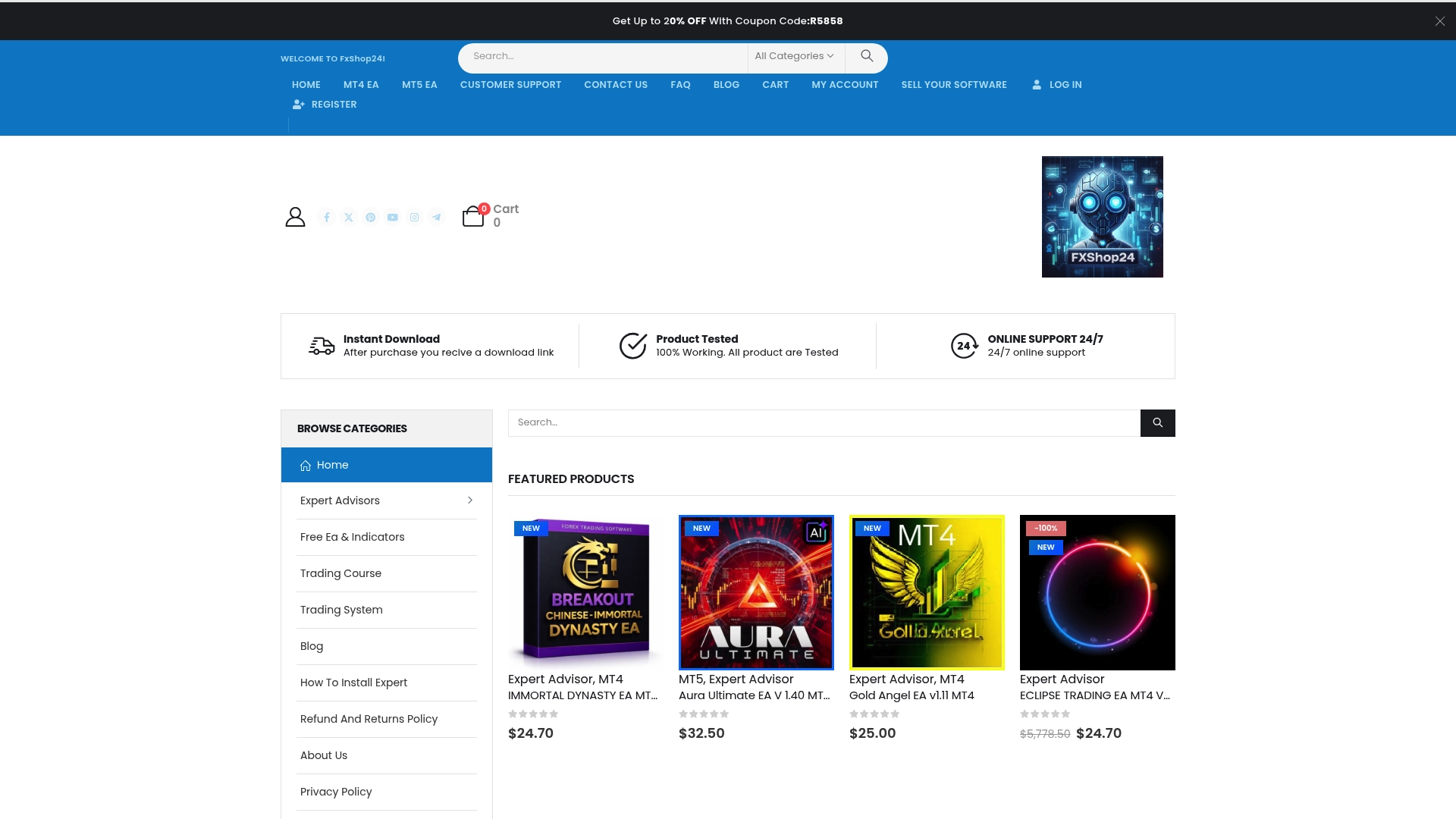
At FxShop24, you will find a curated selection of expert advisors, trading robots, and optimization resources designed for serious gold traders. Whether you are exploring an automated futures trading guide to expand your strategy or reviewing forex gold trading software options across MetaTrader platforms, the platform gives you tested, prop-firm-ready tools with lifetime updates. You can also go deeper with a practical resource on optimizing trading robots to fine-tune performance after deployment.
Frequently asked questions
What makes a gold trading system effective?
An effective gold trading system combines high-quality trade setups with solid risk management and hybrid manual oversight that allows the strategy to adapt when market conditions shift.
How often should you update your automated gold trading system?
Review and update your system at least quarterly or after any major market event, since ongoing review adapts strategies to new market regimes and prevents silent performance decay.
Can fully automated systems outperform hybrid manual oversight?
While automation delivers consistency, hybrid approaches combine automation with human adaptability, typically producing better long-term resilience than fully automated setups alone.
What are the key risks in automated gold trading?
The biggest risks are algorithm overfitting to past data, sudden regime changes the system cannot detect, and poor risk management settings. Mechanical systems require monitoring to catch these issues before they compound into significant losses.