



13
Mar
What is an EA in trading? A 2026 guide for forex and gold
Many retail traders activate Expert Advisors hoping for instant profits, yet most don’t understand how these programs actually make decisions or why they fail in live markets. An EA is not a magic solution but a coded trading strategy that requires careful selection, testing, and monitoring. Without grasping their design, limitations, and proper application, you risk significant losses. This guide explains what Expert Advisors are, how they function in forex and gold trading, the strategies they employ, common pitfalls to avoid, and actionable steps to use them effectively in your 2026 trading workflow.
Table of Contents
- What Is An Expert Advisor (Ea) In Trading?
- Key Features And Common Strategies Of Forex And Gold Eas
- Challenges And Risks When Using Expert Advisors
- How To Effectively Use Expert Advisors In Your Trading Workflow
- Explore Expert Advisors And Automation Tools At Fxshop24
- Frequently Asked Questions
Key takeaways
| Point | Details |
|---|---|
| EAs automate trading | Expert Advisors execute trades based on predefined rules, improving consistency and removing emotional bias from trading decisions. |
| Error handling is critical | Many EAs lack proper error handling for live market conditions, causing failures that backtests never reveal. |
| Gold requires specialized strategies | Gold’s volatility and frequent consolidations demand adaptive EAs that adjust to changing market regimes. |
| Backtesting has limitations | Historical performance doesn’t guarantee future results due to unpredictable volatility and liquidity events. |
| Combine tools for best results | Merging technical indicators, fundamental analysis, and strict risk management produces more reliable EA performance. |
What is an Expert Advisor (EA) in trading?
An Expert Advisor is an automated trading program designed primarily for MetaTrader 4 and MetaTrader 5 platforms. These software tools analyze price data, identify trading opportunities based on coded algorithms, and execute trades automatically without requiring constant human supervision. EAs operate 24/7, eliminating emotional decision making and fatigue that often plague manual traders. They can process market information faster than humans and maintain consistent execution of predefined strategies.
EAs serve various trading approaches including trend following systems that ride momentum, breakout strategies that capitalize on price movements beyond key levels, and scalping methods that profit from small price changes. The role of expert advisors forex gold automation has grown significantly as traders seek consistency and efficiency. However, understanding their operational mechanics is crucial before deployment.
The biggest misconception about EAs is that they perform identically in live trading as they do in backtests. Live markets differ from Strategy Tester simulations because orders fail for reasons testing environments never replicate. Network latency, broker requotes, insufficient margin, and sudden volatility spikes create execution problems that clean historical data cannot predict. Many EAs share fundamental structural weaknesses that compromise real world performance.
Common EA design flaws include:
- Missing error handling on trade execution calls, causing the EA to freeze or skip trades when orders fail
- Static parameters that don’t adjust when market volatility or trending behavior changes
- Over reliance on single indicators without confirmation from multiple data sources
- Inadequate stop loss and position sizing logic that exposes accounts to excessive drawdowns
- Failure to account for spread widening during news events or low liquidity periods
Pro Tip: Always run a new EA on a demo account for at least two weeks before risking real capital, monitoring how it handles order rejections, slippage, and unexpected market gaps.
Key features and common strategies of forex and gold EAs
Expert Advisors employ diverse strategies tailored to different market conditions and trading objectives. Moving Average crossover systems generate buy signals when a faster MA crosses above a slower one and sell signals on the opposite. Price action EAs analyze candlestick patterns, support and resistance levels, and chart formations without relying heavily on lagging indicators. Volatility based strategies use tools like Average True Range to adjust position sizes and stop losses based on current market movement intensity.

Market regime detection represents a more sophisticated approach where EAs identify whether markets are trending, ranging, or experiencing high volatility, then adapt their behavior accordingly. The Vortex Gold MT4 EA demonstrates consistent profitability by combining price action analysis with volatility detection and intelligent trailing stops. This adaptive capability addresses a critical challenge in gold trading.
Gold (XAUUSD) presents unique difficulties for automated systems. Trend following EAs often fail on gold because it frequently consolidates after trending periods, eroding profits through whipsaw trades. Gold’s tendency to experience violent intraday swings followed by tight ranges demands EAs that can quickly recognize regime shifts. Static settings optimized for trending conditions will generate false signals and losses during consolidation phases.
Successful gold EAs typically incorporate:
- ADX (Average Directional Index) to measure trend strength before entering positions
- ATR Ratio to compare current volatility against historical averages
- Dynamic stop losses that widen during high volatility and tighten in calmer conditions
- Time filters to avoid trading during major news releases when spreads widen dramatically
| Strategy Type | Approach | Pros | Cons | Gold Suitability |
|---|---|---|---|---|
| MA Crossover | Trend following with moving averages | Simple, clear signals | Lags price, whipsaws in ranges | Low |
| Breakout | Enters on price breaking key levels | Catches strong moves early | Many false breakouts | Medium |
| Scalping | Multiple small profits from minor moves | Frequent opportunities | High spread sensitivity | Medium |
| Adaptive Regime | Adjusts strategy based on market state | Handles changing conditions | Complex, requires optimization | High |
Pro Tip: Look for EAs that explicitly state they use multiple types of trading robots or combine several analytical methods rather than relying on a single indicator, especially for volatile assets like gold.
Challenges and risks when using Expert Advisors
The gap between backtest performance and live results represents the primary challenge facing EA users. Historical data provides a sanitized environment where every order fills at the requested price with minimal slippage. Real trading involves requotes, partial fills, and execution delays that dramatically alter performance. The most common structural failure in EAs is missing error handling on trade execution calls, causing the program to ignore failed orders rather than retry or adjust.
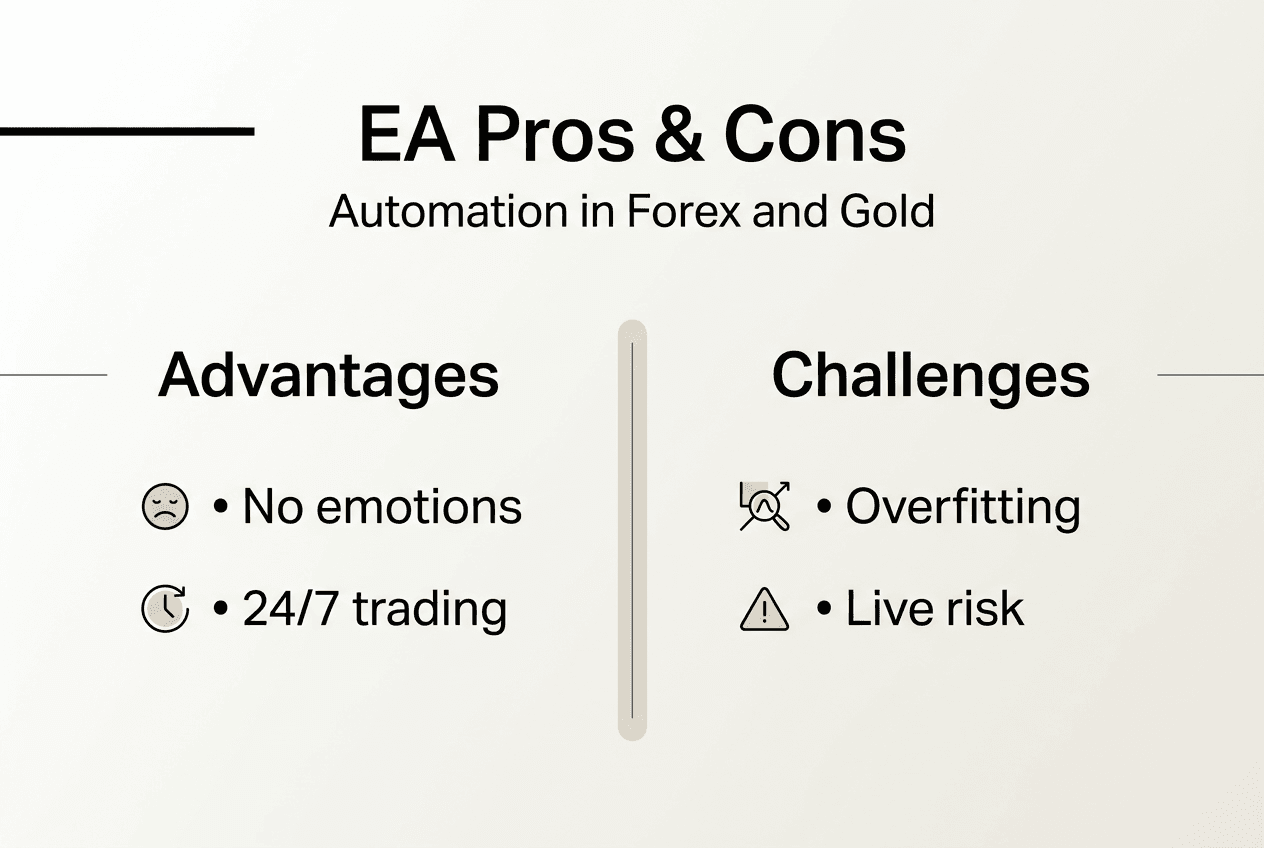
Over optimization, also called curve fitting, occurs when developers excessively tune EA parameters to match historical data perfectly. This creates systems that performed brilliantly in the past but fail miserably in live conditions because they’ve been fitted to random noise rather than genuine market patterns. An EA showing 95% win rate in backtests with dozens of optimized variables is almost certainly over fitted and will underperform when market dynamics shift.
Key EA limitations include:
- Inability to interpret fundamental factors like central bank policy changes or geopolitical events
- Difficulty adapting to black swan events or unprecedented market conditions
- Vulnerability to broker manipulation through stop hunting or artificial spread widening
- Performance degradation as more traders use the same EA, reducing its edge
“While backtesting EAs is crucial, traders must recognize the limitations of historical data and understand that past market conditions don’t predict future volatility or liquidity events accurately.”
Static parameters create another significant risk. An EA optimized for trending markets will generate losses during ranging periods unless it includes logic to detect and adapt to regime changes. Many traders activate EAs with default settings and never adjust them as market character evolves, leading to steady account erosion. The guide to optimizing trading robots emphasizes the importance of periodic reoptimization based on recent market behavior.
Pro Tip: If an EA vendor refuses to show verified live trading results or only displays backtest reports, consider it a red flag. Legitimate developers provide third party verified performance from real accounts.
How to effectively use Expert Advisors in your trading workflow
Successful EA implementation requires a systematic approach that begins long before risking real capital. Following these steps dramatically improves your chances of profitable automation:
Demo test thoroughly: Run the EA on a demo account for at least two to four weeks, monitoring how it handles different market conditions including trending days, consolidations, and high impact news events.
Analyze execution quality: Review the EA’s order history to identify patterns of slippage, requotes, or failed trades that could indicate compatibility issues with your broker’s execution model.
Optimize conservatively: Use recent data (last 6 to 12 months) for optimization and avoid excessive parameter tuning. Focus on robust settings that perform reasonably well across different periods rather than perfect results in one timeframe.
Implement strict risk controls: Set maximum daily loss limits, per trade risk percentages (typically 1 to 2% of account balance), and overall drawdown thresholds that automatically disable the EA if exceeded.
Start with minimal capital: When transitioning to live trading, begin with the smallest position sizes your broker allows to validate real world performance before scaling up.
Monitor and adjust regularly: Review EA performance weekly, comparing actual results against expectations and adjusting parameters when market conditions shift significantly.
Combining EA signals with manual analysis provides an additional safety layer, particularly for gold trading where false signals occur frequently. Use the EA to identify potential opportunities, then manually verify that:
- The broader trend on higher timeframes supports the trade direction
- No major economic announcements are scheduled within the next few hours
- Current spread and volatility levels are within acceptable ranges
- The trade aligns with your overall market outlook and risk tolerance
The importance of mastering risk management in automated trading cannot be overstated. Even the best EA will experience losing streaks, and proper position sizing ensures these drawdowns don’t devastate your account. Calculate position sizes based on the distance to your stop loss and your maximum acceptable risk per trade, not arbitrary lot sizes.
Understanding why testing trading robots matters helps you develop realistic expectations. Testing reveals an EA’s behavior under various conditions, its typical drawdown patterns, and whether its strategy aligns with your trading psychology. An EA that trades frequently with small profits might suit one trader while another prefers fewer trades with larger potential gains.
Combining technical indicators with fundamental analysis creates more robust trading decisions. While EAs excel at processing technical data, incorporating awareness of economic calendars, interest rate decisions, and market sentiment provides context that pure technical systems miss. This hybrid approach reduces the risk of being caught on the wrong side during major fundamental shifts.
Explore expert advisors and automation tools at FxShop24
Ready to implement Expert Advisors in your trading strategy with confidence? FxShop24 specializes in automated trading solutions designed specifically for forex and gold markets on MetaTrader platforms. Our catalog includes thoroughly tested EAs with verified performance records, lifetime updates, and comprehensive installation support. Whether you’re seeking trend following systems, scalping robots, or adaptive multi strategy EAs, you’ll find options tailored to different risk profiles and trading styles.
Explore our complete range of trading software for forex and gold to discover tools that match your automation goals. Learn why expert advisors have become essential for traders seeking consistency and efficiency. Access our detailed guide to optimizing trading robots to maximize your EA performance while minimizing common pitfalls. FxShop24 provides the resources and support you need to transition successfully from manual to automated trading.
Frequently asked questions
What differentiates an EA from manual trading?
Expert Advisors execute trades automatically based on coded rules, operating 24/7 without emotional interference or fatigue. Manual trading requires constant monitoring and decision making by the trader. EAs provide consistency in strategy execution but lack the adaptability humans have for interpreting fundamental events and unusual market conditions.
Do Expert Advisors guarantee profits in forex and gold trading?
No EA guarantees profits, and claims suggesting otherwise are misleading. EAs can improve trading consistency and remove emotional bias, but they still experience losing trades and drawdowns. Success depends on choosing well designed systems, proper risk management, regular monitoring, and adapting to changing market conditions. Understanding the benefits of forex expert advisors helps set realistic expectations.
How do I choose a reliable EA for gold and forex markets?
Prioritize EAs with verified live trading results from third party monitoring services rather than just backtest reports. Look for transparent developers who explain their strategy logic and provide ongoing support. Test thoroughly on demo accounts, checking how the EA handles various market conditions including high volatility and consolidation periods. Avoid systems with excessively high win rates or unrealistic profit claims.
Why is testing and monitoring an EA important?
Testing reveals how an EA performs under real market conditions including slippage, requotes, and execution delays that backtests don’t simulate. Ongoing monitoring detects performance degradation when market dynamics shift, allowing you to adjust parameters or disable the EA before significant losses occur. Regular review ensures the EA continues aligning with your risk tolerance and trading objectives as conditions evolve.