10
Mar
Role of expert advisors in forex and gold automation
Plug in an expert advisor, watch the profits roll in, and retire early. That’s the dream many traders chase, but reality paints a different picture. Most expert advisors (EAs) fail to deliver consistent profits without proper testing, customization, and ongoing oversight. This guide breaks down how EAs actually work, what makes them effective, and how to select and deploy automation tools that genuinely enhance your forex and gold trading performance.
Table of Contents
- Introduction To Expert Advisors In Forex And Gold Trading
- How Expert Advisors Work: Algorithms And Decision-Making
- Benefits And Limitations Of Using Expert Advisors
- Common Misconceptions About Expert Advisors
- Comparative Strategies: Forex Vs Gold Market Expert Advisors
- Evaluating, Backtesting, And Selecting The Right Expert Advisor
- Expert Advisors For Proprietary Trading Firms: Compliance And Optimization
- Conclusion: Maximizing Automation Benefits With Expert Advisors
- Enhance Your Trading With Expert Advisor Resources
- Frequently Asked Questions
Key takeaways
| Point | Details |
|---|---|
| Expert advisors automate trading decisions using coded algorithms for consistency | EAs execute trades based on predefined rules, removing emotional bias and improving speed. |
| Proper selection and rigorous testing determine EA profitability | Backtesting and forward testing are essential to avoid curve-fitting and confirm reliability. |
| Forex and gold market EAs differ due to volatility and risk profiles | Gold EAs handle higher volatility with specialized risk controls compared to forex EAs. |
| Human oversight remains critical despite automation | Market shifts and technical failures require continuous monitoring and adjustment. |
| Prop firm traders need EAs that meet strict compliance requirements | Drawdown limits, detailed logging, and customization ensure adherence to prop firm rules. |
Introduction to expert advisors in forex and gold trading
Expert advisors are algorithm-driven software programs that automatically execute trades on behalf of traders. They operate on platforms like MetaTrader 4 and MetaTrader 5, analyzing market data and placing orders without manual intervention. These tools bring speed, precision, and emotional discipline to trading decisions.
EAs offer several compelling benefits for both forex currency pairs and gold markets:
- Speed: EAs process market data and execute trades faster than human reflexes allow.
- Automation: Trades happen 24/7 without requiring constant screen time.
- Emotion-free decisions: Coded rules eliminate fear, greed, and hesitation from the trading equation.
- Consistent strategy application: EAs follow their programmed logic without deviation or second-guessing.
Forex and gold traders face different challenges, but both markets benefit from automation. Currency pairs typically exhibit lower volatility and clearer technical patterns, while gold experiences sharper price swings and requires more aggressive risk management. Understanding these distinctions helps you choose EAs designed for your specific market focus.
For traders looking to streamline their operations, exploring a comprehensive forex gold trading workflow provides clarity on how automation fits into broader trading systems. Similarly, understanding gold trading software explained helps distinguish platform capabilities from EA functionality. Those interested in cutting-edge approaches should review an ai-powered trading tutorial to see how modern algorithms enhance decision-making.
Pro Tip: Start with demo accounts to test EA behavior in real market conditions before risking live capital. This approach reveals how the software responds to slippage, spread widening, and unexpected volatility.
How expert advisors work: algorithms and decision-making
Expert advisors function as coded decision-making engines that continuously monitor market conditions and execute trades based on predefined rules. Their internal logic processes price data, technical indicators, and time-based triggers to determine when to enter or exit positions. This systematic approach removes the inconsistency inherent in human judgment.
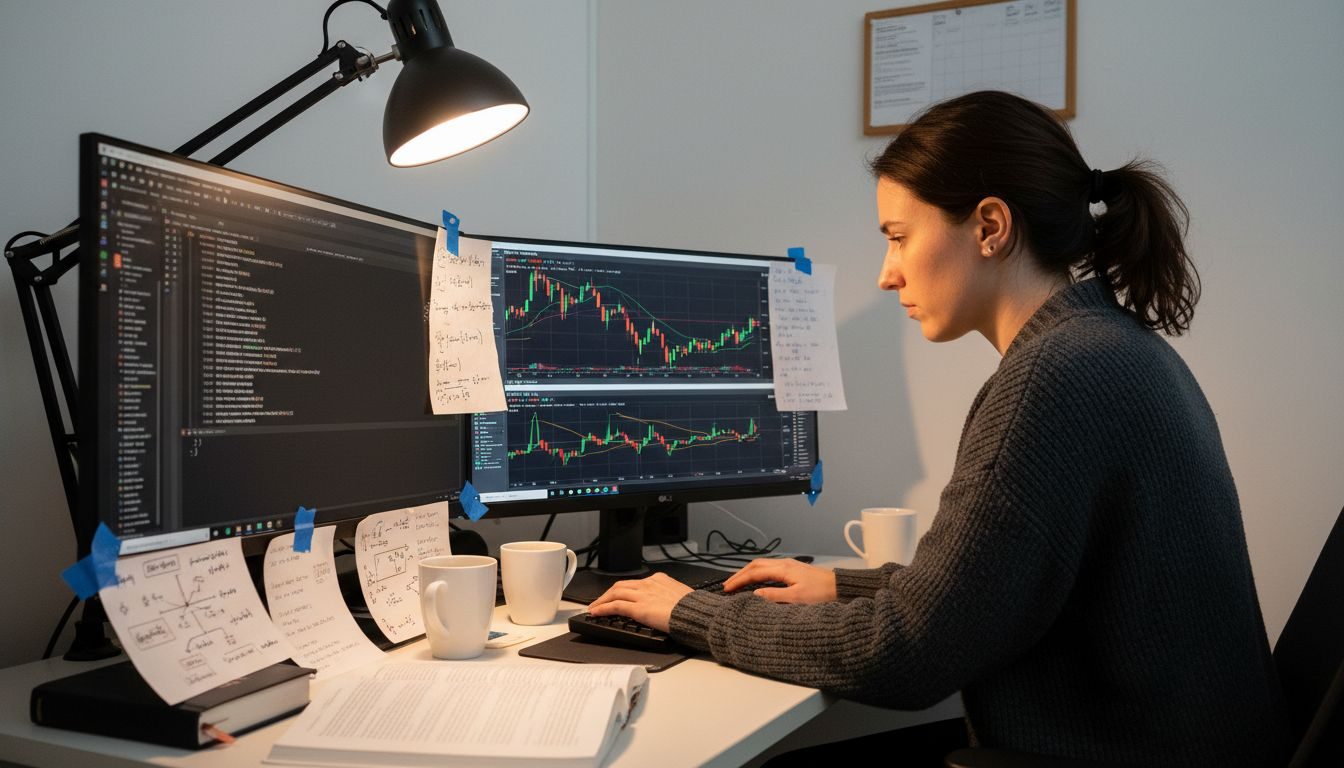
The speed advantage is significant. EAs can execute trades in milliseconds, far faster than the average human reaction time of 250 milliseconds. This rapid response prevents missed opportunities during sharp price movements and ensures orders reach the market before conditions change.
Consistency forms another core strength. Algorithmic trading strategies improve consistency by eliminating the emotional interference that affects 70 to 90 percent of manual trades. Fear causes traders to exit winning positions too early, while greed leads to holding losers too long. EAs apply the same logic every time, regardless of recent wins or losses.
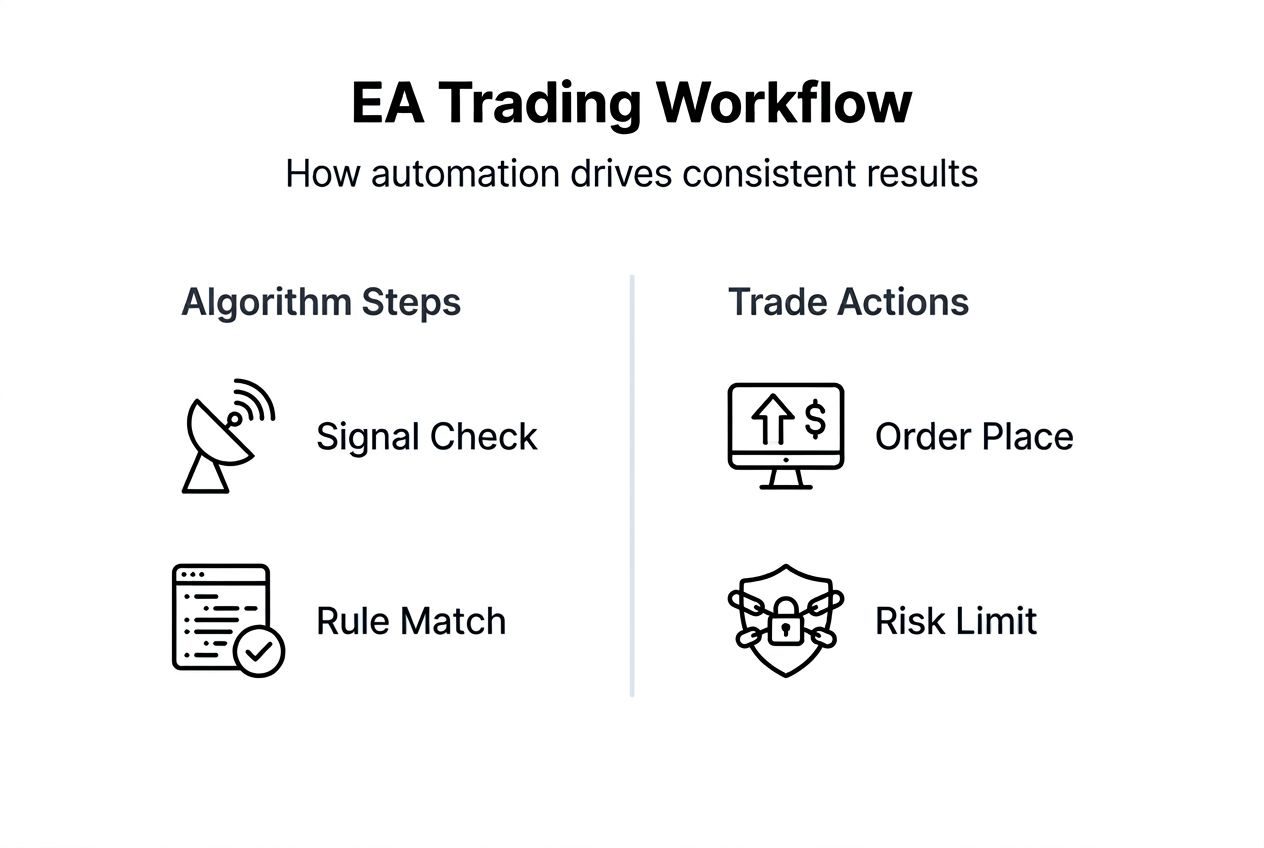
Here’s how a typical expert advisor processes a trading decision:
- Data collection: The EA pulls current price data, indicator values, and account balance information from the trading platform.
- Rule evaluation: It checks whether market conditions match the coded entry criteria, such as moving average crossovers or support breakouts.
- Position sizing: The algorithm calculates appropriate lot sizes based on account risk parameters and stop-loss distance.
- Order execution: If all criteria align, the EA sends a market or pending order to the broker.
- Management: The EA monitors open positions and adjusts stop-loss levels, trailing stops, or profit targets according to its programmed rules.
- Exit execution: When exit conditions trigger, the EA closes positions automatically.
This structured process ensures every trade follows the same evaluation framework. Traders gain confidence knowing their strategy executes exactly as designed, without shortcuts or impulsive overrides. For those seeking deeper insight into systematic approaches, reviewing algorithmic trading basics clarifies how rule-based systems outperform discretionary methods. The key benefits of forex expert advisors extend beyond speed to include discipline and scalability across multiple instruments simultaneously.
Decision-makers in other fields face similar automation challenges when implementing systematic tools. Exploring essential AI tools for decision makers reveals parallels in how structured algorithms enhance outcomes across industries.
Pro Tip: Review your EA’s code or request detailed documentation to understand its exact entry and exit logic. Transparency prevents surprises and helps you align the software with your risk tolerance and trading goals.
Benefits and limitations of using expert advisors
Expert advisors deliver measurable advantages when deployed correctly, but they come with boundaries that traders must recognize and manage.
Key benefits include:
- Improved consistency: EAs apply the same strategy rules across all trades, eliminating the human tendency to deviate after losses or wins.
- Enhanced speed: Automated execution capitalizes on fleeting opportunities that manual traders miss due to reaction delays.
- Built-in risk controls: Features like stop-loss levels, maximum drawdown limits, and position sizing rules protect accounts from catastrophic losses.
- Scalability: A single EA can monitor and trade multiple currency pairs or gold simultaneously without additional effort.
These advantages make EAs attractive for traders seeking to remove emotional interference from their decision-making process. Enhancing trading consistency becomes achievable when systematic rules replace gut feelings.
However, limitations exist:
- Adaptability challenges: EAs struggle with sudden market regime changes, such as transitions from trending to ranging conditions or unexpected news events.
- Technical risks: Software bugs, connectivity issues, or platform crashes can cause missed trades or unintended order execution.
- Over-optimization danger: Curve-fitting parameters to historical data creates EAs that perform brilliantly in backtests but fail in live markets.
- Lack of contextual awareness: EAs cannot interpret fundamental news, geopolitical events, or shifts in market sentiment the way experienced human traders can.
Despite automation advantages, human oversight is essential due to market shifts and technical risks. Traders must monitor EA performance, adjust parameters when market conditions evolve, and disable automation during abnormal volatility or when technical issues arise.
Balancing these strengths and weaknesses requires realistic expectations. EAs amplify good strategies but cannot salvage fundamentally flawed approaches. Before committing capital, traders should invest time in evaluating trading robots to separate genuinely robust systems from over-marketed failures.
Pro Tip: Set up alerts to notify you when your EA encounters errors, reaches drawdown thresholds, or stops executing trades. Proactive monitoring prevents small issues from escalating into account-damaging problems.
Common misconceptions about expert advisors
Many traders approach expert advisors with inflated expectations shaped by aggressive marketing claims. Dispelling these myths prevents costly mistakes and sets the foundation for realistic, profitable automation.
Common misconceptions include:
- Guaranteed profitability: No EA guarantees profits. Market conditions evolve, and systems that worked yesterday may fail tomorrow without adjustment.
- True AI capabilities: Most EAs are rule-based algorithms, not artificial intelligence systems that learn and adapt autonomously. They execute coded instructions, nothing more.
- Plug-and-play simplicity: Effective EA deployment requires customization, testing, and ongoing optimization. Default settings rarely match individual risk profiles or account sizes.
- Vendor claims as truth: Marketing materials often showcase cherry-picked results or backtests optimized to look impressive. Independent validation is essential.
Only a small percentage of EAs remain profitable after realistic forward testing due to curve-fitting and improper use. Traders who skip rigorous evaluation waste money on systems doomed to fail.
Understanding these realities shifts focus from searching for a magic solution to building a systematic evaluation process. Testing, customization, and incremental improvement become the path to consistent results. This mindset aligns with the disciplined approach required for long-term trading success.
Comparative strategies: forex vs gold market expert advisors
Forex and gold markets present distinct trading environments that demand specialized EA approaches. Understanding these differences helps traders select and configure automation tools appropriately.
Key distinctions include:
- Volatility levels: Gold experiences sharper, more frequent price swings compared to major currency pairs. Gold market EAs typically adapt to higher volatility and different risk profiles compared to forex EAs.
- Risk management: Gold EAs often use wider stop-losses and more conservative position sizing to survive violent moves, while forex EAs balance tighter stops with higher frequency.
- Performance benchmarks: Gold strategies may target higher win rates with larger average wins, accepting occasional sharp drawdowns. Forex systems often prioritize steady, smaller gains with controlled risk.
- Market correlations: Forex EAs exploit currency pair relationships and interest rate differentials. Gold EAs focus on safe-haven flows, inflation expectations, and dollar strength.
| Feature | Forex EAs | Gold EAs |
|---|---|---|
| Typical volatility | Lower, steadier moves | Higher, sharper swings |
| Stop-loss distance | Tighter, 20 to 50 pips common | Wider, 50 to 200 pips typical |
| Position sizing | More aggressive, higher frequency | More conservative, selective entries |
| Win rate targets | 50 to 60 percent common | 60 to 70 percent achievable |
| Drawdown tolerance | 10 to 20 percent acceptable | 15 to 30 percent typical |
Traders specializing in gold should explore a top gold trading robots comparison to identify systems engineered for precious metal characteristics. Understanding why trade gold with EAs clarifies the win rate advantage and risk tradeoffs. Comprehensive gold trading software guides provide additional context on platform integration and feature selection.
Choosing between forex and gold EAs depends on your risk tolerance, capital size, and market knowledge. Neither market is inherently superior, but matching EA design to market characteristics significantly impacts results.
Evaluating, backtesting, and selecting the right expert advisor
Selecting an effective expert advisor requires systematic evaluation that goes far beyond reviewing vendor claims or backtest screenshots. Robust backtesting and forward testing are essential to avoid curve-fitting and confirm EA reliability.
Follow this step-by-step evaluation process:
- Define your goals: Clarify target returns, acceptable drawdown limits, and time commitment for monitoring before searching for EAs.
- Review backtest results: Examine historical performance over multiple years and market conditions, focusing on drawdown depth, recovery time, and consistency.
- Conduct forward testing: Run the EA on a demo account for at least three months to validate performance in current market conditions without curve-fitting.
- Customize risk parameters: Adjust lot sizing, stop-loss distances, and maximum open positions to match your account size and risk tolerance.
- Monitor and refine: Track live performance weekly, comparing results to backtest expectations and adjusting parameters as needed.
| Selection Criteria | What to Look For |
|---|---|
| Maximum drawdown | 20 percent or less for conservative traders, 30 percent maximum for aggressive accounts |
| Profit factor | 1.5 or higher indicates healthy risk-reward balance |
| Win rate | 50 percent minimum, 60 percent plus ideal for confidence |
| Adaptability | EA should perform across trending and ranging market conditions |
| Platform compatibility | Must support your broker’s MetaTrader 4 or 5 environment without errors |
| Update frequency | Developers should provide regular updates responding to market evolution |
Common pitfalls to avoid:
- Over-optimization: Tweaking parameters until backtest results look perfect creates systems that fail in live trading.
- Insufficient testing period: Three months minimum forward testing reveals how EAs handle varied conditions.
- Ignoring slippage and spreads: Backtests often assume perfect fills, but live markets introduce execution delays and costs.
For practical guidance, review how to evaluate trading robots thoroughly before committing capital. Resources on enhancing trading consistency explain how systematic evaluation improves outcomes. Understanding the complete forex gold trading workflow clarifies where EA testing fits into broader trading operations.
Expert advice matters in specialized fields. Just as consulting skincare experts improves personal care outcomes, seeking guidance from experienced algorithmic traders accelerates your EA selection learning curve.
Pro Tip: Start with conservative risk settings and gradually increase position sizes as your EA demonstrates consistent profitability over several months. This incremental approach protects capital during the critical validation phase.
Expert advisors for proprietary trading firms: compliance and optimization
Proprietary trading firms impose strict requirements that standard retail EAs often fail to meet. Traders pursuing prop firm funding or operating within firm guidelines need specialized automation tools designed for compliance.
Key prop firm EA requirements:
- Strict drawdown limits: Prop firms require strict drawdown adherence, detailed reporting, and transparency that EAs must support to qualify. Daily and maximum drawdown thresholds are non-negotiable, typically ranging from 5 to 10 percent daily and 10 to 12 percent maximum.
- Detailed trade logging: Firms demand complete records of entry prices, exit prices, timestamps, and position sizes for audit and performance review.
- Risk parameter controls: EAs must allow precise configuration of lot sizes, leverage usage, and maximum concurrent positions to align with firm rules.
- Transparency: Firms reject black-box systems that obscure trading logic. Clear documentation of strategy rules is essential.
- Reporting formats: Automated generation of daily, weekly, and monthly performance reports streamlines compliance.
Optimizing EAs for prop firm environments balances profitability with regulatory constraints. Aggressive systems that maximize returns at retail brokers often violate prop firm risk limits. Traders must prioritize capital preservation and steady growth over home-run trades.
Compliance features to prioritize:
- Configurable daily loss limits that automatically halt trading when thresholds are reached.
- Maximum position size caps preventing oversized trades relative to account balance.
- Time-based trading windows that restrict activity during news events or firm-specified blackout periods.
- Detailed audit trails recording every decision point and parameter adjustment.
For comprehensive strategies, explore prop firm trading tips tailored to MetaTrader environments. Reviewing available prop firm trading systems clarifies which automation tools offer the compliance features firms demand.
Prop firm traders face unique challenges, but properly configured EAs transform strict requirements from obstacles into competitive advantages. Systems designed for compliance deliver the consistency and transparency firms reward with increased capital allocations.
Conclusion: maximizing automation benefits with expert advisors
Expert advisors offer powerful automation capabilities that enhance speed, consistency, and discipline in forex and gold trading. However, their effectiveness hinges on rigorous testing, realistic expectations, and continuous human oversight. EAs amplify good strategies but cannot fix fundamentally flawed approaches.
Success with automation requires balancing technology’s strengths with human judgment. Test thoroughly using both backtesting and forward testing. Customize risk parameters to match your account size and tolerance. Monitor performance actively and adjust when market conditions shift. Treat EAs as tools that require maintenance and refinement, not set-and-forget solutions.
As algorithmic trading technology evolves, EAs will incorporate more sophisticated pattern recognition and adaptive capabilities. Staying informed about industry trends positions you to adopt improvements early. The traders who thrive combine cutting-edge automation with disciplined risk management and realistic performance expectations.
Enhance your trading with expert advisor resources
Ready to implement the insights from this guide? FxShop24 offers comprehensive resources to help you select, deploy, and optimize expert advisors for forex and gold markets. Whether you’re evaluating your first EA or refining existing systems, practical tools and tutorials accelerate your automation journey.
Explore detailed explanations on why use expert advisors to understand the full scope of automation benefits. Get step-by-step guidance with a trading robot setup guide for MetaTrader platforms. Learn about different automated trading systems types to identify which approach matches your trading style. These resources provide the practical knowledge needed to move from understanding EAs conceptually to deploying them effectively in live markets.
Frequently asked questions
What are expert advisors in forex trading?
Expert advisors are automated trading programs that execute trades based on predefined rules in forex markets. They analyze price data, apply technical indicators, and place orders without manual intervention. EAs remove emotional bias and improve consistency by following coded logic every time.
How do I test an expert advisor before live trading?
Backtest using historical data to assess past performance across multiple years and market conditions. Forward test on demo accounts for at least three months to validate behavior in current market environments. Adjust risk parameters based on demo results before deploying with real capital. This systematic approach reveals how the EA handles slippage, spread changes, and unexpected volatility.
Can expert advisors guarantee profits in volatile markets like gold?
Expert advisors cannot guarantee profits in any market, especially volatile ones like gold. Their effectiveness depends on algorithm quality, rigorous testing, and proper risk management. Ongoing monitoring is critical because market conditions evolve and technical issues can arise. EAs amplify good strategies but cannot overcome poor system design or lack of oversight.
What features should proprietary firms look for in expert advisors?
Proprietary firms need EAs with strict drawdown limits and automated risk controls that halt trading when thresholds are reached. Detailed trade logging and reporting tools provide the transparency firms require for compliance and audit purposes. Customization options must allow precise configuration of lot sizes, leverage, and position limits to align with firm-specific rules. EAs designed for prop environments prioritize capital preservation and consistent growth over aggressive returns.