



25
Feb
Why Automated Gold Trading Transforms Forex Profits
Watching gold prices move minute by minute can leave even experienced traders second-guessing their next step. Automated gold trading systems remove that uncertainty by executing trades with mechanical accuracy, relying on computer logic instead of human emotion. As global markets move nonstop, these systems use algorithms on platforms like MT4 and MT5 to identify and act on opportunities around the clock. This guide breaks down core concepts and explains how computer programs and algorithms simplify gold trading for real profits.
Table of Contents
- Automated Gold Trading: Definition and Core Concepts
- Types of Automated Gold Trading Systems
- How EAs and AI Robots Execute Trades
- Real-World Benefits for Forex Traders
- Risks, Limitations, and Key Mistakes to Avoid
Key Takeaways
| Point | Details |
|---|---|
| Automated Trading Efficiency | Automated gold trading systems execute trades based on predetermined rules, removing emotional bias and allowing for consistent decision-making. |
| Types of Trading Systems | There are various automated trading systems such as trend-following, mean reversion, and AI-driven models, each suited for different market conditions. |
| Execution Speed Advantage | Automated systems provide rapid execution of trades, which is crucial for capturing optimal prices and reducing slippage. |
| Importance of Risk Management | Implementing safeguards like daily loss limits and circuit breakers is essential to protect capital from market volatility and system failures. |
Automated Gold Trading: Definition and Core Concepts
Automated gold trading uses computer programs and algorithms to execute trades in the gold markets without constant human intervention. These systems follow predetermined rules that trigger buy and sell orders automatically based on market conditions.
You probably know the frustration of sitting at your computer, watching prices move, and questioning whether you’re making emotional decisions. Automated systems eliminate that entirely. They work 24/5 when markets are open, scanning for opportunities even while you sleep.
How Automated Gold Trading Works
Algorithmic trading systems apply predetermined rules and trends in gold currency markets to automate trade execution without human emotion affecting decisions. The system analyzes market data in real time against your programmed criteria.
Here’s what happens step by step:
- Market data streams into your trading platform (MT4 or MT5)
- The algorithm analyzes prices against your defined conditions
- When conditions match, the system executes a trade automatically
- Position management happens without you lifting a finger
- The cycle repeats thousands of times daily
Unlike manual trading where you might hesitate or second-guess yourself, the system follows your logic perfectly every single time.
Core Components of Automated Gold Trading
Every automated gold trading system includes these essential elements:
- Entry Rules: Specific conditions that tell the system when to buy or sell gold
- Exit Rules: Predetermined profit targets and stop-loss levels that protect your capital
- Risk Management: Position sizing and drawdown limits built into the logic
- Market Filters: Conditions that prevent trading during unfavorable market conditions
- Backtesting Data: Historical performance metrics validating the strategy works
Think of it like setting up a filter for your email. Once configured, emails get sorted automatically without your involvement.
Automated systems eliminate emotional trading and execute your strategy with mechanical precision, reducing the likelihood of costly mistakes during volatile market movements.
Why Gold Trading Benefits from Automation
Gold markets move around the clock across multiple time zones. Manual traders can’t possibly monitor everything. An automated system watches global markets constantly and reacts instantly to opportunities.

You also get consistency. Your strategy executes exactly the same way whether the market is calm or chaotic. Humans react differently depending on stress levels, sleep, or mood. Machines don’t have those variables.
When you use expert advisors and trading robots on MT4 and MT5, you’re leveraging years of coded trading logic that professional developers have tested extensively.
Pro tip: Start by understanding your chosen strategy’s core logic before deploying it. Even the best automated system requires trader knowledge to recognize when market conditions fundamentally change and a strategy update becomes necessary.
Types of Automated Gold Trading Systems
Automated gold trading systems come in several distinct varieties, each built for different trading styles and market conditions. Understanding which type suits your approach is crucial before selecting or deploying any system.
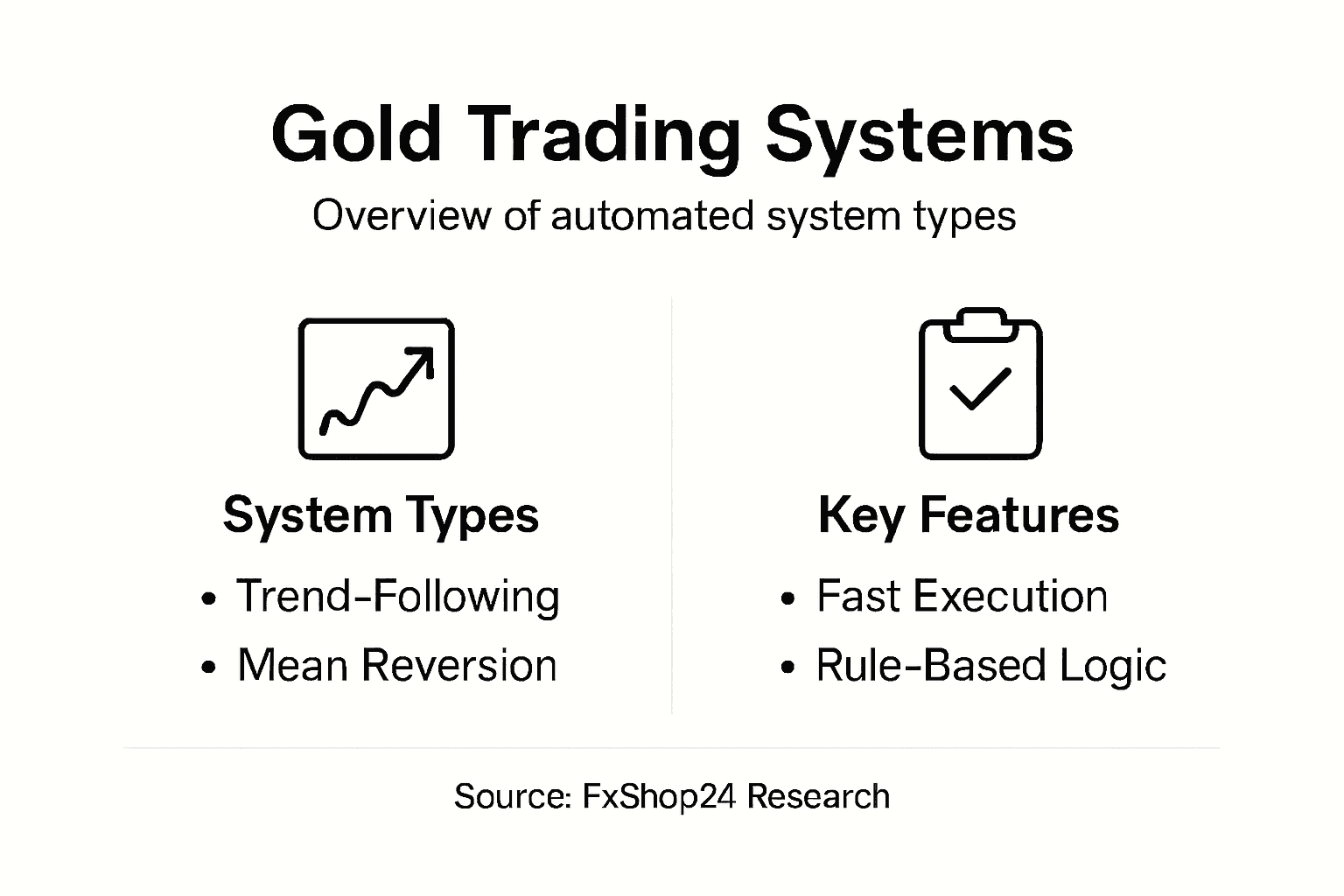
The main distinction lies in how systems decide to enter and exit trades. Some use simple price-based triggers, while others incorporate complex technical analysis or machine learning models. Your choice depends on your risk tolerance and profit goals.
Trend-Following Systems
Trend-following robots identify and ride directional moves in gold prices. These systems buy when gold breaks above resistance and sell when it breaks below support levels. They work best in markets with clear directional momentum.
These systems typically include:
- Moving average crossovers that signal entry points
- Breakout detection above key price levels
- Trailing stop-losses that lock in profits as trends progress
- Filters to avoid false breakouts during choppy markets
Trend followers work well during strong bull or bear markets but can generate false signals when gold trades sideways. They’re popular because the logic is straightforward and backtesting data is easy to validate.
Mean Reversion Systems
Mean reversion systems operate on the opposite principle. They assume gold prices that move too far from average levels will snap back. When gold spikes above its normal range, the system sells. When it crashes below, the system buys.
These systems profit from temporary price extremes rather than sustained trends. They work best in ranging markets where gold oscillates between support and resistance without breaking through.
Mean reversion traders often see quicker profits but also experience rapid stop-outs when prices continue moving unexpectedly in one direction.
Here’s a quick comparison of the main types of automated gold trading systems:
| System Type | Trading Approach | Ideal Market Condition | Adaptability |
|---|---|---|---|
| Trend-Following | Follow price momentum | Strong bull or bear markets | Moderate, some filters |
| Mean Reversion | Seek price reversals | Sideways or range markets | Limited to range |
| AI/ML-Driven | Pattern recognition | All market regimes | High, self-learning |
| Hybrid/Custom | Combine strategies | Mixed or changing markets | Very high, customizable |
Machine Learning and AI-Driven Systems
Advanced gold trading robots now leverage artificial intelligence to recognize patterns humans miss. These systems analyze historical price data, volume patterns, and correlation relationships to predict future moves.
AI-powered approaches include:
- Neural networks that learn from thousands of price patterns
- Random Forest algorithms that weight multiple technical factors
- Deep learning models that recognize subtle market shifts
- Adaptive logic that adjusts parameters as market conditions change
Different system types excel under different market regimes, so many professional traders run multiple automated systems simultaneously to capture varied profit opportunities.
Hybrid and Custom Systems
Many traders combine multiple approaches into hybrid systems. Your strategy might use trend-following logic for strong trends but switch to mean reversion when momentum weakens.
Custom systems built specifically for your broker, timeframe, and risk profile typically outperform generic solutions. When you understand how to automate gold trading on MT4 and MT5, you can code exactly what your analysis suggests.
Pro tip: Test each system type in your specific market conditions before committing capital—what works brilliantly in trending gold markets may lose money during consolidation phases.
How EAs and AI Robots Execute Trades
Expert Advisors (EAs) and AI robots don’t just identify opportunities—they execute complete trades from entry to exit without you touching a single button. Understanding how this execution happens reveals why automation transforms profitability.
When you deploy an EA on MetaTrader, it runs continuously on your broker’s servers or your computer. The system monitors price action, analyzes incoming data, and executes trades when conditions align with your programmed rules.
The Execution Workflow
Expert Advisors connect directly to your broker through MetaTrader’s API. When the EA identifies a trade setup, it immediately sends an order to your broker’s matching system. The order executes at the best available price within milliseconds.
Here’s the execution sequence:
- EA monitors live price feeds and technical indicators
- System validates that entry conditions are met
- Risk calculations determine position size based on your account
- Buy or sell order is placed with your broker
- Stop-loss and take-profit levels are set automatically
- Trade is managed according to preset exit rules
This entire process happens faster than you could manually click buttons and type order details.
Real-Time Data Integration
Modern AI robots leverage machine learning models such as LSTM for time series forecasting. These systems analyze historical patterns and current price action simultaneously to predict likely next moves.
Advanced systems also incorporate:
- Real-time sentiment analysis from news feeds using natural language processing
- Correlation data between gold and other markets
- Volume analysis to confirm trend strength
- Economic calendar events that trigger trading filters
The robot weighs all these inputs and decides whether conditions favor taking a trade.
Risk Management Automation
Position sizing happens automatically based on your account balance and risk tolerance. If you’ve set a 2% risk-per-trade rule, the system calculates exactly how many lots you can trade without exceeding that threshold.
Stop-losses and take-profit levels adjust according to market conditions. Some EAs use trailing stops that move upward with profits, locking in gains while allowing trades to run. Others use fixed levels based on volatility.
The real advantage of AI execution is consistency—your strategy executes identically whether the market is calm or in panic mode, eliminating emotional overrides that destroy manual trading accounts.
Managing Slippage and Rejections
Occasionally orders execute at slightly worse prices than expected (slippage) or get rejected due to liquidity issues. Quality EAs handle these scenarios by automatically retrying orders or adjusting position size.
Robust systems also include circuit breakers that halt trading during extreme volatility or low liquidity periods when execution quality deteriorates.
Pro tip: Start with small position sizes when first deploying an EA to observe how it executes in real market conditions—this reveals any slippage patterns or rejection issues specific to your broker.
Real-World Benefits for Forex Traders
Automated gold trading delivers tangible advantages that directly impact your bottom line. These aren’t theoretical benefits—they’re measurable improvements that traders experience immediately after deploying systems.
The shift from manual to automated trading fundamentally changes how you compete in gold markets. You gain speed, consistency, and the ability to manage positions that would overwhelm a human trader.
Speed and Execution Advantage
Trade execution speed separates winning traders from losing ones. When a setup forms, automated systems react in milliseconds while you’re still reading the chart. This speed advantage compounds over time, capturing entries and exits at optimal prices.
Consider this scenario: Gold prices spike during economic news. Your EA identifies the reversal pattern and places a sell order within 200 milliseconds. By the time you manually click to trade, the best prices are gone and your entry is 50 pips worse. That’s real money lost.
Key speed benefits include:
- Entry orders filled at intended prices before price slippage
- Stop-losses activated instantly when levels are breached
- Take-profit targets executed before momentum reverses
- Multiple positions managed simultaneously without delays
Eliminating Emotional Trading Errors
Your worst trades come when fear and greed override your strategy. Humans frequently override their plans during high-stress moments. You close winners too early or hold losers hoping for reversals that never come.
Automated systems execute your predetermined strategy consistently regardless of market conditions. When your plan says exit at take-profit, the system exits. When rules say cut losses, it cuts. No hesitation. No rationalization.
This consistency alone recovers the cost of automated systems within weeks for most traders.
Scalability and Portfolio Management
Manual traders can realistically manage two to three positions simultaneously. Beyond that, your attention fragments and mistakes multiply. Automated systems manage dozens of positions with identical precision.
You can now:
- Run multiple strategies on the same account
- Trade multiple gold pairs simultaneously
- Monitor different timeframes without fatigue
- Scale positions as your account grows
The real edge of automation isn’t working harder—it’s working smarter by removing human limitations that constrain profitability.
Data-Driven Decision Making
AI systems analyze patterns across thousands of price bars instantly. They identify correlations and micro-trends that human analysis misses. Your EA weighs economic indicators, sentiment data, and technical signals simultaneously to make informed entries.
This removes guesswork from trading. Your system only enters trades when multiple confirming factors align, dramatically improving win rates.
Pro tip: Track your automated system’s performance over 100+ trades before adjusting parameters—this ensures you’re evaluating genuine edge versus lucky randomness.
Risks, Limitations, and Key Mistakes to Avoid
Automated gold trading isn’t a guaranteed path to profits. Systems fail, markets shift, and traders make preventable errors that erase gains. Understanding these pitfalls separates successful automators from those who lose money.
The biggest mistake is believing your EA will work forever without monitoring. Markets change, and systems that profited last year can lose money this year if conditions shift fundamentally.
Technical and Execution Risks
Automated trading systems face inherent risks including technical glitches and latency issues, especially during volatile gold market swings. Your EA might disconnect from your broker, miss trades, or execute at terrible prices during fast-moving markets.
Common technical failures include:
- Internet disconnections interrupting EA operation
- Broker server outages preventing order execution
- Slippage during news releases when spreads widen dramatically
- System crashes leaving open positions unmanaged
- Latency delays causing missed entries at intended prices
These aren’t hypothetical. They happen regularly in live trading, so prepare accordingly.
Model Inaccuracy and Market Regime Changes
Your EA was built on historical data. Gold markets today aren’t identical to markets six months ago. Correlations change, volatility patterns shift, and new market participants enter with different trading styles.
A strategy that crushed it during trending markets can hemorrhage money when gold enters a consolidation phase. Data quality issues and model overfitting to past conditions are major failure points that traders overlook.
The brutal truth: Backtesting results don’t guarantee future performance.
Common Trader Mistakes
Most automated trading failures stem from human error, not system failures. Traders ignore limitations and push systems beyond safe operational boundaries.
Avoid these costly mistakes:
- Deploying live without adequate backtesting and paper trading
- Running multiple strategies that contradict each other’s logic
- Failing to set maximum daily loss limits
- Ignoring broker connectivity and server stability
- Over-leveraging positions beyond risk tolerance
- Never updating systems as markets evolve
- Removing stop-losses because a trade went temporarily against you
Each one of these transforms a profitable system into a capital-destruction machine.
The systems that fail hardest are those deployed without proper risk controls—traders often disable safeguards “temporarily” and never re-enable them, leading to catastrophic losses.
Safeguards That Matter
Robust systems include circuit breakers that halt trading when conditions become unsafe. Maximum drawdown limits prevent one bad week from wiping out months of gains.
Implement these protections:
The following table summarizes key safeguards and their importance in automated gold trading:
| Safeguard | Purpose | Impact on Trading |
|---|---|---|
| Circuit Breakers | Halt trades in volatility | Prevent major losses |
| Daily Loss Limits | Cap daily potential loss | Preserve capital |
| Equity Stops | Shut system at drawdown | Protect account equity |
| Broker Disconnect Alerts | Notify when offline | Prevent unmanaged risks |
- Daily loss limits that pause trading when hit
- Equity stops that shut down systems at preset drawdown levels
- Slippage thresholds rejecting orders during extreme volatility
- Broker disconnect alerts that notify you immediately
Pro tip: Set your maximum acceptable daily loss at 1-2% of account equity, then enforce it religiously—systems that run “just one more trade” to recover losses typically spiral into total account destruction.
Unlock Consistent Profits with Automated Gold Trading Solutions
The article highlights a common trader challenge: emotional decision-making and missed opportunities in fast-moving gold markets. If you want to overcome the risks of manual trading hesitation or inconsistent entries, you need automation that executes your strategy flawlessly and around the clock. The frustration of slippage, unpredictable market shifts, and managing multiple positions can stop your growth. Leveraging proven Expert Advisors and AI-powered robots designed specifically for gold and forex can transform those obstacles into steady profits.
Discover how you can automate and elevate your gold trading by exploring FxShop24’s premium trading systems. Our optimized EAs for MT4 and MT5 come with lifetime updates, unlimited licenses, and tested risk controls to protect your capital when markets turn volatile. Take control today and stop losing money to hesitation and emotional errors. Visit FxShop24 and start automating your success now.
Frequently Asked Questions
What is automated gold trading?
Automated gold trading uses computer programs and algorithms to execute trades in the gold markets without constant human intervention. These systems follow predetermined rules that trigger buy and sell orders based on market conditions.
How does automated gold trading improve trading consistency?
Automated systems execute trades based on predefined rules, eliminating emotional decision-making. This ensures that strategies are consistently applied, regardless of market conditions or emotional stress, leading to more reliable trading outcomes.
What types of automated gold trading systems are available?
There are several types including trend-following systems, mean reversion systems, AI-driven systems, and hybrid systems. Each type has different strategies for entering and exiting trades, catering to various trading styles and market conditions.
What are the risks associated with automated gold trading?
Risks include technical glitches, market regime changes, and model inaccuracies. Traders need to monitor systems continuously and implement safeguards like daily loss limits and circuit breakers to protect against potential losses.