


13
Feb
Why Test Trading Robots Before Going Live
The search for consistently profitable Forex and gold trading often leads traders to automated solutions that promise speed and emotionless discipline. For many MetaTrader 4 and 5 users, the idea of letting sophisticated algorithms scan markets and execute orders sounds appealing, but understanding how these trading robots work—and how to test them properly—can define your financial edge. This guide unpacks the technology behind automated trading while spotlighting the smartest ways to evaluate and deploy robots for real results in fast-moving markets.
Table of Contents
- What Are Trading Robots in Forex and Gold
- Key Types of Trading Robots for MT4/MT5
- How Automated Trading Robots Actually Work
- Critical Benefits of Proper Robot Testing
- Common Pitfalls and Risks to Avoid
Key Takeaways
| Point | Details |
|---|---|
| Importance of Trading Robots | Trading robots automate trading decisions in Forex and gold markets, minimizing emotional errors and enhancing performance. |
| Diverse Robot Types | Various types of trading robots, such as Grid Bots and Scalping Bots, cater to different market scenarios and trader strategies. |
| Effective Testing | Thorough testing of trading robots is essential to validate strategies and mitigate risks before real capital deployment. |
| Recognizing Risks | Understanding the limitations and potential vulnerabilities of trading robots is crucial for effective risk management and investment protection. |
What Are Trading Robots in Forex and Gold
Trading robots, or Expert Advisors (EAs), represent sophisticated algorithmic software designed to automate trading decisions in Forex and gold markets. These digital tools execute trades autonomously by analyzing complex market data and applying predefined strategies without human emotional interference.
Trading robots function through advanced computational processes that enable them to:
- Monitor multiple currency pairs and gold price movements simultaneously
- Execute trades based on precise technical analysis parameters
- Operate 24/5 across global financial markets
- Implement risk management protocols automatically
Trading robots analyze market conditions using complex algorithmic rules that determine optimal entry and exit points. Unlike human traders, these automated systems can process massive amounts of market data within milliseconds, identifying potential trading opportunities with mathematical precision.
In gold and Forex markets, trading robots offer unique advantages by reducing psychological trading errors and maintaining disciplined execution. These systems are particularly valuable for traders seeking consistent performance across volatile market conditions. Modern trading robots integrate advanced machine learning algorithms that continuously adapt to changing market dynamics, making them powerful tools for both novice and experienced traders.
Pro tip: Always thoroughly backtest and validate your trading robot’s strategy across multiple market scenarios before deploying live capital.
Key Types of Trading Robots for MT4/MT5
Trading robots for MetaTrader 4 and 5 platforms come in diverse configurations, each designed to address specific market strategies and trader requirements. These sophisticated automated systems enable traders to implement complex trading approaches without constant manual monitoring.
Trading robots typically fall into several primary categories:
- Grid Bots: Place multiple buy and sell orders at predetermined intervals
- Scalping Bots: Execute rapid, high-frequency trades capturing small price movements
- Trend Following Bots: Identify and trade along established market trends
- Martingale Bots: Adjust trade sizes based on previous trade performance
- Arbitrage Bots: Capitalize on price differences across different exchanges
Top MT4 trading robots demonstrate remarkable diversity in their approach to market analysis. Prominent examples like GPS Forex Robot, Forex Fury, and Galileo FX showcase the advanced capabilities of modern automated trading systems, offering traders sophisticated algorithmic strategies tailored to different risk profiles and market conditions.
Each trading robot type presents unique advantages and potential drawbacks. Grid bots excel in ranging markets by systematically placing orders, while trend-following bots perform optimally during strong directional market movements. Scalping bots require precise execution and low-latency environments to maximize their potential, making platform selection crucial for their performance.
Here’s a summary of popular trading robot types and their ideal market conditions:
| Robot Type | Ideal Market Scenario | Key Strength |
|---|---|---|
| Grid Bot | Sideways/ranging markets | Systematic order placement |
| Scalping Bot | High liquidity, low volatility | Rapid trade execution |
| Trend Follower | Strong trend movements | Trend identification |
| Martingale Bot | Unpredictable price swings | Trade size adjustment |
| Arbitrage Bot | Price differences across exchanges | Exploiting inefficiencies |
Pro tip: Carefully evaluate a trading robot’s historical performance metrics and ensure its strategy aligns with your specific trading objectives and risk tolerance.
How Automated Trading Robots Actually Work
Automated trading robots represent sophisticated software systems that transform complex market analysis into precise, emotionless trading decisions. These digital tools leverage advanced algorithms to continuously monitor financial markets, identifying potential trading opportunities with mathematical precision and speed far beyond human capabilities.
The core functionality of trading robots involves several critical processes:
- Data Collection: Gathering real-time market price information
- Signal Generation: Analyzing patterns and generating trade signals
- Risk Management: Implementing predefined risk control parameters
- Order Execution: Automatically placing trades based on algorithmic rules
- Performance Tracking: Monitoring and logging trade outcomes
Automated trading robots operate through sophisticated pre-programmed algorithms that eliminate emotional decision-making. By committing to specific action profiles, these systems impose trading discipline while rapidly processing massive amounts of market data across multiple currency pairs and financial instruments.
The technological architecture of trading robots relies on complex mathematical models and machine learning techniques. They continuously analyze historical price movements, technical indicators, and market volatility to develop predictive trading strategies. Unlike human traders, these automated systems can simultaneously monitor multiple markets, execute trades within milliseconds, and maintain consistent performance without fatigue or psychological biases.
To better understand automated trading robots, compare human trading versus robot trading:
| Aspect | Human Trader | Trading Robot |
|---|---|---|
| Decision Speed | Seconds to minutes | Milliseconds |
| Emotional Bias | Prone to emotion | Emotionless decisions |
| Market Coverage | Limited pairs | Multiple pairs at once |
| Adaptability | Requires manual change | Automatic reprogramming |
Pro tip: Develop a comprehensive understanding of your trading robot’s underlying algorithm and regularly validate its performance across different market conditions.
Critical Benefits of Proper Robot Testing
Trading robot testing represents a critical process that separates successful automated trading strategies from potentially catastrophic financial losses. By systematically evaluating a trading robot’s performance before deploying real capital, traders can identify potential weaknesses, validate algorithmic strategies, and minimize unexpected risks in live market conditions.
Proper robot testing provides several fundamental advantages:
- Risk Mitigation: Identifies potential strategy failures before actual financial exposure
- Performance Optimization: Refines trading algorithms based on simulated market scenarios
- Strategy Validation: Confirms the robot’s ability to perform across different market conditions
- Psychological Preparation: Builds trader confidence through comprehensive performance assessment
- Cost Prevention: Avoids significant financial losses from untested trading mechanisms
Testing a trading robot involves multiple sophisticated evaluation techniques, including:
- Backtesting against historical market data
- Forward testing using simulated market environments
- Stress testing under extreme market volatility
- Performance analysis across different timeframes and market conditions
- Comprehensive risk management scenario evaluation
A trading robot that hasn’t been thoroughly tested is essentially a financial liability waiting to be triggered.
The most effective robot testing approaches combine rigorous statistical analysis with dynamic performance evaluation. Traders must simulate real-world trading conditions, accounting for market liquidity, transaction costs, and potential algorithmic limitations. This comprehensive approach ensures that the trading robot can consistently generate meaningful returns while maintaining robust risk management protocols.

Pro tip: Create a detailed testing checklist that covers multiple market scenarios and continuously update your evaluation parameters to reflect changing market dynamics.
Common Pitfalls and Risks to Avoid
Trading robot vulnerabilities can transform potentially powerful automated systems into significant financial liabilities. Understanding and anticipating these risks is crucial for traders seeking to leverage algorithmic trading strategies effectively and protect their investment capital.
The most critical risks associated with trading robots include:
- Strategy Rigidity: Inability to adapt to rapidly changing market conditions
- Overoptimization: Creating algorithms that perform exceptionally in backtesting but fail in live markets
- Technical Failures: Software glitches, connection interruptions, or platform compatibility issues
- Hidden Transaction Costs: Unexpected fees that can erode trading profits
- Unrealistic Performance Expectations: Assuming consistent returns without understanding algorithmic limitations
Trading robot limitations stem from their inherent inflexibility and potential inability to adjust quickly to unexpected market shifts. Automated systems frequently struggle with real-time adaptation, which can lead to substantial financial losses when market conditions deviate from predefined parameters.
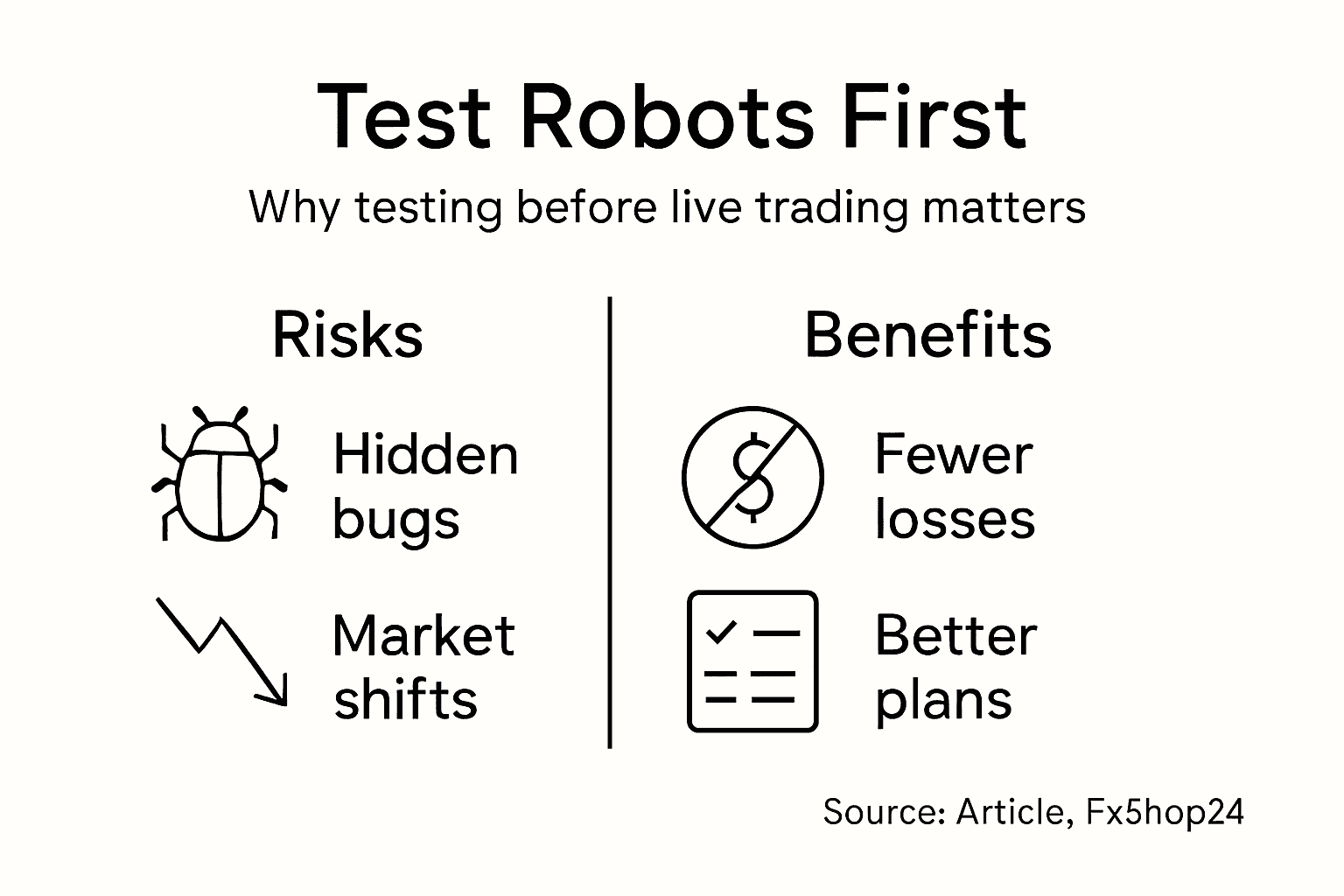
Traders must recognize that no trading robot represents a guaranteed financial solution. Each algorithmic system carries inherent risks that require continuous monitoring, periodic recalibration, and a comprehensive understanding of its underlying strategy. Successful implementation demands a balanced approach that combines automated trading capabilities with human oversight and strategic intervention.
Pro tip: Develop a robust risk management protocol that includes automatic stop-loss mechanisms and regular performance audits to mitigate potential algorithmic trading vulnerabilities.
Secure Your Trading Success with Rigorous Robot Testing
Testing your trading robots before going live is critical to avoid unexpected losses and ensure the automated system performs reliably across diverse market conditions. This article highlights the importance of thorough backtesting, forward testing, and stress testing to identify weaknesses and validate the robot’s strategy. If you want to prevent costly mistakes caused by untested algorithms and enjoy confident, disciplined trading, understanding the testing process is essential.
At FxShop24, we specialize in providing fully tested, prop firm-ready Expert Advisors and automated trading tools designed specifically for Forex and gold traders using MetaTrader 4 and 5. Our collection includes AI-powered robots and premium trading systems with lifetime updates and unlimited licenses so you can confidently deploy your automated strategies with peace of mind.
Explore our range of high-performance, extensively tested trading robots for MT4 and MT5 at FxShop24. Start your journey to disciplined, emotionless trading and reduce your risks today by selecting reliable, tested EAs tailored for real-world market conditions. Take control of your trading success now by visiting FxShop24’s Expert Advisors collection and benefit from our seamless instant downloads and comprehensive support.
Frequently Asked Questions
Why is it important to test trading robots before deploying them?
Testing trading robots is crucial to identify potential weaknesses, validate algorithmic strategies, and mitigate risks, ensuring a more reliable trading experience.
What are the benefits of backtesting a trading robot?
Backtesting allows traders to evaluate a trading robot’s performance against historical market data, helping to refine strategies and confirm the robot’s effectiveness under various conditions.
What types of testing should I conduct on my trading robot?
You should conduct backtesting, forward testing in simulated environments, stress testing under market volatility, and performance analysis across different timeframes to comprehensively assess the robot’s reliability.
What risks are associated with not testing trading robots?
Not testing trading robots can lead to strategy rigidity, overoptimization, technical failures, and unrealistic performance expectations, all of which can result in significant financial losses.
Recommended
- How To Backtest An Expert Advisor On MT5: Step-by-Step For Beginners | FxShop24 Marketplace
- From Demo To Real: Transitioning Safely With Expert Advisors | FxShop24 Marketplace
- Stop Losing Money: 10 Forex Trading Bot Mistakes That Kill Accounts (And How To Fix Them) | FxShop24 Marketplace
- Trading Robot Setup Guide: Master MetaTrader Automation
- Advantages of Using an Online Financial Advisor: Online Wealth Management Tips