



23
Feb
Why Use Expert Advisors: Enhancing Trading Consistency
Trading manually on platforms like MetaTrader 4 and MetaTrader 5 quickly tests any trader’s patience and discipline. The appeal of Expert Advisors is clear for those seeking consistent results and fewer emotional errors. With EAs handling market analysis, trade execution, and risk management based on programmed logic, you can experience continuous, emotion-free trading and instantly capture opportunities across multiple currency pairs. This guide details how Expert Advisors function, their key advantages, and what to consider before using them for more reliable performance.
Table of Contents
- Expert Advisors Defined For MT4 And MT5
- Types Of Expert Advisors And Trading Strategies
- Key Benefits Of Automated Trading With EAs
- Major Risks And What To Avoid When Using EAs
- MT4 Versus MT5: Platform Distinctions For EAs
Key Takeaways
| Point | Details |
|---|---|
| Automated Trading Efficiency | Expert Advisors execute trades based on pre-defined strategies, eliminating emotional biases and ensuring consistent performance. |
| Backtesting Importance | Thorough backtesting with historical data is crucial to validate EA strategies before live trading, preventing costly errors caused by overfitting. |
| Monitoring Necessity | Regular supervision of EAs is essential to adapt to changing market conditions and to catch any irregular performance or issues. |
| Platform Selection | Choosing between MT4 and MT5 affects EA capabilities; MT5 offers broader asset support and faster data processing, while MT4 is known for its reliability in forex trading. |
Expert advisors defined for MT4 and MT5
An Expert Advisor is an automated trading program that runs on MetaTrader 4 (MT4) or MetaTrader 5 (MT5) platforms. These are the industry-standard platforms retail traders and professionals use worldwide. EAs execute trades automatically based on coded strategies without you sitting at your screen.
Expert Advisors work by analyzing market data continuously. The programs monitor price movement and execute trades when specific conditions are met. Your EA never sleeps, processes multiple currency pairs simultaneously, and responds faster than any human trader could.
How Expert Advisors Function
EAs are written in MetaQuotes Language (MQL4 for MT4, or MQL5 for MT5). This specialized programming language lets developers build algorithms that interact directly with your trading platform. The code tells your EA exactly when to enter trades, how much to risk, when to exit, and how to manage losses.
Here’s what an EA does:
- Monitors the market 24/5 without human intervention
- Analyzes multiple assets at once
- Opens trades when predefined conditions trigger
- Closes positions based on profit targets or stop losses
- Manages risk automatically using programmed rules
- Records trade history for performance analysis
Unlike manual trading where emotions influence decisions, your EA follows its rules consistently. Every trade follows the exact same logic. No hesitation. No revenge trading.
Why This Matters for Your Trading
Consistency is the biggest advantage. Your EA trades the same way every single day. When the market conditions match your strategy’s rules, your EA acts immediately. When they don’t, it waits—no guessing, no FOMO trades.
You also gain backtesting capabilities. Before risking real money, you can test your EA against years of historical price data. You’ll see if the strategy would have been profitable in past market conditions. This removes the guesswork from strategy selection.
Expert Advisors remove emotion from trading and execute strategies with mechanical precision 24 hours a day, five days a week.
MT4 and MT5 are specifically designed to host EAs. Both platforms provide the infrastructure, historical data, and backtesting tools you need. MT5 is newer and offers more advanced features, while MT4 remains popular because it’s stable and widely supported.
Pro tip: Start by backtesting any EA thoroughly using at least 2-3 years of historical data before running it on a live account—this reveals whether the strategy survives real market conditions, not just recent price action.
Types of expert advisors and trading strategies
Expert Advisors come in many varieties, each designed for different market conditions and trader goals. The type you choose depends on your risk tolerance, available capital, and how much time you can dedicate to monitoring trades. Some traders use one EA, while others run multiple strategies simultaneously for diversification.
Strategy-Based EA Categories
Scalping, trend following, hedging, and grid trading represent the most common EA approaches. Scalping EAs execute dozens of micro-trades daily, capturing small price movements. Trend-following EAs hold positions longer, riding major market movements over hours or days. Hedging EAs protect existing positions by opening offsetting trades. Grid trading EAs place multiple orders at predetermined price intervals.
Each strategy has distinct characteristics:
- Scalping EAs require tight stops and execute high-frequency trades
- Trend-following EAs use moving averages and momentum indicators
- Hedging EAs reduce risk by balancing opposing positions
- Grid trading EAs profit from price oscillations within ranges
Choosing the right strategy depends on your market outlook. Bull markets reward trend-following. Ranging markets suit grid trading. Volatile markets work with hedging approaches.
Here’s a comparison of the most popular Expert Advisor strategy types and when to consider each:
| EA Strategy Type | Best Suited Market | Typical Trade Duration | Main Benefit |
|---|---|---|---|
| Scalping | High volatility | Seconds to minutes | Profits from small moves |
| Trend Following | Strong trends | Hours to days | Captures large price swings |
| Hedging | Uncertain trends | Varies by scenario | Reduces overall risk |
| Grid Trading | Sideways/ranging | Minutes to hours | Takes advantage of swings |
Analysis-Based EA Types
Some EAs focus on technical analysis, using indicators like RSI, MACD, Bollinger Bands, and moving averages. These scan price charts for repeating patterns and entry signals. Other EAs incorporate fundamental analysis, reacting to economic news and interest rate decisions. A few advanced systems combine both approaches.
Technical EAs trade faster because chart signals update continuously. Fundamental EAs make fewer but potentially larger trades based on economic events.
Many successful traders combine multiple EA strategies within a single system to diversify their approach and reduce reliance on any single method.
Hybrid EAs blend strategies together. One might use technical analysis for entry signals while employing grid trading for risk management. This combination approach reduces the chance that a single market condition will break your entire strategy.
Pro tip: Test any new EA type using backtesting and paper trading for at least 30 days before committing capital—different strategies perform vastly differently depending on current market volatility and your broker’s execution speed.
Key benefits of automated trading with EAs
Automated trading with Expert Advisors eliminates the biggest obstacle most traders face: emotion. When your EA executes trades, it follows logic, not fear or greed. You won’t second-guess entries, hold losing positions hoping they recover, or chase trades you missed. That discipline transforms results.

Removing Emotional Bias
Emotional trading kills accounts. You see a loss and panic-sell at the bottom. You see a winning trade and hold too long hoping for more. Your EA never does this. Automated systems execute trades based only on predefined rules, eliminating these costly mistakes entirely.
Your EA doesn’t experience fear or FOMO. It doesn’t feel tired after a string of losses. It doesn’t celebrate a win and become overconfident. Every trade follows the exact same criteria.
24/7 Market Coverage
Forex markets never close. Forex operates around the clock, five days a week across global time zones. You can’t monitor charts 24 hours daily. Your EA can and does.
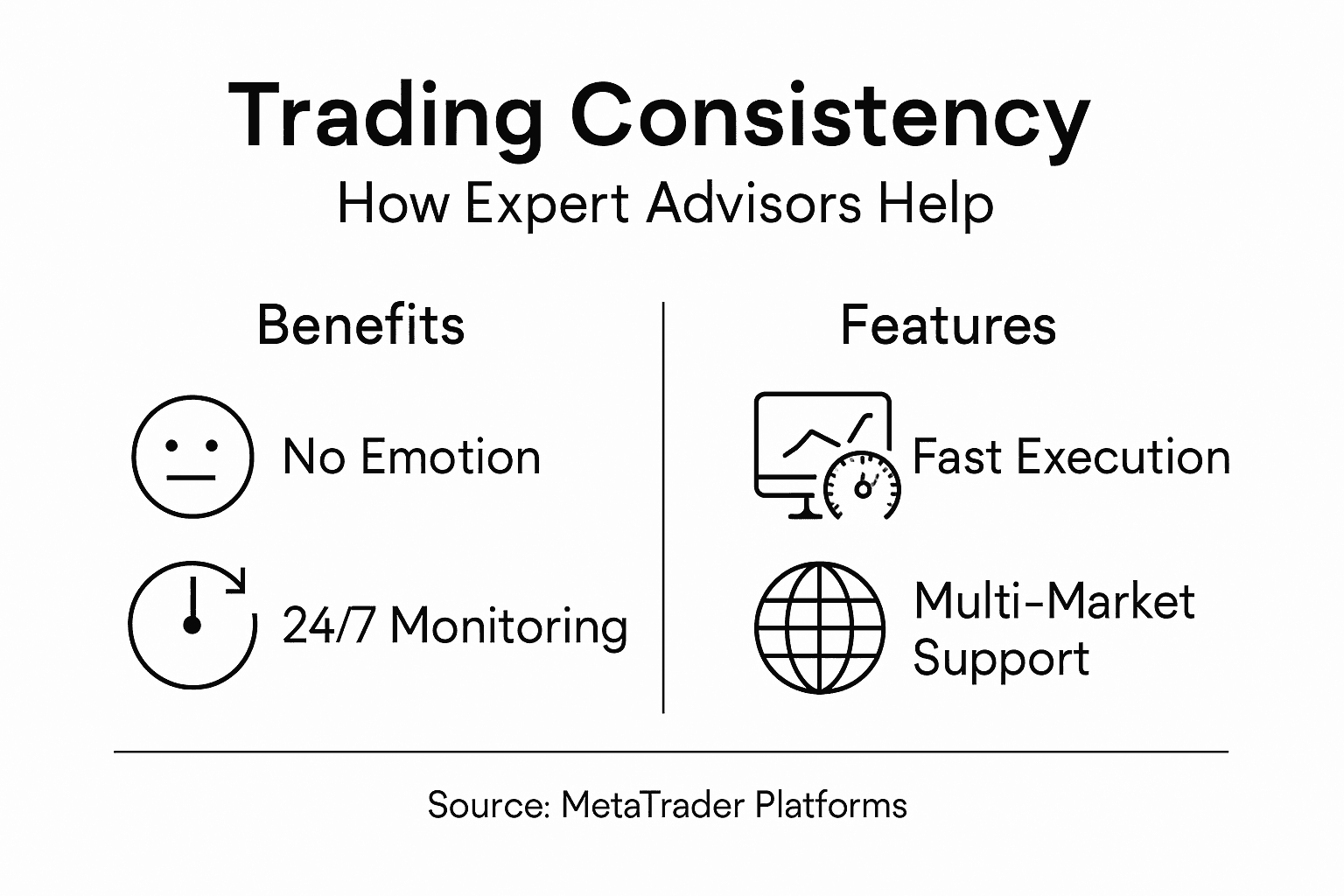
While you sleep, your EA monitors markets. While you work, it watches for entry signals. This constant vigilance means you capture opportunities you’d miss manually.
Multi-Market Analysis
Your EA can analyze dozens of currency pairs simultaneously. It screens for entry signals across EUR/USD, GBP/USD, USD/JPY, and more at the same time. A manual trader can realistically watch maybe three pairs closely.
This multi-market capability offers several advantages:
- Identifies the best trade setups across multiple pairs
- Diversifies risk by not relying on one currency pair
- Captures setups in different time zones automatically
- Reduces exposure if one pair trends against you
Consistent Trade Execution
Discipline is the real edge in trading. Your EA executes every setup the exact same way. Same position size, same stop loss placement, same profit target. This consistency compounds over time.
Automated trading enforces disciplined execution, helping traders avoid impulsive decisions and achieve better long-term results through mechanical consistency.
When your system generates a signal, your EA acts instantly. No hesitation. No waiting to see if it might reverse. This speed prevents slippage from price gaps and ensures fills close to your expected entry.
Efficiency and Time Savings
You reclaim your life. No staring at charts for eight hours. No stress from monitoring open positions. No missed trades because you stepped away from your desk. Your EA handles trading while you focus on family, work, or other interests.
Pro tip: Monitor your EA’s performance weekly rather than daily—daily monitoring encourages overtrading and interfering with the system, which typically degrades results instead of improving them.
Major risks and what to avoid when using EAs
Expert Advisors are powerful tools, but they’re not magic. Many traders deploy EAs without understanding how they work, resulting in catastrophic losses. The biggest mistake is treating your EA like a set-and-forget money machine. It isn’t.
Poor Backtesting and Optimization
Flawed development and backtesting processes cause most EA failures. Traders rush coding, skip validation steps, or optimize strategies too aggressively on historical data. This creates an illusion of profitability that evaporates in live trading.
Overfitting is the real killer. You tweak your EA’s parameters until it produces perfect results on past data. Then you deploy it live and lose money immediately. The system was fitted to history, not market reality.
Proper backtesting requires discipline:
- Test on at least 2-3 years of historical data
- Use out-of-sample data the EA hasn’t seen before
- Test across different market conditions and volatility levels
- Account for real trading costs like spreads and commissions
- Never optimize more than 3-4 parameters simultaneously
Data Quality and Dependencies
Bad data produces bad results. If your backtesting data contains errors or gaps, your EA will appear profitable when it isn’t. Ensure your historical data comes from a reliable broker and covers all market conditions.
Data errors are invisible. You won’t know your backtests are flawed until your EA loses money live. That’s too late. Always source data from reputable providers and double-check quality before running extensive backtests.
Market Adaptation Failures
Markets change constantly. A strategy that dominated trending markets fails in ranges. A grid trading EA works during calm periods but blows up during volatility spikes. EAs follow fixed rules and struggle to adapt without human intervention when conditions shift dramatically.
Your EA can’t think. It can’t recognize that major economic news is coming. It can’t sense market sentiment shifts. It executes its rules, period.
Real Trading Complexities Ignored
Backtesting assumes perfect conditions. Live trading introduces friction:
- Slippage causes fills away from your expected entry price
- Latency creates delays between signal generation and execution
- Spreads widen during news events and low liquidity periods
- Requotes occur when prices move too fast for your broker to accept
Your backtests probably ignore these costs. Live trading won’t. Assume slippage will cost 50% of your expected profit.
Lack of Supervision
EAs require ongoing supervision to handle market changes, broker conditions, or unexpected events—never deploy and ignore.
You must monitor your EA regularly. Check performance weekly. Review equity drawdowns. Watch for unusual behavior. If your EA suddenly stops trading or trades more frequently, something’s wrong.
Brokers sometimes change their execution model or connection. Market structure shifts. Economic conditions deteriorate. Your EA doesn’t adapt. You must intervene.
Pro tip: Run your EA on a demo account for 30 full days alongside live market conditions before risking real capital—this reveals slippage, latency, and real-world factors that backtesting never shows.
MT4 versus MT5: Platform distinctions for EAs
MT4 and MT5 are the two dominant platforms for running Expert Advisors, but they’re not interchangeable. Choosing between them affects your EA’s capabilities, performance, and which markets you can trade. Understanding the differences matters before you commit to either platform.
Core Language and Programming Differences
MT4 uses MQL4 while MT5 uses MQL5, and the programming languages differ significantly. MQL4 is simpler and easier to learn, making it popular for forex-focused traders. MQL5 supports object-oriented programming, enabling developers to build more sophisticated and modular EAs.
MQL5’s advanced capabilities allow complex strategies that would be difficult or impossible in MQL4. However, this complexity requires more programming expertise. If you’re buying pre-built EAs rather than coding yourself, this distinction matters less—but it explains why some advanced strategies only exist for MT5.
MT4 EAs written in MQL4 won’t run on MT5. You need MQL5 versions specifically coded for the newer platform. This limits your options if you’re committed to MT4.
Platform Capabilities and Assets
MT4 dominated the forex market for years and remains popular for currency trading. MT5 expanded the ecosystem significantly. It supports forex, equities, futures, and cryptocurrencies all within one platform. This broader asset access is MT5’s biggest advantage.
Your EA choice depends on what you want to trade:
- Forex only → MT4 works fine, MT5 also excellent
- Gold and commodities → MT5 offers better tools and broader access
- Multiple asset classes → MT5 is mandatory
- Equities or futures → MT5 only
If your strategy trades only currency pairs, MT4’s simplicity might appeal. If you want flexibility to trade multiple assets, MT5 is essential.
Performance and Speed
MT5 processes data faster and provides superior charting capabilities. Backtesting runs quicker on MT5. The platform includes more analytical tools and built-in indicators. These advantages compound when running complex EAs with heavy computational demands.
MT4 is slower but remains reliable. For simple strategies, the performance difference is negligible. For sophisticated EAs analyzing multiple timeframes across dozens of pairs simultaneously, MT5’s speed advantage becomes noticeable.
Real-World Consideration
MT5 offers faster processing, enhanced charting, and more analytical tools—but MT4 remains stable and widely supported for forex-focused traders.
Not all brokers support MT5 equally. Some brokers favor MT4 due to legacy systems and client familiarity. If your preferred broker only offers MT4, your decision is made. Check broker support before selecting your platform.
MT4 has been around longer, meaning more EAs exist for it. Finding a quality EA for MT4 is easier. MT5 has fewer pre-built options, though this gap closes yearly.
Pro tip: If you’re choosing between platforms, verify that your preferred broker offers strong MT5 support and that quality EAs exist for your trading strategy—this prevents discovering incompatibility issues after purchasing an EA.
To help choose between MT4 and MT5 for your EA, here is a feature comparison:
| Feature | MT4 | MT5 |
|---|---|---|
| Programming Language | MQL4, procedural | MQL5, object-oriented |
| Asset Classes Supported | Primarily forex | Forex, stocks, futures |
| Backtesting Speed | Slower, basic | Fast, multi-currency |
| Charting Tools | Limited indicators | Advanced analytics |
| EA Library Availability | Large, wide selection | Growing, but fewer legacy |
Unlock Consistent Trading Success with Expert Advisors from FxShop24
Struggling with emotional trading and missing out on key market moves is a challenge every trader faces. This article highlights how Expert Advisors remove emotion and deliver disciplined, mechanical trade execution while monitoring multiple markets 24 hours a day. If your goal is to trade with consistency and discipline while saving time and reducing guesswork, automated trading software is the answer.
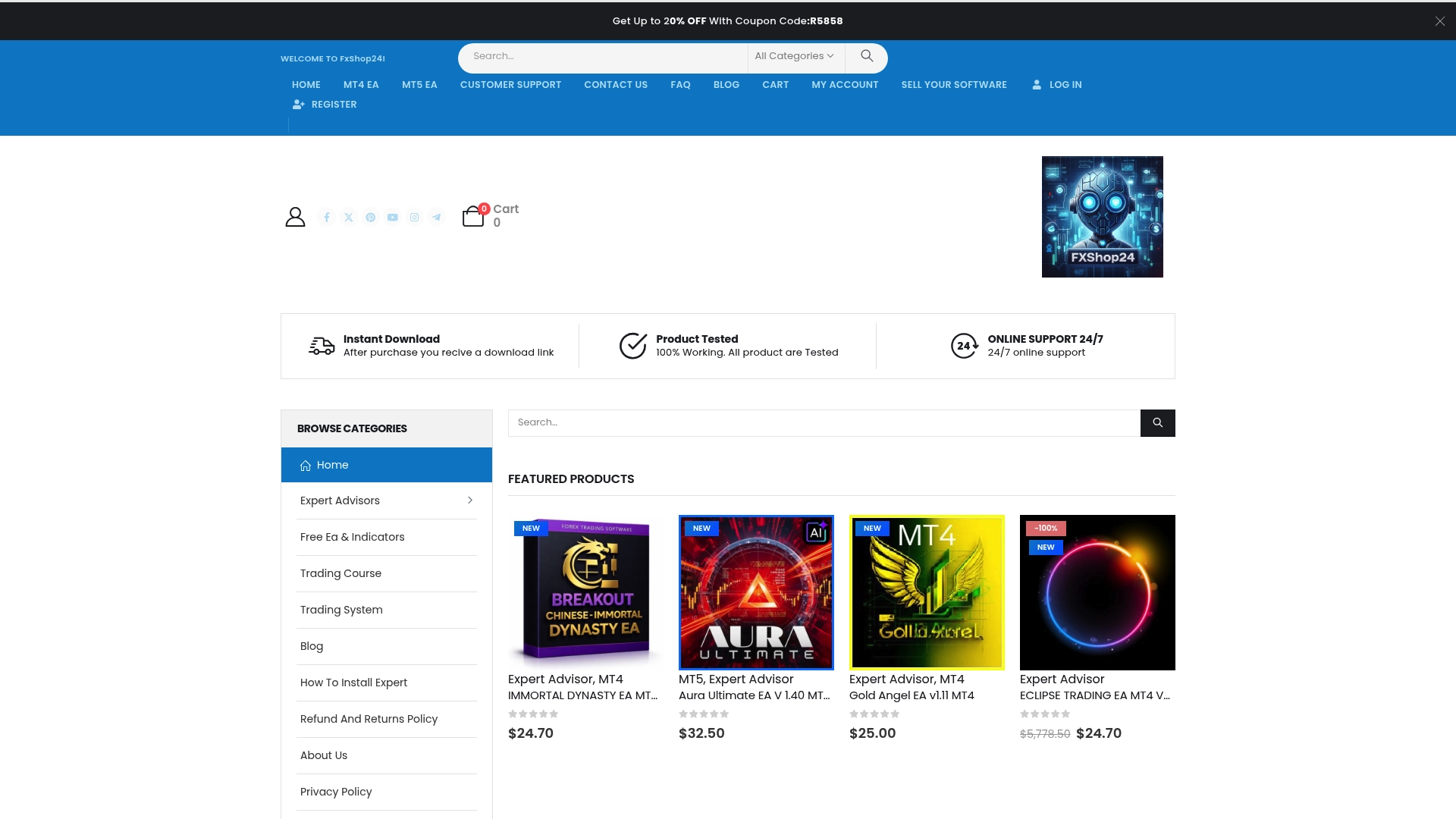
Explore FxShop24 to access a wide range of tested Expert Advisors, premium trading systems, and AI-powered robots designed for MetaTrader 4 and MetaTrader 5. Benefit from prop firm-compatible tools that offer lifetime updates and unlimited licenses, enabling you to automate your forex and gold trading strategies with confidence. Start your journey towards more disciplined and efficient trading now at FxShop24 and experience the edge automation gives you. Don’t wait let technology work for you today.
Frequently Asked Questions
What are Expert Advisors in trading?
An Expert Advisor (EA) is an automated trading program that runs on MetaTrader 4 (MT4) or MetaTrader 5 (MT5) platforms, executing trades automatically based on coded strategies without human intervention.
How do Expert Advisors enhance trading consistency?
EAs enhance trading consistency by following predefined rules without emotional bias, executing the same trading logic across all trades and maintaining discipline, which can improve long-term results.
Can I backtest my Expert Advisor before using it?
Yes, you can backtest your EA using historical market data to assess its performance under various conditions, helping you determine if the strategy is viable before risking real capital.
What are the common types of trading strategies for Expert Advisors?
Common types of EA strategies include scalping, trend following, hedging, and grid trading, each suited to different market conditions and trader goals.