


18
Apr
Master trading tool selection: your guide for MT4/MT5
TL;DR:
- Successful automated trading depends on verified live performance and strict risk management criteria.
- MT4 is ideal for retail forex automation, while MT5 supports multi-asset and gold trading.
- Ongoing EA optimization is essential, as markets evolve and strategies need regular updates.
Choosing the wrong expert advisor or trading platform can drain your account faster than any bad trade. The difference between consistent automated profits and costly failures often comes down to a single decision made before you ever place a live order: which tool do you actually use? MT4 is preferred for retail forex due to its simplicity and established EA library, while MT5 delivers advanced multi-asset support including gold. This guide walks you through exactly how to evaluate platforms, select reliable EAs, test them properly, and avoid the traps that catch most traders off guard.
Table of Contents
- Key requirements for successful trading tool selection
- Comparing MT4 vs MT5 for forex and gold automation
- Evaluating and selecting expert advisors (EAs) for forex and gold
- Best practices for testing and optimizing automated trading tools
- Our perspective: Why ongoing EA optimization beats shortcuts
- Explore next-level trading tools and automation solutions
- Frequently asked questions
Key Takeaways
| Point | Details |
|---|---|
| Match tools to your needs | Choose trading platforms and EAs that align with your markets, strategy, and risk tolerance. |
| Demand live performance proof | Always require at least six months of verified live results before trusting any EA. |
| Prioritize risk management | Favor EAs with low drawdown, real stop-losses, and avoid grid or martingale systems. |
| Test and optimize regularly | Use robust backtesting, demo forward testing, and ongoing optimization to stay ahead. |
| Platform matters for automation | MT4 is best for simple forex needs, while MT5 excels in advanced, multi-asset automation. |
Key requirements for successful trading tool selection
Now that you understand why tool selection matters, let’s break down what you actually need to look for before making a choice. Most traders jump straight to buying an EA after seeing a flashy equity curve. That’s a mistake. The foundation of any good automated setup starts with a clear checklist of non-negotiable requirements.
The most important factor is verified live performance. Backtests are easy to manipulate. What you want is at least six months of live results on platforms like Myfxbook or FXBlue. According to EA selection criteria, key factors include verified live performance, low drawdown, real stop-loss, no martingale, and broker compatibility. These aren’t optional extras. They’re the baseline.
Here’s what your requirements checklist should cover:
- Verified live results: Minimum six months on Myfxbook or FXBlue
- Maximum drawdown: Below 20% for retail traders
- Profit factor: Greater than 1.5 across live data
- Stop-loss on every trade: No exceptions
- No grid or martingale logic: These blow accounts in volatile markets
- Broker compatibility: ECN or raw spread accounts only
Pro Tip: Before you evaluate any EA’s returns, check whether the broker used in its live results offers similar spreads to yours. A 0.5 pip difference on XAUUSD can completely change profitability.
Use the table below to quickly assess any tool you’re considering:
| Requirement | Minimum Standard | Red Flag |
|---|---|---|
| Live track record | 6+ months | Demo only or backtest |
| Max drawdown | Below 20% | Above 30% |
| Profit factor | Above 1.5 | Below 1.2 |
| Stop-loss usage | Every trade | Any trade without SL |
| Strategy type | Trend/range/scalp | Grid or martingale |
| Broker type | ECN/raw spread | Market maker only |
For deeper context on what separates good tools from dangerous ones, review EA evaluation criteria and cross-reference it with MT4 vs MT5 comparison to understand how platform choice also affects these requirements.
Comparing MT4 vs MT5 for forex and gold automation
With your criteria in hand, it’s crucial to match them against the capabilities of the available platforms. MT4 and MT5 are not interchangeable. They serve different trader profiles, and picking the wrong one limits what your EA can actually do.
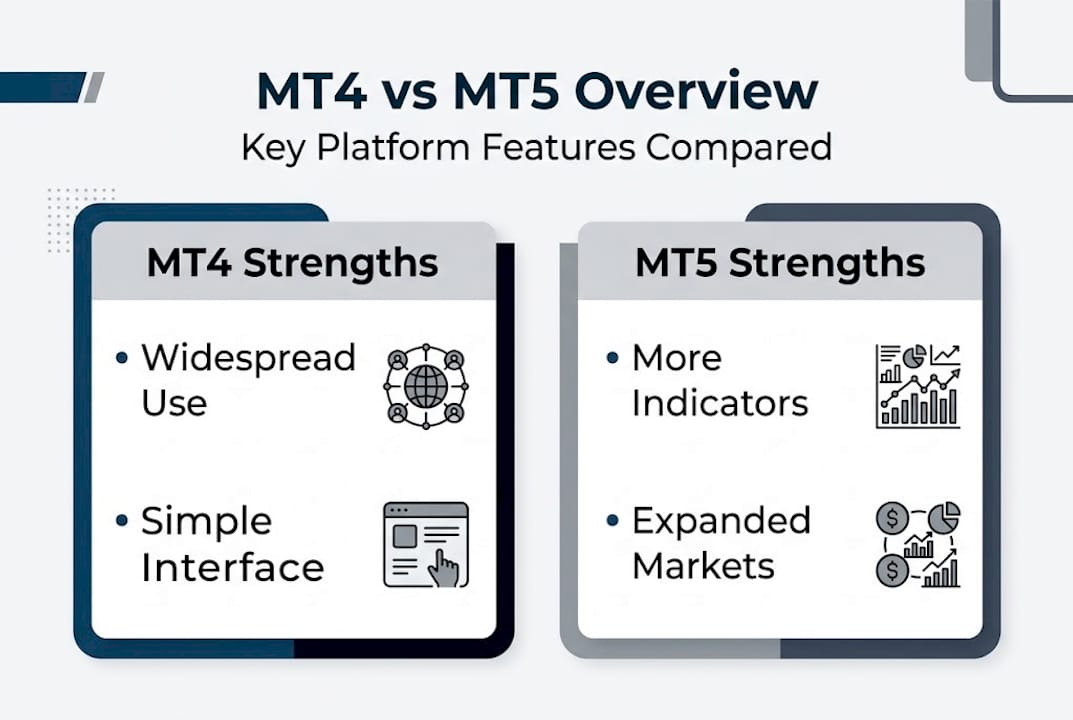
MT4 remains the go-to for retail forex traders. Its strength is simplicity, a massive EA marketplace, and a community that has been building and sharing tools for over 15 years. If you’re trading major forex pairs and want access to thousands of pre-built EAs, MT4 is hard to beat. The MT4 vs MT5 comparison shows MT4 wins on ease of use and ecosystem size, while MT5 leads on technical depth.
MT5 is built for traders who need more. It offers 38 built-in indicators versus MT4’s 30, supports 21 timeframes compared to 9, and allows multi-threaded strategy testing. Professionals use MT5 for multi-threaded testing and AI integration, which is a significant advantage for firms running complex automated strategies across gold and multiple forex pairs.
| Feature | MT4 | MT5 |
|---|---|---|
| Built-in indicators | 30 | 38 |
| Timeframes | 9 | 21 |
| EA marketplace size | Very large | Growing |
| Gold (XAUUSD) support | Limited | Full multi-asset |
| Strategy tester | Single-threaded | Multi-threaded |
| Best for | Retail forex | Firms and multi-asset |
Key considerations when choosing:
- Retail traders starting with forex automation: start with MT4
- Traders focused on gold or running multiple strategies: use MT5
- Prop firms and professional setups: MT5 is the stronger foundation
For a direct breakdown of how robots perform on each platform, the MT4 vs MT5 robot showdown covers real-world performance differences. If you’re leaning toward MT5, MT5 platform benefits outlines why it’s the preferred choice for serious automation.
Evaluating and selecting expert advisors (EAs) for forex and gold
Once you’ve picked the right platform, the next step is to zero in on EAs that match your trading needs and risk profile. This is where most traders either get it right or waste months on tools that never deliver.
Follow this step-by-step process to shortlist reliable EAs:
- Filter for live verified results. Only consider EAs with Myfxbook or FXBlue accounts showing real money trades. Live results are more reliable than backtests, and any EA without a stop-loss or using grid/martingale logic should be eliminated immediately.
- Check the drawdown history. Look at the worst drawdown period, not just the current number. A 15% drawdown during a calm market tells you nothing about how the EA handles a news spike.
- Verify the track record length. Aim for at least 6 to 12 months of live stats. Anything shorter is too small a sample to trust.
- Look for strategy transparency. The developer should explain what conditions trigger entries and exits. Vague descriptions like “proprietary algorithm” without any detail are a warning sign.
- For gold-specific EAs: Volatility handling matters more than anything else. Gold EAs show sustainable returns of 3 to 15% monthly with drawdown between 10 and 15% when properly optimized for XAUUSD sessions.
“Curve-fitting is the silent killer of EA performance. An EA that looks perfect on historical data often fails the moment market conditions shift even slightly.”
Pro Tip: Cross-reference any EA’s live stats with the broker’s spread data for the same period. If the EA was tested on a broker with 0.1 pip spreads and you’re trading on 1.5 pip spreads, the real-world results will look very different.
For a practical walkthrough of how gold automation works from signal to execution, the gold automation workflow is worth reviewing before you commit to any XAUUSD EA. You can also compare community-tested options through gold EA reviews to benchmark what good performance actually looks like.
Best practices for testing and optimizing automated trading tools
Selecting promising EAs is only half the battle; robust testing and optimization safeguard your capital in real-world markets. Skipping this phase is the most expensive mistake automated traders make.
Here’s a proven testing sequence:
- Backtest with real tick data. Use data from Dukascopy or TrueFX for the most accurate simulation. Generic broker data often has gaps that inflate backtest results. Testing with real tick data combined with walk-forward analysis is the standard method for avoiding overfitting.
- Run a three-month forward test on demo. Three months minimum captures different market conditions including trending, ranging, and high-volatility periods.
- Stress test on news events. Manually review how the EA behaved during major events like Non-Farm Payrolls or central bank announcements. If it held positions through a 100-pip spike without a stop-loss triggering, that’s a problem.
- Measure the right metrics. A Sharpe ratio above 1 and recovery factor above 3 are the recommended benchmarks for a reliable EA. These two numbers tell you more than raw profit percentage.
- Use the MT5 strategy tester’s multi-threaded mode. For MT5 stress testing, running multiple parameter sets simultaneously saves hours of manual work.
“The goal of testing isn’t to find an EA that looks perfect. It’s to find one that fails gracefully under pressure.”
Pro Tip: Never optimize an EA on the same data you used to backtest it. Use separate in-sample and out-of-sample data sets to get an honest picture of how it performs on data it has never seen.
Ongoing monitoring matters as much as initial testing. Markets shift. An EA that worked in a trending 2024 environment may underperform in a choppy 2026 range. The MT5 testing workflow provides a structured approach for keeping your testing process consistent and repeatable.
Our perspective: Why ongoing EA optimization beats shortcuts
Having covered the technical how, let’s challenge a popular myth about trading automation that limits results. The biggest misconception in automated trading is that finding a great EA is a one-time event. Set it, run it, collect profits. That mindset is responsible for more blown accounts than any single bad strategy.
Markets evolve constantly. Central bank policies shift. Volatility regimes change. An EA optimized for 2023 conditions may be completely misaligned with what the market is doing in 2026. Professionals emphasize ongoing optimization rather than relying on static EAs, and there’s a clear reason for that: the edge in any strategy decays over time.
Copying someone else’s EA without understanding its logic puts you in a reactive position. When it starts losing, you won’t know whether it’s a temporary drawdown or a fundamental breakdown. Traders who build a disciplined review process, checking performance monthly, re-running forward tests after major market shifts, and adjusting parameters when needed, consistently outperform those chasing the next “best EA.” For a structured approach to keeping your automation current, the MT5 robots guide is a strong starting point for building that ongoing review habit.
Explore next-level trading tools and automation solutions
If you’re ready to apply these best practices to real trading, here are trusted solutions and toolkits you can explore. At FxShop24, we’ve built a catalog of tools specifically designed for traders who take automation seriously.
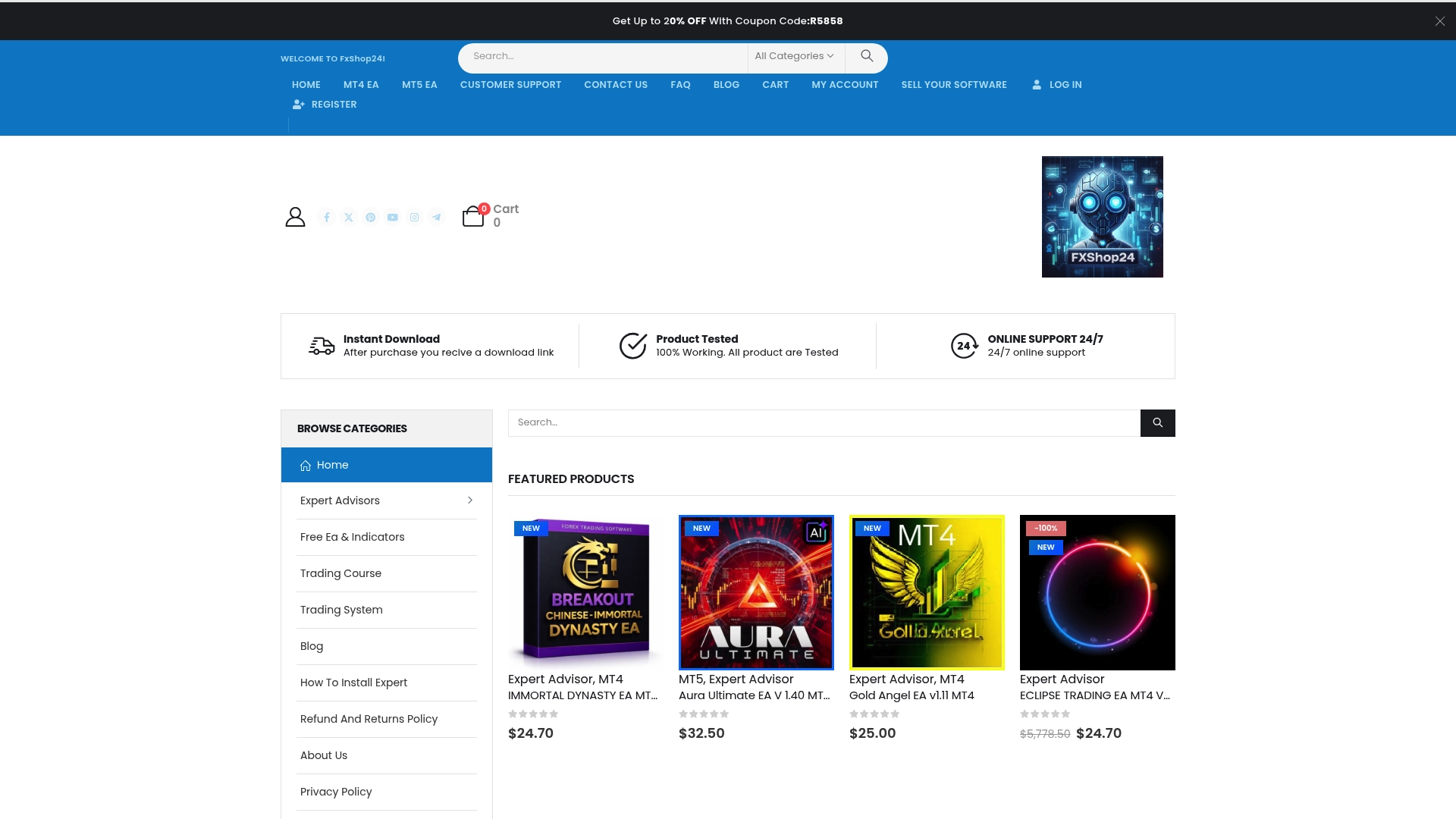
Start with the essential MT4/MT5 tools section to find indicators, utilities, and EAs that match the criteria covered in this guide. If you want to understand which automation approach fits your trading style, the breakdown of automated trading systems covers everything from scalpers to swing systems. For traders ready to step into AI-driven execution, our AI trading bot solutions are built for both MT4 and MT5, with verified live results and prop firm-ready configurations.
Frequently asked questions
How do I verify the real performance of a trading EA?
Always check for Myfxbook or FXBlue live results with six months of verified history and reject any EA that only shows demo or backtest data.
Is it safe to use grid or martingale EAs for gold and forex trading?
Most experts advise against them because grid/martingale strategies carry a high risk of account blowout, particularly during volatile market conditions.
What is the ideal drawdown for a safe trading EA?
Target drawdown below 20% for standard retail accounts; prop firm EAs limit drawdown to 5 to 10% for challenge and funded accounts.
How long should I forward test an EA before going live?
Forward test on demo for a minimum of three months; three months of forward testing captures enough market variation to give you a reliable read.
Can I use the same EA for both forex and gold markets?
Not reliably. Gold EAs require specific optimization for higher volatility and tighter spread conditions that most standard forex EAs are not built to handle.