



14
Apr
Master Wealth Management in Forex: EA Strategies
TL;DR:
- Most retail traders fail due to poor risk management, not strategy quality.
- Automating risk controls with EAs enforces discipline and protects capital effectively.
- A strong wealth management system involves proper position sizing, risk limits, diversification, and AI monitoring.
Most retail forex traders spend months hunting for the perfect entry signal, the ideal indicator combo, or the hottest new EA. Yet 90% still fail not because their strategies are wrong, but because they never build a real wealth management system around those strategies. Wealth management in forex is not about picking winners. It is about controlling losses, sizing positions intelligently, and designing a portfolio that survives the inevitable rough patches. When you pair these principles with automated trading tools like EAs on MT4 or MT5, you get something genuinely powerful: discipline that never sleeps, never panics, and never breaks its own rules.
Table of Contents
- What is wealth management in forex?
- Automated wealth management: How EAs enforce discipline
- The key risk management frameworks for forex EAs
- Portfolio design: Diversification and coordinated protection
- Perspective: Most traders miss the big picture—here’s why risk always beats strategy
- Level up your forex wealth management with the right tools
- Frequently asked questions
Key Takeaways
| Point | Details |
|---|---|
| Disciplined risk protocol | Consistently risk only 0.5-2% per trade to ensure long-term survival in forex. |
| Diversify with EAs | Combine uncorrelated EAs and pairs, using portfolio-level limits for consistent performance. |
| Automate for consistency | Leverage EAs and AI to enforce position sizing, stops, and reviews without emotion or fatigue. |
| Weekly rule review | Audit rule adherence weekly rather than just focusing on profits or losses for true improvement. |
What is wealth management in forex?
Wealth management in forex goes far beyond deciding when to buy or sell a currency pair. It is the ongoing process of protecting your capital, growing it consistently, and making sure no single trade or market event can wipe out your account. Think of it as the operating system running underneath every trade you place.
Simple trade execution asks: “Where do I enter and exit?” Wealth management asks: “How much should I risk, across how many positions, and what happens if everything goes wrong at once?” These are completely different questions, and most retail traders only ever answer the first one.
The four core pillars of forex wealth management are:
- Position sizing: Deciding exactly how many lots to trade based on your account size and acceptable risk per trade
- Risk control: Setting stop-losses, maximum drawdown limits, and daily loss caps that protect your equity
- Portfolio design: Choosing uncorrelated strategies and pairs so losses do not stack on top of each other
- Psychology management: Removing emotional decision-making from the equation, which is where automation becomes essential
As complete risk management systems confirm, core mechanics include position sizing, portfolio risk controls, automated stops, and coordinated limits working together as a unified system, not as separate afterthoughts.
“A trading strategy without a risk framework is just gambling with extra steps.”
This is exactly where AI in forex trading is reshaping the game. AI-powered tools can monitor multiple risk dimensions simultaneously, something no human trader can do consistently across dozens of open positions. Pairing that with structured EA trading strategies gives you a framework that is both intelligent and scalable.
The practical reality is that even a mediocre strategy with excellent wealth management can be profitable over time. A brilliant strategy with no risk framework will eventually blow up. Understanding forex automation workflow helps you see how each layer of protection connects to the next. Wealth management is not a feature you add later. It is the foundation you build everything on top of.
Money management EAs are specifically designed to automate these pillars, enforcing rules that most traders know they should follow but consistently ignore under pressure.
Automated wealth management: How EAs enforce discipline
Knowing the rules of wealth management is easy. Following them when you are down three trades in a row and your emotions are screaming at you to double up is a completely different challenge. This is the core problem that EAs solve.
An EA on MT4 or MT5 enforces your wealth management rules mechanically, every single time, without hesitation. Here is how that plays out in practice:
- Automated stop-loss placement: Every trade gets a stop-loss at the exact level your risk model specifies, calculated from your account balance and the current volatility of the pair.
- Dynamic position sizing: The EA calculates lot size automatically so that each trade risks the same percentage of your equity, not a fixed lot that becomes proportionally larger as your account shrinks.
- Take-profit coordination: Profit targets are set consistently, preventing you from closing winners too early out of fear or holding them too long out of greed.
- Daily and weekly loss caps: If the EA hits a predefined drawdown limit for the day, it stops trading entirely, protecting you from catastrophic losing streaks.
- Trade log and review triggers: Many advanced EAs generate performance data that makes weekly rule reviews straightforward and data-driven.
The psychological edge here is enormous. EAs counter the tendency to hold losing trades far longer than winning ones, a bias that research shows causes traders to hold losers 2.11 times longer than winners on average. That single behavioral flaw destroys more accounts than any bad strategy ever could.

Pro Tip: Before deploying any EA for live wealth management, backtest it across at least three years of historical data and forward-test it on a demo account for a minimum of 60 days. Overfitting to past data is a real risk, and live market conditions always introduce surprises that backtests cannot fully replicate.
For traders new to this space, mastering MT4 EAs is the logical starting point, while understanding the broader expert advisor benefits helps you set realistic expectations. The risk management strategies for algorithmic trading framework reinforces why systematic rule adherence is non-negotiable for long-term survival.
The key risk management frameworks for forex EAs
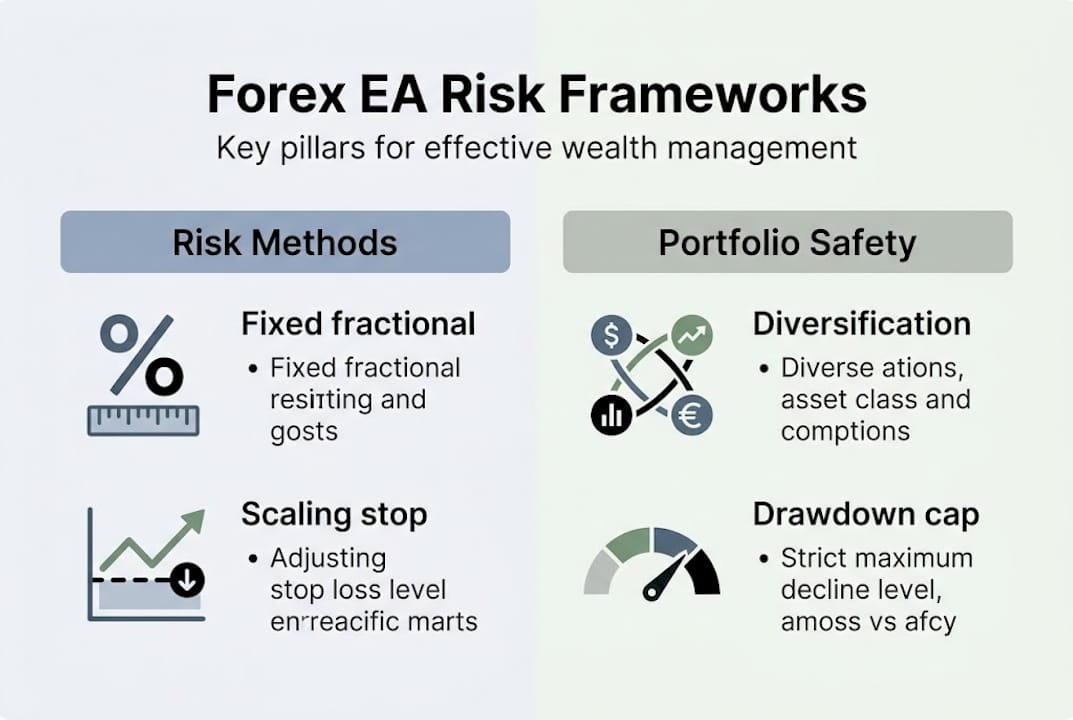
Discipline without the right framework is just rigid rule-following that may not actually protect you. The methodology behind your position sizing and risk controls matters enormously. Here is a practical comparison of the main approaches used in EA-based wealth management.
| Framework | How it works | Best for | Key risk |
|---|---|---|---|
| Fixed fractional | Risk a set % per trade (e.g., 1%) | Consistent compounding | Drawdown amplifies in losing streaks |
| ATR-based sizing | Lot size adjusts to current volatility | Volatile pairs like XAUUSD | Requires accurate ATR calibration |
| Kelly Criterion | Sizes bets based on win rate and reward ratio | High-confidence systems | Overestimates edge; use half-Kelly |
| Open risk cap | Limits total open risk across all positions | Multi-EA portfolios | Requires portfolio-level monitoring |
| Drawdown ladder | Reduces position size as drawdown deepens | Capital preservation focus | May miss recovery opportunities |
Methodologies for EAs include fixed fractional, ATR-based sizing, Kelly Criterion, open risk caps, and drawdown ladders, each serving a distinct purpose depending on your strategy and risk tolerance.
A drawdown ladder in action looks like this: at 5% drawdown, reduce position size by 25%. At 10%, reduce by 50%. At 15%, stop trading entirely and review. This graduated response prevents a bad week from becoming a catastrophic month.
- Fixed fractional is the safest starting point for most retail traders
- ATR-based sizing is essential when trading gold or high-volatility pairs
- Kelly Criterion should only be used at half-Kelly or less to avoid ruin risk
- Drawdown ladders are non-negotiable for any EA running on a prop firm account
For practical implementation, backtesting your MT4 EA and backtesting on MT5 are essential steps before committing real capital to any of these frameworks. Dukascopy’s overview of forex risk management methods provides additional context on combining these approaches effectively.
Portfolio design: Diversification and coordinated protection
Running a single EA on a single pair is not wealth management. It is a single bet, repeated over and over. Real wealth management at the portfolio level means designing a system where individual failures do not cascade into account-level disasters.
Here is how to build a resilient EA portfolio step by step:
- Select uncorrelated strategies: Pair a trend-following EA on EURUSD with a mean-reversion EA on GBPJPY. Their losses should not coincide.
- Enforce a portfolio open risk cap: Keep total open risk across all active trades between 1.5% and 2% of your account at any given time.
- Apply correlation filters: Never run two EAs that both go long on USD-correlated pairs simultaneously. Correlation stacking multiplies your real risk far beyond what individual position sizing suggests.
- Use news filters: Major economic releases like Non-Farm Payrolls or central bank decisions can spike volatility to levels that invalidate normal stop-loss placements. Good EAs pause trading automatically around these events.
- Implement AI monitoring: Real-time AI agents can track exposure, correlation, and market events across your entire portfolio simultaneously, catching risk concentrations before they become problems.
Portfolio open risk caps at 1.5 to 2%, combined with no correlation stacking and active news filters, represent the current best practice for AI-assisted forex risk management in 2026.
Pro Tip: Stop reviewing your P&L trade by trade. Instead, monitor your total portfolio risk exposure in real time. A single trade that looks fine in isolation can be catastrophic when it correlates with three other open positions you forgot about.
The trading automation trends for 2026 show that AI-assisted portfolio monitoring is becoming standard practice, not a luxury. Combining this with algorithmic risk controls gives your portfolio a level of protection that manual oversight simply cannot match at scale.
Perspective: Most traders miss the big picture—here’s why risk always beats strategy
Here is something most trading educators will not tell you directly: the traders who consistently grow their accounts over years are not the ones with the best entry signals. They are the ones who are obsessed with not losing.
We have seen this pattern repeatedly. A trader spends six months optimizing an EA’s entry parameters, chasing a higher win rate, then blows 30% of their account in a single week because they had no drawdown ladder and no portfolio cap. The strategy was fine. The risk architecture was nonexistent.
Professional traders do not measure success by win rate. They measure it by risk-adjusted return, maximum drawdown, and consistency over rolling 90-day periods. That mental shift changes everything about how you build and manage your trading systems.
The actionable takeaway is simple: replace your weekly P&L review with a weekly risk review. Ask yourself whether your position sizing held up, whether your correlation exposure was within limits, and whether your EAs followed their rules. AI-driven risk management tools make this review faster and more accurate than any spreadsheet ever could. Strategy obsession is a trap. Risk obsession is the path forward.
Level up your forex wealth management with the right tools
You now have a clear picture of what separates traders who grow their accounts from those who repeatedly rebuild from zero. The frameworks are proven. The automation tools exist. The missing piece is usually access to the right EAs and systems that actually implement these principles out of the box.
At FxShop24, you will find a curated selection of MT4 EA downloads and forex trading tools built specifically for disciplined, risk-first trading. Whether you need a standalone money management EA or a full automated trading system with built-in drawdown protection, the platform offers instant downloads, lifetime updates, and prop firm-ready configurations. Stop investing in new strategies before you have locked down your risk controls.
Frequently asked questions
What is the best risk per trade for EA-based forex wealth management?
Most experts recommend risking 0.5% to 2% of your account per trade when using EAs, with lower percentages preferred during high-volatility conditions or drawdown periods.
How do I diversify my EA portfolio to reduce risk?
Use uncorrelated strategies and pairs across your portfolio, enforce portfolio-wide risk caps, and actively monitor correlation exposure to prevent similar risks from stacking.
Why do most retail forex traders lose money even with EAs?
90% of retail failures trace back to poor risk management, including holding losing trades too long and ignoring systematic limits, problems that EAs can solve only when configured with proper risk parameters from the start.
How does AI improve forex risk management versus traditional EAs?
AI-driven agents provide real-time, multi-dimensional monitoring across exposure, correlation, and market events, adapting to changing conditions far faster than traditional rule-based EAs operating in isolation.
Recommended
- Most Profitable Expert Advisor: How To Choose The Right EA For Your Strategy | FxShop24 Marketplace
- Scalping EA Secrets Revealed: What Top MT4 Traders Don’t Want You To Know | FxShop24 Marketplace
- Gold EA Secrets Revealed: What Experts Don’t Want You To Know | FxShop24 Marketplace
- Master Forex Gold Trading Workflow For Automated Success
- Real Estate Investment Strategies Shaping Legacy and Yield