
21
Oct
Scalping EA Secrets Revealed: What Top MT4 Traders Don't Want You to Know
Ever wonder why some traders quietly rake in profits with their scalping EAs while others blow accounts faster than they can fund them? Here's the uncomfortable truth: the profitable ones aren't using magic settings or secret indicators. They're just following principles that the forex education industry conveniently glosses over.
Let's pull back the curtain on what really separates the winners from the losers in the scalping EA game.
The Dirty Truth About EA Marketing vs Reality
Walk into any Telegram group or YouTube comment section, and you'll hear the same fairy tales. "My EA made 500% in a month!" Screenshots of demo accounts. Backtests showing perfect equity curves. What they don't show? The three blown live accounts that came before the cherry-picked winner.
Professional scalping EA users know something the marketing materials won't tell you: success isn't about the EA's entry signals: it's about everything else.
The real edge comes from understanding exit management, risk parameters, and market timing that most traders completely ignore. While beginners obsess over which moving average crossover to use, profitable traders focus on when NOT to trade and how to exit positions without giving back profits.

Exit Management: The $10,000 Secret
Here's what separates amateur EA users from professionals: exit strategy. Entry timing represents maybe 30% of your success. The other 70%? How and when you get out.
Most scalping EAs come with basic trailing stops, but professional traders modify these extensively. Instead of using aggressive trailing that moves your stop loss immediately when price advances, they implement candle-based trailing systems that follow previous candle lows and highs with customizable lookback periods.
The smart money also uses moving average trailing, which provides more breathing room than candle-based methods by tracking a fast MA. This prevents premature exits during normal market noise while still protecting profits during genuine reversals.
But here's the kicker: they never rely on the EA's default exit settings. Ever.
The Settings That Actually Matter (Hint: It's Not Your Indicators)
Forget about optimizing your RSI periods or tweaking Bollinger Band deviations. The settings that determine your success or failure are the ones nobody talks about in those flashy sales pages.
Lot Size Management: Professional EA users never use fixed lot sizes. They use dynamic position sizing based on account equity, recent drawdown, and volatility measurements. A 0.01 lot might be perfect during calm markets, but it becomes suicide during NFP releases.
Time Filters: This is huge. Successful traders know their EAs inside and out, including exactly when they perform poorly. London open chaos? EA off. Friday afternoon thin liquidity? EA off. Major news events? You better believe the EA is off.
Spread Filters: Here's something that'll save you thousands: spread filters that automatically shut down trading when spreads widen beyond normal levels. Most blown accounts happen during news events when spreads spike to 5-10 pips, making scalping impossible.

The Social Media Hype Machine
Let's talk about what you see on social media versus reality. Those Instagram posts showing massive profits? Those Telegram channels with "exclusive" EAs making 50% per month? It's performance theater.
Real profitable EA users keep quiet for good reasons. First, they don't want to oversaturate their edge by sharing it with thousands of traders. Second, they understand that any edge in the market is temporary: the more people using the same strategy, the faster it stops working.
The traders posting their "amazing results" are usually either selling something, using demo accounts, or showing you the 1% of trades that worked while hiding the 99% that didn't.
2025 Market Realities: What's Changed
The scalping game has evolved dramatically. Market makers have gotten smarter, spreads have tightened in some areas while widening in others, and regulatory changes have shifted how brokers handle high-frequency trading.
Prop Firm Integration: The biggest change is prop firm compatibility. Modern scalping EAs need built-in drawdown monitoring, automatic trading halts when approaching risk limits, and compliance with minimum stop loss distances. Many older EAs simply can't pass prop firm challenges because they violate basic risk rules.
AI and Machine Learning: While everyone's talking about AI trading bots, the reality is more nuanced. The most successful scalping strategies now incorporate machine learning for market condition detection: knowing when to trade versus when to stay flat.
Crypto Integration: Smart EA users are running multi-asset strategies. Bitcoin and major crypto pairs offer volatility opportunities that traditional forex pairs lack, but they require different risk parameters and timing.
According to the Bank for International Settlements, algorithmic trading now accounts for over 75% of forex market volume, making traditional scalping strategies less effective without proper adaptation.
Risk Management: The Boring Stuff That Saves Accounts
Here's what profitable traders obsess over while beginners focus on profit targets: drawdown management and position correlation.
Maximum Daily Loss Limits: Pro traders set hard daily loss limits, usually 1-2% of account balance. When hit, all EAs shut down until the next trading day. No exceptions, no "one more trade" thinking.
Portfolio Heat Management: Running multiple EAs? They calculate total portfolio heat: the maximum possible loss if every open position hits its stop loss simultaneously. This number never exceeds 5-6% of account balance.
Correlation Analysis: Professional EA users avoid running multiple systems that trade correlated pairs during the same time periods. EUR/USD and GBP/USD scalping EAs running simultaneously? That's double exposure disguised as diversification.

How to Spot Quality EAs vs Marketing Hype
Red Flags:
- Backtests showing perfectly smooth equity curves (markets aren't smooth)
- No mention of maximum drawdown periods
- Promises of specific profit percentages
- Lack of forward testing results
- No clear explanation of the trading strategy
Quality Indicators:
- Detailed risk management features
- Multiple exit strategies
- Market condition filters
- Prop firm compatibility modes
- Transparent drawdown statistics
- Live trading results over multiple market conditions
The best EAs come with extensive documentation explaining not just how to install them, but when NOT to use them.
FXShop24's Professional Approach
At FXShop24, we've tested hundreds of scalping EAs across various market conditions, and our top performers share common characteristics that separate them from the crowd.
Our verified scalping systems include comprehensive risk management, multiple trailing stop options, and built-in prop firm compliance features. More importantly, they come with realistic performance expectations and clear guidelines on optimal market conditions.
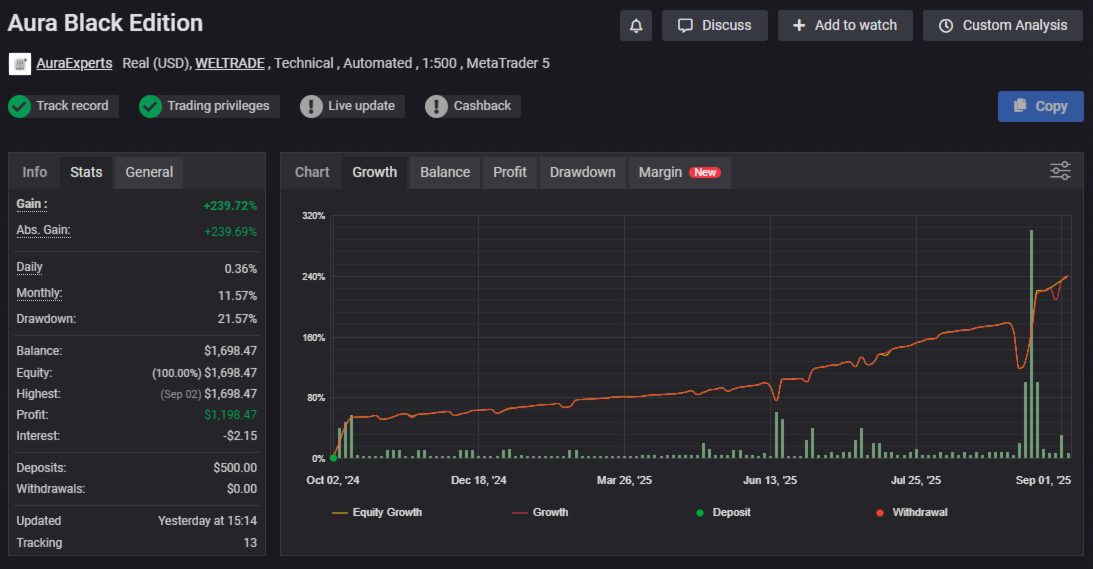
The Aura Black Edition EA, for example, shows realistic drawdown periods alongside its profit generation, giving traders a complete picture of what to expect.
The Bottom Line
Successful scalping EA trading isn't about finding the holy grail system that never loses. It's about understanding risk management, knowing when to trade, and having realistic expectations about drawdown periods.
The traders making consistent profits aren't using secret strategies: they're using boring, disciplined approaches to risk management that most people find too tedious to implement.
Want to join the profitable minority? Stop chasing the latest "breakthrough" EA and start focusing on the fundamentals that actually determine long-term success. Your account balance will thank you.
The real secret isn't in the EA's code: it's in how you manage the psychological and financial aspects of automated trading that everyone else ignores.