

22
Feb
6 Examples of Automated Trading Strategies for MT4 and MT5
Finding reliable automated trading strategies for MetaTrader can feel overwhelming, especially with so many methods claiming consistent profits. Choosing the wrong system often leads to unnecessary losses and missed opportunities. The good news is, there are proven approaches that adapt to changing market conditions and deliver measurable, repeatable gains. This guide brings you insights backed by current research, highlighting practical methods that outperform outdated strategies, including dynamic momentum learning and advanced execution algorithms. Get ready to discover actionable techniques for trend following, grid trading, scalping, risk management, arbitrage, and AI-powered EAs. By the end, you’ll know exactly how to build smarter, more resilient trading systems for both MT4 and MT5 platforms.
Table of Contents
- Trend Following Systems For Consistent Profits
- Grid Trading Strategies To Capture Price Swings
- Scalping Methods For Fast Forex Gains
- Martingale Techniques For Risk Management
- Arbitrage Approaches To Exploit Market Inefficiencies
- AI-Powered EAs For Adaptive Trading Decisions
Key Insights
| Key Message | Explanation |
|---|---|
| 1. Utilize Trend Following for Consistent Profits | Automated systems can capitalize on market momentum by following trends, which often persist longer than traders expect. |
| 2. Simplify with Grid Trading Strategies | Setting up buy and sell orders at regular intervals can capture small price swings without manual intervention, promoting consistency through automation. |
| 3. Implement Scalping for Quick Gains | Automating small trades across tight timeframes allows for frequent profits, making it essential to use an efficient EA for execution without delay. |
| 4. Be Cautious with Martingale Techniques | While appealing, increasing stakes after losses can lead to catastrophic outcomes without strict controls and effective risk management strategies. |
| 5. Explore AI-Powered EAs for Adaptability | AI-driven systems learn and adjust strategies in real-time based on market conditions, providing a significant edge over static trading systems. |
1. Trend Following Systems for Consistent Profits
Trend following systems are automated strategies that identify and profit from sustained price movements in either direction. These systems eliminate emotion and capitalize on market momentum by holding positions as long as the trend persists.
Unlike countertrend strategies that fight the market, trend followers ride existing waves. This approach works because markets trend more often than many traders realize, and trends can persist for weeks, months, or longer.
Why Trend Following Works on MT4 and MT5
MetaTrader platforms excel at executing trend-following logic because they handle continuous monitoring and position management automatically. Your Expert Advisor (EA) scans price action 24/5 without fatigue or bias.
Research shows that dynamic momentum learning significantly improves trend-following performance by adapting to changing market conditions. Modern systems that adjust quickly to regime shifts outperform static momentum strategies, especially during volatile periods.
How Trend Following Generates Consistent Profits
Consistent profits come from compounding small wins over time rather than hunting home-run trades. Here’s what makes this work:
- Risk management: Strict stop losses limit losses while trends run profitable
- Position sizing: Fixed, percentage-based lot sizes keep risk constant across all trades
- Duration advantage: Holding winners longer captures more pips than scalping allows
- Reduced decision fatigue: Automation eliminates the urge to exit winning trades early
Trend followers profit not from predicting where markets go, but from systematically following where markets actually go.
Many successful prop traders use trend-following systems because they deliver measurable, repeatable results. The ST-Scalper V3.0 trend-following system for MT5 demonstrates how advanced indicators enhance trend detection accuracy on the MetaTrader 5 platform.
Building Your Own Trend Following Strategy
You don’t need complex mathematics. Most profitable trend systems use simple components:
- Identify trend direction (moving averages, higher highs/lows)
- Enter on pullbacks within the trend
- Exit on trend reversal signals
- Always use stop losses below recent swing lows
Backtesting reveals whether your specific entry and exit rules generate positive results on historical data. This removes guesswork and proves whether your logic works.
Pro tip: Test your trend-following EA on multiple currency pairs across different timeframes before running live—systems that work on EURUSD may fail on GBPUSD without adjustment.
2. Grid Trading Strategies to Capture Price Swings
Grid trading places buy and sell orders at regular intervals above and below a central price level. This strategy profits from price oscillations within a defined range, capturing small moves repeatedly rather than waiting for large trending moves.
Think of it as setting multiple nets to catch fish swimming in both directions. Every time price bounces between your grid levels, you lock in profits automatically.
How Grid Trading Works in Practice
Your EA divides a price range into equal intervals and places orders systematically. When price touches a buy level, your position increases. When it reaches a sell level, you close at a profit and repeat.
The beauty lies in automating repetitive execution. Instead of manually watching price and guessing when to trade, your system handles thousands of micro-transactions that compound into substantial gains.
Research on algorithmic execution in FX markets shows that systematic order placement strategies effectively capture price fluctuations across different market conditions. Grid systems work because they exploit the natural tendency of prices to oscillate rather than moving in straight lines.
Why Grid Trading Suits Both MT4 and MT5
MetaTrader’s order management capabilities make grid trading efficient and scalable. Your EA can monitor dozens of open positions simultaneously while managing partial closures and adjusting grid spacing as needed.
Grid strategies work across timeframes and currency pairs, making them adaptable to various market conditions. You can tighten grids during low volatility or widen them when swings expand.
Key advantages for automated execution include:
- Defined risk: Know your maximum loss before entering
- Predictable payouts: Each closed grid level generates fixed profit
- Less emotional: Removes the temptation to overtrade or chase trends
- 24/5 consistency: Your EA works while you sleep
Grid trading succeeds by treating price swings as income-generating events rather than unpredictable chaos.
When you compare different automated strategies, grid, DCA, and arbitrage bots each solve different problems. Grid systems specifically excel when markets are ranging or oscillating within support and resistance zones.
Setting Up Your Grid Parameters
Three variables determine your success: grid spacing, position size, and profit targets. Wide spacing works best in volatile markets. Narrow spacing suits quiet, range-bound periods.
Your profit per grid level should be 10-20 pips minimum to cover spreads and slippage. Position size must allow your account to survive if price moves against your entire grid without recovering.
Pro tip: Start with a narrow price range on your first grid EA to observe how it behaves in live conditions, then gradually expand your range once you trust the system’s logic.
3. Scalping Methods for Fast Forex Gains
Scalping targets small price movements over short timeframes, typically holding positions for seconds to minutes. Your goal is capturing 2-10 pips per trade repeatedly throughout the day, turning volume into profit.
This strategy works because large price swings are made up of countless tiny moves. Instead of waiting for the big move, scalpers profit from the friction between bid and ask prices.
Why Scalping Works in Automated Form
Manual scalping requires constant screen watching and lightning-fast reflexes. Automation removes the human delay that costs scalpers money during execution. Your EA enters and exits at optimal prices without hesitation.
Scalping thrives on high-frequency execution and tight risk management. A profitable scalping EA might make 50 trades daily with 60% win rate, generating consistent income from small, repeatable setups.
Research shows that successful scalping depends on breakout and pullback techniques combined with volume filters. Using these proven methods prevents overtrading and reduces the risk of catching false breakouts that wipe out multiple winning trades.
The Scalping Setup on MT4 and MT5
Scalping requires precise entry timing and automatic stop loss placement. Your EA monitors tight price ranges and executes when conditions align perfectly.
Key elements of a scalping system include:
- Tight stop losses: 10-20 pips maximum to limit risk per trade
- Quick exits: Take profit levels hit within minutes, not hours
- Spread awareness: Only trade major pairs with tight spreads
- Volatility filters: Skip choppy periods when scalping fails
- Position sizing: Never risk more than 1-2% per trade
Scalping succeeds through volume and speed, not size. One hundred small wins beat waiting for one big winner.
Understanding scalping EA secrets helps you avoid common pitfalls like overoptimization and curve-fitting. When evaluating scalping systems, focus on trade frequency, average win size, and maximum consecutive losses rather than total return percentage.
Implementing Scalping in Your Trading Plan
Start with a single currency pair and tight timeframe like the 5-minute chart. Allow your EA to develop a track record of at least 100 trades before scaling positions.
Monitor slippage carefully. If your EA expects 5-pip profits but execution costs 6 pips, the system loses money regardless of strategy accuracy. This is why using a reliable broker matters for scalping.
Pro tip: Test your scalping EA during high liquidity sessions (London overlap and New York morning) where spreads are tightest, then gradually test other times to identify which periods remain profitable.
4. Martingale Techniques for Risk Management
Martingale systems adjust position size after losses, increasing your stake to recover losses and lock in profit. The concept sounds appealing until you understand the mathematics behind sustained losing streaks.
While martingale methods can recover losses theoretically, they demand discipline, capital reserves, and realistic expectations about what they actually accomplish.
Understanding Martingale in Forex Automation
A basic martingale EA doubles position size after each loss, betting that the next trade wins and recovers everything. If your first trade loses 10 pips at 0.1 lots, your second trade uses 0.2 lots, and the third uses 0.4 lots.
The danger emerges during extended losing streaks. Five consecutive losses means your sixth trade requires 3.2 lots, risking massive drawdown if that trade also fails.
Martingale methods in financial modeling emphasize the importance of proper portfolio structure and risk constraints. Modern applications recognize that martingale systems must incorporate strict safeguards to avoid catastrophic account damage.
Why Martingale Fails Without Proper Guardrails
Martingale assumes winning probability remains constant and capital never runs out. Real trading violates both assumptions regularly. Market regimes change, spreads widen during volatility, and accounts have finite size.
A sequence of five losses in a row happens more often than traders expect. During this sequence, your account equity swings wildly between profits and devastating losses.
Problems with uncontrolled martingale include:
- Exponential lot growth: Doubles quickly exceed account capacity
- Margin calls: Brokers close positions when equity drops too far
- Psychological strain: Watching positions grow creates emotional pressure
- Drawdown catastrophe: One bad streak destroys months of gains
Martingale systems work perfectly until they fail spectacularly, often when you least expect it.
Implementing Controlled Martingale Safely
Modified martingale limits lot increases and resets after wins. Instead of doubling every loss, increase by 50% or 25%. Set a maximum martingale level (never exceed 5 steps).
This reduces profits per trade but keeps your account alive through inevitable losing streaks. You sacrifice explosive upside for consistent survival.
Safety parameters for your EA should include:
- Maximum consecutive losses allowed (typically 3-5)
- Lot size cap preventing over-leverage
- Daily loss limit stopping trading after hitting it
- Reset trigger returning to base lot size after win
This controlled approach transforms martingale from a risky gamble into a reasonable risk management tool that traders actually use on prop firm challenges.
Pro tip: Test your modified martingale EA with very tight loss limits first, ensuring it survives 100 consecutive trades on demo before considering any live capital.
5. Arbitrage Approaches to Exploit Market Inefficiencies
Arbitrage captures risk-free profits by exploiting price differences across markets or currency pairs simultaneously. When EURUSD trades at 1.0950 on one broker and 1.0952 on another, arbitrage locks in the spread instantly.
This strategy works because market inefficiencies exist briefly before algorithms eliminate them. Your EA must detect and execute these opportunities faster than competitors.
Types of Forex Arbitrage
Triangular arbitrage involves three currency pairs where pricing misalignment creates profit. For example, if EUR to USD gives one rate but EUR to GBP to USD yields a different value, the difference is arbitrageable.
Statistical arbitrage identifies correlated pairs trading at unusual distances. When EURUSD and GBPUSD diverge beyond historical norms, mean reversion bets that they reconverge.
Research shows that arbitrage opportunities in FX markets decline rapidly due to algorithmic execution. Modern traders face millisecond windows where mispricings exist before electronic trading eliminates them.
Why Automated Arbitrage Suits MT4 and MT5
Your EA monitors multiple price feeds simultaneously, something impossible manually. When inefficiencies appear, automation executes both sides of the trade before human traders even notice.
Speed determines arbitrage success. Neural network approaches now detect arbitrage patterns in high-dimensional market data automatically. Your EA can process thousands of price comparisons per second.
Advantages of automated arbitrage include:
- Risk-free execution: Both sides locked simultaneously
- Emotion eliminated: System executes when conditions align
- Speed advantage: Faster than manual detection and entry
- Consistency: Same logic applies to every opportunity
Arbitrage profits shrink daily as algorithms get faster, but persistent inefficiencies still reward those with superior detection and execution.
Implementing Arbitrage on Your Platform
Start with triangular arbitrage using three currency pairs on the same broker. Your EA calculates the round-trip conversion rate and compares it to direct rates.
Key steps for your strategy include:
- Monitor three pairs simultaneously (EUR/USD, GBP/USD, EUR/GBP)
- Calculate theoretical cross-rate and compare to actual price
- Enter all three trades instantly when spread exceeds transaction costs
- Close all positions when prices normalize
Profit margins run 5-20 pips typically, requiring precise execution. Transaction costs (spreads, commissions, slippage) must stay below the captured spread or trades lose money.
Smaller opportunities demand faster execution. Larger, slower inefficiencies are easier to exploit but disappear quickly as other algorithms spot them.
Pro tip: Test arbitrage EAs during Asian and European market overlaps when price feeds lag slightly, creating temporary inefficiencies that faster execution can capture profitably.
6. AI-Powered EAs for Adaptive Trading Decisions
AI-powered Expert Advisors learn from market data and adjust trading logic in real-time based on changing conditions. Unlike static systems, adaptive EAs evolve their strategies as market regimes shift, capturing opportunities traditional systems miss.
This represents the frontier of automated trading. Your EA doesn’t just execute rules—it improves them continuously.
How AI Learns to Trade Better
Machine learning models process vast price histories to identify patterns humans cannot detect. Reinforcement learning allows EAs to experiment with different trading approaches and reward strategies that generate profits.
AI EAs synthesize information from multiple sources simultaneously. While traditional EAs follow one or two indicators, AI frameworks integrate heterogeneous market data into executable trading decisions dynamically.
The advantage becomes clear during market transitions. When volatility spikes or correlations shift, your AI EA adjusts position sizing and entry criteria automatically. Static systems often fail precisely when adaptability matters most.
Adaptive Decision-Making on MT4 and MT5
Adaptive EAs monitor market conditions constantly and modify behavior based on what’s working. If trend-following profit during bullish periods but fails in ranges, your AI recognizes this shift and switches strategies accordingly.
This self-improvement capability separates AI EAs from manual backtesting systems. Your EA learns from live trading results, not just historical data.
Key features of adaptive AI trading include:
- Real-time adjustment: Changes parameters without your intervention
- Regime detection: Identifies when market conditions shift
- Strategy switching: Activates different logic for different environments
- Performance optimization: Continuously improves based on feedback
- Risk awareness: Adjusts risk when drawdown increases
AI-powered EAs don’t predict the future—they adapt to what’s happening now better than humans ever could.
Research shows that AI speculators optimize trades dynamically in ways that sustain superior returns across market cycles. This adaptive capacity gives AI EAs a genuine edge over fixed-rule systems.
Implementing AI EAs Safely
Start with proven AI EAs on demo accounts to observe their adaptation behavior. Watch how they adjust position sizing and strategy parameters under different market conditions.
Implementation steps include:
- Test on demo for at least 100 trades across varied market environments
- Monitor the AI’s adaptation decisions to ensure they make sense
- Set maximum risk limits the AI cannot exceed
- Use position sizing caps preventing oversized bets
- Maintain manual override capabilities if markets behave unexpectedly
The most important safeguard is understanding that AI improves gradually. Don’t expect revolutionary results immediately. Allow 50-100 trades for the system to learn your market’s patterns.
Pro tip: Start with AI EAs designed for major currency pairs where machine learning has abundant historical data to learn from, then expand to exotic pairs once the system demonstrates consistent adaptation.
Below is a comprehensive table summarizing the strategies and approaches discussed in the article focusing on automated trading systems and techniques.
| Strategy/Approach | Description | Benefits/Outcomes |
|---|---|---|
| Trend Following Systems | Utilize algorithms to track and invest in ongoing market trends. | Generates consistent profits by holding positions during trends, minimizing emotion-based decisions. |
| Grid Trading Strategies | Based on systematic order placement around a central price level to profit from market oscillations. | Automates profit acquisition from price swings within defined ranges, suitable for ranging markets. |
| Scalping Methods | Focus on capturing small price movements over short timeframes frequently during a trading session. | Provides potential for frequent gains with minimized risk per trade due to short holding durations. |
| Martingale Techniques | Adjust position sizes after losses to potentially recover and gain profits gradually. | Custom safeguards allow controlled use of the method, reducing risks typically associated with martingales. |
| Arbitrage Approaches | Exploit price differences across markets or currency pairs for risk-free short-term profits. | Enables immediate gains from temporary inefficiencies in market pricing. |
| AI-Powered Expert Advisors (EAs) | Adaptive systems using machine learning to adjust trading strategies dynamically based on changing market conditions. | Enhances the robustness and effectiveness of trading systems during volatile or varying market regimes. |
Unlock the Power of Automated Trading Strategies Today
If you are eager to overcome the challenges of emotional decision-making and inconsistent profit results described in “6 Examples of Automated Trading Strategies for MT4 and MT5” now is the time to equip yourself with proven tools designed for real market conditions. Whether you want to ride trends, scalp quick gains, or harness AI adaptability, the key lies in deploying expert advisors that manage risk and execute flawlessly.
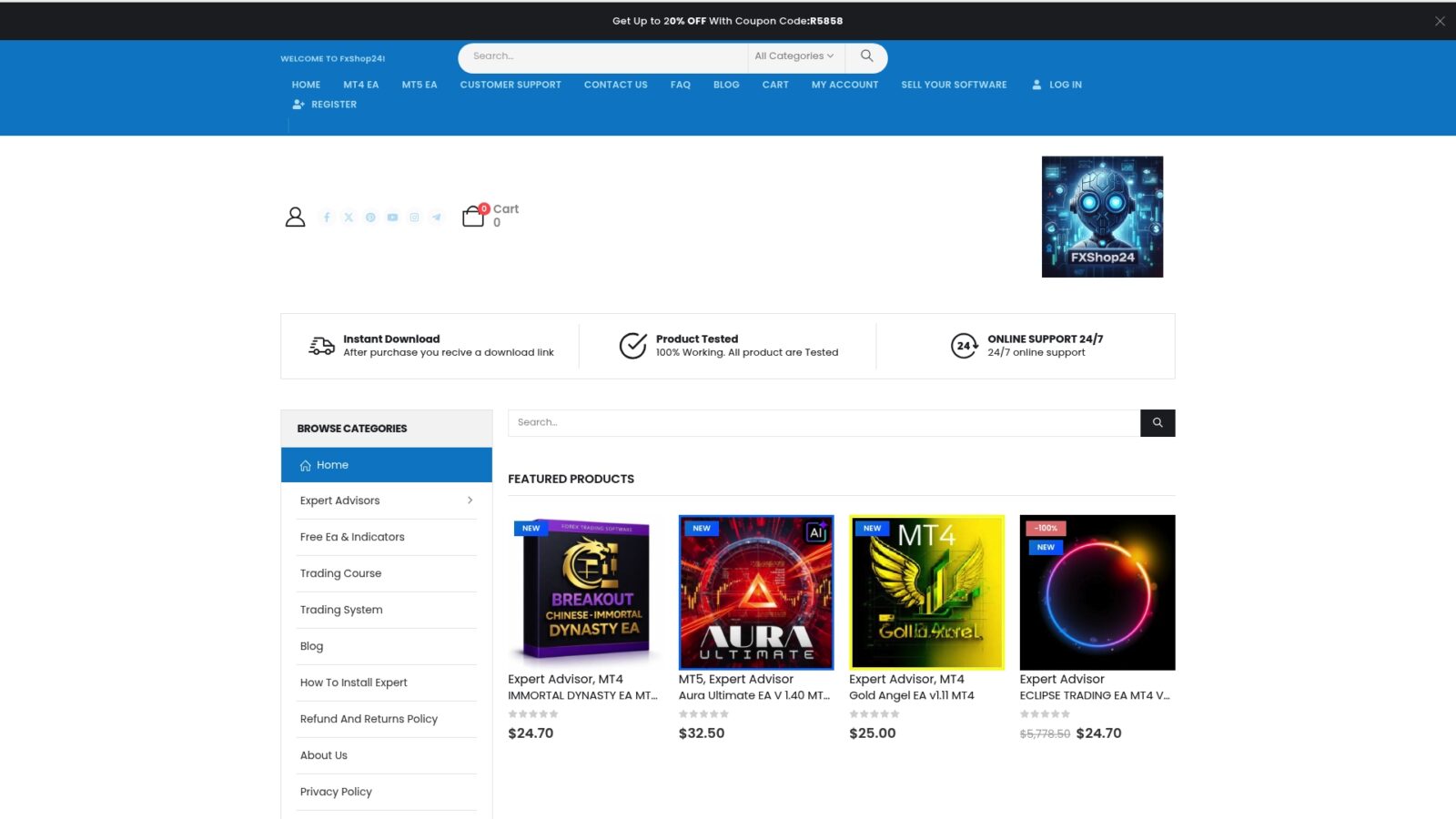
Explore FxShop24 where you will find a carefully curated collection of automated trading systems and AI-powered EAs optimized for MetaTrader 4 and MetaTrader 5. Benefit from products that come with lifetime updates, unlimited licenses, and prop firm compatibility to confidently take your forex and gold trading to the next level. Don’t wait until market volatility eats your profits. Visit FxShop24 now and start harnessing the potential of reliable, automated trading strategies that adapt, protect, and profit.
Frequently Asked Questions
What are some types of automated trading strategies for MT4 and MT5?
Automated trading strategies for MT4 and MT5 include Trend Following, Grid Trading, Scalping, Martingale Techniques, Arbitrage, and AI-Powered Expert Advisors. Each strategy caters to different trading goals and risk tolerance levels.
How can I build my own automated trading strategy for MT4 or MT5?
To build your own automated trading strategy, start by identifying the trend direction, defining your entry and exit rules, and implementing risk management practices like stop losses. Backtest your strategy using historical data to evaluate its effectiveness before trading it live.
What is the importance of backtesting an automated trading strategy?
Backtesting an automated trading strategy is crucial as it allows you to assess its performance using historical market data. This process helps refine your strategy and reduces uncertainty, ensuring that your approach is based on real-world performance results.
How do I set up parameters for Grid Trading in MT4 or MT5?
To set up Grid Trading parameters, determine your grid spacing, position size, and profit targets. For example, consider using 10-20 pips as the minimum profit per grid level to cover spreads, ensuring your trades remain profitable.
What are the risks associated with using a Martingale technique in automated trading?
The Martingale technique can pose significant risks, such as exponential lot growth that could exceed your account capacity and lead to margin calls. Implement strict safeguards like maximum consecutive losses and daily loss limits to mitigate potential risks of this strategy.
How does an AI-Powered Expert Advisor improve its trading decisions?
An AI-Powered Expert Advisor improves its trading decisions by learning from market data and adjusting its strategies in real-time based on changing conditions. Start with proven AI EAs on demo accounts to observe how they adapt to various market environments.