


4
May
Why Use Premium Trading Systems? Benefits for Forex and Gold
TL;DR:
- Premium trading systems are professionally built, continuously updated automation tools designed to meet strict prop firm evaluation rules and provide verifiable performance records. They offer advanced risk management, compliance features, and dedicated support, unlike basic free EAs, which often lack these critical functionalities and flexibility. Using such systems properly focuses on risk control and discipline enforcement, increasing the likelihood of passing evaluations and maintaining funded accounts.
Not every automated trading system is built to handle the real demands of forex and gold markets. Many traders discover this the hard way, loading up a free expert advisor (EA) only to blow through a prop firm evaluation because of a single rule violation. Prop firm automation works best when the system is configured to comply with strict evaluation rules including daily loss caps and drawdown limits, and to avoid prohibited strategies entirely. This guide breaks down exactly what premium trading systems offer, why they matter for prop traders and serious retail traders, and how to choose one that actually aligns with your goals.
Table of Contents
- What are premium trading systems?
- Key advantages over free trading systems
- Why compliance matters: The prop firm perspective
- Advanced risk management and support: Premium system essentials
- What most traders get wrong about premium systems
- Ready to upgrade? Where to find premium trading systems
- Frequently asked questions
Key Takeaways
| Point | Details |
|---|---|
| Premium means compliance | Premium trading systems are designed to meet strict prop firm and regulatory requirements, minimizing rule violations. |
| Advanced risk controls | Superior risk management features in premium systems reduce major trading losses and increase long-term consistency. |
| Better support and updates | Ongoing technical support and frequent updates keep premium EAs reliable and adapt them to market changes. |
| Not a magic bullet | Premium systems require proper use and configuration—success depends on discipline, not just software. |
What are premium trading systems?
A premium trading system is not just an expensive version of a free tool. It is a professionally built, continuously updated automated solution with verifiable performance records, built-in risk controls, and dedicated customer support. In the MetaTrader ecosystem, these systems typically take the form of expert advisors running on MT4 or MT5, and they are designed to handle the complexity of live market conditions rather than just produce impressive backtest results.
The contrast with free or basic EAs is significant. Free EAs provide limited risk management, limited support, and inconsistent update schedules. Premium systems, on the other hand, come with advanced features that align with what serious traders and prop firms actually need. Understanding what those expert advisor features look like in practice is the first step toward making a smart investment.
Here is what typically separates a premium system from a basic one:
- Advanced risk management modules including automatic daily drawdown caps, position sizing rules, and floating loss monitors
- Compliance settings designed to work within prop firm evaluation rules and avoid banned strategies like martingale or grid trading
- Verified, audited performance data from live accounts, not just backtests
- Regular software updates that keep the system functional as market conditions evolve
- Responsive technical support from the development team, including installation guidance and configuration help
- Unlimited license options so traders can run the EA across multiple accounts without extra cost
“Premium EAs are primarily recommended because of better features, support, and updates, along with claimed verified performance, while free EAs are attractive but often provide limited risk management, support, and update cadence.” — beirmancapital.com
The phrase “prop-firm ready” has become a genuine quality marker in the EA market. It signals that the system was built with evaluation compliance in mind from day one, not retrofitted to pass rules after the fact.
Key advantages over free trading systems
With the basics in place, let’s see what tangible advantages premium trading systems offer and where free alternatives fall short.
The comparison between free and premium systems is not just about features on a spec sheet. It shows up directly in outcomes: who passes their evaluation, who blows their account, and who consistently generates returns month after month.
| Feature | Free EAs | Premium EAs |
|---|---|---|
| Risk management controls | Basic or none | Advanced, customizable |
| Drawdown cap enforcement | Rarely included | Standard feature |
| Strategy compliance options | Limited | Prop firm-ready settings |
| Backtesting and journaling tools | Minimal | Full-featured |
| Software updates | Infrequent | Ongoing, lifetime |
| Technical support | Community forums | Direct developer support |
| Performance verification | Unverified claims | Live account statements |
| License flexibility | Often restricted | Unlimited in top tiers |
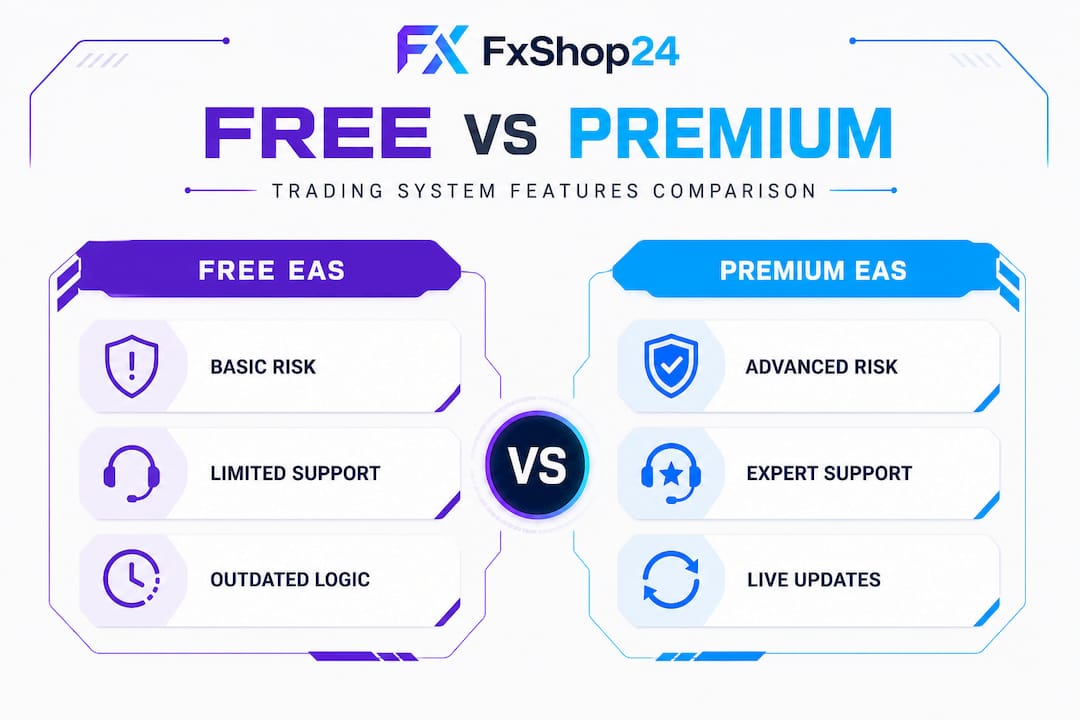
Paid EA tools offer more features including proper risk management, backtesting, and journaling, while free EAs typically come with basic features and limited flexibility. This gap is not cosmetic. It directly affects whether your automation holds up under real trading conditions.
The top 5 reasons to prefer premium over free systems:
- Compliance enforcement. Premium systems let you set exact daily loss limits and maximum drawdown thresholds, which mirrors the exact rules prop firms use during evaluations. A free EA without these controls is essentially operating blind.
- Performance accountability. Top premium providers publish live account results with verified statements. You are not buying on faith alone. You can compare performance across different brokers and market conditions before committing.
- Ongoing software updates. Forex and gold markets shift. Regulations change. A free EA abandoned by its developer after six months becomes a liability. Premium systems include lifetime updates to keep your automation current.
- Real technical support. When something breaks at 2:00 a.m. right before a major news event, community forums are not enough. Premium systems offer direct developer support, setup guidance, and troubleshooting that can save a live account.
- Serious risk controls. Position sizing, anti-martingale logic, and news filters are standard on premium platforms. These features alone make the difference between staying in an evaluation and getting disqualified on day one.
Pro Tip: Before purchasing any EA, ask the vendor directly whether the system has been tested on a live account during both trending and ranging market conditions. Verified live results across different environments are a much stronger signal than backtest performance alone.
For a deeper look at premium vs free EAs and how each performs in real evaluations, the differences become even clearer when you look at specific case studies. You can also explore a range of expert advisor examples from MT4 and MT5 to understand what realistic configurations look like in 2026.
Why compliance matters: The prop firm perspective
Beyond features and support, gaining funding and keeping it depends on passing strict compliance gates. Let’s look at why this matters for every automated trader.
Prop firms have one primary concern: protecting their capital. To do that, they enforce rigid rules during evaluations and funded phases. These rules are not suggestions. Violating them ends the evaluation immediately, regardless of your profit percentage.
Compliance is as critical as performance in this context. Many firms ban specific automation patterns outright, including copy trading, latency arbitrage, and almost universally, grid and martingale strategies. Premium systems are designed with these restrictions in mind, offering rule-aligned risk controls from the start.
Here is a breakdown of common prop firm rules and what they mean for automated traders:
| Rule type | Typical limit | Automation risk if ignored |
|---|---|---|
| Daily drawdown cap | 4% to 5% of account | EA takes too many trades in a session |
| Maximum overall drawdown | 8% to 12% of account | No soft stop built into free EA |
| Forbidden strategy: Martingale | Universally banned | Free EA doubles down after losses |
| Forbidden strategy: Grid trading | Banned by most firms | Multiple correlated open positions |
| News trading restriction | Varies by firm | EA trades during high-impact events |
| Minimum trading days | Often 4 to 10 days | EA finishes challenge too fast |
Knowing these rules is one thing. Having an EA that enforces them automatically is another entirely. Most free tools leave this responsibility entirely to the trader, creating enormous room for error.
Before running any automation through an evaluation, check the following:
- Confirm your EA does not use grid or martingale logic, even in edge cases
- Set a hard daily loss limit that mirrors the firm’s exact percentage
- Enable any built-in news filter to pause trading during major economic releases
- Review the EA’s behavior on correlated pairs to avoid hidden overexposure
- Test on a demo account under simulated evaluation conditions before going live
Understanding the full scope of proprietary trading advantages helps traders frame why firms are so strict in the first place. And if you are newer to automation, the automated trading systems guide provides a solid foundation for understanding how these systems interact with firm rules in practice.
Advanced risk management and support: Premium system essentials
With regulatory compliance understood, the next layer of value in premium systems is robust risk management and having professional support on your side.

Risk management in automated trading is not a single feature. It is a layered system of controls that work together to protect capital at every stage of a trade’s lifecycle. Free EAs might include a basic stop-loss, but premium systems go much further.
Key advanced risk features to look for in a premium trading system:
- Dynamic position sizing that adjusts lot sizes based on account balance and drawdown status, not fixed lot inputs
- Real-time floating loss monitoring that can close all open trades if the daily loss threshold is about to be hit
- Automatic maximum drawdown enforcement that disables trading when the overall account drawdown approaches the firm’s limit
- Anti-correlation filters that prevent the EA from opening multiple positions in the same direction across correlated pairs simultaneously
- News event pause logic that suspends trading 30 to 60 minutes before and after scheduled high-impact economic releases
- Time-based filters that restrict trading to specific market sessions, avoiding low-liquidity periods where spreads widen dangerously
Premium EA tools offer advanced risk management, superior backtesting environments, and ongoing updates that keep the system aligned with current conditions. For a trader managing funded accounts, these features are not optional. They are the difference between consistent operation and termination of a funded account.
Support is equally important, though it often gets overlooked during the purchase decision. When you run automated systems on live accounts, problems happen. A syntax error in the EA settings, a broker-side issue affecting order execution, or a sudden market event can all require immediate diagnosis.
For a practical breakdown of how to implement and protect your automation properly, the guide on mastering risk management in MT4 and MT5 covers specific settings you should configure before going live. And if you want to understand the broader strategic value these systems provide, the page on trading system advantages puts it in concrete terms for forex and gold traders specifically.
Pro Tip: Before buying any premium system, send the vendor’s support team a test question. Ask something specific about configuration for a particular prop firm’s rules. A fast, knowledgeable reply tells you the support infrastructure is real. A slow or generic response tells you everything you need to know about what happens after purchase.
What most traders get wrong about premium systems
After examining the facts, it is time for a grounded look at how premium trading systems are best used in the real market.
Here is the uncomfortable reality: a premium trading system is not a profit machine. It is a discipline machine. The traders who buy premium EAs expecting guaranteed monthly returns are almost always disappointed. The traders who use premium systems to enforce their trading process and protect their capital during evaluations are the ones who build sustainable funding careers.
The myth is that premium automation replaces skill and strategy. The reality is that it replaces the emotional and mechanical errors that cost disciplined traders their evaluations. Prop traders value premium automation precisely because it can be configured to stay within evaluation limits rather than maximize raw return. Notice that framing: the goal is limits, not maximization.
This is a mindset shift that most retail traders struggle to make. They come to automation wanting more trades, bigger returns, and faster account growth. Premium automation, used correctly, does the opposite. It slows things down. It stops the EA from trading during dangerous conditions. It closes positions before they breach daily loss limits. It says no when a trader’s gut says yes.
Process orientation beats performance chasing every single time over a six-month span across multiple evaluation attempts. The traders who fail evaluations repeatedly are almost never doing so because of a bad strategy. They fail because of a single bad day, a news event they forgot to check, or a position that ran too long without a hard stop. Premium systems solve exactly those problems, not by trading better, but by preventing critical errors.
The one actionable step every automated trader should take right now: open your EA’s settings and configure the daily loss limit to a number that is 0.5% tighter than your prop firm’s actual limit. This buffer means you are never operating right at the edge of disqualification. Small changes like this, focused on enhancing trading consistency, compound over time into real funding outcomes.
Ready to upgrade? Where to find premium trading systems
If this article has shifted how you think about automation, the natural next step is finding systems built around the principles we have covered, not marketed with unrealistic promises, but built for rule compliance, real risk management, and long-term account preservation.
FxShop24 offers a curated selection of automated trading systems for forex and gold markets, designed specifically for MT4 and MT5 platforms. Every system available on the platform is evaluated for prop firm compatibility, and many include lifetime updates with unlimited license access. Whether you are preparing for your first evaluation or managing multiple funded accounts, you will find systems aligned with what serious trading requires. Explore the full breakdown of trading system advantages to compare options, and review the expert advisor section to understand exactly why expert advisors built for compliance outperform generic tools in real evaluation environments.
Frequently asked questions
Can premium trading systems guarantee I will pass a prop firm evaluation?
No, premium systems cannot guarantee prop firm funding success. They help you comply with rules and avoid violations, but results still depend on market conditions and how carefully you configure the system settings before each evaluation phase.
Are premium trading systems worth it for beginner forex traders?
Premium systems offer better support and safety features that help beginners avoid major mistakes during live trading. However, they still require basic trading knowledge to configure correctly, since paid EA tools offer features that need proper setup to deliver their full risk management benefits.
How do premium trading systems handle risk differently than free EAs?
Premium platforms offer far more customization including drawdown control, dynamic position sizing, and advanced stop-loss rules. These features reduce the chance of breaching key limits because paid EA tools manage risk through multiple layered controls rather than a single basic stop-loss setting.
Will a premium trading system automatically comply with all prop firm rules?
Most top-tier systems are built for compliance with common prop firm rules, but you must still configure them with the correct limits and exclusions for your specific firm. Premium automation configured correctly improves the probability of staying within evaluation limits rather than relying on default settings that may not match your firm’s exact requirements.