



1
May
Prop firm rules decoded: A guide for automated traders
TL;DR:
- Most funded accounts fail due to rules like the consistency rule, not strategy failure.
- Automated traders must ensure their EA’s profit distribution aligns with prop firm rules to pass challenges.
- Adjusting EAs to include daily profit caps and reducing lot sizes improves compliance and success chances.
More than half of funded prop trading accounts don’t fail because the strategy stopped working. They fail because the trader, or the expert advisor (EA) running on autopilot, broke a rule that was hiding in plain sight. Industry data shows the consistency rule alone accounts for a massive share of prop firm disqualifications, with firms like FundingPips Zero enforcing a 15% cap, TradeDay at 30%, and Apex at 50%. If your EA fires off one giant trade that generates 60% of the month’s profit in a single day, you could be out before you even realize what happened. This guide breaks down exactly how these rules work, why they hit automated traders especially hard, and what you can do about it.
Table of Contents
- Understanding prop firm rules: The basics
- The consistency rule: Why it matters for EAs
- Side-by-side: Key prop firm rules compared
- Adapting your EAs and strategies for prop firm success
- The uncomfortable truth: Why most automation fails prop firm rules
- Automate smarter: Tools and resources for prop firm success
- Frequently asked questions
Key Takeaways
| Point | Details |
|---|---|
| Consistency is critical | More than half of failed funded accounts are due to breaking the consistency rule, not losing trades. |
| Rule flexibility varies | Some prop firms enforce strict profit distribution, others offer leniency making them better for some EAs. |
| Adapt your automation | EAs must be specifically tuned for prop firm rules to pass and stay funded. |
| Choose your firm wisely | Pick a prop firm with rule sets that match your strategy’s performance profile for best results. |
Understanding prop firm rules: The basics
Proprietary trading, or prop trading, is when a firm provides capital to traders in exchange for a share of the profits. To protect that capital, firms impose strict evaluation rules that every trader, human or automated, must follow. Getting a prop firm overview early in your journey helps you avoid the costly surprises that trip up so many automated traders.
The rules themselves fall into a few major categories:
- Maximum drawdown: The total percentage your account can fall from its highest point before you’re disqualified. Most firms set this between 8% and 12%.
- Daily loss limit: A hard cap on how much you can lose in a single trading day, typically 4% to 5% of the account balance.
- Consistency rule: A requirement that no single day’s profit should represent too large a share of your total profits during the evaluation period.
- News trading restrictions: Some firms prohibit holding trades through major economic news events, which is a huge issue for time-insensitive EAs.
- Lot size and leverage caps: Maximum position sizes relative to account equity.
“The consistency rule is the rule most traders never read carefully enough, and it’s the one that ends their funded accounts.”
The proprietary trading advantages are real and compelling: access to large capital without risking your own money, structured profit splits, and the discipline that comes from working within a framework. But those advantages disappear fast if your EA doesn’t know the rules it’s trading under.
Why does this matter more for automated strategies than for manual traders? Because humans tend to intuitively spread their activity across multiple sessions and days. An EA follows logic and market conditions. If the conditions align perfectly on a Tuesday, the EA might close five large winners in one session and blow the consistency threshold while the trader is asleep.
The consistency rule: Why it matters for EAs
Of all the rules, consistency trips up more automated traders than you’d expect, and the reason is almost always structural, not strategic.
The consistency rule works like this: firms measure your best single day’s profit as a percentage of your total account profit during the evaluation. If that percentage exceeds the firm’s threshold, you fail. It doesn’t matter if your overall return is strong. One outsized day breaks the rule.
Here’s a concrete example. Suppose you’re running a $100,000 challenge and your EA produces $8,000 in total profit over 20 trading days. If $3,000 of that came on a single big-momentum day, you just violated a 30% consistency rule. You passed the target. You stayed within drawdown. But the account is still disqualified.

This is exactly the “hero trade” problem that kills funded accounts post-evaluation. Many EAs are designed to capture large moves when the market offers them, which is perfectly valid from a pure profit perspective. But in the prop firm world, that’s a liability.
| Prop Firm | Consistency Rule | Max Drawdown | Daily Loss Limit |
|---|---|---|---|
| FundingPips Zero | 15% max single-day profit | 8% | 4% |
| TradeDay | 30% max single-day profit | 6% | 3% |
| Apex Trader Funding | 50% max single-day profit | 6% | N/A |
| FTMO 1-Step | No consistency rule | 10% | 5% |
| MyForexFunds (Standard) | 40% max single-day profit | 10% | 5% |
The firms with the tightest consistency caps are genuinely hard to pass with a typical high-variance EA. When you look at prop firm EA challenge strategies, the single most important selection criterion should be whether the EA produces smooth, distributed results or lumpy, momentum-driven returns.
Pro Tip: Before purchasing or deploying any EA for a prop firm challenge, run a backtest and pull the daily profit distribution. If any single day represents more than 20% of total profit across a sample period, the EA will likely struggle under consistency-enforcing firms. Look for EAs where daily gains cluster in a narrow range.
The best MQL5 prop firm strategies are specifically coded to include daily profit limits within the EA’s own logic. This means the EA will stop trading once it hits a self-imposed target for the day, protecting the consistency ratio even if market conditions are ripe for more trades.
Side-by-side: Key prop firm rules compared
Understanding these nuances becomes clearer when you see them side by side. Not all prop firms are created equal, and the difference in rule structure can determine whether your current EA can pass a challenge at all, without any modification.
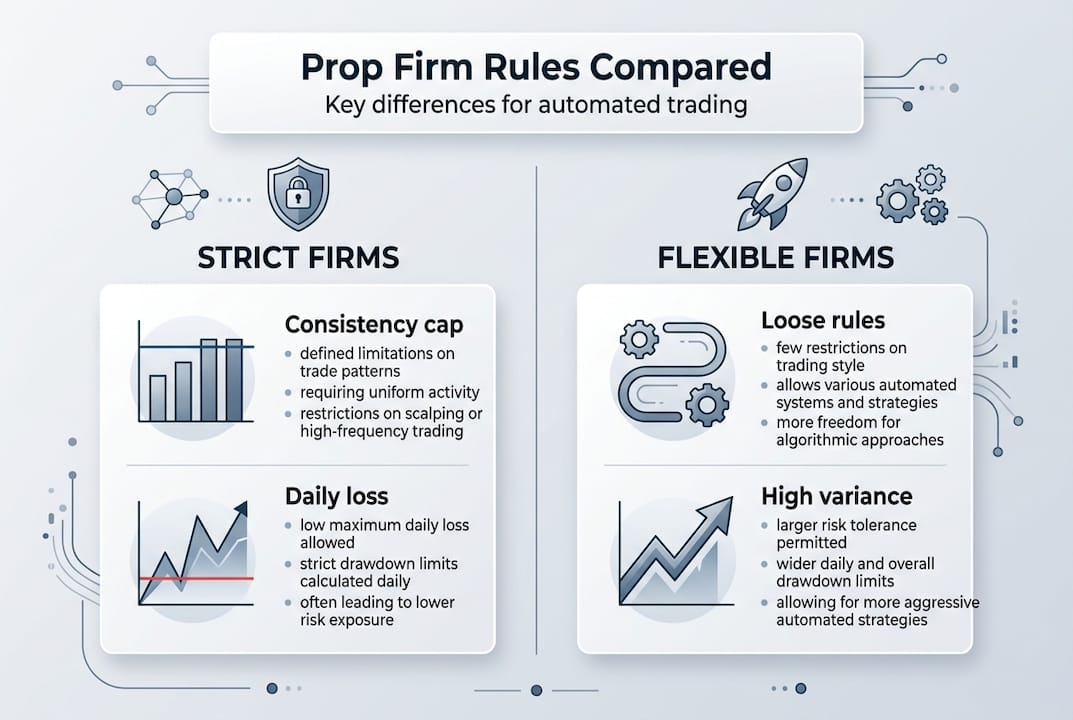
| Feature | Strict Firms | Flexible Firms |
|---|---|---|
| Consistency rule | Yes, 15-40% cap | None or lenient (50%+) |
| News trading | Banned | Allowed |
| Weekend holding | Prohibited | Permitted |
| EA and automation | Allowed with caveats | Fully allowed |
| Scaling options | Limited | Often available |
The consistency rule data makes one thing clear: firm selection is a strategy decision, not just an administrative one. Choosing the wrong firm for your EA type can doom you before the first trade even closes.
Here’s a breakdown of the key differences between strict and flexible prop firm environments:
Strict consistency firms:
- Require daily profit balance across the evaluation window
- Often ban news trading within 2 to 5 minutes of major releases
- May prohibit holding positions overnight or over weekends
- Demand lower drawdown tolerance, which limits trade sizing
Flexible firms:
- Allow larger single-day profit spikes without disqualification
- Permit news trading and overnight holding
- Support a wider range of EA types including scalpers and swing traders
- Often have higher drawdown allowances, giving strategies more breathing room
For automated traders doing a prop firm EA comparison, the key question is not just “will this EA make money?” It’s “will this EA make money in a way that matches this firm’s rulebook?” Those are two very different questions with very different answers.
News trading is worth calling out specifically. An EA built around trading the non-farm payroll report every first Friday of the month might produce excellent historical returns. But if your chosen firm bans news trading, every single one of those trades is grounds for disqualification. Not a loss. Not a drawdown issue. A direct rule violation.
Adapting your EAs and strategies for prop firm success
With the rule landscape mapped, the question becomes how to adapt your automation for a higher chance of passing. This isn’t about making your EA worse. It’s about making it prop firm compliant without gutting its core edge.
Here’s a step-by-step approach to evaluating and adjusting any EA before deploying it in a challenge:
Audit the profit distribution. Pull 6 to 12 months of backtest or live data. Calculate each day’s profit as a percentage of total monthly profit. Identify outlier days that would breach your target firm’s consistency threshold.
Add a daily profit cap parameter. If you have access to the EA source code, insert a maximum daily profit limit. Once the EA hits that limit, it stops trading for the day. This is the most effective single adjustment you can make.
Reduce position sizing during high-volatility sessions. News events, London open, and major economic releases often produce your biggest days. Scaling down lot sizes during these windows smooths out the profit curve without eliminating profitability.
Backtest under drawdown constraints. Rerun your strategy with hard limits matching your target firm’s maximum and daily drawdown rules. See how many of your historical trades would have been force-closed under those rules.
Choose your firm based on EA profile, not brand reputation. A well-known firm with a tight consistency rule is the wrong choice for a high-variance EA. An obscure firm with no consistency rule might be the perfect fit. Use the prop trading tips available to map EA behavior to firm rules explicitly.
Test in a demo challenge first. Many firms offer demo or practice challenges. Run your modified EA through a full evaluation cycle before spending money on a real challenge.
Pro Tip: When choosing a prop firm EA, prioritize EAs that have been explicitly tested and verified against consistency rules, not just drawdown limits. Consistency compliance is the newer, more nuanced benchmark that separates the best prop firm EAs from the rest.
The single biggest feature to look for in a prop firm ready EA is built-in daily stop logic. This is a parameter that tells the EA: “If today’s profit reaches X, shut down for the day.” Combined with a solid core strategy, this one feature alone dramatically increases your pass rate across most firms.
Also look for hero trade avoidance design, meaning the EA avoids letting any single position grow to a size that distorts the overall profit picture. Partial take-profit logic, where the EA exits trades in stages rather than all at once, naturally spreads profit recognition across multiple sessions and reduces single-day concentration.
The uncomfortable truth: Why most automation fails prop firm rules
Here’s the hard reality that most content on this topic dances around. The majority of EAs on the market were never designed with prop firm rules in mind. They were built to maximize returns in a standard live or demo account where the only rules are the market’s rules. That’s a completely different optimization problem.
When a developer builds an EA to perform well on a backtested Sharpe ratio or total return, they’re solving for absolute profitability. When a prop firm grades your performance, they’re solving for rule-compliant profitability, which is a much narrower target. The consistency rule’s real-world impact is that it forces you to leave profit on the table on your best days to protect your account on your worst days.
What experienced prop traders actually do differently is treat firm selection and EA optimization as separate workstreams. They don’t ask “is this EA good?” They ask “is this EA good for this firm’s specific rules?” That mindset shift changes everything.
The traders who consistently pass prop firm challenges with automated systems aren’t always running the most profitable EAs. They’re running the most compliant ones. There’s a meaningful distinction between the two, and ignoring it is the most expensive mistake in automated prop trading.
Our perspective at FxShop24 is this: before spending $500 on a new EA, spend 30 minutes mapping your current EA’s daily profit distribution against your target firm’s consistency threshold. You might already have a winning tool that just needs one parameter adjusted. Or you might discover that your EA is fundamentally incompatible with strict consistency firms, in which case the solution is firm selection, not EA replacement.
The prop firm EA selection process should always start with the rulebook, not the marketing page. Read the rules, then evaluate the EA. Not the other way around.
Automate smarter: Tools and resources for prop firm success
Ready to raise your pass rate? The good news is that with the right tools and a clearer understanding of the rules, passing prop firm challenges with automated strategies is very achievable.
FxShop24 offers a curated selection of automated futures trading systems and MT4/MT5 EAs specifically tested for prop firm compatibility, including consistency rule compliance. Every EA in our catalog comes with detailed performance data showing daily profit distribution, not just overall returns, so you can make an informed choice before committing to a challenge fee. We also publish in-depth guides covering the types of automated trading systems that work best for different prop firm environments. Whether you’re looking for a scalper suited to flexible firms or a swing-based EA that passes strict consistency checks, our resources are built to help you match tool to rulebook with confidence.
Frequently asked questions
What is the consistency rule in prop firm trading?
The consistency rule requires that no single day’s profit exceeds a set percentage of total evaluation profits, discouraging one-off big wins and enforcing steady performance. Industry data shows this rule eliminates more than 50% of funded accounts across major firms.
How do prop firm rules affect automated trading strategies?
Automated strategies that generate uneven profits, with spikes on high-volatility days, often breach consistency rules even when overall returns are strong. Strict enforcement at firms like FundingPips Zero and TradeDay makes this a critical issue for EA traders.
Can I use high-risk, high-reward EAs for prop firm challenges?
Not usually; high-variance EAs that produce occasional large wins tend to violate consistency rules and get disqualified even when the account is profitable overall. The hero trade problem is a specific design flaw that kills funded accounts post-evaluation.
Which prop firms are more lenient with consistency rules?
Firms like FTMO 1-Step impose no consistency rule at all, making them a better fit for variable-result EAs and high-variance strategies that can’t distribute profits evenly across evaluation days.
How can I adapt my EA to meet prop firm requirements?
Add a built-in daily profit cap to your EA, reduce lot sizing during high-volatility sessions, and audit your historical profit distribution before committing to a challenge. Choosing even daily P&L design as a primary EA criterion is the most effective long-term adjustment you can make.
Recommended
- Prop Firms: A Comprehensive Guide For Aspiring Traders | FxShop24 Marketplace
- 7 Actionable Prop Firm Trading Tips For MT4 And MT5 Users
- Stop Wasting Time—Prop Firm EA Selection Hacks Every Trader Should Know | FxShop24 Marketplace
- How Do Prop Firms Work? A Simple Guide For Aspiring Forex Traders | FxShop24 Marketplace