
13
Apr
Top expert advisor examples for MT4 and MT5 in 2026
TL;DR:
- Effective EAs balance strategy, risk management, and adaptability to last in live trading.
- Choose EAs based on your goals, risk tolerance, and market conditions, then thoroughly test.
- Most failures stem from poor discipline and neglecting process rather than EA quality alone.
Choosing the wrong expert advisor can quietly drain your account while you sleep. That frustration is real, and it’s one of the most common problems retail and institutional Forex traders face today. With hundreds of EAs flooding the market, knowing which ones actually perform, and why, is the difference between consistent gains and a blown account. This article cuts through the noise and gives you a clear, practical breakdown of proven EA examples for both MT4 and MT5, what makes each one worth considering, and exactly how to match one to your trading goals.
Table of Contents
- What makes a great expert advisor?
- Top examples of expert advisors for MT4 and MT5
- Comparison table: Popular EA examples side by side
- How to choose the right expert advisor for your trading goals
- Our perspective: What most traders get wrong with expert advisors
- Next steps: Power up your trading with top EAs
- Frequently asked questions
Key Takeaways
| Point | Details |
|---|---|
| Know your EA criteria | Choose EAs based on strategy, risk management, and compatibility with your trading style. |
| Compare top EA options | Use side-by-side comparisons to find EAs fit for your goals and platforms. |
| Test before you commit | Backtest and demo each expert advisor to validate performance and reliability. |
| Prioritize process, not hype | Long-term EA success depends on discipline, monitoring, and smart adaptation. |
What makes a great expert advisor?
With the importance of selecting the right EA clear, let’s break down exactly what matters most when evaluating your options.
Not all EAs are created equal. The market is full of flashy dashboards and backtested equity curves that look incredible on paper but fall apart in live conditions. Effective EAs balance strategy, risk controls, and adaptability, and that balance is what separates tools that last from ones that fail within weeks.
When evaluating any EA, focus on these core criteria:
- Strategy clarity: The EA should have a defined, logical approach, whether that’s trend following, mean reversion, or breakout trading. Vague or overfitted strategies are a red flag.
- Risk management: Look for built-in stop-loss controls, lot size limits, and drawdown caps. An EA without solid risk controls is a liability.
- Adaptability: Markets shift. A good EA adjusts to volatility changes, not just fixed conditions from years ago.
- Transparency: Verified live results, clear parameter documentation, and honest drawdown reporting are non-negotiable.
- Real-time execution: Latency matters, especially for scalping EAs. Slow execution kills edge.
- Customization: You need to adjust settings for your account size, risk appetite, and broker conditions.
- Reliable support: Updates, bug fixes, and responsive customer service extend an EA’s lifespan significantly.
The role of EAs in automation is to remove emotional decision-making, but only if the underlying logic is sound. An EA running a flawed strategy just executes mistakes faster.
Pro Tip: Before purchasing any EA, ask for a verified Myfxbook or FX Blue live account link. Backtested results alone are not sufficient proof of real-world performance.
Also watch out for common pitfalls: over-optimization (curve fitting to historical data), lack of forward testing, and EAs that only work on one broker’s feed. These are warning signs that a product won’t survive real market conditions.
Top examples of expert advisors for MT4 and MT5
Armed with the evaluation framework, let’s explore top-rated EAs available on the market for MT4 and MT5.
The EA landscape covers several distinct strategy types, each suited to different trader profiles. Here are the most relevant categories with standout examples:
- Scalping EAs: These target small, frequent gains in fast-moving markets. Scalping EAs excel in fast-moving markets but require stringent risk controls and low-latency brokers. Best for experienced retail traders who understand spread costs.
- Grid EAs: These place buy and sell orders at fixed intervals above and below the current price, profiting from market oscillation. They work well in ranging conditions but carry high drawdown risk in trending markets.
- Trend-following EAs: These ride established momentum using indicators like moving averages or the Average Directional Index (ADX). Lower trade frequency, but higher average win size. Suitable for swing traders.
- News-trading EAs: Designed to capitalize on volatility spikes around major economic releases. These require very fast execution and are best for traders who understand fundamental catalysts.
- AI-powered EAs: The most adaptive category. AI-powered EAs adapt to changing market conditions for improved performance by learning from new data rather than relying solely on fixed rules. These are gaining traction among both retail and institutional traders.
- Prop firm-ready EAs: Specifically tuned to pass funded account challenges, with strict drawdown limits and controlled lot sizing. Increasingly popular as prop trading grows.
You can explore the full range of automated trading system types to understand which category fits your style before committing to a specific product. For a broader look at what’s working in live markets, reviewing best Forex trading systems gives useful context.
“The best EA is not the one with the highest win rate. It’s the one that fits your risk tolerance, your broker, and your long-term trading plan.”
Pro Tip: If you’re new to automation, start with a trend-following EA on a demo account for at least 30 trading days before going live. This gives you a realistic sense of drawdown behavior.
Comparison table: Popular EA examples side by side
With individual examples described, a side-by-side table clarifies the nuance between your choices.
No single EA fits all traders; compare risk, cost, and strategies before making any decision. The table below gives you a quick-reference matrix to shortlist candidates based on your priorities.

| EA type | Strategy | Risk level | Automation level | Platform | Best for |
|---|---|---|---|---|---|
| Scalping EA | High-frequency, small gains | High | Fully automated | MT4, MT5 | Experienced retail traders |
| Grid EA | Buy/sell grid intervals | Very high | Fully automated | MT4, MT5 | Range-bound market traders |
| Trend-following EA | Momentum indicators | Medium | Semi to full auto | MT4, MT5 | Swing traders |
| News-trading EA | Volatility on releases | High | Fully automated | MT5 preferred | Fundamental-aware traders |
| AI-powered EA | Adaptive machine learning | Medium | Fully automated | MT4, MT5 | Tech-forward retail traders |
| Prop firm EA | Controlled drawdown strategy | Low to medium | Fully automated | MT4, MT5 | Funded account challengers |
Reading this table effectively means prioritizing your own constraints first. If drawdown is your biggest concern, the prop firm EA category is your starting point. If you want maximum adaptability, AI-powered options deserve serious attention.
One critical mistake traders make is treating this comparison as a final answer. It isn’t. The table is a shortlist tool. Every EA in this list behaves differently depending on the broker, the currency pair, and the market regime it’s deployed in. What works in a trending Euro/US Dollar environment may fail completely during a choppy, low-volatility week.
Backtesting and forward testing are what turn a shortlist into a confident choice. Skipping that step because an EA “looks good” on paper is one of the most expensive mistakes you can make.
How to choose the right expert advisor for your trading goals
After comparing top EAs, the final step is making a confident, personalized selection.
Selection without a process is just guessing. Follow these steps to move from curiosity to confident deployment:
- Define your goals clearly. Are you targeting consistent monthly returns, passing a prop firm challenge, or building long-term capital? Your goal shapes every other decision.
- Set your risk parameters. Decide your maximum acceptable drawdown percentage and your target risk-to-reward ratio before looking at any EA.
- Shortlist based on strategy fit. Use the comparison table above to narrow your options to two or three candidates that match your goals and risk tolerance.
- Backtest with quality data. Backtesting is essential for EA selection and customization. Use at least three to five years of historical data across different market conditions.
- Run in demo mode. Forward test your shortlisted EA on a demo account for a minimum of four weeks. Watch how it handles news events and volatile sessions.
- Optimize settings carefully. Adjust lot sizes, stop-loss levels, and session filters to match your broker’s conditions. Avoid over-optimization.
- Monitor and review. Set a monthly review schedule to check performance metrics and adjust if market conditions shift.
| Evaluation metric | What to look for | Warning sign |
|---|---|---|
| Win rate | 50% or above with positive expectancy | Win rate above 90% (likely curve-fitted) |
| Max drawdown | Below 20% of account | Drawdown exceeding 30% |
| Profit factor | Above 1.5 | Below 1.0 |
| Trade frequency | Consistent with strategy type | Extremely high without clear logic |
| Sharpe ratio | Above 1.0 | Negative or near zero |
Understanding why use EAs goes beyond automation. It’s about building a repeatable, emotion-free process that compounds over time.
Our perspective: What most traders get wrong with expert advisors
With selection tactics covered, let’s share an honest perspective based on real-world observation.
Here’s the uncomfortable truth: most traders who fail with EAs don’t fail because they chose a bad EA. They fail because they never committed to a disciplined process around it. They buy an EA, run it for two weeks, see a losing streak, and switch to the next shiny product. That cycle repeats indefinitely.
The EA’s role in automation is to execute a strategy consistently, not to guarantee profits. Even the best EA will have losing months. The traders who succeed long-term are the ones who understand their EA’s logic deeply enough to know when to pause it and when to let it run.
Over-reliance is equally dangerous. Treating an EA like a set-and-forget ATM ignores the reality that market conditions change. An EA optimized for 2023 volatility may underperform in 2026’s market structure. Regular review is not optional. It’s part of the job. Disciplined process, not headline features, is what drives long-term EA success.
Next steps: Power up your trading with top EAs
Ready to take action with expert advisors? Start experimenting with high-performing EAs today.
FxShop24 gives you direct access to a curated marketplace of tested, prop firm-ready EAs for MT4 and MT5. Whether you’re exploring strategy types or ready to deploy, the resources are right here.
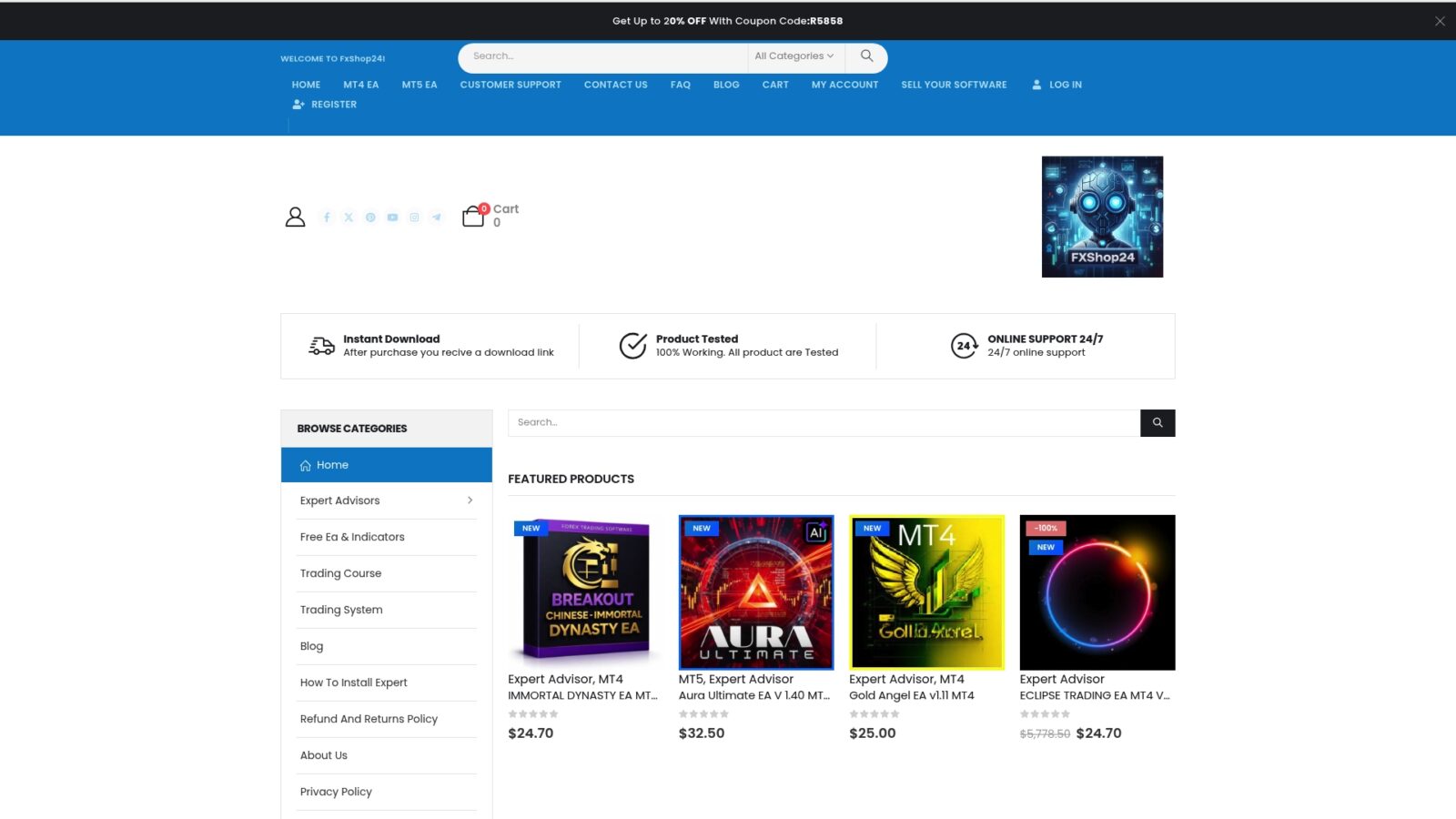
Browse the full range of automated trading system types to find the category that fits your style. If you’re interested in futures markets, check out futures trading automation for specialized tools. For a powerful AI-driven option, the AI Trading Bot 2 EA MT4 is one of the most adaptive products in the catalog. Instant download, lifetime updates, and full installation support are included with every purchase.
Frequently asked questions
What is an expert advisor in Forex trading?
An expert advisor (EA) is a software program that automates trading decisions and execution on platforms like MT4 or MT5, removing manual intervention from the trading process.
Which platform is better for expert advisors, MT4 or MT5?
MT4 remains the popular choice for EAs due to wider broker support, but MT5 offers additional features including faster execution and more timeframes, making it the better option for complex strategies.
How do I test if an expert advisor is safe and profitable?
Backtesting is critical to evaluating EA performance and safety. Run historical tests, optimize parameters, and always forward test in demo mode before committing real capital.
Can I use multiple expert advisors at the same time?
Yes, running multiple EAs is possible with proper management. Assign each EA to a separate chart or account and monitor them regularly to prevent strategy conflicts or margin issues.