


25
Apr
What is an EA? Forex and gold trading automation explained
TL;DR:
- Expert advisors are automated trading tools that execute predefined rules but require proper design and management.
- Successful EA use depends on matching strategies to market conditions and continuous oversight.
- Thorough testing, risk management, and understanding market behavior are essential for profitable automation.
Most traders who buy their first expert advisor expect one thing: to press a button, walk away, and watch their account grow. That expectation is almost always wrong, and it’s the single biggest reason so many traders lose money with automation. An expert advisor is not a profit machine. It’s a sophisticated trading tool that executes rules automatically, and its performance depends entirely on how well those rules are designed, tested, and managed. This article gives you a practical, honest breakdown of what EAs do, how they work, what strategies they use, and how to deploy them effectively in forex and gold markets.
Table of Contents
- What is an expert advisor (EA)?
- How EAs execute trades: The logic and strategies inside
- Advantages and risks of automated trading with EAs
- Best practices for using EAs in forex and gold trading
- Why experience beats pure automation: An expert perspective
- Find the right EA and trading tools for your strategy
- Frequently asked questions
Key Takeaways
| Point | Details |
|---|---|
| EAs automate trading | Expert advisors (EAs) use coded strategies to place trades on your behalf automatically. |
| Not all EAs suit every market | Selecting and adjusting EAs according to forex or gold market conditions is essential for success. |
| Automation needs oversight | Combining EAs with manual supervision and risk management leads to safer and more reliable trading. |
What is an expert advisor (EA)?
An expert advisor is a software program written in a specialized coding language called MQL, which runs directly inside MetaTrader platforms. Its core job is simple: monitor market data continuously and act on predefined rules without waiting for you to click a button. When those rules are met, the EA places trades, adjusts stop losses, scales into positions, or closes orders, all automatically.
Automated trading decisions on platforms like MT4 or MT5 are what EAs are specifically built for, covering forex pairs and increasingly gold (XAUUSD). The technology is not new. Professional hedge funds have used algorithmic trading for decades. What changed is accessibility. MetaTrader brought that same logic to retail traders, and now anyone with a broker account can run a fully automated trading system on their laptop.
Understanding how forex trading systems work is essential before deploying any EA, because every EA is built on a trading system’s logic. Without that foundation, you cannot evaluate whether the EA you’re looking at is genuinely profitable or just backtested to look good.
Here’s a quick reference for what EAs actually do at a functional level:
| Function | Who it’s for | Platform compatibility | Key benefit |
|---|---|---|---|
| Trade entry automation | Active and passive traders | MT4, MT5 | No missed entries |
| Position sizing | Risk-conscious traders | MT4, MT5 | Consistent lot sizing |
| Stop loss / take profit | All traders | MT4, MT5 | Rule-based risk control |
| Multi-pair scanning | High-volume traders | MT5 preferred | Covers more markets |
| News filter / session filter | Gold and forex traders | MT4, MT5 | Avoids volatile events |
EAs work across currency pairs like EUR/USD, GBP/JPY, and USD/CHF, but gold (XAUUSD) is arguably where automated trading delivers the most value, because gold moves fast and reacts sharply to news. Manual trading gold around the clock is exhausting. Automation handles it without fatigue.
What EAs cannot do is just as important to understand. They cannot predict the market. They cannot adapt to completely new economic regimes without being reprogrammed. They cannot replace judgment during major unexpected events like central bank emergency announcements or geopolitical shocks.
Some expert advisor examples show just how varied EA designs can be, from ultra-fast scalpers that target 5-pip moves to slow position traders that hold trades for days based on weekly trend signals.
Pro Tip: Before you buy or download any EA, write down your personal trading goals. Are you targeting small consistent gains or larger infrequent wins? Your answer should determine the type of EA you choose, because misalignment between goals and strategy is one of the top reasons EAs underperform.
How EAs execute trades: The logic and strategies inside
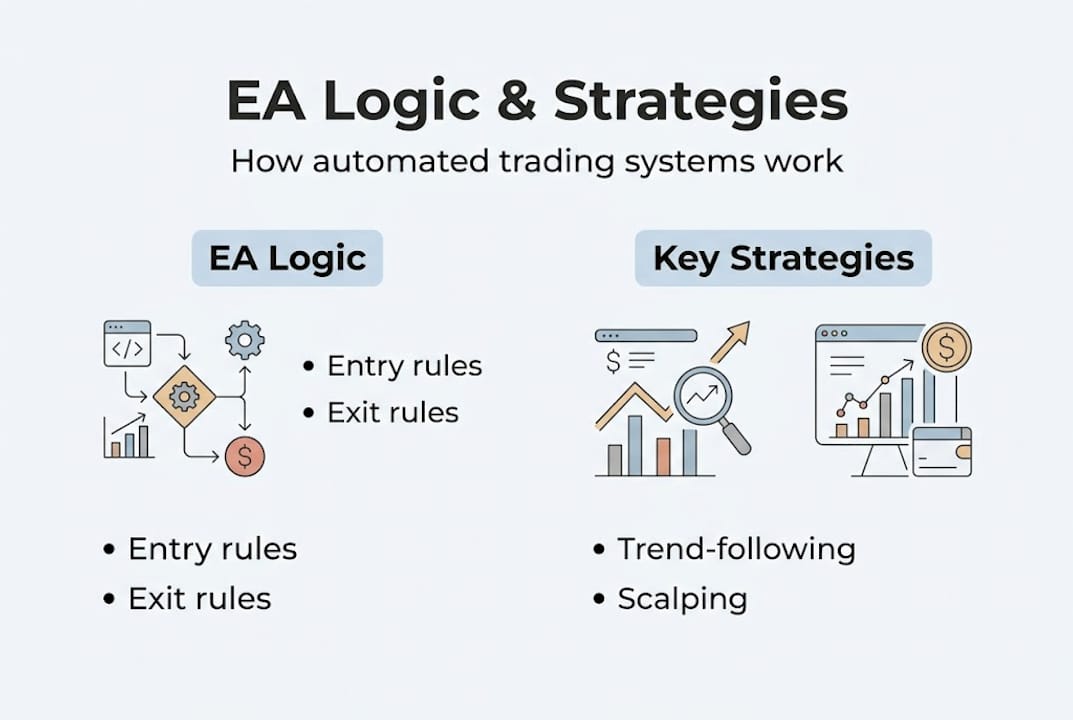
Once an EA is attached to a chart, it runs in a continuous loop. Every time a new price tick arrives, the EA checks its conditions. If the conditions match the coded rules, it acts. If they don’t, it waits. That’s the core execution cycle, and it happens in milliseconds.
Here’s a simplified look at how a trade gets placed:
- Market data received: The EA reads the current bid/ask price, recent candles, volume, and indicator values (such as RSI, ATR, or moving averages).
- Condition check: The EA compares current data against its coded rules. For example: “If the 50 EMA crosses above the 200 EMA and RSI is below 60, enter long.”
- Order placement: If conditions are met, the EA sends a buy or sell order to the broker instantly.
- Trade management: The EA continues monitoring the open position, adjusting stop loss levels, trailing profits, or adding to the position based on additional rules.
- Exit: The EA closes the trade when the take profit level is hit, the stop loss is triggered, or a reversal signal appears.
Common EA strategies include trend-following (e.g., Super Trend with ATR), scalping (targeting 5 to 20 pips), grid trading (placing orders at fixed price intervals), and martingale (doubling lot sizes after each losing trade). Each approach has a unique risk profile.
| Strategy | Market fit | Pros | Cons |
|---|---|---|---|
| Trend-following | Trending markets | High reward potential | Frequent false signals in ranging markets |
| Scalping | Low-spread, liquid markets | Consistent small gains | Sensitive to broker latency and spread |
| Grid trading | Ranging, low-volatility markets | Works without direction | Catastrophic in strong trends |
| Martingale | Ranging markets only | Recovers losses quickly in range | Account-destroying in trending conditions |
Take scalping as a concrete example. A scalping EA targeting EUR/USD might look for a 10-pip move during the London open session when spreads are tight and volume is high. It enters, grabs its 10 pips, and exits before any major reversal. On gold, that same scalping approach might target 50 to 100 pips because gold’s pip value and volatility are much larger.
Important risk note: Grid and martingale strategies can be risky during strong trends. A martingale EA that keeps doubling position size during a sustained USD rally, for example, can wipe an account in hours. These strategies require strict drawdown limits and are best used in confirmed ranging conditions only.
Understanding which trading strategies in EAs match which market environments is arguably the most valuable skill an automated trader can develop. Knowing why a strategy works in one condition and fails in another keeps you in control, even when the EA is doing the heavy lifting.
Matching EA features for success often comes down to whether the EA includes adaptive filters that recognize when market conditions have changed. The best EAs have built-in volatility filters, trend detection, and session restrictions that tell the EA to stand down when conditions are unfavorable.
Advantages and risks of automated trading with EAs
Automated trading with EAs offers real, tangible advantages that manual trading simply cannot match. But those advantages come with equally real risks that you need to understand before going live.
Key advantages:
- 24/5 operation: EAs trade around the clock across all sessions without fatigue, meaning gold trades during the Asian session or forex opportunities during the New York open are never missed.
- Emotional discipline: EAs follow their rules exactly. They don’t revenge trade after a loss or over-leverage after a win. That consistency is one of the most underrated benefits of automation.
- Speed: An EA can detect a signal and submit an order in milliseconds. Manual traders take seconds at best. In fast markets like gold, speed matters enormously.
- Backtesting capability: Before you risk real money, you can test an EA against years of historical data to understand how it performs across different market conditions.
- Multiple pair management: A single EA can monitor 10 or 20 currency pairs simultaneously, something no human trader can do effectively.
Key risks:
- Over-optimization (curve fitting): An EA that’s been fine-tuned to look perfect on past data often fails on live markets because real market conditions never repeat exactly.
- Technical failures: Internet outages, broker server issues, or platform crashes can cause missed trades, duplicate entries, or unclosed positions.
- Market regime changes: An EA built on 2022 ranging conditions may perform terribly in a 2024 trending environment. EAs don’t inherently adapt.
- Poor logic design: Many retail EAs contain flawed logic that produces good backtest results but fails in live trading due to unrealistic assumptions about slippage and execution.
Grid and martingale strategies specifically can be profitable in ranging markets but carry extremely high risk during trending conditions, making them unsuitable for most gold traders who face frequent directional breakouts.

Understanding automated trading systems explained in depth helps you ask the right questions when evaluating any EA: What market regime was it designed for? What drawdown did it produce historically? How does it handle a losing streak?
Pro Tip: Always run an EA alongside your own market awareness. Even the most robust EA benefits from a human checking in daily. If a major economic event is scheduled, consider pausing the EA temporarily. Automated does not mean unmonitored.
Best practices for using EAs in forex and gold trading
Deploying an EA responsibly requires more than downloading it and attaching it to a chart. The traders who get the most out of automation treat their EAs as tools that require active management, not passive income machines.
Follow these steps for a safe, effective EA deployment:
- Research thoroughly: Before purchasing or using any EA, study its strategy, check verified backtest reports, and look for live performance data from third-party sources like MyFXBook. Vendor claims alone are not enough.
- Demo test first: Run every new EA on a demo account for at least four to six weeks, covering different market conditions. Look for consistency, not just profitability.
- Adapt settings to your broker: Spread, execution speed, and minimum lot size vary between brokers. An EA optimized for one broker may produce different results on another. Adjust accordingly.
- Apply session filters: For gold specifically, avoid running EAs during low-liquidity periods or immediately before major economic announcements. A real-world example: a gold scalper EA left running during a surprise Fed rate decision spike can trigger a 200-pip adverse move with no logical stop placement. Session filters prevent exactly that scenario.
- Monitor live performance regularly: Check your EA’s live trades weekly. Compare them to the strategy logic. If results deviate significantly from demo testing, investigate before losses compound.
- Set hard drawdown limits: Most professional traders use a 10 to 15% account drawdown limit as a circuit breaker. If an EA hits that level, stop it and investigate before resuming.
Multi-timeframe filters and session restrictions are two of the most effective tools for improving EA robustness in both forex and gold. A trend filter on the daily timeframe combined with an entry signal on the 15-minute chart dramatically reduces false signals and improves overall win rate.
For gold specifically, look at EAs like the SafeGold Scalper EA, which is built with gold’s volatility patterns in mind. Generic EAs not designed for XAUUSD often struggle because gold’s spread, volatility, and reaction to news differ significantly from most forex pairs.
Using a well-structured forex trading systems guide as your foundation helps you evaluate whether a given EA’s logic is sound before committing real capital.
Pro Tip: Don’t treat your EA like a set-and-forget appliance. The traders who succeed with automation treat it more like managing an employee: setting clear performance expectations, reviewing results regularly, and making adjustments when performance slips.
Why experience beats pure automation: An expert perspective
Here’s the uncomfortable truth that most EA vendors won’t tell you: the majority of traders who buy automated systems still lose money. Not because the EAs are always bad, but because the traders don’t understand what they’re running.
We’ve seen accounts saved by a single manual intervention that no EA could have predicted. During a surprise central bank announcement, a gold EA running a trend-following strategy was caught in a massive 300-pip spike against the position. The trader paused the EA, manually adjusted the stop, and avoided a catastrophic loss. An EA running on pure automation with no oversight would have taken the full hit.
The real edge in automated trading comes from combining EA logic with human judgment and market context. EAs excel at consistency and speed. Humans excel at context and adaptability. Together, they’re far more powerful than either alone.
Knowing the top EA features for success gives you a framework for evaluating what an EA can and cannot handle before you deploy it. But experience teaches you the nuances that no specification sheet covers, like how your specific broker’s execution quality affects a scalping EA, or how gold’s behavior shifts during different geopolitical conditions.
Test extensively. Adapt continuously. Observe before you trust. That’s the approach that separates profitable EA traders from the ones who burn through accounts chasing automation myths.
Find the right EA and trading tools for your strategy
If this article has clarified what EAs actually do and what it takes to use them well, the logical next step is finding tools built with those principles in mind.
At FxShop24, every EA we offer is selected for real-world performance, not just impressive backtests. Whether you’re looking for a precision EA Forex Scalper MT4 for tight-spread forex pairs or you want to explore the full landscape of automated trading systems for MT4/MT5, we’ve got solutions designed for both retail traders and prop firm challenges. For traders focused on gold, our gold trading software guide breaks down what to look for in a XAUUSD-focused EA. All products come with instant download, lifetime updates, and full installation support.
Frequently asked questions
What does an EA actually do on MetaTrader?
An EA automates trading decisions by placing, modifying, and closing trades based on coded rules without requiring any manual intervention from the trader.
Are EAs legal and safe to use in forex trading?
EAs are fully legal on all major retail trading platforms, but safety depends on how well the EA aligns with your broker’s conditions and how disciplined your risk management practices are.
Do EAs guarantee profits?
No EA guarantees profits. Market conditions, broker execution, and EA settings all influence outcomes, and grid and martingale EAs can fail severely during strong directional trends.
Can I use the same EA for both forex and gold trading?
Many EAs technically support both markets, but each market behaves differently in terms of spread, volatility, and news sensitivity, so settings must be adjusted separately for each.
What should I check before letting an EA trade live?
Run thorough demo testing across varied market conditions for at least four to six weeks and review historical performance data from independent sources before activating the EA on a live account.