



23
Apr
Support in trading software: the edge traders miss
TL;DR:
- Adequate support is crucial for maintaining platform stability and protecting trading capital. Good support enables quicker recovery from technical issues and ensures consistent strategy execution. Prioritizing vendors with responsive channels, clear SLAs, and proactive guidance enhances trading performance and risk management.
Even the most sophisticated trading software can become a liability the moment something goes wrong without adequate support behind it. Many retail forex traders and professional firms spend hours comparing features, backtesting results, and reading strategy reviews, yet almost none of them scrutinize the support infrastructure behind their chosen platform. That oversight is costly. A platform failure during a high-volatility news event, a misconfigured expert advisor (EA), or a security breach can wipe out gains in minutes. This guide breaks down exactly why support is mission-critical, what great support looks like in practice, and how you can leverage it to protect and grow your trading performance.
Table of Contents
- Why support is critical for trading software success
- Types of support available in leading trading software
- evaluating the quality of support: what to look for
- How robust support transforms trading outcomes
- The hidden value of support: what most traders miss
- boost your trading with the right software and support
- frequently asked questions
Key Takeaways
| Point | Details |
|---|---|
| Support drives outcomes | Strong support ensures your trading software delivers maximum uptime and fast recovery from issues. |
| Multiple support types | Leading vendors offer technical, educational, community, and security support for different trader needs. |
| Test before you commit | Always evaluate support channels before relying on any trading software to safeguard your investments. |
| Proactive support reduces risk | Engaging with support teams can prevent losses, especially during volatile market conditions. |
Why support is critical for trading software success
Traders often treat support as a last resort, something you contact only when things break. That framing is wrong and expensive. Support is actually an ongoing safety net that keeps your trading environment stable, your strategies optimized, and your capital protected at all times.
Consider what happens when an EA stops executing orders at 2 a.m. during an Asian session spike. Without responsive support, you are blind. You cannot roll back the configuration, you cannot diagnose a connection error, and you cannot recover a missed position. Poor support creates real losses due to software malfunctions, platform downtime, and an inability to implement updated strategies fast enough to matter.
Here is what poor support actually costs traders in practice:
- Platform downtime during peak hours means missed entries and exits
- No escalation path leaves you stuck troubleshooting alone under market pressure
- Generic knowledge base articles that never address your specific MT4 or MT5 configuration
- No proactive alerts when a known bug affects your trading style or instrument
- Zero onboarding help forces newer traders to figure out complex installations alone
“The difference between a $200 loss and a $2,000 loss is often response time. When your platform goes down mid-trade, every minute counts.”
Strong support flips each of those risks. It gives you faster recovery, higher uptime, and confidence to run more complex strategies. Research confirms that automated trading platforms with dedicated support see dramatically higher active trader retention compared to those without. If you are setting up MT4 or MT5 for the first time, a solid MT4/MT5 setup guide can prevent many of these issues before they start, but only if the vendor also provides human backup when that guide runs out of answers.
Institutional desks learned this lesson years ago. They negotiate service level agreements (SLAs) before committing to any trading infrastructure. For retail traders running automated strategies, the logic is identical: your support ecosystem is part of your trading edge, not an afterthought.
Types of support available in leading trading software
Not all support is created equal. Understanding the different categories helps you match the type of support you need to the software you choose. Quality support combines technical troubleshooting, training resources, and real-time communication channels into a cohesive system.
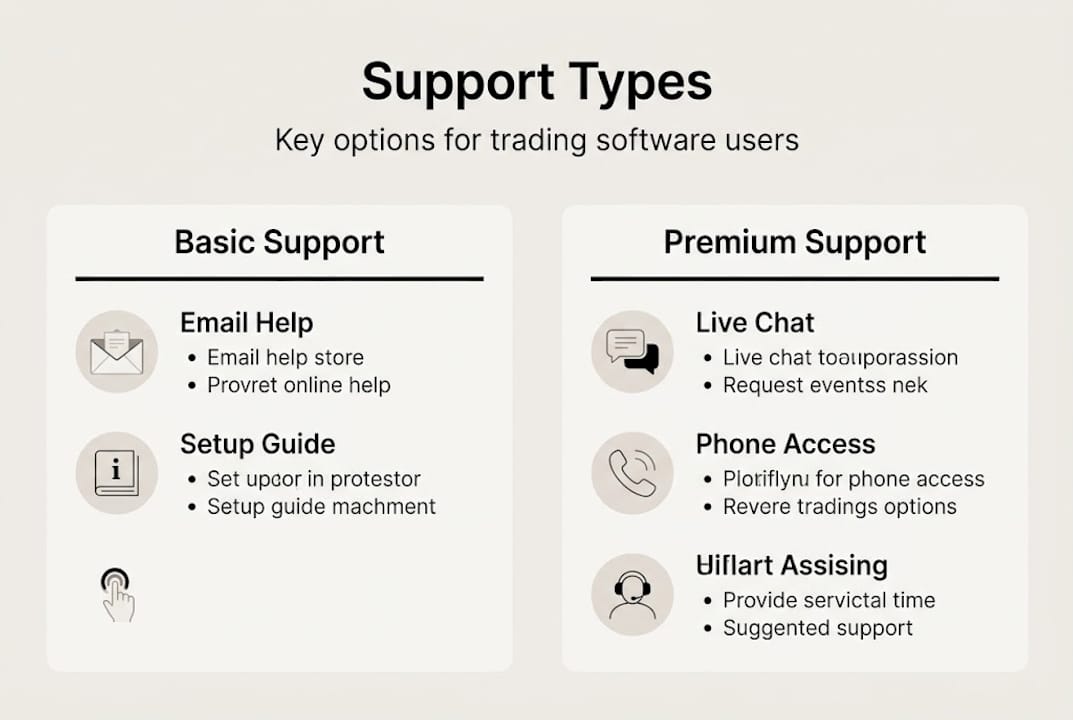
Here is a breakdown of the four primary support types you will encounter across types of trading software for forex and gold markets:
| Support type | What it covers | Best for** | Channel examples |n|—|—|—|—| | Technical | Platform errors, EA bugs, connectivity | All trader levels | Live chat, remote desktop, email tickets| | Educational | Strategy setup, platform navigation | New and intermediate traders | Video tutorials, webinars, PDF manuals| | Community | Script sharing, peer questions | Advanced algo traders | Forums, Discord, GitHub repositories| | Security | Account protection, fraud response | All, especially prop firms | Email alerts, dedicated security line|
Here is how to prioritize what matters most for your situation:
- Define your trading style first. If you run fully automated EAs 24/5, technical and security support are non-negotiable.
- Check availability hours. A support team that only operates 9 to 5 EST is useless during London or Tokyo sessions.
- Test the educational content. Watch one tutorial before you buy. If it is vague or outdated, the rest probably is too.
- Join the community before committing. Active forums signal an engaged vendor. Dead forums are a red flag.
- Ask about incident response. A good vendor has a documented procedure for security events, not just a generic email address.
For example, the Trade Assistant support model includes installation guidance and update notices, which matches what prop firm traders need. And on the security side, cloud data security best practices for financial firms set the standard for what incident response should look like in trading environments.
evaluating the quality of support: what to look for
Knowing support types exist is not enough. You need a practical method for ranking vendors before you spend money. High-quality support teams respond quickly, offer transparent escalation paths, and continuously update their educational resources. Use that standard as your benchmark.
| Quality indicator | Green flag | Red flag** |n|—|—|—| | Response time | Under 2 hours (live chat), under 24 hrs (email) | Days to respond, no acknowledgment| | Channel variety | Live chat + email + phone + knowledge base | Single email-only channel| | Update transparency | Release notes published, changelogs available | Silent updates with no explanation| | User reviews | High ratings, specific praise for support | Generic reviews, complaints about ghosting| | SLA availability | Clear SLA for premium or institutional plans | No SLA mentioned anywhere|
The warning signs are just as important as the green flags. If a vendor gives generic responses that do not address your specific MT4 or MT5 setup, that is a signal they will fail you at the worst possible moment. Professional traders know this, which is why they often demand SLAs that specify resolution windows and escalation contacts.
Pro tip: Before investing in any trading software, send the support team a specific technical question (not just “how does this work?”). Ask something like “How does your EA handle slippage during high-impact news events?” The quality and speed of that answer tells you everything about what you will get when real problems hit.
User reviews on third-party platforms are underrated research tools. Look for patterns, not single complaints. If multiple users mention slow response times during drawdown periods, that is a structural problem, not a fluke. For a deeper look at managing risk on your platform, reviewing troubleshooting steps and understanding software security tips will give you a stronger baseline for asking the right questions. Also check cybersecurity essentials benchmarks used by financial firms to see what a genuinely secure support infrastructure requires.
How robust support transforms trading outcomes
Let’s put this in concrete terms. A prop firm trader running a gold EA on MT5 notices slippage anomalies during Friday’s U.S. session close. The EA is executing correctly on paper but filling 4 to 6 pips worse than backtest benchmarks consistently. Without strong support, this trader spends days or weeks diagnosing broker-side vs. software-side issues.

With strong support? The vendor’s technical team identifies a latency conflict between the EA’s tick processing and the broker’s quote feed within two hours, pushes a configuration fix, and documents the solution. That kind of rapid intervention prevents losses during critical incidents and protects both capital and confidence.
Here is what robust, ongoing support actually enables:
- Custom indicator debugging: Advanced traders rely on bespoke scripts. Support teams who understand MQL4 and MQL5 code can fix broken indicators that generic help desks would never resolve.
- Security advisories: When a known vulnerability hits MetaTrader platforms, proactive vendors notify users before they are exposed, not after.
- Strategy adaptation: Markets change. Good support teams release updated parameters and filters as volatility regimes shift, keeping your EA competitive.
- Platform upgrade guidance: Moving from MT4 to MT5 is not trivial. Support that walks you through the migration, step by step, saves hours and reduces error risk.
Pro tip: Keep a log of every interaction with your support team, including ticket numbers, timestamps, and outcomes. Review it quarterly. This practice reveals whether your vendor is improving, stagnating, or quietly degrading in quality.
For a smooth start, the installation guide and the trading software setup resources serve as the first line of support. But when those resources reach their limits, the human team behind them is what separates serious platforms from disposable ones. Consider also exploring trade finance resources to understand how institutional traders structure operational risk, including technology support, into their overall frameworks.
The hidden value of support: what most traders miss
Here is an uncomfortable reality: most trading content focuses on entries, exits, risk management, and strategy selection. Almost none of it discusses what happens after you press buy on a trading software product. Support is treated as invisible infrastructure, and that is exactly why it is such a powerful edge when you take it seriously.
The traders who proactively engage with their support teams are often the first to benefit from new features, get bugs fixed before they cause damage, and receive early access to major platform releases. They are also the ones who submit feature requests that shape product roadmaps. That is not luck. It is the compounding reward of treating support as a relationship rather than a complaint line.
Volatile markets expose weak support instantly. When spreads blow out during a central bank announcement and your EA starts behaving unexpectedly, your support team’s response time is not a convenience metric. It is a performance variable with a direct dollar value. A useful reference point for understanding platform differences that affect this is our platform comparison between MT4 and MT5, which also touches on the support ecosystems around each.
boost your trading with the right software and support
Choosing trading software is only half the decision. The support structure behind it determines whether that software performs when the stakes are highest. FxShop24 offers a curated selection of EAs, trading robots, and automation tools, each backed by installation guidance, update notices, and multi-channel customer support.
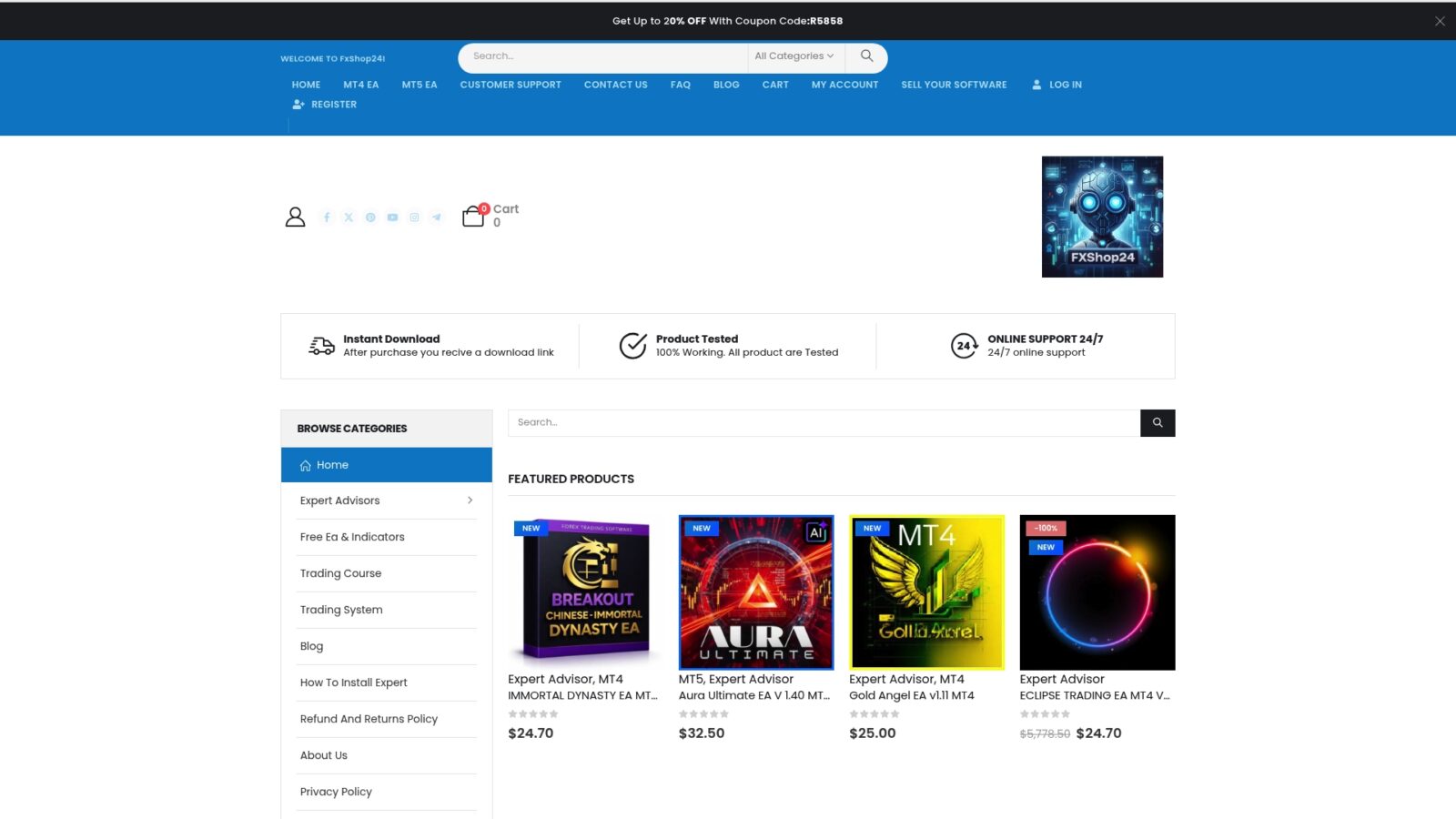
Whether you are a retail trader running your first EA or a prop firm managing multiple automated strategies, the right starting point is comparing platforms by their actual support capabilities, not just their marketing claims. Browse software types to see which tools align with your trading style, and explore automated trading systems built for serious performance with lifetime updates and prop firm compatibility included.
frequently asked questions
What should I do if my trading software stops working during a trade?
Immediately contact your provider’s support through their fastest channel, such as live chat, and document the issue with timestamps and screenshots. Fast support response significantly reduces the risk of compounding losses during critical platform failures.
How do I know if a trading software provider offers high-quality support?
Test their response time by asking a specific technical question before purchasing, and check if they offer multi-channel access plus educational resources. Support quality metrics like response speed and escalation transparency are reliable indicators of overall service standard.
Does better support always cost more in trading software?
Not always. Some leading providers bundle robust support into their base offering, though professional-grade SLAs with prioritized escalation typically come with premium or institutional subscription tiers.
Can strong support help prevent trading losses beyond just fixing bugs?
Yes. Good support teams provide proactive guidance on installation best practices, security configuration, and platform updates that prevent issues from occurring in the first place.
Recommended
- MT4/MT5 Trading Software Security: Protect Your Investments
- TraderAgent MT4 – Ultimate Trade Execution & Risk Control Tool | FxShop24 Marketplace
- 7 Types Of Trading Software Every Forex Trader Should Know
- Gold EA Secrets Revealed: What Experts Don’t Want You To Know | FxShop24 Marketplace
- DEXE Technical Analysis Mar 2 / Naijatipsland