


24
Jan
How Forex Trading Systems Work for Automated Success
Manual trading can leave you drained as you watch currency charts for hours, hoping not to miss a profitable move. For retail traders working with MT4 or MT5, automated trading systems promise to remove emotional bias and fatigue, letting you trade around the clock without constant supervision. With rule-based algorithms executing trades systematically and sophisticated tools now accessible, you can benefit from consistent strategies in the fast-moving forex and gold markets, no matter where you live.
Table of Contents
- Defining Forex Trading Systems And Automation
- Key Types Of Forex Trading Systems Explained
- How Automated Systems Operate On MT4 And MT5
- Practical Uses And Real-World Applications
- Risks, Limitations, And Safety Considerations
Key Takeaways
| Point | Details |
|---|---|
| Forex Trading Systems | These systems automate the execution of currency trades using predefined rules, enhancing consistency and speed. |
| Types of Automated Systems | Major types include trend-following, mean-reversion, arbitrage, grid trading, and scalping systems, each tailored for different market conditions. |
| Platform Features | MT4 is single-threaded and focuses on forex, while MT5 supports multi-threaded processing and various asset types, making it more efficient for automated systems. |
| Risks of Automation | Traders should be wary of over-optimization and technical failures, and implement risk controls to protect their accounts from unforeseen market events. |
Defining Forex Trading Systems and Automation
A forex trading system is a structured, rule-based framework that executes currency trades without requiring you to manually enter each position. Instead of sitting at your screen watching price movements, these systems follow predefined conditions—technical indicators, price patterns, moving average crossovers—and automatically place buy or sell orders when specific criteria are met. The core difference between manual trading and automated systems lies in consistency and speed. When you trade manually, emotions like fear and greed influence your decisions. You might hold a losing trade too long hoping it recovers, or exit a winning trade too early out of nervousness. Automated systems eliminate this psychological interference by following their programmed logic exactly every single time.
Automation in forex refers to the technology that powers these systems—the software infrastructure that monitors price data, evaluates conditions, and executes trades across your MT4 or MT5 platform. Research shows that rule-based algorithms executing trades systematically enhance trading consistency and improve risk management by removing human error from the equation. The most sophisticated versions incorporate machine learning capabilities that analyze historical price patterns and adapt their strategies based on market conditions. When you deploy an automated system, you’re essentially hiring a digital trader that never sleeps, never gets tired, and never second-guesses itself. These systems can process vast amounts of market data in milliseconds—far faster than any human could manually calculate entry and exit points.
What makes automation particularly powerful for retail traders like you is the elimination of timing risk. Traditional manual traders often miss trading opportunities during off-hours or while sleeping. An automated system running on your VPS (virtual private server) or directly on MT4/MT5 catches these moves in real-time. For instance, if gold spikes 45 pips during the Asian session while you’re sleeping in North America, a properly configured system captures that move automatically. The system also maintains strict emotional discipline by executing trades without hesitation or hesitation, following its programmed strategy regardless of market noise or news events that might otherwise distract manual traders.
The setup isn’t complex. You select or create a trading system with specific rules, integrate it into your MT4 or MT5 terminal through Expert Advisors (EAs), and let it trade according to your specifications. The system monitors your chosen currency pairs or gold continuously, enters positions when conditions align, manages them with your set stop-loss and take-profit levels, and exits automatically. No intervention needed from you beyond the initial configuration.
Pro tip: Start by backtesting any automated system over at least 2 years of historical data before deploying it with real money—this reveals how the system performs across different market conditions and helps you understand its realistic performance expectations rather than relying on promotional claims.
Key Types of Forex Trading Systems Explained
Forex trading systems fall into two primary categories based on how trades are executed: manual systems and automated systems. Manual systems rely on your direct analysis and discretionary decisions—you read the charts, identify patterns, and decide when to enter and exit trades. Automated systems, by contrast, use predefined rules executing trades systematically, eliminating the need for constant monitoring. The choice between these depends on your trading style, available time, and tolerance for letting algorithms make decisions on your behalf. Most retail traders gravitate toward automation specifically because it removes the burden of staring at screens all day while maintaining consistent strategy execution.
Within automated systems, you’ll encounter several distinct types tailored for different market conditions and timeframes. Trend-following systems identify and ride directional price movements, capturing momentum as currency pairs move upward or downward over hours or days. Mean-reversion systems do the opposite—they bet that prices will return to their average after moving too far in one direction, profiting from overbought or oversold conditions. Arbitrage systems exploit price discrepancies between different markets or currency pairs, entering and exiting positions within seconds to lock in small, consistent profits. Grid trading systems place multiple buy and sell orders at regular intervals around a price level, profiting from volatility as prices bounce between support and resistance levels. Scalping systems execute dozens or hundreds of trades daily, capturing tiny 2-5 pip movements per trade through high-frequency execution. Each type applies technical, fundamental, or sentiment analysis through Expert Advisors and algorithmic bots to keep your strategy consistent across multiple assets and timeframes.
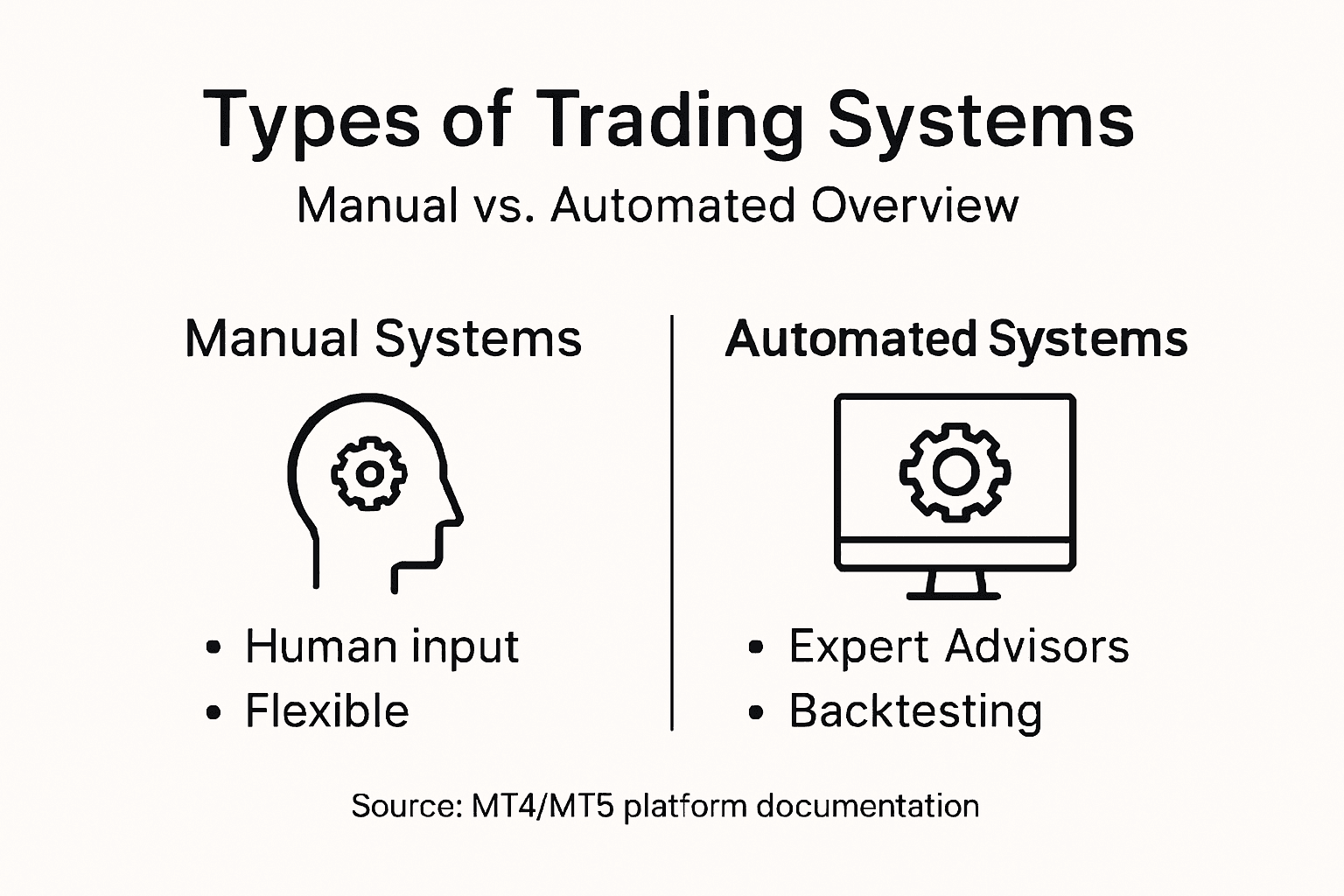
Here’s a summary of major automated forex trading system types and their core advantages:
| System Type | Primary Strategy | Main Advantage |
|---|---|---|
| Trend-Following | Ride market momentum | Maximizes trending moves |
| Mean-Reversion | Profit from reversals | Captures overextended swings |
| Arbitrage | Exploit price discrepancies | Locks in rapid micro-profits |
| Grid Trading | Orders at intervals | Profits from volatility |
| Scalping | High-frequency quick trades | Harvests small, fast gains |
The time-based execution styles matter too. Scalping holds positions for seconds to minutes, targeting quick profits in liquid pairs. Day trading enters and exits within a single trading session, avoiding overnight gap risk. Swing trading captures multi-day trends, holding positions for 3 to 14 days. Position trading takes the long view, holding trades for weeks or months based on fundamental factors. An automated system can operate across any of these timeframes—some traders deploy a scalping robot on EUR/USD while simultaneously running a swing trading system on gold. The beauty of automation is that each system operates independently, allowing you to diversify your trading approach without requiring separate manual effort.
The most effective traders don’t choose just one type and stick with it forever. Market conditions change, and what works during trending markets fails during sideways consolidation. Successful traders maintain multiple systems in their arsenal, activating them based on current market structure. You might enable your trend-following EA when strong directional momentum is present, then switch to a mean-reversion system when the market enters a ranging phase. This adaptability is what separates consistently profitable traders from those chasing losses with a single rigid strategy.
Pro tip: Test multiple system types on your MT4 or MT5 using historical backtesting before deciding which ones fit your risk tolerance and account size—scalping systems require tight stops and rapid execution while swing trading systems need larger accounts to withstand drawdowns.
How Automated Systems Operate on MT4 and MT5
Automated trading systems live inside your MT4 or MT5 platform as Expert Advisors (EAs), which are specialized software programs coded in programming languages called MQL4 or MQL5. Think of an EA as a digital employee stationed permanently at your trading terminal. Once you install and activate it, the EA never stops working. It monitors your chosen currency pairs or gold around the clock, analyzing price movements, indicator values, and market conditions based on the rules you’ve programmed into it. The moment conditions align with your predefined criteria, the EA executes a trade instantly without waiting for your confirmation. This real-time analysis and instant trade execution based on programmed algorithms eliminates emotional hesitation and captures opportunities the moment they appear.

The operational difference between MT4 and MT5 matters for your trading strategy. MT4, the older platform, handles single-threaded processing, meaning it analyzes one data stream at a time. MT5 introduced multi-threaded capability, allowing it to analyze multiple assets and timeframes simultaneously without slowing down. When you run a complex EA involving multiple currency pairs or numerous indicators, MT5 processes the calculations faster and more efficiently. MT5 also supports multi-asset trading, letting a single EA trade not just forex pairs but also stocks, commodities, and cryptocurrencies on the same platform. For backtesting purposes, which you must do before deploying any EA with real money, MT5 provides advanced features that allow you to test strategy performance across different market conditions and stress-test your system’s resilience. That said, MT4 remains popular among retail traders because thousands of proven EAs were built for it, and many prop trading firms still accept MT4 submissions.
Below is a comparison of MetaTrader 4 (MT4) and MetaTrader 5 (MT5) platform features for automated trading:
| Feature | MT4 | MT5 |
|---|---|---|
| Processing | Single-threaded | Multi-threaded |
| Asset Support | Forex only | Forex, stocks, crypto |
| Backtesting Tools | Basic | Advanced (multi-asset) |
| EA Compatibility | MQL4 language, huge library | MQL5 language, growing base |
When you activate an EA on your account, several processes happen behind the scenes. The EA accesses your account’s live market data and generates trading signals based on its internal logic. Upon signal generation, it automatically places orders at your specified entry price, sets stop-loss levels to limit losses if the market moves against you, and places take-profit orders to close winning trades at your target price. The EA manages everything from entry through exit without requiring any action from you. It can open and close multiple positions simultaneously across different pairs, maintain precise position sizing based on your risk parameters, and adapt its behavior based on account equity changes. You can also configure the EA to operate only during specific market hours (like during London or New York sessions) or to skip trading during high-volatility news events when slippage becomes problematic.
The MetaTrader 5 marketplace provides thousands of pre-built automated tools ready to download and deploy, though you can also customize existing EAs or hire developers to build your own. The key requirement is ensuring your EA has been properly backtested and forward-tested before you trade with real capital. Many novice traders make the mistake of deploying an EA based solely on marketing claims without verifying actual performance through rigorous historical testing.
Pro tip: Always run your EA through at least 500 trades of historical backtesting before deploying it with real money, and enable the “hedging” option in your MT5 account settings if you plan to hold both long and short positions simultaneously—this prevents your broker from netting opposite trades together.
Practical Uses and Real-World Applications
Automated forex trading systems solve real problems that retail traders face every single day. The first and most obvious application is 24/7 market monitoring without your constant presence. The forex market trades around the clock across Asian, European, and American sessions. A manual trader sleeping in New York misses opportunities in Tokyo. An automated system doesn’t sleep. It monitors price action across all major sessions simultaneously, capturing moves you would otherwise miss entirely. If a high-impact economic report creates sudden volatility in EUR/USD at 2 AM your time, your EA reacts instantly with entry signals while you rest. This continuous vigilance allows you to participate in every profitable setup across every trading session without sacrificing sleep or work time.
Another critical application involves consistent strategy execution across multiple markets. Many traders struggle with discipline—they follow their system perfectly on one trade but deviate on another based on emotions or overconfidence. Machine learning-driven automated trading systems optimize strategies, predict market movements, and improve profitability by integrating technical and fundamental analysis with adaptive AI that adjusts for dynamic market conditions. An EA eliminates discretion entirely. It applies identical rules to every single trade without exception. If your system says to enter on a 50-period moving average crossover with 2 percent risk, it executes exactly that—no more, no less—across EUR/USD, GBP/USD, and gold simultaneously. This mechanical consistency produces reliable, repeatable results that manual trading simply cannot match.
Risk management becomes measurable and automatic with deployed systems. You program your EA to never risk more than your specified percentage per trade, to close losing positions at your predetermined stop-loss, and to take profits at calculated levels. This prevents the catastrophic account wipeouts that plague undisciplined traders. Consider a real-world scenario: a trader using a grid trading EA on gold can maintain hundreds of small positions that collectively profit from volatility without any single loss exceeding their risk tolerance. The EA manages position sizing, order placement, and exit execution across all orders simultaneously, something physically impossible for a manual trader to do with the same precision. Automated forex trading robots combining technical analysis, fundamental metrics, and sentiment analysis enable traders to maximize profits via fast execution while reducing human error across diverse market situations.
Additional practical applications include backtesting strategies before risking capital, testing multiple systems simultaneously to identify which works best in current market conditions, and operating multiple trading strategies without requiring your divided attention. A scalping EA can trade the 1-minute timeframe on EUR/USD while a swing trading system simultaneously works the daily chart on gold. Each operates independently according to its own logic, allowing you to diversify your approach and reduce dependence on any single strategy.
Pro tip: Deploy your first automated system on a demo account for at least two complete market weeks before going live, ensuring it handles real market conditions like gap openings, news spikes, and volatility shifts without unexpected behavior.
Risks, Limitations, and Safety Considerations
Automated trading systems are powerful tools, but they come with real dangers that can destroy accounts if you ignore them. The most insidious risk is over-optimization, also called curve-fitting. This happens when you tweak your EA’s parameters obsessively to perfectly match historical price data. You test it on the last two years of EUR/USD and achieve 89 percent win rate and 3,200 pips of profit. Looks perfect on a backtest. Then you deploy it live and it loses money immediately. Why? Because the system was optimized so tightly to past conditions that it fails when market structure shifts even slightly. Real markets change constantly. Economic cycles rotate. Volatility patterns evolve. A system that performs brilliantly in a trending market collapses in a ranging market, and vice versa. Over-optimization to past data causes poor future performance and lack of adaptability to unexpected market events, making systems unreliable when deployed with real capital.
Technical failures represent another category of risk you cannot ignore. Your VPS disconnects from the internet. Your broker’s server experiences downtime during high volatility. Your EA contains a coding bug that triggers errant orders. Your internet connection drops during a critical trade execution. These scenarios happen more often than you think. That’s why comprehensive risk controls and safeguards including maximum order size limits and kill switches are essential for maintaining system stability and protecting your account. A kill switch is a manual override that stops your EA instantly if something goes wrong. Maximum order size limits prevent the system from placing a single enormous trade that could wipe your account if it moves against you. Pre-trade validation checks confirm that market data is current and legitimate before executing orders. Without these safeguards, a single technical glitch can transform your 10,000-dollar account into a 200-dollar account in seconds.
System complexity creates blind spots that even experienced traders miss. A sophisticated EA combining multiple indicators, machine learning components, and intricate position management logic becomes difficult to understand and interpret. You deploy it because the backtest results looked phenomenal, but when it loses money in live trading, you cannot diagnose why. Is the problem the moving average calculation? The sentiment analysis component? The position sizing algorithm? Complexity without transparency breeds false confidence. You think you understand what the system does, but you actually don’t. A simpler system with clear, understandable logic that you can explain to someone else is more reliable than a black box that nobody fully comprehends.
Market events outside normal parameters create catastrophic risks. Flash crashes, gap openings, extreme volatility spikes during major economic announcements, and liquidity droughts can cause your stop-losses to execute at prices far worse than intended. Your EA might be programmed perfectly, but if the market gaps 200 pips below your stop-loss overnight, you lose 200 pips instead of your planned 20. Automated systems cannot think. They cannot decide to hold a position through unusual circumstances or override their logic based on external context.
Pro tip: Set strict maximum daily and weekly loss limits in your EA settings so that if losses exceed your tolerance threshold, the system stops trading automatically until the next day or week, preventing a single bad session from decimating your account.
Unlock True Automated Trading Success with Proven Forex Systems
Forex trading systems work best when they eliminate emotional errors and execute well-tested strategies consistently. If you struggle with missing trading opportunities while you sleep or find it difficult to stick to strict risk controls automated systems can transform your approach. The challenge is finding expert advisors that deliver on their promises with real backtested results and adaptability across changing market conditions. Concepts like trend-following, mean-reversion, and grid trading require reliable software that runs seamlessly on MetaTrader 4 or MetaTrader 5 platforms.
Discover powerful, prop firm-ready automated trading solutions at FxShop24 that harness the latest AI and algorithmic strategies designed specifically for forex and gold markets. Benefit from lifetime updates, unlimited licenses, and instant downloads so you can start capturing opportunities 24/7 without hesitation. Take control of your trading discipline and risk management today with tested EAs and indicators built for real-world market volatility. Visit FxShop24 now and automate your path to consistent profitability using expert systems tailored for both novice and professional traders.
Frequently Asked Questions
What is a forex trading system?
A forex trading system is a structured, rule-based framework that executes currency trades automatically based on predefined conditions such as technical indicators and price patterns, eliminating the need for manual trade entry.
How do automated forex trading systems work?
Automated forex trading systems, often referred to as Expert Advisors (EAs), operate within trading platforms like MT4 or MT5. They analyze market data, generate trading signals based on programmed rules, and execute trades instantly without human intervention.
What are the benefits of using an automated trading system?
The benefits include 24/7 market monitoring, consistent strategy execution without emotional interference, improved risk management, and the ability to capture trading opportunities instantly, even when the trader is not actively monitoring the market.
What should I consider before using an automated trading system?
Before using an automated trading system, consider factors like the system’s optimization over historical data, risk management settings, complexity of the strategy, and the importance of backtesting its performance under various market conditions.
Recommended
- What Is Forex Automation: Transforming Modern Trading
- Stop Losing Money: 10 Forex Trading Bot Mistakes That Kill Accounts (And How To Fix Them) | FxShop24 Marketplace
- Are Forex Trading Bots Dead? Do People Still Pass Prop Firm Challenges With EAs? | FxShop24 Marketplace
- From Demo To Real: Transitioning Safely With Expert Advisors | FxShop24 Marketplace
Author