



10
Jun
What Is Strategy Automation? A 2026 Business Guide
TL;DR:
- Strategy automation integrates real-time data, AI, and workflows to streamline strategic planning, execution, and monitoring. It reduces overhead costs by up to 75%, shrinks response times by months, and reallocates up to 72% of executive time toward strategic decisions. Implementing it effectively requires starting small, establishing governance, and continuously managing data quality to avoid failure.
Strategy automation is the use of technology to connect strategic planning, execution, and monitoring into a single, continuously updated system. Where traditional planning cycles rely on quarterly reviews, spreadsheets, and manual reporting, strategic automation replaces those processes with real-time data integration, AI-driven analysis, and automated workflows. Platforms like ERP systems, CRM integrations, and AI agents now handle tasks that once consumed entire planning teams. The result is faster decisions, tighter alignment between goals and operations, and a measurable reduction in the administrative burden on leadership.
What is strategy automation and why does it matter now?
Strategy automation is defined as the systematic use of digital tools, AI agents, and integrated data platforms to replace manual strategic management tasks with automated, real-time processes. The industry term most commonly used alongside this concept is strategic automation, which refers specifically to applying automation at the planning and governance layer of an organization, not just at the operational level.
The distinction matters. Operational automation handles repetitive tasks like invoice processing or inventory reordering. Strategic automation handles higher-order functions: tracking whether your organization is moving toward its goals, reallocating resources when market conditions shift, and generating competitive intelligence without a team of analysts doing it manually. Tools like Cascade, Workboard, and Quantive operate in this space, alongside AI agents built on platforms like Microsoft Copilot and custom GPT workflows.
For trading professionals and business owners, the relevance is direct. Strategic automation in business converts static annual plans into adaptive systems that respond to live data. That shift from reactive to proactive management is the core value proposition.
What are the primary benefits of strategy automation for organizations?
The financial case for adopting strategic automation is well-documented and significant. Overhead costs drop 30 to 75% by eliminating manual tasks like data consolidation, status reporting, and cross-departmental coordination. That range reflects implementation depth: organizations that automate a single workflow see modest savings, while those that integrate automation across the full strategic lifecycle see the upper end. ROI of 150 to 500% is achievable within two to five years, which positions this as one of the highest-return technology investments available to mid-market and enterprise organizations.
The time savings at the executive level are equally striking. Up to 72% of executive time is consumed by manual processes before automation, including administrative coordination, information gathering, and status meetings. Reclaiming even half of that time redirects leadership attention toward decisions that actually require human judgment. That is not a marginal efficiency gain. It fundamentally changes how a leadership team operates.
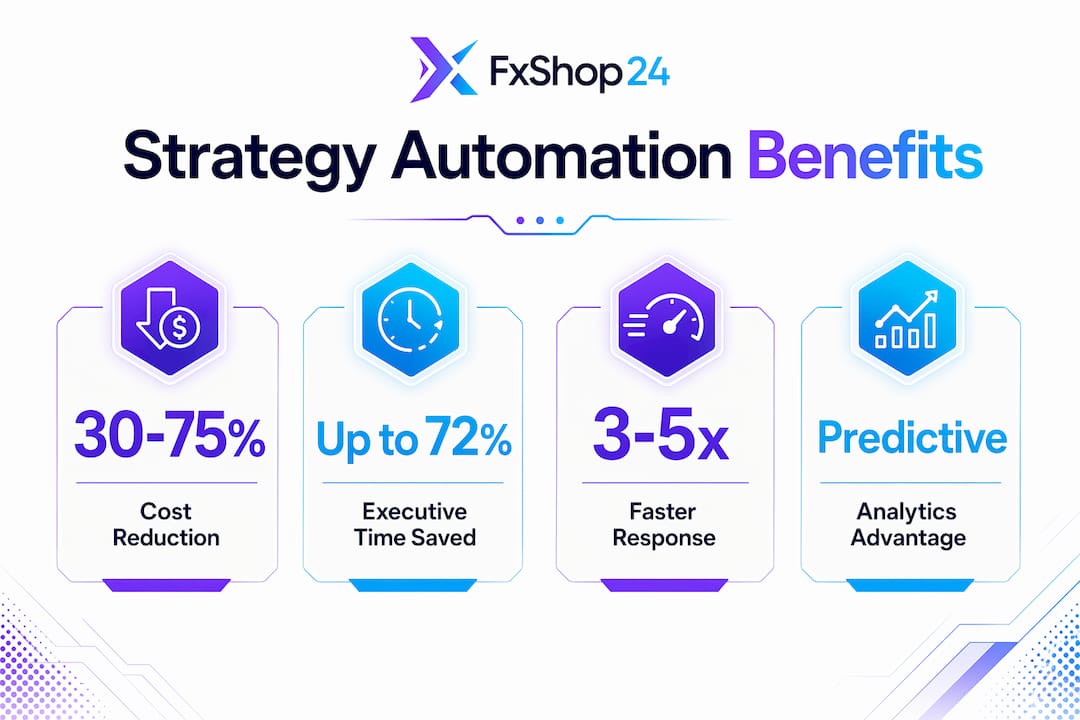
Response time improvement is the third major benefit, and arguably the most strategically significant. Organizations using automated strategic dashboards report response time improvements of 3 to 6 months, shifting from quarterly adjustment cycles to near-real-time resource reallocation. In volatile markets, that speed difference separates organizations that adapt from those that react too late.
Predictive analytics within strategy automation adds another layer by anticipating delays, resource constraints, and budget risks before they materialize. This transforms management from a reactive discipline into a forward-looking one, where leaders address problems in the planning stage rather than the crisis stage.
How does strategy automation work in practice?
The functional architecture of strategic automation rests on four interconnected components.
Centralized strategy system. A single platform serves as the source of truth for all strategic objectives, KPIs, and initiatives. Every team and business unit connects to this hub, eliminating the fragmented spreadsheets and siloed reporting that create misalignment.
Automated data integration. The centralized system pulls live data from ERP platforms like SAP or Oracle, CRM systems like Salesforce, and project management tools like Asana or Jira. Lack of automated data integration is the primary barrier to automation success, because without unified data, every dashboard and report still requires manual input to stay current.
Real-time strategic dashboards. These replace monthly or quarterly reporting decks with continuously updated views of performance against objectives. Leaders see where execution is on track and where it is drifting, without waiting for a reporting cycle to close.
AI agents for strategic functions. AI agents automate competitive research, goal alignment, and initiative tracking by continuously gathering external data and generating strategic outputs. An AI agent monitoring competitor pricing, for example, can flag a market shift within hours rather than weeks.
The most advanced application is cascading automation. Cascading automation transforms strategy execution into a living system that instantly updates objectives, budgets, OKRs, and operational tasks when conditions change. If a revenue target is revised, cascading automation propagates that change through every connected budget line, team OKR, and project milestone automatically.
Pro Tip: Start with one AI agent embedded in a high-frequency process, such as weekly competitive scanning or OKR progress tracking, before attempting to automate the full strategic lifecycle. A single working agent builds organizational confidence faster than a large-scale rollout that stalls mid-implementation.

No-code platforms now allow business users to build and modify these integrations without IT involvement, which dramatically shortens the time between identifying a strategic need and deploying a solution.
How to choose the right approach and avoid common pitfalls
Not all automation approaches deliver equal results, and the gap between a successful implementation and a failed one often comes down to sequencing and process selection.
| Approach | Best for | Key risk |
|---|---|---|
| Single workflow automation | Organizations new to strategic automation | Limited impact if the workflow is not high-frequency |
| AI agent deployment | Teams needing faster competitive or performance intelligence | Requires clean, integrated data to function accurately |
| Full cascading automation | Mature organizations with unified data infrastructure | High complexity; fails without strong governance |
| No-code strategy platforms | Business units needing flexibility without IT dependency | Can create inconsistency if not governed centrally |
A true automation strategy prioritizes processes using clear criteria: volume, risk, and process stability. High-volume, low-risk, stable processes are the best candidates for early automation. Complex, judgment-heavy processes with irregular inputs should come later, after the foundational infrastructure is in place.
The most common failure mode is attempting to automate the entire strategic lifecycle at once. Most organizations fail by taking this approach, which creates implementation paralysis and rarely delivers the focused wins needed to justify continued investment. The organizations that succeed start with one automated workflow or agent, demonstrate measurable value, and expand from there.
The second major pitfall is shadow strategy. This occurs when teams, frustrated by a system that does not reflect their reality, maintain their own manual workarounds in parallel. The result is two versions of strategy: the official automated one and the real one living in spreadsheets. Preventing shadow strategy requires a centralized real-time strategic hub that all business units actively update and trust.
Pro Tip: Before selecting any automation tool, audit how many places your organization currently stores strategic data. If the answer is more than two, consolidation is your first project, not automation.
Governance models with clear ownership and performance metrics are non-negotiable as automation scales. Without defined accountability for data quality and system updates, even well-designed automation degrades over time.
What are the practical first steps to implement strategy automation?
Getting started with strategic automation does not require a large technology budget or a dedicated transformation team. The following sequence works for organizations at any scale.
Map current strategic workflows. Document every manual process involved in planning, reporting, and performance tracking. Identify where data is collected, who touches it, and how long each step takes. This baseline reveals your highest-impact automation targets.
Set clear business outcomes. Define what success looks like before selecting any tool. Faster board reporting, reduced planning cycle time, and improved OKR completion rates are all measurable outcomes that should drive tool selection, not the reverse.
Prioritize high-impact use cases. Use the criteria of volume, risk, and stability to rank your automation candidates. A weekly competitive intelligence report that currently takes three hours to compile manually is a better first target than an annual strategic planning process that happens once a year.
Choose the right technology stack. For most organizations, the starting point is a strategy platform like Cascade or Quantive combined with RPA tools like UiPath or Automation Anywhere for data collection tasks. AI agents built on platforms like OpenAI or Microsoft Copilot Studio handle the analytical layer. The workflow for forex automation follows a similar layered logic, which trading professionals can adapt directly to broader organizational strategy.
Build a pilot and measure it. Deploy one automated workflow or agent, run it for 60 to 90 days, and measure the outcome against your baseline. Document the time saved, the errors eliminated, and the decisions improved. This evidence justifies the next phase of investment.
Establish governance from day one. Assign ownership for each automated process, define data quality standards, and set a review cadence. Automation without governance drifts. The risk management principles that apply to automated trading systems apply equally here: define the rules before the system runs unsupervised.
Key takeaways
Strategy automation delivers the highest returns when organizations integrate data first, automate incrementally, and govern continuously rather than deploying technology without a clear ownership structure.
| Point | Details |
|---|---|
| Core definition | Strategy automation connects planning, execution, and monitoring through integrated technology and AI agents. |
| Financial impact | Organizations can reduce strategic overhead by 30 to 75% and achieve 150 to 500% ROI within five years. |
| Speed advantage | Automated dashboards compress response cycles from quarterly to near-real-time, a 3 to 6 month improvement. |
| Biggest pitfall | Attempting full-lifecycle automation at once causes failure; start with one workflow or AI agent. |
| Governance is mandatory | Clear ownership, data standards, and performance metrics prevent shadow strategy and system degradation. |
Why strategy automation is no longer optional
At Fxshop24, we work with traders and business owners who have already made the shift from manual execution to automated systems. What we observe consistently is that the professionals who resist automation do not stay competitive for long. The performance gap between those who automate and those who do not widens every quarter, and it widens faster than most people expect.
The insight that rarely gets discussed is this: the hardest part of strategy automation is not the technology. It is the organizational willingness to treat strategy as a living system rather than a document that gets reviewed twice a year. Every tool we have seen succeed was deployed inside an organization that had already accepted that static planning is a liability. Every tool we have seen fail was dropped into a culture that still believed the annual plan was the real work.
The future of automated trading mirrors the future of organizational strategy: those who build systems that adapt in real time will outperform those who rely on periodic human review. That is not a prediction. It is already the observable reality in the markets we track daily.
— FxShop24
Automate your trading strategy with Fxshop24
If strategy automation has you thinking about how to apply these principles directly to your trading operations, Fxshop24 has the tools to make that transition concrete. The same logic that drives organizational strategic automation, real-time data, automated execution, and continuous performance monitoring, powers the expert advisors and trading systems available on the platform.
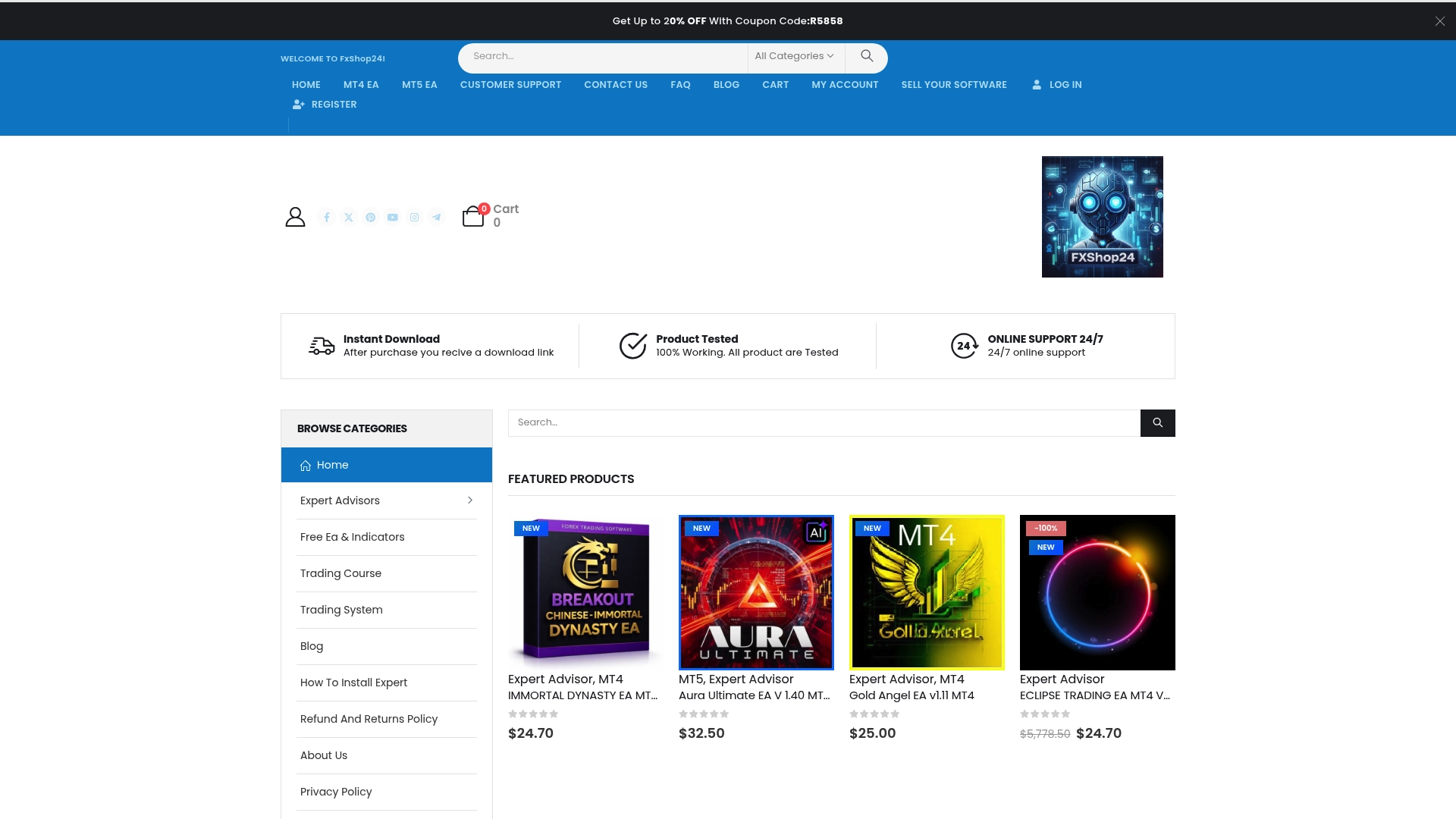
Fxshop24 offers a full catalog of automated futures trading systems built for MetaTrader 4 and MetaTrader 5, covering forex and gold markets with prop firm-ready configurations. Whether you are building your first automated strategy or scaling an existing one, the platform provides instant downloads, lifetime updates, and direct support. Explore the trading automation trends for 2026 to see where the market is heading and which systems are positioned to perform.
FAQ
What is the strategy automation definition in simple terms?
Strategy automation is the use of technology, including AI agents, integrated dashboards, and automated workflows, to replace manual strategic planning and monitoring tasks with real-time, data-driven processes.
What are the main benefits of strategy automation?
The primary benefits include a 30 to 75% reduction in strategic management overhead, response time improvements of 3 to 6 months, and the recovery of up to 72% of executive time previously spent on manual coordination tasks.
How does strategy automation work with existing business tools?
Strategy automation integrates with ERP systems like SAP, CRM platforms like Salesforce, and project tools like Jira to pull live data into a centralized strategy hub, eliminating manual reporting and enabling real-time visibility.
What are the most common strategy automation tools?
Platforms like Cascade, Quantive, and Workboard serve as centralized strategy hubs, while RPA tools like UiPath handle data collection and AI agents built on Microsoft Copilot or OpenAI manage competitive research and OKR generation.
How long does it take to see ROI from strategic automation?
Most organizations achieve measurable ROI within two to five years, with early pilots delivering visible time savings and cost reductions within the first 60 to 90 days of deployment.