


7
Jun
The Role of EAs in Gold Trading: 2026 Guide
TL;DR:
- Expert Advisors execute gold trades automatically based on predefined rules, removing emotion and enabling 24/7 market coverage. Validated strategies, like liquidity sweep systems with fixed ATR stops, achieve high win rates such as 71% in 2026; continuous monitoring and proper deployment are essential. Incorporating AI multi-agent architectures enhances signal accuracy, but traders must supervise and adapt EAs to changing market regimes for optimal results.
Expert Advisors (EAs) are algorithmic trading systems that execute gold trades automatically based on predefined rules, removing emotion from decisions and enabling consistent, around-the-clock market participation. The role of EAs in gold trading has expanded significantly as AI-driven architectures and validated backtesting methods give traders a measurable edge on XAU/USD. Platforms like MetaTrader 4 (MT4) and MetaTrader 5 (MT5) have made deploying these systems accessible to retail traders and institutional desks alike. This guide covers how EAs work, what the performance data actually shows, and how to deploy them without common mistakes that erode returns.
How do Expert Advisors operate in gold trading?
An Expert Advisor is a program that runs inside MT4 or MT5, scanning price data and executing trades the moment a set of conditions is met. The system never sleeps, never second-guesses, and never deviates from its rules. That consistency is both its greatest strength and its most important constraint.

The algorithms powering EAs for gold trading typically fall into a few categories. Trend-following systems track moving averages or momentum signals to enter in the direction of the dominant move. Mean-reversion systems look for overextended price action and fade the move back toward equilibrium. A third category, increasingly common in 2026, targets liquidity sweeps: moments when price briefly breaks a key level to trigger stop orders before reversing sharply.
What data does an EA actually analyze? Most systems process:
- Price action signals: candlestick patterns, support and resistance levels, and breakout conditions on the H1 or H4 chart
- Momentum indicators: RSI divergence, ATR-based volatility filters, and moving average crossovers
- Session filters: time-of-day rules that restrict trading to the London or New York session when gold volume is highest
- Spread filters: conditions that pause execution when the bid-ask spread widens beyond a defined threshold
The most sophisticated systems now use multi-agent AI architectures where multiple models analyze the same trade idea independently and a central orchestrator only approves execution when the models reach consensus. This debate-style validation reduces false signals that a single-model system would miss.
Pro Tip: When evaluating any EA for gold, check whether it includes a spread filter. Gold spreads can spike to 5x their normal width during low-liquidity periods, and an EA without a spread filter will execute into those conditions without hesitation.
What are the strategic advantages and limitations of using EAs for gold?
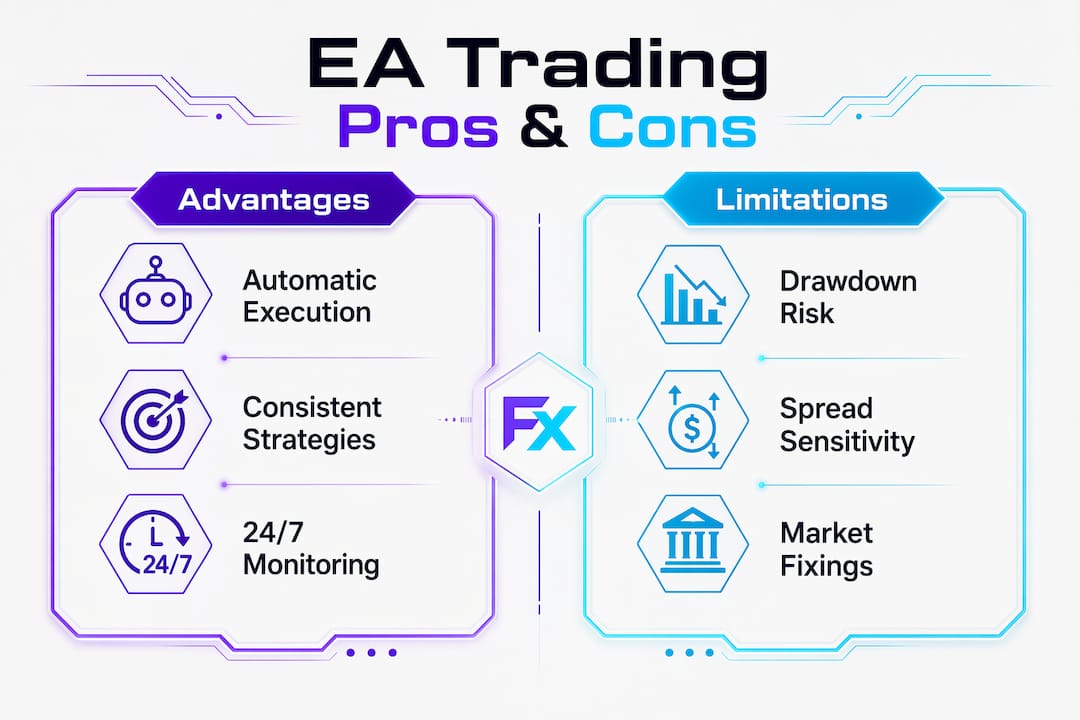
The case for automation in gold trading is straightforward. Gold trades 24 hours a day across Asian, London, and New York sessions. No human trader can monitor all three sessions with consistent discipline. An EA can.
The core advantages are well-documented:
- Emotionless execution: The EA follows its rules on a losing streak exactly as it does on a winning streak. Human traders rarely manage this.
- 24/7 market coverage: Gold reacts to geopolitical events and macroeconomic data at any hour. An EA captures setups that occur while you sleep.
- Strict risk parameters: Position sizing, stop-loss placement, and maximum daily drawdown limits are enforced automatically on every single trade.
- Speed: An EA can identify a signal and place an order in milliseconds. Manual traders executing the same setup will almost always get a worse fill.
The limitations are equally real. Overfitting is the most common failure mode. A developer optimizes an EA on five years of historical data until the backtest looks perfect, then deploys it live only to watch it fail because the strategy was tuned to past noise rather than durable market structure. Market regime shifts present a related problem. A momentum EA that performed well during a trending gold market in 2024 may generate consistent losses in a choppy, range-bound 2026 environment.
“Backtesting alone is not sufficient; continuous monitoring and adaptation are critical as algorithmic strategies degrade over time in live trading environments.”
Drawdown periods are psychologically brutal even when the strategy is statistically sound. A trader who abandons an EA after a 15% drawdown may be stopping it right before the recovery. Understanding your EA’s historical maximum drawdown before going live is not optional. It is the baseline for deciding whether you can tolerate the system at all.
One nuance specific to gold that most EA guides ignore: LBMA Gold Price fixings at 10:30 and 15:00 BST cause temporary spread widening and erratic price behavior. Professional traders avoid placing orders during these windows and wait 10 to 15 minutes after each fixing for cleaner execution conditions. Any EA deployed on gold should have this timing logic built in.
How effective are automated gold trading strategies in 2026?
Performance data from validated strategies gives a clearer picture than marketing claims. A liquidity sweep strategy on XAU/USD H1 achieved a 71% win rate as of May 2026 by combining three conditions: a confirmed liquidity sweep of a prior high or low, a momentum exhaustion signal, and alignment with the dominant trend on a higher timeframe. That combination filters out the majority of false breakouts that plague simpler systems.
Stop placement methodology matters more than most traders realize. Fixed ATR stops outperform trailing stops in mean-reversion gold strategies because they lock in a defined risk-reward ratio and avoid the common problem of trailing stops giving back gains during normal price oscillation. The 71% win rate cited above was achieved using fixed ATR-based targets, not trailing exits.
| Strategy type | Win rate indicator | Key condition |
|---|---|---|
| Liquidity sweep (XAU/USD H1) | 71% validated (May 2026) | Sweep + momentum exhaustion + trend alignment |
| Trend-following EA | Varies by regime | Moving average alignment + session filter |
| Mean-reversion EA | Higher in ranging markets | ATR-based fixed stops outperform trailing stops |
| AI multi-agent system | Reduced false signals | Model consensus required before execution |
AI-powered multi-model systems analyze trade ideas in sequence, creating a structured debate that improves signal quality and prevents the blind spots that affect any single algorithm. This architecture is now the standard for institutional-grade automated systems and is increasingly available to retail traders through platforms like MT5.
Pro Tip: Never judge an EA on fewer than 200 live trades. Gold markets cycle through trending and ranging regimes, and a sample smaller than 200 trades will not capture enough regime variation to give you a statistically meaningful read on performance.
For context on current gold price dynamics that your EA will be operating in, tracking live precious metals prices gives you a real-time reference point for volatility conditions and spread behavior.
How should traders implement and manage EAs for gold trading?
Deployment sequence matters as much as strategy selection. Follow this order before risking any real capital:
- Backtest on at least 5 years of historical XAU/USD data using MT4 or MT5’s Strategy Tester. Look for consistent results across different market conditions, not just peak performance periods.
- Forward-test on a demo account for a minimum of four to eight weeks. Demo testing simulates live conditions without capital risk and reveals execution issues that backtests cannot replicate.
- Start live trading with reduced position size, typically 25% to 50% of your intended allocation, until the EA demonstrates live performance consistent with its backtest.
- Monitor weekly, not daily. Daily monitoring leads to premature intervention. Set a review schedule and stick to it unless the EA breaches a predefined drawdown threshold.
- Review and adapt quarterly. Gold market dynamics shift. An EA that worked well in Q1 may need parameter adjustments by Q3 if volatility conditions change materially.
Broker selection directly affects EA performance. Latency and execution quality have a measurable impact on gold EAs, particularly near session opens and during high-impact news events. Choose a broker with ECN execution, tight average spreads on XAU/USD, and a server located close to major liquidity providers. A 50-millisecond latency difference can mean the difference between a filled order at your target price and a slipped fill that turns a winning trade into a marginal one.
Position sizing is the single most controllable risk variable. Most professional EA operators risk between 0.5% and 1.5% of account equity per trade. For gold specifically, where ATR can exceed 20 to 30 points on an active day, fixed fractional position sizing protects the account during drawdown periods far better than fixed lot sizing. You can find detailed frameworks for this in Fxshop24’s guide on automated trading risk management.
Key takeaways
The most effective EAs for gold trading combine liquidity-aware algorithms, fixed ATR risk management, and continuous post-deployment monitoring to maintain performance across changing market regimes.
| Point | Details |
|---|---|
| EA definition and function | Expert Advisors execute gold trades automatically on MT4/MT5 based on predefined algorithmic rules. |
| Performance benchmark | A validated liquidity sweep strategy achieved a 71% win rate on XAU/USD H1 as of May 2026. |
| Stop methodology | Fixed ATR stops outperform trailing stops in mean-reversion gold strategies by preserving win rate. |
| Deployment sequence | Backtest, then demo forward-test for 4 to 8 weeks before committing live capital to any EA. |
| Timing awareness | Avoid EA order placement during LBMA fixings at 10:30 and 15:00 BST to prevent poor fills. |
What I’ve learned from watching EAs trade gold at scale
After working with automated gold trading systems across multiple market cycles, the pattern that stands out most is how often traders underestimate regime sensitivity. An EA with a 70%+ win rate in a trending market can flip to a 40% win rate in a choppy one. The strategy itself has not broken. The market has simply changed shape. Traders who understand this stay in the game. Those who don’t pull the plug at exactly the wrong moment.
The shift toward AI-driven multi-agent architectures is the most meaningful development in automated gold trading right now. The idea that multiple models can debate a trade idea before execution, rather than one model acting unilaterally, mirrors how experienced trading desks actually operate. It is not a gimmick. It is a structural improvement in how decisions get made under uncertainty.
My honest recommendation: treat your EA as a junior trader, not a set-and-forget machine. It needs supervision, periodic review, and occasional recalibration. The traders who get the most out of automation are the ones who stay engaged with their systems rather than walking away entirely. Automation handles execution. Judgment still belongs to you.
— FxShop24
Explore automated gold trading tools at Fxshop24
Fxshop24 offers a curated selection of tested EAs and automated trading systems built specifically for gold and forex markets on MT4 and MT5.
Whether you are looking for your first EA or upgrading to an AI-powered system, the Fxshop24 marketplace covers the full spectrum. The automated futures trading systems guide is a strong starting point for traders evaluating gold-focused automation. For a broader overview of what is available, the top EA examples for MT4 and MT5 page showcases leading systems validated for 2026 market conditions. Every product comes with installation support and lifetime updates, so your system stays current as market dynamics evolve.
FAQ
What is the role of EAs in gold trading?
Expert Advisors automate trade execution on XAU/USD by scanning for predefined signals and placing orders without manual input. Their primary role is to remove emotional decision-making and maintain consistent rule-based trading across all market sessions.
Do EAs actually work for gold trading?
Validated strategies show measurable results. A liquidity sweep EA on XAU/USD H1 achieved a 71% win rate in May 2026, though performance depends heavily on market regime, broker execution quality, and proper deployment practices.
How long should I test an EA before trading gold live?
Industry practice recommends backtesting on at least five years of historical data followed by several weeks to months of demo forward-testing before live deployment. Skipping the demo phase is the most common and costly mistake retail traders make.
What trading hours should my gold EA avoid?
EAs should be configured to avoid order placement during LBMA Gold Price fixings at 10:30 and 15:00 BST. These windows cause temporary spread widening and erratic fills that degrade EA performance and skew backtest-to-live comparisons.
What makes AI-powered EAs different from standard rule-based systems?
AI-powered systems use multi-agent architectures where multiple models evaluate the same trade idea and must reach consensus before execution. This reduces false signals and single-model blind spots that affect conventional rule-based EAs.