


22
Apr
Top trading system advantages for forex & gold success
TL;DR:
- Automated trading systems enhance speed, scalability, and emotional discipline in volatile markets.
- Proper validation, backtesting, and AI integration are key to building reliable, adaptable trading strategies.
- Continuous optimization and process discipline are essential for long-term trading success.
Navigating volatile forex and gold markets without a structured edge is like driving without headlights at night. Retail traders and proprietary firms alike face relentless pressure: missed entries, emotional exits, and systems that look great on paper but collapse under live conditions. Automated trading systems and expert advisors (EAs) have shifted the equation, giving traders repeatable, rules-based execution that scales across markets. But not every system is built equally, and picking the wrong one costs more than just capital. This article maps out the core advantages of trading systems, the criteria that separate good from great, and how you can use them to build consistent performance in forex and gold.
Table of Contents
- Key evaluation criteria for trading systems
- Performance and reliability in volatile markets
- Emotionless execution and rule compliance
- Maximizing returns: Backtesting, optimization, and advanced AI setups
- A fresh perspective: Why most traders overlook the best trading system advantages
- Discover the best trading systems for your forex and gold strategy
- Frequently asked questions
Key Takeaways
| Point | Details |
|---|---|
| Backtesting is critical | Validating strategies with historical data prevents curve-fitting and ensures reliability in live markets. |
| Speed boosts performance | Automated systems offer rapid, scalable monitoring and execution ideal for volatile forex and gold trading. |
| Emotionless trading | Expert Advisors help traders and firms avoid emotional mistakes and maintain strict rule compliance. |
| Hybrid AI advantages | Combining AI with traditional indicators can yield up to 92% accuracy and reduce false signals by 60%. |
| Retail gains access | Retail traders can now utilize institutional-grade trading strategies for improved results. |
Key evaluation criteria for trading systems
Choosing a trading system isn’t about chasing the highest backtested return. It’s about finding a system that holds up across different market conditions, passes rigorous validation, and fits your specific trading environment, whether you’re a retail trader or running a prop firm desk.
Here are the core criteria you should use to evaluate any trading system:
- Win rate and accuracy: A strong win rate is meaningless without low false signal rates. AI-driven hybrid setups achieve up to 92% accuracy and reduce false signals by 60%, making them far more reliable than traditional indicator-only systems.
- Backtesting depth: Surface-level backtesting on a single historical period isn’t enough. You need out-of-sample testing and walk-forward optimization to confirm that a system’s edge isn’t just a product of curve-fitting to old data.
- Execution speed and latency: In fast-moving forex and gold markets, milliseconds matter. Systems that execute under tight latency thresholds reduce slippage and improve fill quality significantly.
- Rule compliance and adaptability: For prop firms, systems must operate within strict risk parameters. For retail traders, adaptability across market regimes is what creates longevity. Check out our automation guide for forex and gold for a deeper breakdown of what features matter most by trader type.
Understanding algorithmic trading benefits goes beyond speed. The structural discipline that algorithmic systems enforce is just as valuable as their technical capabilities.
Statistic callout: Hybrid AI setups reduce false signals by 60% and hit 92% accuracy, giving traders a measurable edge over manual approaches.
Pro Tip: Always test your system with live market simulations, not just historical data, before full-scale deployment. Demo performance and backtest results both lie in their own ways. Only forward-tested, real-tick simulations tell you what a system truly does under pressure.
Performance and reliability in volatile markets
With criteria in mind, let’s look at how the best trading systems stand up under real market pressure. Volatility in forex and gold isn’t an exception; it’s the normal operating environment. Gold can gap hundreds of dollars in minutes during geopolitical events. EUR/USD can move 150 pips on a CPI print. Manual traders simply can’t react fast enough.
Automated systems solve this with low-latency execution under 1 minute and the ability to monitor dozens of currency pairs and gold simultaneously. That kind of coverage would require a team of traders working manually, and even then, consistency would suffer.
Here are the four pillars of performance reliability:
- Speed: Orders execute the moment conditions are met, no hesitation.
- Coverage: Monitor XAU/USD, EUR/USD, GBP/JPY, and more at once without losing focus.
- Consistency: The same rules fire every time, no discretionary override.
- Minimized downtime: Well-built EAs run 24/5 without fatigue-related errors.
| Performance metric | Manual trading | Automated system |
|---|---|---|
| Order execution speed | 3 to 30 seconds | Under 1 second |
| Simultaneous pairs monitored | 1 to 3 | 10 to 50+ |
| Emotional error rate | High | Near zero |
| Overnight session coverage | Limited | Full |
For a direct comparison of outcomes, our manual vs automated trading results breakdown makes the performance gap very clear. If you’re trading gold specifically, our guide on how to optimize gold trading systems covers strategy-specific tuning for XAU/USD volatility patterns.
The scalability advantage also compounds over time. AI-driven trading speed improvements mean that as market complexity increases, well-designed systems become more valuable, not less.
Emotionless execution and rule compliance
Speed and scalability are essential, but discipline and compliance make or break trading system performance. The biggest account killers in trading aren’t bad signals. They’re emotional decisions: holding losers too long, exiting winners too early, and revenge trading after a drawdown.
Automated systems eliminate this entirely. There is no fear, no greed, no hesitation. Custom EAs ensure rule compliance, emotion-free execution, and scalability for prop firms and retail traders alike. The EA doesn’t care if the last five trades lost. It fires when conditions are met, period.

For prop firms, this is especially critical. Violating a drawdown rule or holding a position through a news event can blow an account. Custom EAs can be programmed to hard-stop before any rule breach occurs. The role of expert advisors in this context goes beyond automation, they become compliance tools.
| Trading type | Emotional bias | Rule adherence | Scalability |
|---|---|---|---|
| Manual trading | High | Inconsistent | Low |
| Automated EA | None | Programmatic | High |
Retail traders also benefit. Through the right EA, even a solo trader running a $10,000 account can execute with the same discipline as an institutional desk. The automated trading workflow that powers institutional strategies is now accessible at the retail level.
For compliance-driven environments, this matters even more. Finance compliance frameworks increasingly expect systematic, auditable execution rather than discretionary decision-making. Automated systems naturally align with this direction.
“The single biggest edge in trading is doing the same thing correctly, every single time. Automated systems are the only tool that guarantees it.”
Pro Tip: For prop funding, select EAs with customizable logic so you can adjust risk parameters to meet each firm’s specific drawdown limits and lot size rules without rebuilding the entire strategy.
Maximizing returns: Backtesting, optimization, and advanced AI setups
With discipline and compliance in place, advanced optimization unlocks the true potential of trading systems. Most traders underinvest in this phase and wonder why their system degrades after a few months.
Effective backtesting isn’t a one-time event. It’s a continuous validation process. Hybrid AI setups achieve up to 92% accuracy and reduce false signals by 60%, but only when paired with proper walk-forward optimization that tests performance across multiple market regimes, not just cherry-picked periods.
Here’s a step-by-step approach to effective system selection and optimization:
- Run in-sample backtesting on at least 3 to 5 years of historical data.
- Validate out-of-sample on data the system has never seen.
- Apply walk-forward optimization across rolling time windows to confirm robustness.
- Review results by market regime: trending, ranging, high-volatility, and low-volatility.
- Deploy on demo first, then live with minimum lot sizes before scaling.
AI-enhanced high-frequency setups add another dimension, processing signals faster and adapting to regime changes dynamically. Traditional indicator setups miss this entirely, which is why hybrid approaches outperform single-method systems consistently.
Our coverage of automation trends 2026 shows that AI integration in EAs is no longer optional for traders who want to stay competitive. And if you’re evaluating gold-specific systems, our analysis of gold EA win rates shows why XAU/USD remains one of the highest-opportunity markets for automated strategies.
Pro Tip: Prioritize systems that blend classic indicators like moving averages or RSI with AI-driven signal filtering. The AI reduces noise; the indicators provide context. Together, they outperform either approach alone.
A fresh perspective: Why most traders overlook the best trading system advantages
Here’s what we see consistently: traders buy systems based on marketing metrics, peak backtest returns, and vendor claims, then go live without real validation. When the system underperforms, they blame the market. But the gap between demo results and live performance isn’t bad luck. It’s a failure of process.
Most traders skip walk-forward optimization because it’s time-consuming. They test on one market period and assume the result is universal. It isn’t. Markets rotate between trending and ranging phases constantly, and a system optimized for one will fail in the other.
The other overlooked strategy is blending AI with classic technical indicators. Many traders treat AI systems as a replacement for traditional analysis. The smarter approach, and what institutional desks have known for years, is to use AI as a filter on top of technical setups, not a substitute.
Retail traders who study manual vs automated trading comparisons quickly realize that the edge isn’t in the technology alone. It’s in the process behind deploying that technology correctly. AI-driven trading insights reinforce this: the best-performing setups combine structured methodology with adaptive systems.
The traders who win long-term treat system selection as an ongoing discipline, not a one-time purchase.
Discover the best trading systems for your forex and gold strategy
You now have a framework for evaluating, testing, and optimizing trading systems across forex and gold markets. The next step is putting it into practice with tools built for serious traders.
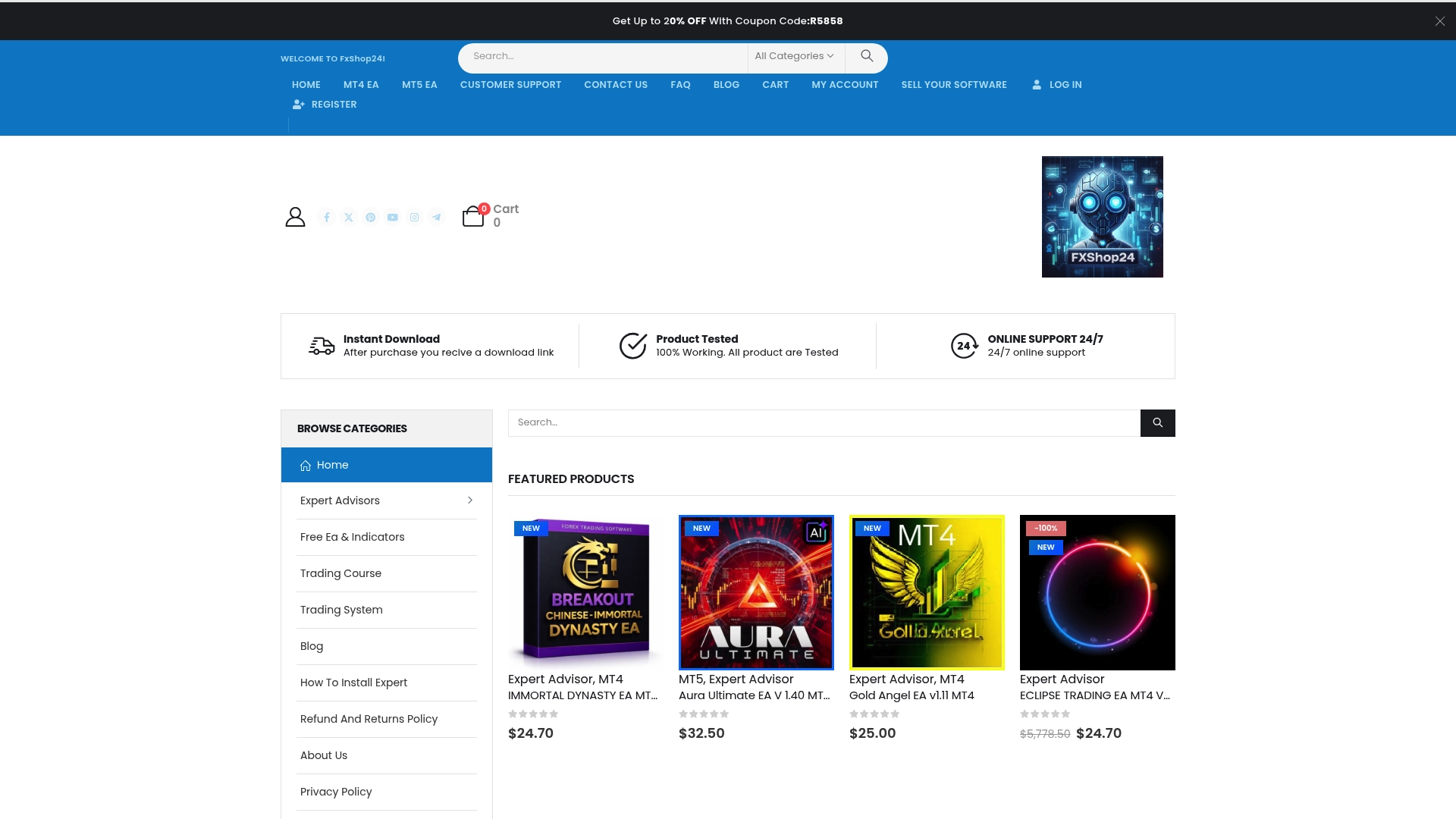
At FxShop24, we offer a full range of MT4/MT5 trading systems with detailed performance reviews, prop firm compatibility notes, and installation support. Whether you’re exploring automated futures trading or need a step-by-step walkthrough on optimizing trading robots, FxShop24 has the resources and products to move you from evaluation to execution. Every EA comes with lifetime updates and an unlimited license, so you scale without extra costs.
Frequently asked questions
How do automated trading systems improve performance in forex and gold markets?
Automated trading systems increase speed, scalability, and eliminate emotional bias, ensuring faster and more consistent decisions across multiple pairs and sessions simultaneously.
What is the role of backtesting in choosing trading systems?
Backtesting validates strategies against historical data to prevent curve-fitting. Validation before live deployment is the most important step in confirming a system’s real-world viability.
Can retail traders access institutional-grade expert advisor strategies?
Yes. Many automated systems give retail traders institutional-grade strategy access with emotion-free execution that previously required large capital and dedicated trading desks.
How do prop trading firms ensure rule compliance with automated systems?
Prop firms use custom EAs with programmable logic that enforces rule compliance automatically, including drawdown limits, lot sizing, and news event filters.
What are the most important steps in optimizing trading system returns?
Prioritize robust backtesting, walk-forward optimization, and systems that blend AI with classic indicators. Hybrid setups achieve 92% accuracy and reduce false signals by 60% compared to traditional methods alone.