



22
Jan
7 Best Examples of Forex Trading Systems for MT4 and MT5
Automating your Forex trading can feel overwhelming, especially when every system claims to offer an edge on platforms like MT4 and MT5. Between market swings, news volatility, and sudden trend reversals, finding strategies that actually work is a real challenge. You need practical systems that navigate uncertainty and help you make informed trades, not just theory or hype.
This guide breaks down the most effective automated Forex strategies—each tailored to different market situations. You’ll discover proven approaches like grid algorithmic trading, which places buy and sell orders at fixed intervals to capitalize on price oscillations, and scalping, which uses fast indicators for rapid decision making during high-activity sessions. The insights ahead will help you choose systems that fit your style and risk tolerance, so you can trade smarter, react faster, and manage risk with confidence.
Ready to explore the real-world strategies successful traders use to automate decisions and capture consistent results on MT4 and MT5? The list reveals what actually works, why each method matters, and how you can put it into action—so you never have to guess again.
Table of Contents
- Trend Following Systems: Riding Market Momentum
- Grid Trading Systems: Profiting From Market Swings
- 3. Scalping Strategies: Quick Trades For Fast Profits
- 4. Breakout Systems: Capturing Big Market Moves
- 5. Martingale Systems: Doubling Down On Trades
- 6. News Trading Systems: Trading On Market Events
- 7. AI-Powered EAs: Smart Automation For Forex Success
Quick Summary
| Takeaway | Explanation |
|---|---|
| 1. Trend following profits from market momentum | Identify the market direction early and ride it for potential gains. This approach benefits from market trends without predicting reversals. |
| 2. Grid trading capitalizes on price oscillations | Place buy and sell orders at fixed intervals to profit from natural market swings, regardless of overall direction. |
| 3. Scalping maximizes opportunities with quick trades | Execute small trades multiple times a day, capturing minor price movements for cumulative profits. |
| 4. Breakout systems harness significant market movements | Position yourself before key breakout points to capitalize on large price movements following a range. |
| 5. Carefully manage risk in Martingale systems | Only double your position a limited number of times to avoid catastrophic losses during extended losing streaks. |
1. Trend Following Systems: Riding Market Momentum
Trend following systems represent one of the most time-tested approaches to forex trading. These systems capitalize on the simple principle that markets move in directions, and your job is to identify those directions early and ride them as far as they’ll go.
The beauty of trend following lies in its directness. Unlike traders who attempt to predict exact price reversals or catch the tiniest tick movements, trend followers simply ask one question: which direction is the market moving? Once you answer that, you position yourself to profit from that momentum. This approach works across all timeframes, whether you’re trading 15-minute bars or daily charts, and it works regardless of whether the market is trending up, down, or even sideways (though it performs best in strong directional moves).
Why does trend following work? Markets don’t reverse instantly. Price moves from one level to another through a series of ups and downs, but the overall direction persists. Large institutional traders, news events, and fundamental shifts in sentiment create these extended moves. Retail traders who use trend following systems simply position themselves to benefit from these larger price swings rather than fighting against them. The key insight is that you’re not trying to be smarter than the market or predict the future. You’re simply responding to what the market is already showing you.
When implementing a trend following system in MT4 or MT5, you’ll typically use moving averages, momentum indicators, or price action patterns to confirm the direction. A moving average crossover, for example, signals that the trend has shifted. You might buy when a fast-moving average crosses above a slow-moving average, and sell when it crosses below. Tools like the ST-Scalper V3.0 indicator with trend-following capabilities provide automated signals that remove emotional decision-making from the equation.
The practical advantage here is substantial. Instead of staring at charts trying to identify trend changes manually, your EA or indicator does the heavy lifting. The system identifies when a new trend has begun and enters the position. It also knows when to exit, either when the trend shows signs of reversing or when a predetermined profit target is reached. Many successful traders operate multiple trend following systems simultaneously across different currency pairs and timeframes, letting automation handle the routine work while they focus on portfolio management.
One reality you’ll discover quickly: not all market conditions favor trend following. During ranging or choppy markets, your system might trigger false signals and take small losses repeatedly. However, when a strong trend arrives, the gains from that one trend often more than compensate for the losses from false signals. This is why patience and proper position sizing matter. You’re essentially betting that the next big trend will arrive before too many small losses accumulate.
The practical setup involves choosing your trend indicators carefully. Some traders prefer simple moving average combinations (like a 20-period and 50-period average). Others use momentum oscillators like the Relative Strength Index or stochastic indicators to confirm entry points. The exact method matters less than having consistent rules that you follow without exception. This consistency is what separates successful trend followers from those who abandon the system during losing streaks.
Pro tip: Set your stop loss levels above or below recent swing highs and lows rather than arbitrary pip distances. This approach lets trends run while protecting you when the market structure actually breaks, giving your system room to breathe while keeping losses controlled.
2. Grid Trading Systems: Profiting from Market Swings
Grid trading takes a fundamentally different approach than most forex strategies. Instead of trying to catch the beginning and end of a major trend, grid systems profit from the natural price oscillations that happen constantly in every market. Think of it as placing multiple buy and sell orders at fixed intervals throughout a price range, letting the market swing between them while you collect profits on each movement.
How does grid trading work? Imagine a currency pair bouncing between 1.0500 and 1.0600. A grid system places buy orders at 1.0500, 1.0510, 1.0520, and so on up to 1.0600, with corresponding sell orders above and below those levels. When price drops to 1.0510, you buy. When it bounces to 1.0530, you sell that position at a small profit. Then when it drops again to 1.0520, you buy again. The system repeats this process automatically, capturing small profits on every swing. Instead of making one big trade per month, you’re making dozens of small profitable trades.
The beauty of this approach lies in its ability to work regardless of market direction. A trending market, a ranging market, even a choppy sideways market all create price swings that grid systems exploit. Academic research confirms that grid algorithmic trading operates through fixed-interval orders to profit from price oscillations, making it particularly robust under uncertain market conditions. This consistency across market types is why many traders prefer grid systems when they’re uncertain about the direction prices will move.
What makes grid trading practical for MT4 and MT5 traders is automation. You don’t manually place dozens of orders and monitor each one. An Expert Advisor handles the entire process. It calculates the grid based on your starting price and the range you expect the market to move within. It places all the orders automatically. It manages exits and profit taking. You simply set your parameters and let it work. This removes the emotional component that ruins most traders. There’s no temptation to exit early or move your stops. The rules are pre-programmed.
The practical implementation requires you to understand a few key parameters. The grid interval is the distance between each buy and sell order. A tighter interval (like 10 pips) means more trades and more frequent profits, but each profit is smaller and you need larger account capital to handle multiple open positions. A wider interval (like 50 pips) means fewer trades with larger profits per trade, but you wait longer between wins. Your starting grid price should be in the middle of the expected range. Your maximum grid levels determine how many orders can be active simultaneously. Too many simultaneous orders can drain your account quickly if the market moves sharply against you. Too few means you miss profit opportunities.
Many successful grid traders using MT4 or MT5 focus on currency pairs with consistent ranges. The British Pound and Japanese Yen, for example, tend to move in ranges more predictably than some other pairs. During range-bound markets, grid systems thrive. During major trending moves, you need proper risk management to ensure that the losses from orders placed against the trend don’t wipe out your profits from orders placed with the trend.
Position sizing becomes critical with grid systems. Because you’re managing multiple simultaneous positions, each individual position must be smaller than if you were making single trades. Some traders risk only 0.1 to 0.5% of their account per grid level. This seems conservative until you realize you might have 20 or 30 active positions at once. Your total risk exposure could be significant. Understanding how to balance aggressive profit taking with defensive position sizing separates profitable grid traders from those who blow accounts.
Pro tip: Start with a small grid in your demo account and observe how it behaves through at least one complete market cycle before increasing position sizes, ensuring you understand the drawdown behavior when the market moves sharply in one direction.
3. 3. Scalping Strategies: Quick Trades for Fast Profits
Scalping represents the speed dating world of forex trading. You enter a trade, hold it for seconds to minutes, capture a small profit of 5 to 15 pips, and exit. Repeat this process dozens of times throughout the trading day and those tiny profits compound into substantial gains. It’s not about massive moves. It’s about precision execution and volume.
Why scalp instead of swing trade or position trade? The answer lies in probability and consistency. Large trending moves happen relatively infrequently. You might wait weeks for a major trend to develop. Scalping, by contrast, creates trading opportunities constantly. Every minor price fluctuation within a trend offers a scalping opportunity. This means you’re not relying on one perfect trade per month. You’re building profits from numerous small, high-probability setups that repeat multiple times daily. When you execute 20 trades and win 16 of them, the losses on the other 4 become irrelevant to your bottom line.
Scalping requires specific market conditions to work effectively. You need tight spreads, which means trading during the most active market sessions when major financial centers are open. London and New York session overlap provides the tightest spreads and highest volume. Currency pairs with the most liquidity, like EUR/USD, GBP/USD, and USD/JPY, are your best candidates. You also need volatility but not extreme volatility. Scalping thrives in markets moving with purpose but not experiencing shock news or economic surprises.
The technical setup for scalping relies on fast, responsive indicators. Scalping strategies prioritize speed using indicators like Stochastic, RSI, and short-period EMAs that generate quick signals. A Stochastic indicator on a 5-minute chart reaches overbought or oversold conditions faster than on a daily chart. Short-period exponential moving averages respond instantly to price changes. These fast indicators feed your EA or your manual trading with rapid entry signals. You don’t have time to overthink. A signal appears, you execute, and you’re out within minutes.
One critical difference between scalping and other strategies is that you cannot afford slippage or delays. If your broker’s execution is slow or your internet connection lags, those losses from delayed entries and exits will exceed your scalping profits. This is why successful scalpers choose brokers with fast execution and reliable infrastructure. Many scalpers also keep their position sizes smaller than trend traders because they’re willing to accept smaller profits in exchange for faster execution and lower risk per trade.
Automation transforms scalping from exhausting manual work into manageable profit generation. Manual scalping requires you to sit at your computer, watching charts constantly, making dozens of decisions. Your eyes tire. Your focus wanes. Your emotions spike with each small loss. An EA handles this relentlessly. It watches 24 hours. It executes the moment conditions align. It exits at predetermined profit targets. It applies the same rules to every single trade without emotion or fatigue.
The reality of scalping is that it works best when combined with solid money management. You’re making many trades, so even a small edge compounds significantly. But that same leverage works in reverse if your risk per trade is too high. A professional scalper risks 0.5% to 1% per trade, knowing they’ll execute 15 to 50 trades daily. If they win 65% of those trades, they’re profitable. If they make the mistake of risking 5% per trade because they’re greedy, one bad streak wipes them out.
Scalping also requires understanding market microstructure. Price doesn’t move smoothly. It jumps in small increments. These increments create patterns that repeat constantly. Volume spikes precede price moves. Support and resistance levels at small scales become significant. Many professional scalpers use volume analysis combined with price action to identify when a scalp setup has the highest probability of success.
Pro tip: Always scalp during peak liquidity hours in your chosen currency pair and never hold positions through economic news releases, since the sudden volatility spikes will turn profitable setups into losses instantly.
4. 4. Breakout Systems: Capturing Big Market Moves
Breakout systems operate on a simple but powerful principle. Price moves in ranges until something breaks. When that something breaks, the subsequent move tends to be substantial. Your job is identifying where those breakout points exist and positioning yourself to profit when price shatters through them.
Why do breakouts matter? Consider a currency pair that trades between 1.1000 and 1.1050 for weeks. That range represents equilibrium. Buyers and sellers keep prices within those boundaries. But when an economic report releases or sentiment shifts, suddenly buyers overwhelm sellers, or vice versa. Price doesn’t bounce back into the range. It explodes through the upper boundary and keeps moving. That explosion is a breakout. The traders who positioned before the explosion capture enormous profits. The traders who waited for confirmation catch the move but with less profit potential. The traders who didn’t recognize the breakout miss it entirely.
Breakout systems identify likely breakout points in advance. Support and resistance levels are the primary tool. A support level is a price where buyers consistently step in. A resistance level is a price where sellers consistently intervene. When price approaches resistance and breaks through it decisively, a bullish breakout occurs. When price approaches support and breaks through it decisively, a bearish breakout occurs. The strength of the breakout depends on how long that level held. A resistance level that’s been in place for months creates a more powerful breakout when finally broken than a level that formed last week.
Identifying breakout candidates requires looking at price structure. You scan your charts for clear horizontal levels where price bounced multiple times. You note volatility compression zones where price moves tightly for a period, suggesting energy is building. You observe technical formations like triangles, rectangles, and wedges that precede major moves. An easy breakout indicator can automate detection of these patterns, alerting you when price approaches key breakout levels.
The practical advantage of breakout systems is that they align you with the market’s biggest moves. Trend following systems catch moves that are already underway. Scalping systems profit from small oscillations. Breakout systems position you before major momentum develops, meaning you capture the bulk of the move. A single successful breakout trade might generate 100 to 300 pips of profit. That one trade can offset weeks of smaller gains from other strategies.
Timing is everything in breakout trading. You need the breakout to be decisive, not a false breakout that reverses quickly. Professional breakout traders use volume confirmation. When price breaks through a level on high volume, the breakout is likely genuine. When price breaks through on low volume, traders are hesitant and reversals become more common. They also use the size of the breakout movement. If price breaks through resistance by 50 pips on high volume, that signals strength. If price breaks through by 5 pips on low volume, that signals weakness.
False breakouts represent the primary risk of breakout systems. Price breaks through a level, your EA enters, and then price reverses back through that level, stopping you out for a loss. This happens because some participants exit losing positions as price approaches key levels, briefly pushing price through before the main breakout followers enter. Professional breakout systems handle this with buffer zones. Rather than entering the exact moment price touches the level, they wait for price to move 5 to 10 pips past the level, confirming that the breakout is real.
Breakout systems work across all timeframes. A daily chart breakout captures weeks or months of moves. A 4-hour chart breakout captures days of moves. An hourly chart breakout captures hours of moves. Your choice depends on your trading style and how much time you want to hold positions. Swing traders prefer daily and 4-hour breakouts. Day traders prefer hourly and 15-minute breakouts. The timeframe doesn’t change the principle. Price builds pressure until it breaks out. You position before the break if possible or immediately after confirming the break.
Drawdown management becomes crucial with breakout systems because you’re only trading when you expect big moves. If the market enters a range-bound period without major breakouts, you might take only a few trades per month. During those few trades, if the market moves against you immediately, your account experiences significant drawdown before the next successful breakout recovers it. Professional breakout traders size positions smaller during choppy markets and increase size when market conditions show clear breakout potential.
Pro tip: Combine breakout trading with support and resistance levels that have been tested at least three times, as heavily tested levels produce more explosive breakouts when finally broken through.
5. 5. Martingale Systems: Doubling Down on Trades
Martingale systems represent one of the most controversial and emotionally charged trading approaches. The core idea is deceptively simple: after you lose a trade, you double your position size on the next trade. When that trade wins, you recover all previous losses plus gain a profit equal to your original position size. It sounds mathematically inevitable. It feels like you’re turning the odds in your favor. And yes, I learned the hard way that it doesn’t quite work that way in real forex markets.
How does the Martingale principle function? Imagine you trade one standard lot and lose. Your loss is 100 pips times 10 dollars per pip equals 1,000 dollars. On the next trade, you now trade two standard lots. If that trade wins just 50 pips, you gain 2,000 dollars. That 2,000 gain covers your 1,000 loss plus gives you 1,000 profit, exactly what you would have made if you’d won the first trade. The mathematics appears flawless. The underlying assumption is that you will eventually win. Markets move up and down. Sooner or later, a winning trade must appear. When it does, all your losses vanish and you’re profitable.
The appeal is obvious. This system offers psychological comfort. You don’t need to predict market direction accurately. You don’t need a high win rate. A 40% win rate works fine if you’re doubling down on losses. The strategy almost guarantees profitability over a long enough timeframe, assuming you have unlimited capital and the market doesn’t move against you catastrophically. This is why the Martingale strategy operates through exponential position sizing after losses, creating the illusion of inevitable recovery.
But here’s where reality diverges sharply from theory. The Martingale system requires enormous capital reserves. Consider a losing streak of just five consecutive trades. You start with one lot. After loss one, you trade two lots. After loss two, you trade four lots. After loss three, you trade eight lots. After loss four, you trade sixteen lots. After loss five, you trade thirty-two lots. If each loss is just 50 pips, you’ve now lost 50 plus 100 plus 200 plus 400 plus 800 pips, totaling 1,550 pips. Your 32-lot winning trade at 50 pips gains 1,600 pips, covering losses plus 50 pips profit. But those 32 lots require a massive account. A typical retail trader simply doesn’t have sufficient capital to sustain long losing streaks.
The second critical flaw is that forex markets don’t exist in isolation. Margin requirements limit how much you can trade. Broker limits restrict maximum position sizes. Account balance limits restrict how many times you can double down. A losing streak of eight or ten trades, which absolutely can and does happen regularly, requires either a massive account or violates your broker’s rules. Worse, during sharp market moves driven by major economic news, your capital can evaporate before you ever reach your winning trade. You might experience a 500-pip move in your losing direction, which exceeds your total available capital before you get the chance for that recovery trade.
Martingale systems do find occasional use in forex trading, particularly on MT4 and MT5, but with important modifications. Instead of doubling down indefinitely, professional traders set maximum limits. They might double down only twice or three times maximum. They might use fractional increases instead of full doublings, like adding 1.5 times the previous size instead of 2.0 times. They carefully calculate position sizes to never exceed their account’s margin requirements even after multiple losing trades. They also accept that sometimes they’ll hit their maximum and take a larger loss rather than let the system destroy the entire account.
The psychological impact of Martingale systems deserves serious consideration. Early wins feel fantastic. Your first doubling trade wins, and you’re thrilled. But late-stage losses hit brutally. Your fifth or sixth consecutive loss leaves your heart pounding and your palms sweating. Many traders abandon the system emotionally before reaching the recovery trade, crystallizing massive losses. Others become reckless, increasing position sizes beyond their mathematical limits because they’re certain the next trade must win. This overconfidence immediately before catastrophic losses is a dangerous pattern.
Many prop trading firms explicitly prohibit Martingale systems in their trading rules. They’ve seen too many promising traders blow accounts using Martingale EAs. The regulatory environment also views Martingale systems skeptically because they encourage excessive leverage. Some brokers restrict maximum position sizes specifically to prevent Martingale strategies from becoming too dangerous.
If you’re considering Martingale systems, understand that you’re not eliminating risk. You’re shifting when that risk hits. Early on, you feel comfortable because losses are small and frequent. Late in a losing streak, risk becomes catastrophic. The strategy works until the specific losing streak that exceeds your capital arrives. That streak always comes eventually.
Pro tip: If you use a Martingale system, set a maximum number of doublings allowed (typically two or three maximum) and a maximum account percentage to risk per sequence, treating each Martingale sequence as a single trade for risk management purposes.
6. 6. News Trading Systems: Trading on Market Events
News trading systems operate on a fundamental market principle: major economic announcements create price volatility and directional movement. When the Federal Reserve announces interest rate decisions, when employment data releases, or when geopolitical events unfold, currency markets react dramatically. News trading systems position themselves to profit from these reactions.
Why does news create trading opportunities? Markets incorporate expectations into prices. Before a major announcement, prices reflect what traders believe will happen. When the actual announcement arrives and differs from expectations, prices move sharply to correct the discrepancy. A stronger than expected jobs report sends the US dollar higher immediately. Weaker than expected inflation data sends it lower. These moves happen in seconds. They tend to be substantial. Traditional traders struggle to execute fast enough. Automated news trading systems, by contrast, execute the moment the data releases.
News trading differs fundamentally from other systems you’ve encountered so far. Trend following waits for established trends. Grid trading profits from oscillations. Scalping captures tiny moves. News trading, however, anticipates and reacts to specific catalysts. You know exactly when news arrives. The FOMC meeting happens on Wednesday at 2 PM Eastern. The unemployment report releases the first Friday of every month at 8:30 AM. The economic calendar provides this schedule. Your system watches that calendar and prepares trades in advance.
The practical setup involves monitoring economic calendars and pre-positioning your trades. You identify which news events matter most for your chosen currency pairs. Interest rate decisions move currencies substantially. Employment data impacts USD significantly. GDP releases affect multiple currency pairs. You mark these events in your calendar and program your EA to be ready. Some news systems enter trades before the announcement, betting on the direction they expect. Others wait for the announcement, then enter when the market confirms the direction.
Systems that incorporate AI and market sentiment analysis demonstrate enhanced effectiveness around news events, adapting strategy selections in real-time based on how markets actually respond. This approach moves beyond simple reaction to data. It analyzes how market participants are positioned, what sentiment prevails, and selects the best trading approach for the current conditions.
The risk of news trading centers on slippage and gap risk. When major news releases, spreads widen dramatically. Your expected 2-pip spread suddenly becomes 10 pips. Your entry price slips. Your exit price slips worse. A 50-pip profit target becomes achievable only if the market moves 70 pips in your direction, accounting for slippage. Additionally, major news can gap price dramatically. A currency pair trading at 1.0500 before announcement might open at 1.0550 after. If you were betting on a downward move, that gap wipes out your account. Brokers frequently disable automated trading seconds before major news releases specifically to prevent this catastrophic outcome.
Many professional news traders use discretionary manual trading rather than EAs for news events. They want the flexibility to adjust their approach based on pre-announcement positioning and sentiment. They monitor the market while news is being released and make quick decisions based on how price initially reacts. An automated system cannot adapt this flexibly. However, EAs excel at executing specific predetermined strategies with perfect timing and discipline.
The calendar approach requires understanding which news matters for which currencies. US data impacts the US dollar. European Central Bank decisions impact the euro. Bank of England announcements impact British pound. Chinese GDP releases impact the Chinese yuan. You can’t trade every piece of news. You focus on the economic announcements that historically move your chosen currency pairs the most.
News trading works on any timeframe, but most effectively on daily and 4-hour charts. Shorter timeframes like 15-minute charts experience too much noise around news releases. The actual movement you’re trying to capture gets obscured by temporary overreaction and whipping. Daily charts capture the sustained directional move that follows news, once the market has fully absorbed the implications.
Positional awareness becomes critical before major news. If you’re already holding a position and major news releases, you face gap risk. Many news traders close all positions before significant announcements to eliminate this risk, then re-enter positions after the announcement based on the new information.
Pro tip: Never trade major news releases without understanding your broker’s policies on slippage and margin requirements during volatility spikes, and always use wider stop losses during news events to account for sudden price movements.
7. 7. AI-Powered EAs: Smart Automation for Forex Success
Artificial intelligence has transformed Expert Advisors from simple rule-based systems into adaptive trading machines that learn and evolve. AI-powered EAs represent the frontier of automated forex trading, combining machine learning algorithms with real-time market data to make trading decisions that improve over time. Stop. Think. This is different from everything you’ve read so far.
How does AI in forex trading actually work? Traditional EAs follow predetermined rules. If moving average A crosses moving average B, buy. These rules never change. They work great in the market conditions for which they were designed and fail miserably when conditions shift. AI-powered EAs, by contrast, analyze historical market data to identify patterns. They recognize market regimes. They adjust their strategies when they detect that conditions have changed. Some use neural networks trained on years of price data. Others employ decision tree algorithms that optimize entry and exit logic continuously. The result is a system that adapts rather than remains static.
The practical advantage is remarkable. A traditional scalping EA might perform beautifully during volatile 8 AM London sessions but lose money during quiet Asian sessions. An AI-powered EA detects this pattern, reduces position sizes during Asian sessions, and increases them during London sessions. A trend-following EA might identify that trends behave differently depending on whether we’re in a high volatility environment or low volatility environment. It adjusts its trend confirmation criteria accordingly. This adaptability translates directly into more consistent profits across varying market conditions.
Machine learning models can identify correlations humans miss entirely. Perhaps GBP/USD behaves differently on days when crude oil is moving sharply. An AI model discovers this relationship. It then adjusts its strategy on oil-moving days to account for this correlation. Or perhaps the system notices that news trading strategies work better on certain days of the week or during certain times of the month. These patterns emerge from analyzing massive datasets. A human trader would need years of observation to identify them. An AI model identifies them in hours.
Another capability of AI systems is risk management optimization. Instead of using fixed stop loss and take profit levels, AI-powered EAs calculate dynamic levels based on current market volatility. When the market is quiet, stop losses tighten. When volatility spikes, stop losses widen. Position sizes adjust based on recent drawdown history and market conditions. This dynamic approach outperforms fixed risk parameters across different market environments.
The challenge with AI-powered EAs centers on overfitting. This occurs when an AI model learns the specific quirks of historical data so thoroughly that it fails on new, unseen data. Imagine an AI trained on five years of EUR/USD data that identifies patterns that worked perfectly during those five years but are completely irrelevant going forward. The system trades beautifully in backtests and catastrophically in live trading. Preventing overfitting requires careful model validation. Understanding how to properly backtest an Expert Advisor becomes essential when evaluating AI EAs because backtesting results mean almost nothing if the model is overfit.
Many retail traders misunderstand what AI can do. AI cannot predict the future. It cannot know that the Federal Reserve will surprise markets with an unexpected rate cut. It cannot anticipate geopolitical shocks. What AI does exceptionally well is optimize execution given current market conditions. It improves entry timing. It refines exit logic. It manages position sizing intelligently. It recognizes when current conditions match historical patterns and adjusts accordingly.
The computational requirements of AI-powered EAs matter for practical implementation. Some AI systems require significant processing power. MT4 and MT5 have limitations on how complex an EA can be. Some brokers restrict backtesting capabilities to prevent excessive server load from complex models. You need to ensure that your chosen AI EA can actually run efficiently on your broker’s servers.
Training data quality directly determines AI system quality. An AI model trained on only bull market data will fail during bear markets. A model trained on high volatility data will miss patterns in low volatility environments. The best AI EAs use diverse training data spanning multiple market regimes, economic conditions, and volatility environments. They update their models periodically with new data as markets evolve.
The transparency challenge with AI systems is real. A traditional EA shows you exactly what rules it follows. An AI model sometimes cannot explain why it made a specific trade. This black box nature concerns some traders and many prop trading firms. Some AI EAs include interpretability features that explain trading logic. Others remain completely opaque. Understanding which type you’re using matters for your confidence and risk management.
AI-powered EAs work best when combined with sound money management and realistic expectations. They improve consistency and adapt to changing conditions, but they do not eliminate the risk inherent in forex trading.
Implementing an AI EA requires patience. You cannot evaluate its performance over a few days or even a few weeks. AI systems need time to encounter different market conditions, identify patterns, and prove their adaptability. Many traders give up on AI EAs too early, exiting positions during the brief drawdowns that occur while the system is learning. The traders who succeed with AI are those who understand that the learning process takes time.
The future of forex trading clearly leans toward AI-powered solutions. The edge from traditional rule-based systems is shrinking as more traders use similar indicators and strategies. AI systems that continuously learn and adapt maintain their edges longer. If you’re serious about automated trading, understanding AI-powered EAs becomes increasingly important for your long-term success.
Pro tip: Start by paper trading an AI EA for at least one full month before risking real capital, allowing the system to encounter multiple market conditions and prove its adaptability before you commit actual funds.
Below is a comprehensive table summarizing the various forex trading systems and concepts discussed throughout the article.
| Strategy/System | Description | Key Elements | Best Suited For |
|---|---|---|---|
| Trend Following | Profiting from consistent market trends using indicators. | Moving average crossovers, momentum indicators, and automated systems. | Riding long-term market momentum effectively. |
| Grid Trading | Capitalizing on market oscillations by placing orders at fixed levels. | Grid intervals, predefined ranges, and automated EAs. | Markets with predictable range movements. |
| Scalping | Making quick trades to capture small market movements. | Fast indicators like RSI and short-period EMAs, and tight spreads. | High-volume trading during peak liquidity hours. |
| Breakout Systems | Taking advantage of significant price movements after range breakouts. | Support and resistance levels, volume confirmation, and precise entry timing. | Capturing substantial market opportunities ahead of trends. |
| Martingale Systems | Doubling down on losing trades for eventual recovery. | Exponential position sizes, risk limits, and strict discipline. | Experienced traders with significant capital buffers. |
| News Trading | Executing trades based on market reactions to economic announcements. | Economic calendars, pre-positioning strategies, and slippage risk management. | Market environments with high-impact news events. |
| AI-Powered EAs | Adaptive systems leveraging machine learning for decision-making. | Historical data analysis, evolving strategies, and risk management optimization. | Automation enthusiasts seeking advanced trading solutions. |
Elevate Your Forex Trading with Proven Automated Systems for MT4 and MT5
Navigating the challenges of various forex trading systems like trend following, grid trading, scalping, or AI-powered EAs requires reliable tools that consistently perform under real market conditions. Whether you struggle with managing multiple positions, controlling risk during news events, or executing fast scalps, automation can be your strongest ally. FxShop24 understands these pain points and offers expertly crafted Expert Advisors and indicators designed to bring discipline and precision to your trading.
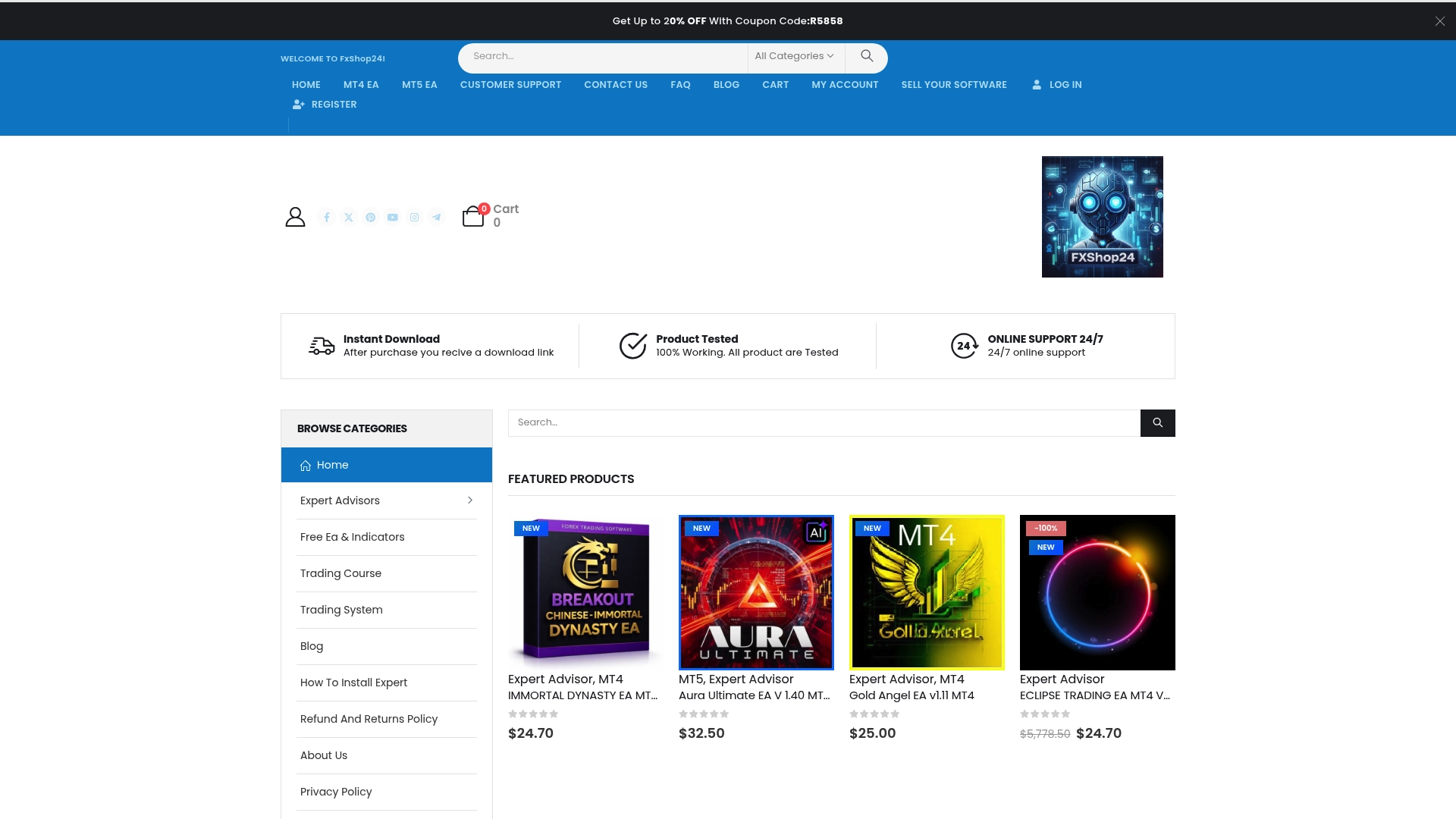
Discover a wide selection of tested and prop firm-ready automated trading solutions at FxShop24 engineered to fit your trading style. From adaptive AI-powered EAs to breakthrough trend following and grid systems, each product features lifetime updates and unlimited licenses. Take control of your trading journey today by exploring our offerings and start automating smarter trades with confidence. Visit FxShop24 now and experience how the right trading system can turn market complexity into consistent profit opportunities.
Frequently Asked Questions
What are the key features of trend following systems in forex trading?
Trend following systems focus on identifying the market’s direction and capitalizing on that momentum. To implement a trend following system, use tools like moving averages or momentum indicators, and establish clear rules for when to enter and exit trades.
How do grid trading systems operate in forex markets?
Grid trading systems profit from the natural oscillations in price by placing buy and sell orders at fixed intervals. Start by defining your grid interval and monitoring price movements to capture profits from these small market swings.
What is involved in setting up a scalping strategy for forex trading?
Scalping strategies involve making quick trades to capture small price movements, typically within seconds to minutes. Use fast, responsive indicators and focus on high liquidity currency pairs during peak trading hours to maximize your profit opportunities.
How can breakout systems be effectively implemented in forex trading?
Breakout systems target significant price movements that occur after established ranges are broken. Identify key support and resistance levels, and program your system to execute trades when prices decisively breach these points.
What precautions should be taken when using Martingale systems in forex trading?
Martingale systems rely on doubling your trade size after a loss to recover previous losses, but they require substantial capital and carry significant risk. Set a maximum number of position size doublings to prevent excessive losses and ensure you manage risk carefully.
How can I effectively trade news events in the forex market?
To trade news events, monitor an economic calendar for important announcements and prepare your trades in advance. Position your strategies either before the announcement or react quickly afterward based on the market’s initial reaction for better results.
Recommended
Author