
5
Apr
Forex trading terminology explained for every trader
TL;DR:
- Proper understanding of forex terms is essential to avoid costly trading mistakes.
- Advanced terminology like drawdown and slippage is critical for evaluating automated trading systems.
- Mastering forex language provides a competitive edge by enabling precise tool configuration and risk management.
Forex has a language problem. Not because the terms are impossibly complex, but because most traders pick them up on the fly, assume they understand them, and then build entire strategies on shaky definitions. A misread order type, a confused margin calculation, or a blurry understanding of leverage can quietly drain your account before you even realize what went wrong. Whether you’re manually placing trades or running automated systems through MT4 or MT5, the words you use to configure your tools are the foundation everything else sits on. This guide gives you clear definitions, real comparisons, and practical context so you can trade with confidence and precision.
Table of Contents
- Why forex trading terminology matters
- Key forex trading terms every trader must know
- Advanced terminology for modern and automated traders
- How to apply forex terminology for better trading decisions
- Why truly mastering forex terminology is a competitive edge
- Ready to master every aspect of forex trading?
- Frequently asked questions
Key Takeaways
| Point | Details |
|---|---|
| Understanding terminology | Clear forex language prevents costly mistakes and unlocks better trading strategies. |
| Foundations for automation | Accurate use of trading terms is the key to successful EA configuration and workflow. |
| Application in real trading | Applying terminology to platforms and workflows enables smarter, more confident decisions. |
| Competitive trader edge | Mastery of forex vocabulary is a critical skill that separates elite traders from the rest. |
Why forex trading terminology matters
Forex trading is not just about reading charts or picking the right direction. The moment you place a trade, you’re interacting with a system built on precise definitions. Get the language wrong, and the system does exactly what you told it to, not what you meant.
Many retail traders lose money because they misinterpret order types and market terms. That’s not a beginner problem. It’s a terminology problem. A trader who confuses a stop order with a stop-loss order, or who doesn’t fully understand how margin works, is making decisions based on incomplete information. The market doesn’t care about your intent.
When you move into automated trading, the stakes get even higher. An expert advisor (EA) follows instructions literally. If you input the wrong lot size because you misunderstood position sizing, or set the wrong stop-loss distance because you confused pips with points, the EA will execute that mistake at scale, across every trade it opens.
Here’s what poor terminology awareness typically leads to:
- Placing market orders when a limit order was needed, resulting in worse entry prices
- Setting leverage too high because the relationship between margin and position size wasn’t clear
- Misreading drawdown statistics during backtesting and overestimating a strategy’s safety
- Configuring EA parameters incorrectly due to unfamiliar input labels
- Misunderstanding spread costs and underestimating their impact on profitability
“The difference between a profitable setup and a losing one is often just one misunderstood term.”
If you’re just starting to learn forex, building your vocabulary from day one is the smartest investment you can make. And before you think about forex capital requirements, make sure you understand what your money is actually doing when it’s deployed in the market.
Pro Tip: Don’t just memorize definitions. Find a demo account and deliberately use each term in a live context. Placing a limit order on a demo account cements the concept in a way reading never will.
Now that you know why you need to get this right, let’s start with the most important forex terms.
Key forex trading terms every trader must know
Understanding why these words matter, let’s break down exactly what they mean. The foundational terms like spread, pip, and leverage are essential to every trading strategy, yet they’re consistently misunderstood even by traders with months of experience.

Here’s a quick reference table with real numeric examples:
| Term | Definition | Real-world example |
|---|---|---|
| Pip | Smallest standard price move | EUR/USD moves from 1.1000 to 1.1001 = 1 pip |
| Spread | Difference between buy and sell price | Bid 1.1000, Ask 1.1002 = 2 pip spread |
| Lot | Standardized trade size | 1 standard lot = 100,000 units of base currency |
| Leverage | Borrowed capital ratio | 1:100 leverage means $1,000 controls $100,000 |
| Margin | Deposit required to open a position | 1% margin on $100,000 = $1,000 required |
| Stop-loss | Order to close trade at a set loss level | Buy at 1.1000, stop-loss at 1.0950 = 50 pip risk |
The confusion between pip and point trips up many traders. A pip is typically the fourth decimal place on most pairs. A point is one tenth of a pip on five-decimal brokers. If your EA is set to a 50-point stop-loss and you think it’s 50 pips, your actual risk is ten times smaller than intended.
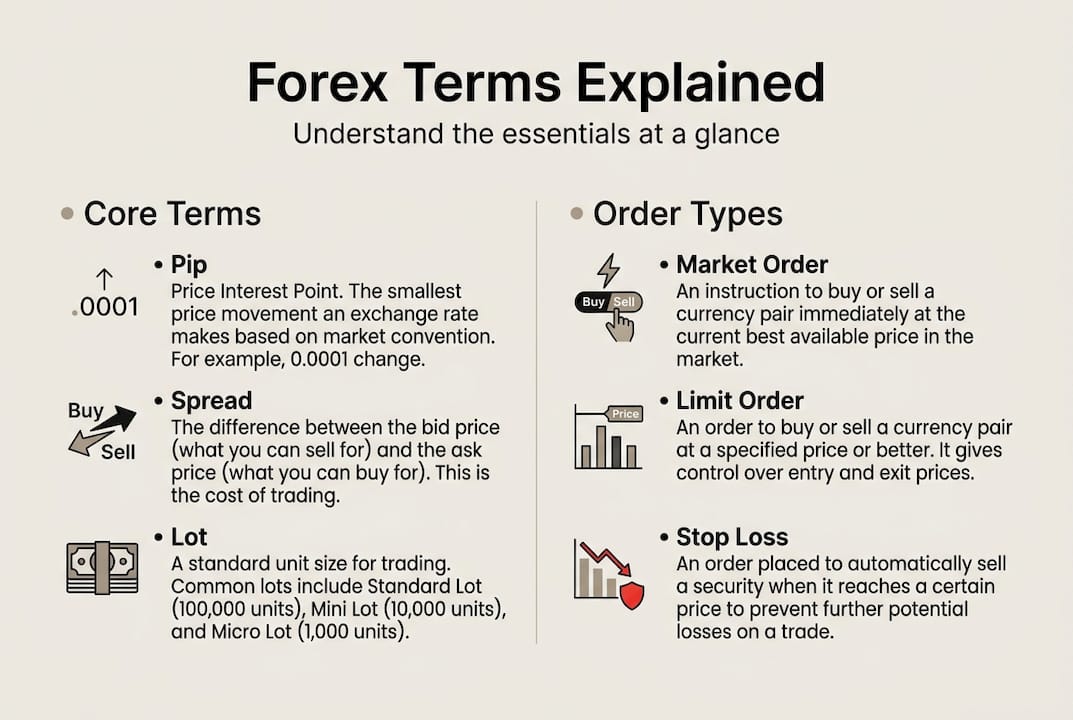
For order types guidance, the distinction between market, limit, and stop orders is critical. A market order executes immediately at the current price. A limit order only fills at your specified price or better. A stop order triggers once price hits a level, then executes at market.
Key distinctions you must keep straight:
- Lot size directly determines pip value and therefore your dollar risk per trade
- Leverage amplifies both gains and losses, not just gains
- Spread is a cost you pay on every trade, even if the trade is profitable
- Margin is not a fee. It’s collateral held by your broker
For anyone building or using an algorithmic trading system, these terms appear constantly in strategy logic, risk rules, and trade filters. Getting them wrong at the definition stage means every downstream decision is compromised.
Advanced terminology for modern and automated traders
With the basics under control, it’s time to advance to terms that matter for serious and automated traders. These concepts shape how you evaluate systems, configure software, and manage risk at a higher level.
Automated systems and EAs require precise parameter settings based on a clear understanding of advanced terminology. Guessing at what “drawdown” means when reviewing an EA’s performance report is how traders end up with systems they don’t actually understand.
| Classic term | Automation equivalent |
|---|---|
| Stop-loss | Maximum drawdown threshold |
| Trade history | Backtesting results |
| Manual entry | EA signal trigger |
| Position sizing | Lot calculation algorithm |
| Market analysis | Strategy optimization pass |
Here are the advanced terms you need to own:
- Drawdown: The peak-to-trough decline in your account balance. A 20% drawdown means your account fell 20% from its highest point before recovering. This is the most important risk metric for evaluating any EA.
- Equity: Your current account value including open trade profits or losses. It moves in real time.
- Slippage: The difference between the price you expected and the price you actually got. High slippage kills scalping strategies.
- Backtesting: Running an EA against historical price data to simulate how it would have performed. Results are only as good as the data quality.
- Optimization: Adjusting EA input parameters to find the best-performing settings over a historical period. Over-optimization leads to curve fitting, where a system works perfectly on past data but fails live.
- Execution speed: How fast your broker processes orders. In automated trading, milliseconds matter for strategies that rely on tight entries.
Exploring essential trading tools for MT4 and MT5 becomes much more productive once you understand what these terms mean in practice. You’ll know what to look for in a platform and what questions to ask.
Pro Tip: When reviewing an EA’s backtesting report, always check the maximum drawdown alongside the profit factor. A high profit factor with a 60% drawdown is not a safe system, no matter how impressive the returns look.
For a deeper look at what separates effective EAs from risky ones, the expert advisor features that matter most are directly tied to how well you understand these advanced concepts.
How to apply forex terminology for better trading decisions
Now that you’re clear on the terms themselves, let’s put that knowledge into action. Knowing a definition is step one. Using it correctly inside a trading platform or EA configuration is where real skill develops.
Successful integration of manual and automated strategies starts with a solid grasp of terms across both approaches. Here’s a practical workflow for applying your terminology knowledge:
- Before placing any trade, identify your order type. Are you entering at market or waiting for a specific price with a limit order? This single decision changes your entry cost and execution certainty.
- Calculate your position size using lot size, pip value, and your account balance. Never guess. A 1% risk rule means risking no more than 1% of your balance per trade, and you can’t apply that without knowing your pip value.
- Set your stop-loss in pips, not in dollars. Dollar-based thinking disconnects you from the actual price structure. Pips keep your logic tied to market behavior.
- When configuring an EA, review every input label carefully. Terms like “TakeProfit,” “StopLoss,” “MagicNumber,” and “LotSize” have specific functions. Entering the wrong value in any of these fields produces unintended behavior.
- Monitor drawdown in real time during live EA operation. If the EA hits a drawdown level you didn’t expect, that’s a signal to pause and review the strategy settings, not just wait it out.
“Terminology is the operating system of your trading mind. Without it running correctly, every decision above it is unreliable.”
Common mistakes traders make when they guess at vocabulary include setting lot sizes in units instead of standard lots, confusing take-profit with trailing stop, and misreading equity as balance during high-volatility periods. Each of these errors has a direct cost.
Exploring types of forex robots becomes far more useful once you can evaluate them using precise language. You’ll know what questions to ask, what metrics to compare, and what red flags to spot.
Pro Tip: Build a personal glossary. Every time you encounter a term in a platform, EA description, or broker document that you’re not 100% sure about, write it down with your own definition and a real example. Review it monthly.
Why truly mastering forex terminology is a competitive edge
Here’s an uncomfortable truth: most traders believe their results come from finding the right system or signal. But the traders who consistently perform well share something more fundamental. They are precise with language.
The difference between “equity” and “balance” sounds trivial until you realize that trading decisions made during drawdown look completely different depending on which number you’re watching. Balance stays flat while equity swings. If you’re monitoring the wrong metric, your risk assessment is off.
The same applies to algorithmic strategies. Traders who configure EAs without fully understanding terms like slippage tolerance or optimization depth often end up with systems that look great in backtests but fall apart in live conditions. They blame the market. The real issue was a vocabulary gap.
Elite traders treat terminology as a living practice. They revisit definitions as platforms update, as new instruments emerge, and as automation technology evolves. What “execution speed” meant five years ago is different from what it means in today’s algorithmic environment. Staying current with language keeps your thinking sharp and your tools properly configured. Mastery here is not a one-time achievement. It’s a habit.
Ready to master every aspect of forex trading?
If you’re serious about applying your knowledge, here’s how you can go even further. Understanding forex terminology gives you a real edge when selecting and configuring trading tools. The right vocabulary means you can evaluate platforms, read EA documentation accurately, and make informed decisions about automation.
At FxShop24, you’ll find a full range of trading software for MT4 and MT5 built for traders who want precision and performance. Whether you’re working through the MT4 expert advisor guide or exploring automated futures trading systems, every resource is designed to help you move from understanding to execution. Browse the full catalog and find tools that match your strategy.
Frequently asked questions
What are the most important forex trading terms for beginners?
Beginners should focus on pip, lot, spread, leverage, margin, and order types. These essential terms form the foundation of every trade decision you’ll make.
How does understanding forex terminology help automate trading?
Accurate terminology ensures you configure EA inputs correctly and apply proper risk controls. Precise parameter settings in automated systems depend entirely on understanding what each term means.
What’s the difference between equity and balance in a trading account?
Balance is your account total with no open trades factored in. Equity updates in real time to reflect any open position profits or losses, making it the more relevant number during active trading.
Do trading terms differ between manual and automated systems?
Most core terms apply to both, but automation introduces specific concepts like backtesting, optimization, and execution speed. Automation-centric terminology is essential for anyone configuring or evaluating EAs.
Where can I find detailed guides for advanced trading tools?
FxShop24 offers in-depth resources covering everything from platform basics to advanced EA configuration. Start with the MT4 and MT5 tool guides for a structured path through the most important concepts.
Recommended
- How Do I Even Start Learning Forex As A Complete Noob? | FxShop24 Marketplace
- Defining AI Trading Bots: What Every Trader Needs
- Market, Limit, And Stop Orders: The Beginner’s Guide To Smarter Trading | FxShop24 Marketplace
- What Is Trading Strategy And Why It Matters
- Maximize returns: advanced best practices for crypto trading