



11
May
Boost profitability with trend following in forex and gold
TL;DR:
- Trend following remains a profitable systematic approach in forex and gold markets, especially when automation accounts for costs and execution issues. Proper risk management, diversified assets, and filters like ATR are essential for long-term success, while handling market frictions ensures strategy robustness. Using automated systems that incorporate these principles on MT4 and MT5 enhances trading consistency and real-world performance.
Trend following has been called dead so many times it has practically become a running joke in trading forums. The argument goes that algorithmic high-frequency traders have erased every edge, that markets are too efficient, and that momentum strategies no longer work. This is wrong, and the data proves it. Automated trend following on MetaTrader 4 and MT5 is not just alive in 2026, it is one of the most consistently applied approaches for forex and gold traders who understand implementation. This article gives you the mechanics, the history, the common traps, and the platform-specific guidance to put it to work.
Table of Contents
- What is trend following and why does it work?
- Core mechanics of automated trend following on MT4 and MT5
- Breakout systems: The Turtle rules and modern variants
- Pitfalls, risk management, and keys to performance
- What most traders miss about trend following automation
- Unlock the power of automated trend following on MT4/MT5
- Frequently asked questions
Key Takeaways
| Point | Details |
|---|---|
| Trend following works | Empirical research confirms trend following can boost returns and lower risk, especially during drawdowns. |
| Automation can enhance consistency | Automating trend strategies on MT4/MT5 removes emotion and enables persistent rule-based execution. |
| Execution details matter | Real-world performance hinges on handling market friction, not just entry logic. |
| Modern systems blend classic and new | Blending proven breakout rules with adaptive filters can reduce overtrading and maintain an edge. |
What is trend following and why does it work?
Trend following is a systematic trading approach that buys assets moving up and sells assets moving down, holding positions until the momentum reverses. No forecasting, no opinion, no news-watching. The logic is simple: prices often move in sustained directions for longer than most participants expect, and a rules-based system can capture that movement more consistently than discretionary guessing.
The classic tools of trend following include breakout signals (entering when price crosses a recent high or low), moving average crossovers (going long when a short-term average crosses above a longer one), and volatility filters like the Average True Range (ATR) to size positions and set stops. These tools have been used for decades because they directly reflect one market truth: trends exist, and riding them pays.
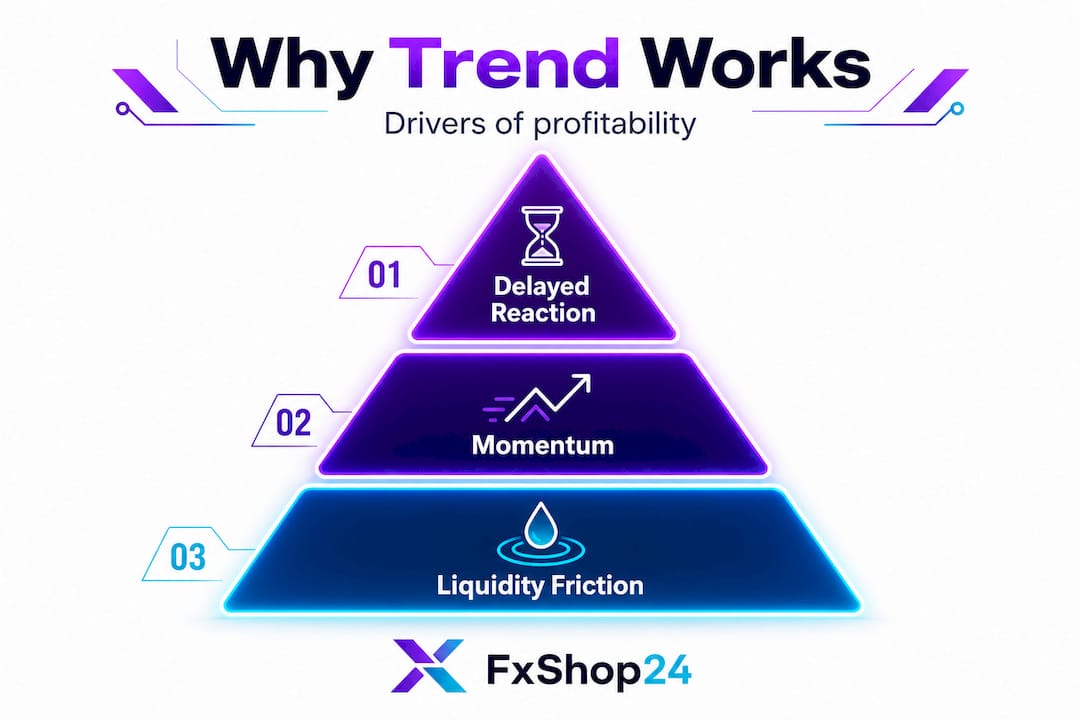
Why does it keep working? Several reasons. First, market participants are systematically slow to update beliefs, which allows price moves to persist. Second, trend following performs well precisely when other strategies fail. In sharp risk-off episodes, trend followers are already short risk assets and long safe havens, capturing crisis moves that crush equity-heavy portfolios.
Here is a simplified comparison of what trend following offers versus a traditional portfolio:
| Metric | Trend following | 60/40 portfolio |
|---|---|---|
| Average annual return | ~8 to 12% | ~7 to 9% |
| Max drawdown | ~15 to 25% | ~30 to 45% |
| Sharpe ratio | ~0.5 to 0.8 | ~0.4 to 0.6 |
| Crisis alpha | Strong positive | Typically negative |
| Correlation to equities | Low to negative | High |
Note that these figures vary across studies and time periods, but the directional picture is consistent. Trend following delivers positive returns and diversification benefits even during major drawdowns, though transaction costs and implementation quality are critical to realizing those returns.
Key reasons trend following endures:
- Systematic discipline removes emotional decision-making from trading
- Diversification across assets and timeframes smooths equity curves
- Asymmetric payoff from cutting losses and letting winners run
- Crisis alpha provides positive returns when traditional assets crash
- Rule-based structure adapts naturally to automated execution
The one genuine caveat? Costs. Spread, slippage, and commission eat into trend following returns more than many traders realize. This is not a reason to avoid the strategy but a reason to build cost awareness into every automated system from day one.
Core mechanics of automated trend following on MT4 and MT5
Expert Advisors (EAs) are the engine that makes trend following fully automated on MetaTrader platforms. An EA monitors the market continuously, detects trend signals, executes trades with predefined entry and exit parameters, manages open positions, and applies risk controls, all without you touching the keyboard.
Here is a sequential framework for automating a basic trend following breakout strategy:
- Define the trend signal. For example, a 20-period high breakout on the H1 chart for gold (XAUUSD) or a major currency pair.
- Set the entry rule. Enter long when price closes above the 20-bar high; enter short when price closes below the 20-bar low.
- Configure the ATR stop. Place the stop loss at 2x ATR below the entry for longs (above for shorts) to give the trade breathing room without excessive risk.
- Size the position. Risk no more than 1 to 2% of account equity per trade. Use ATR-based position sizing to normalize risk across different volatility environments.
- Set the exit rule. Exit on a reversal signal, a trailing stop triggered by a 10-bar low (for longs), or a maximum hold time if the trade does not develop.
- Test with variable spread and slippage. Never backtest with fixed spread. Gold spreads can widen dramatically during news events and session opens.
- Validate with forward testing. Run the EA on a demo account for at least 60 trading days before going live.
One critical issue that separates MT4 from MT5 for automation is data quality and execution environment. MT5 supports multi-asset testing across a unified environment and offers more sophisticated order types natively. MT4 remains the most widely used platform with the largest EA ecosystem. The MT4 gold trading advantages are well-documented, particularly in terms of broker compatibility and available indicators.
For traders new to automating trend systems on MT4/MT5, the key decision is whether to code a custom EA in MQL4 or MQL5 or use a professionally built EA that already incorporates robust trend logic.
“Execution and market frictions should be treated as part of the strategy itself. Spread widening and slippage in gold in fast FX regimes can materially change realized edge, especially for breakout systems whose stops may fill worse than expected.”
Gold trading specifically creates unique friction challenges. The spread on XAUUSD can move from 20 cents to over $1 during volatile sessions. A breakout entry triggered at exactly the wrong moment could see the stop filled at a materially worse price than the backtest assumed. Using breakout indicators that account for spread in signal generation reduces this problem significantly.
Pro Tip: When running backtests on any trend-following EA for gold or forex, set the spread to at least 150% of your broker’s typical spread and add a slippage of 3 to 5 pips. If the system still shows positive expectancy under these conditions, it has a genuine edge.

Breakout systems: The Turtle rules and modern variants
The Turtle Trading system is the most famous real-world example of mechanical trend following ever documented. In the early 1980s, Richard Dennis and William Eckhardt recruited ordinary people and taught them a rules-based breakout system. Those traders (the “Turtles”) generated extraordinary returns over the following decade, proving that systematic methods could be taught, replicated, and scaled.
The classic Turtle rules work as follows:
- Entry (System 1): Buy a 20-day breakout, sell a 20-day breakdown
- Entry (System 2): Buy a 55-day breakout, sell a 55-day breakdown
- Sizing: Risk 1 unit per 1 ATR of movement (N-based sizing)
- Pyramiding: Add up to 4 units as the position moves in your favor
- Stop loss: 2N from the entry for each unit
- Exit: Price moves against you to a 10-day (System 1) or 20-day (System 2) extreme
The Turtle system works, but it has weaknesses in choppy markets. The system generates frequent false breakouts, which create strings of small losses that erode confidence and capital.
The modern “Turtle thermometer” variant addresses this directly. Suppressing a new breakout entry after a recent losing outcome, while still capturing longer-term breakouts if the market genuinely trends, dramatically reduces the chop problem. The system essentially “cools down” after a whipsaw before reengaging.
| Feature | Classic Turtle | Thermometer variant | Modern breakout EA |
|---|---|---|---|
| Entry signal | 20 or 55-day breakout | 20-day + cooling filter | Multi-timeframe confirmation |
| False signal reduction | None | Suppresses re-entry after loss | ATR + trend filter |
| Pyramiding | Yes (4 units) | Yes (conditional) | Optional |
| Automation suitability | Moderate | High | High |
| Gold/FX optimization | Basic | Better | Fully adapted |
Why does this matter for automated trading on MT4/MT5?
- Automated EAs can implement the thermometer filter precisely and without hesitation
- EAs never get bored and skip signals, a common human error
- Consistent rule application is the core advantage of automation over discretionary trading
- Modern breakout EAs incorporate multi-timeframe filters that pure Turtle rules lack
- Position sizing is calculated and executed instantly without manual math errors
The breakout EA solutions available for MT5 take these principles and add layers of modern market-aware filtering that the original Turtle system never had. Similarly, traders on MT4 can deploy a breakout EA for MT4 that captures the core Turtle logic with contemporary execution improvements.
Pitfalls, risk management, and keys to performance
The strategy logic is the easy part. Most traders who fail with automated trend following do not fail because of bad entry rules. They fail because of three consistent mistakes.
Pitfall 1: Overfitting the backtest. When you optimize parameters too aggressively on historical data, the EA performs brilliantly in backtesting and terribly in live trading. The strategy has memorized the past rather than identified a genuine edge.
Pitfall 2: Ignoring transaction costs. Even a small edge becomes a losing strategy when costs exceed returns. A system that generates 200 trades per year at $10 average cost per trade needs to earn $2,000 per year just to break even on costs alone.
Pitfall 3: Improper position sizing. Sizing too large turns a statistically valid strategy into a margin-call machine. One bad streak wipes out accounts that could have survived and recovered with correct sizing.
Here is a numbered framework for robust risk management in automated trend systems:
- Set hard stop losses on every trade. No exceptions, no overrides. The stop is non-negotiable.
- Use ATR-based position sizing. Calculate size based on current volatility so that each trade risks a consistent percentage of equity regardless of instrument or session.
- Diversify across pairs and timeframes. Running a trend EA on gold, EUR/USD, and GBP/USD simultaneously reduces exposure to any single market’s chop cycle.
- Test on out-of-sample data. Reserve the most recent 20% of historical data for validation only. If the system does not perform on unseen data, it is overfit.
- Monitor live vs. backtest deviation. If your live results diverge from backtest expectations by more than 20%, investigate before continuing to trade. The cause is almost always slippage, spread, or a changed market regime.
- Review parameters quarterly. Markets evolve, and so should your parameters. Trend following is not static.
Trend following evidence is robust across a century of data, but only translates to real-world profits when implementation challenges are actively managed. Reviewing top gold trading systems provides useful benchmarks for how these controls are handled in professionally built EAs.
Pro Tip: After 30 live trades, compare the average slippage per trade in your live account to what your backtest assumed. If the live slippage is consistently 40% higher than assumed, your backtest expected value was overstated and you need to either tighten the strategy or switch brokers.
What most traders miss about trend following automation
Here is the uncomfortable reality we see repeatedly: traders invest significant time choosing entry signals and almost no time understanding execution. The entry is the sexy part. The broker, the spread environment, and the order execution latency are boring. But they determine whether you make money or not.
Most underperformance in live automated systems traces back to execution friction, not strategy failure. A system that looks great on paper operates in a real environment where spreads widen at 5 PM New York time, where news events create momentary liquidity gaps, and where stop orders trigger at prices that differ from the backtest by meaningful amounts. Spread widening and slippage on gold in fast market conditions can turn a profitable breakout system into a net-negative one.
Our perspective on this is direct: treat every automated trend system as a living tool that needs regular monitoring, not a set-and-forget machine. The traders who perform best long-term are not those who built the best backtest, they are the ones who cross-tested across multiple brokers, validated parameters every quarter, and took execution data seriously from day one.
The best examples of robust automated systems share one quality: their developers obsessed over live execution data, not just backtested returns. Build that habit from the start, and your edge will survive in real markets.
Unlock the power of automated trend following on MT4/MT5
Everything we have covered, from Turtle mechanics to ATR-based sizing to execution friction, points to one practical question: where do you find systems that already incorporate these principles correctly?
At FxShop24, we curate and develop automated trading systems for MT4/MT5 that are built around real-market performance, not just clean backtests. Our range includes breakout EAs for gold and major forex pairs, trend following robots tested on prop firm conditions, and supporting indicators that tighten signal quality before execution. Every product includes lifetime updates and unlimited licenses, so you are not buying a one-time snapshot of a strategy but a continuously refined tool. If you are ready to move from learning to trading, the right automated system is your next step.
Frequently asked questions
Is trend following still profitable in 2026 for Forex and gold?
Yes, trend following remains robust and profitable when automated correctly, with proper attention to transaction costs and position sizing.
What is the most important factor when automating trend following on MT4/MT5?
Handling execution friction is the most critical factor. Spread and slippage in gold and fast forex markets can erase strategy edge if not accounted for in system design.
What is a Turtle breakout system and why is it relevant today?
The Turtle system uses breakout entries with defined risk and sizing rules. Modern variants suppress re-entry after losses to reduce false breakout exposure, making the approach more effective in today’s markets.
Can I automate trend following strategies without coding?
Yes, MT4 and MT5 support plug-and-play EAs and indicators that deploy full trend strategies instantly without any coding knowledge required.