


10
May
AI-powered trading explained: boosting forex and gold performance
TL;DR:
- AI-powered trading does not guarantee superior returns, as performance is highly dependent on market conditions and model choice. It excels at speed, data processing, and pattern recognition but struggles with regime shifts, overfitting, and unforeseen events, requiring careful validation and ongoing calibration. Traders should understand both AI’s strengths and limitations, integrating robust risk controls and continuous performance assessment to succeed in live markets.
Most traders assume that adding AI to their strategy automatically unlocks superior returns. That assumption is costly. Benchmarks show AI is not consistently superior to a simple buy-and-hold approach, and performance depends heavily on model choice and market conditions. In volatile assets like gold and forex, those risks are amplified even further. Before you automate a single trade, you need to understand what AI-powered trading actually does, where it genuinely adds value, and where it can quietly destroy your account. This guide covers all of it in plain, actionable terms.
Table of Contents
- What is AI-powered trading? Key concepts demystified
- Strengths and weaknesses of AI in forex and gold markets
- How AI-powered trading works on MT4 and MT5 platforms
- Common mistakes and risk management for AI-powered trading
- Why most traders misjudge AI’s potential (and what truly works)
- Upgrade your edge: AI and automation tools for MT4/MT5
- Frequently asked questions
Key Takeaways
| Point | Details |
|---|---|
| AI is not a guarantee | AI-powered trading systems do not always outperform simpler strategies and require careful application. |
| Vulnerabilities exist | Overfitting and market regime changes can cause even the best AI to fail if not properly managed. |
| Workflow matters | Integrating AI into MT4/MT5 requires clear steps, robust validation, and ongoing oversight. |
| Manage your risks | Effective risk management and ongoing model recalibration are crucial to AI trading success. |
What is AI-powered trading? Key concepts demystified
AI-powered trading means using machine learning algorithms and statistical models to analyze market data, generate signals, and execute trades without constant human input. It goes well beyond a simple rule-based expert advisor (EA) that fires when price crosses a moving average. True AI systems learn from data, update their internal parameters, and attempt to adapt to changing conditions.
But here is where most traders get confused. AI is not a crystal ball, and it is not magic. It is a set of mathematical tools that are only as good as the data they are trained on and the conditions they operate in. The benefits of AI trading systems are real, but they come with specific requirements and hard limits that every trader must understand before going live.
Here are the core tasks AI handles in a trading context:
- Pattern recognition: Identifying recurring structures in price, volume, and order flow data across thousands of historical candles
- Signal generation: Producing buy or sell signals based on learned patterns, often combining multiple inputs like technical indicators, sentiment data, and inter-market correlations
- Risk management: Dynamically adjusting position sizes, stop losses, and exposure based on real-time volatility readings
- Execution optimization: Timing entries and exits to minimize slippage in fast-moving markets like XAU/USD
The critical distinction from traditional automation is adaptation. A standard EA follows fixed rules forever. An AI model is supposed to update those rules as the market changes. In practice, however, AI models struggle when market regimes shift sharply or when real-time events like central bank decisions hit the market without warning. Understanding the role of AI in trading means accepting both the capability and the constraint simultaneously.
Pro Tip: Before deploying any AI-powered EA, ask the developer exactly what data the model was trained on, what time period it covers, and how frequently the model is retrained. If those answers are vague, the system may be far more brittle than marketed.
Strengths and weaknesses of AI in forex and gold markets
Knowing the fundamentals, it’s crucial to weigh the promised advantages against the pitfalls AI actually encounters in live trading, especially in highly liquid and news-sensitive markets like EUR/USD and XAU/USD.
Where AI genuinely adds value:
- Speed and unbiased execution: AI systems process incoming data and execute orders in milliseconds, removing hesitation, revenge trading, and emotional bias from the equation entirely
- Large data mining: AI can process years of tick data simultaneously, spotting subtle correlations that no human analyst could track manually
- Continuous operation: Unlike you, an AI bot does not need sleep, does not get frustrated after a losing streak, and does not miss a setup at 3 AM on a Tokyo session
- Multi-variable inputs: Modern AI models can integrate price, volume, news sentiment, macroeconomic indicators, and even social media signals simultaneously
Where AI consistently falls short:
- Regime shifts: When the market transitions from a trending regime to a ranging regime or vice versa, AI models trained on prior data can generate a string of losing trades before adapting, if they adapt at all
- Overfitting: This is the single most destructive problem in AI trading. A model trained too precisely on historical data learns the noise, not the signal, and collapses in live conditions. Overfitting and regime shifts are the two most common causes of catastrophic live failures
- Black swan events: Sudden geopolitical shocks, emergency rate hikes, or flash crashes are outside most models’ training distribution and can trigger massive, uncontrolled drawdowns
- Latency and slippage: In fast gold markets, a model that generates the right signal 200 milliseconds too late can still lose money on the trade due to slippage eating the edge
Research confirms that AI strategies underperform simpler rules-based approaches in highly volatile periods. That is not a reason to abandon AI, but it is a strong reason to combine AI signals with robust manual oversight and risk controls.
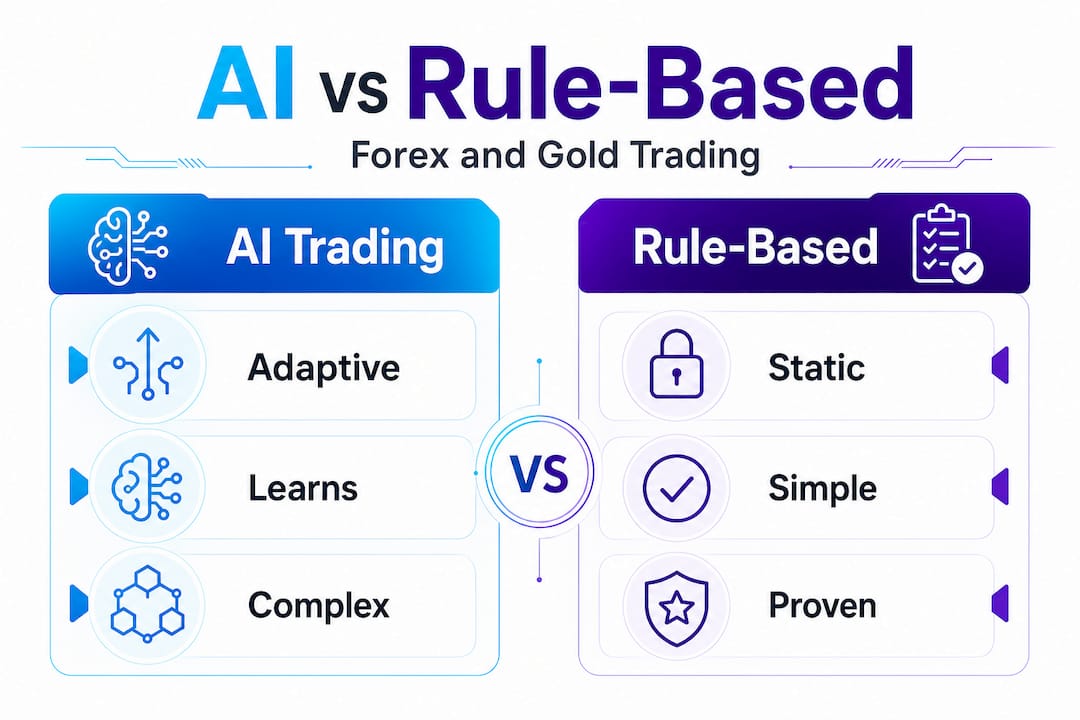
| Feature | AI-powered trading | Traditional rule-based EA |
|---|---|---|
| Adaptability | Learns from new data | Static rules only |
| Speed | Millisecond execution | Millisecond execution |
| Overfitting risk | High if not validated | Lower, but still present |
| Regime change handling | Often struggles | Predictably consistent |
| News/event handling | Poor without filters | Poor without filters |
| Setup complexity | High | Moderate |
| Ongoing maintenance | Required frequently | Minimal |
For AI-powered trading in forex and gold, this table should be your reality check. The strengths are real. So are the risks. You need both columns in front of you before you commit capital. Exploring how AI performs in forex trading across different regimes is one of the most valuable exercises you can do before going live.
How AI-powered trading works on MT4 and MT5 platforms
Once you recognize both sides of AI performance, it’s time to understand how AI-driven automation actually gets applied on MetaTrader 4 and MetaTrader 5, the two dominant retail trading platforms globally.

MT4 and MT5 support AI-driven automation primarily through expert advisors written in MQL4 or MQL5. More sophisticated setups connect external Python or R-based models to the platform via a socket bridge or an API layer, letting a powerful machine learning model generate signals that the EA then executes natively inside MetaTrader. This hybrid approach is increasingly common among professional traders using prop firm accounts.
Here is a practical workflow for integrating AI with MT4/MT5:
- Select your AI model type: Decide whether you will use a native MQL-based neural network, an external model connected via socket, or a pre-trained AI EA from a trusted provider. Each has different maintenance requirements and performance profiles.
- Define your data inputs: Identify which data feeds your model will consume. Standard inputs include OHLCV (open, high, low, close, volume) data, ATR (average true range) for volatility, and any additional economic calendar feeds.
- Backtest on in-sample data: Run your model on historical data from a specific date range, typically 70 to 80 percent of your full dataset, to optimize parameters.
- Validate on out-of-sample data: This is the step most traders skip and the step that matters most. Test the model on the remaining 20 to 30 percent of data it has never seen. If performance collapses here, the model is overfit.
- Forward test on a demo account: Run the model live on demo capital for at least 60 to 90 days, covering multiple market conditions including high-volatility events.
- Deploy with strict position sizing: Go live with micro or mini lot sizes first. Scale only after confirming the model performs consistently with real spreads and real slippage.
- Monitor and recalibrate: Set a weekly review schedule. Watch for drawdown acceleration, unusual trade clustering, or signal degradation that signals model decay.
The AI trading tutorial for MT4/MT5 covers this workflow in greater technical detail, including specific parameter settings for gold and major forex pairs. For traders newer to the concept, reviewing AI trading bots explained is a useful foundation before moving to live deployment.
A critical technical point: LLMs and generic AI tools built for broad use cases lack the real-time market data access needed for genuine trading edge. They also lose their advantage entirely if every trader on the platform uses the same model. Proprietary, specialized AI models with narrow training objectives consistently outperform general-purpose tools in live market conditions.
| Parameter | Recommended setting | Common mistake |
|---|---|---|
| Training data window | 3 to 5 years minimum | Using less than 12 months |
| Out-of-sample validation | 20 to 30% of total data | Skipping entirely |
| Walk-forward periods | Quarterly re-optimization | Set-and-forget for years |
| Max drawdown limit | 10 to 15% hard stop | No drawdown limit set |
| Slippage buffer | Built into backtest settings | Ignoring slippage entirely |
Pro Tip: Always run your AI model through a walk-forward test, not just a single backtest. Walk-forward testing re-optimizes the model on rolling windows of data, which gives you a far more realistic picture of how it will behave in changing market conditions.
Common mistakes and risk management for AI-powered trading
Understanding real-world operations, let’s focus on how to avoid the most damaging errors in AI automation and manage your downside risk effectively.
The majority of traders who lose money with AI-based systems make the same identifiable mistakes. Recognizing them before deployment is far cheaper than learning them through a blown account.
Common mistakes and their antidotes:
- Overfitting the model: Fitting every quirk of historical data produces a model that looks brilliant in backtests and fails immediately in live markets. Antidote: Always validate on out-of-sample data before going live.
- Ignoring slippage and spread costs: Backtests that do not account for real-world spread widening and slippage during high-impact news events will always look better than live performance. Antidote: Use realistic spread models and add a slippage buffer in your backtest settings.
- No drawdown limits: Letting an AI bot run without a hard circuit breaker is one of the fastest ways to lose a prop firm account or your personal capital. Antidote: Set a maximum daily and total drawdown limit inside your EA settings and honor it unconditionally.
- Neglecting model decay: Market dynamics shift constantly. A model trained in 2023 may be completely blind to the volatility patterns that define 2026 gold trading. Antidote: Schedule quarterly model reviews and retrain when performance degrades.
- Over-relying on one strategy: Running a single AI model on a single asset class creates dangerous concentration risk. Antidote: Diversify across multiple uncorrelated strategies and pairs.
“Overfitting to historical data leads to live failure; model decay from market regime changes and poor handling of news or geopolitics, slippage, and latency are the core mechanisms destroying AI trading performance in real markets.”
Understanding why automating gold trading requires specific risk controls will help you build systems that survive the inevitable volatility spikes in XAU/USD. Staying current with forex gold automation trends also helps you anticipate which market structures your models need to account for as conditions evolve through 2026.
Model decay and regime changes are not hypothetical risks. They are the documented primary causes of live AI trading failures across retail and institutional systems alike. Managing slippage and latency is not optional; it is a fundamental requirement for any AI system trading liquid but fast-moving assets like EUR/USD or gold.
Pro Tip: After any major macroeconomic event, such as a Federal Reserve rate decision or a sudden geopolitical shock, recalibrate your AI model or at minimum pause trading until the model’s signal quality stabilizes. Running a model trained on pre-event data through a post-event market is a common and avoidable cause of large drawdowns.
Why most traders misjudge AI’s potential (and what truly works)
Here is the uncomfortable reality that most AI trading marketing ignores: complexity does not equal edge. Traders routinely overestimate what AI can do because the word “AI” itself carries enormous psychological weight in 2026. A system that uses neural networks sounds inherently superior to one using a simple moving average crossover. But the research data does not support that intuition.
Benchmark studies confirm that AI models are not consistently superior to simpler approaches, and their performance is regime-dependent. The traders who succeed with AI-powered systems are not the ones who found the most sophisticated model. They are the ones who validated their models most rigorously, set the most disciplined risk controls, and committed to continuous adaptation as markets evolved.
The real edge in AI trading is not the algorithm. It is the process surrounding the algorithm. Validation beats complexity. Robustness beats accuracy on in-sample data. A simple model that survives five market regimes beats a brilliant model that only works in one.
What we have seen consistently is that traders who treat their AI systems as static, finished products fail. Traders who treat them as living systems requiring regular review, recalibration, and honest performance assessment succeed over the long run. For a deeper look at what this means in practice, the AI-powered trading deep dive on our site walks through specific validation frameworks and regime-detection methods worth implementing before you risk live capital.
The traders who win with automation are not the ones chasing the newest AI model. They are the ones who understand exactly why their system works and remain disciplined enough to stop it when it stops working.
Upgrade your edge: AI and automation tools for MT4/MT5
Ready to put these lessons into practice? The gap between understanding AI trading theory and actually running a validated, profitable system on MT4 or MT5 comes down to having the right tools and the right guidance.
At FxShop24, every solution we offer is built with real trading conditions in mind, not just clean backtests. Whether you are looking for top forex trading tools to complement your existing setup, want to understand the full range of trading software types available for forex and gold, or are exploring automated futures trading systems for broader market exposure, you will find rigorously tested, prop firm-compatible options with lifetime updates and unlimited licenses. Stop guessing and start trading with tools built for the conditions you actually face in live markets.
Frequently asked questions
Why do AI-powered trading systems sometimes fail after strong backtests?
Overfitting to historical data means the model has memorized past noise rather than learned genuine patterns, so it fails to generalize when facing new market conditions in live trading.
Is AI trading always better than manual or simple automated systems?
No. Studies confirm AI is not consistently superior to simpler strategies, and performance is highly dependent on model design and the current market regime.
What are the biggest risks when using AI bots for trading gold and forex?
The top risks are model decay from regime shifts, overfitting to historical data, and failure to account for real-time events, slippage, and latency in fast-moving markets.
How can I reduce the risk of live trading failure with AI systems?
Regularly recalibrate your models after major market events, always validate on out-of-sample data, and monitor your system continuously for signs of model decay or performance degradation before losses compound.