



8
May
Automate and pass prop firm challenges on MetaTrader
TL;DR:
- Most prop firm failures stem from emotional trading, rule violations, and inconsistent execution. Automating compliance through MetaTrader EAs helps enforce risk limits, respect rules, and maintain discipline, increasing challenge success. Careful setup, testing, and verification of automation ensure sustainable performance and trustworthy payout histories.
You spent months developing a solid trading strategy, paid the challenge fee, and still blew the account on day three — not because your entries were wrong, but because a single impulsive trade wiped out your daily drawdown limit. Sound familiar? Most prop firm failures happen at the intersection of emotion, rule complexity, and poor execution consistency. The good news: automated trading on MetaTrader 4 and MetaTrader 5, when correctly configured for compliance, directly addresses each of those failure points. This guide walks you through everything from understanding prop firm structures to verifying your setup is genuinely ready to perform.
Table of Contents
- Understanding prop firm trading and automation
- Prop firm trading rules and compliance essentials
- Step-by-step: Setting up for prop firm compliance with MetaTrader
- Verification and real-world testing: Pass rates, pitfalls, and progress tracking
- The truth most traders miss about prop firm automation
- Take your prop firm trading further with automated solutions
- Frequently asked questions
Key Takeaways
| Point | Details |
|---|---|
| Prop firm rules matter | Meeting trailing drawdowns, profit consistency, and news trading limits is crucial for passing evaluations. |
| Automate for precision | Expert Advisors with correct risk and news filters boost compliance and consistency in prop firm trading. |
| Setup and infrastructure | A VPS-hosted MetaTrader EA setup reduces slippage and ensures reliable 24/7 execution for prop firm accounts. |
| Verification and reviews | Track performance, check firm credibility, and leverage on-chain payout/review sites for security. |
Understanding prop firm trading and automation
Proprietary trading firms, commonly called prop firms, provide traders with funded capital in exchange for a share of the profits. The appeal is obvious: you get to control large positions without risking your own savings beyond the initial challenge fee. Firms like FTMO, MyForexFunds, and The5ers have attracted hundreds of thousands of traders globally because the model promises scalable income with limited personal capital exposure.
But here’s the reality check. Prop firms enable scaling with relatively low personal risk, yet pass and payout rates remain disappointingly low across the industry. Some critics argue that certain firms are more interested in collecting challenge fees than actually funding traders. This doesn’t mean the model is broken, but it does mean you need to approach it strategically.
“Not all prop firms are created equal. Some invest in trader development while others are essentially structured around repeat challenge revenue. Due diligence before you choose a firm is as important as the strategy you trade.”
Automation is the clearest way to remove emotional decision-making from the equation. Expert advisors (EAs) on MetaTrader 4 and MT5 can enforce your rules mechanically. They trade at defined risk per position, respect daily loss limits, and apply news filters automatically. Understanding prop firm essentials before selecting your EA is critical, because not all automated systems are built with compliance in mind.
Why prop firm automation matters:
- EAs trade without emotional deviation from the plan
- Automated risk sizing prevents position errors during volatile sessions
- News filters stop trading during restricted high-impact periods
- 24/7 execution via VPS ensures no missed entries due to system downtime
| Approach | Emotional risk | Consistency | Rule compliance |
|---|---|---|---|
| Manual trading | High | Variable | Human error prone |
| Semi-automated | Medium | Moderate | Partial |
| Fully automated EA | Low | High | Programmable |
The comparison above isn’t theoretical. Prop firms specifically reward consistency, and that’s exactly where automated systems outperform manual traders at scale.
Prop firm trading rules and compliance essentials
Understanding the rules is where most traders stumble. They read the headline numbers — “10% profit target, 5% max drawdown” — and think that’s enough. It isn’t. The specific mechanics of how those rules are enforced can catch even experienced traders off guard.
Trailing versus static drawdown is one of the biggest distinction points. Static drawdown means your account can lose up to a fixed dollar amount from the starting balance. Trailing drawdown, however, follows your highest equity point upward and never resets. If your account peaks at $110,000 on a $100,000 challenge, your drawdown floor moves to $104,000 permanently. Trailing drawdown rules are generally harder to manage, particularly in futures-style prop firm structures, because a winning streak paradoxically tightens your cushion.
Consistency rules are another compliance minefield. Many prop firms now cap how much profit you can earn in a single day relative to your total challenge target. A common threshold is that no single day should represent more than 35 to 40 percent of your total target profit. An EA that fires off a massive winning position during a volatile session could technically violate consistency rules even if the overall account is profitable.
Pro Tip: Before deploying any EA on a funded challenge, backtest it specifically against the consistency rule cap. If one day’s simulated results would breach the 35% threshold, adjust position sizing or add intra-day profit caps to the EA settings.
News trading restrictions have tightened significantly in 2026. Several firms now define a broader blackout window around major economic releases like Non-Farm Payrolls, CPI data, and Federal Reserve announcements. Running an EA without a built-in news filter during these windows is a rule violation waiting to happen. Pairing your EA with a decoding prop firm rules framework helps you identify these risks before they become disqualifying events.
Demo-to-live slippage is frequently overlooked. Challenge phases often run on demo accounts with tight spreads and instant fills. Funded accounts run on live servers where slippage, requotes, and wider spreads are real. An EA optimized purely for demo conditions may execute differently under live conditions, which can erode profits and push drawdown metrics beyond acceptable limits.
| Rule type | Common threshold | Risk level for EAs |
|---|---|---|
| Static drawdown | 10% from starting balance | Manageable with fixed SL |
| Trailing drawdown | Follows peak equity | High, requires tight risk sizing |
| Daily profit cap | 35-40% of total target | Needs intra-day profit monitor |
| News blackout window | 2-5 minutes before/after event | Requires automated news filter |
| Demo-live slippage variance | Varies by broker and session | Test across multiple sessions |
Following actionable prop firm tips specifically designed for MT4 and MT5 setups gives you a practical checklist to audit against each of these rule categories before you ever run a challenge.
Step-by-step: Setting up for prop firm compliance with MetaTrader
Rules understood, setup begins. The difference between traders who consistently pass challenges and those who don’t often comes down to infrastructure quality, not just strategy quality.
Step 1: Choose a prop-firm-compatible EA. Not all EAs are built for prop firm environments. You need one with configurable drawdown limits, built-in news filters, and adjustable daily loss caps. An EA without these features will require significant manual intervention, defeating the purpose of automation. Review EA selection hacks to narrow down your options with a structured framework rather than guessing.
Step 2: Set up a Virtual Private Server (VPS). Running your EA from a home computer introduces downtime risk, latency spikes, and the chance that a power cut or internet outage kills an open trade. A VPS setup for EAs places your MetaTrader instance on a server geographically close to your broker’s data center. Latency drops, execution improves, and your EA runs 24/7 without you monitoring it.
Step 3: Configure fixed stop losses and dynamic risk sizing. Every trade opened by the EA must have a hard stop loss attached. No exceptions. Using a VPS for EAs combined with fixed stop losses and dynamic risk sizing is what separates disciplined automated traders from those who blow challenges on single bad trades. Dynamic risk sizing means the EA automatically adjusts lot size based on current account balance, keeping risk percentage constant even as the account grows or shrinks.

Step 4: Run multi-session spread tests. Before going live on a challenge, test your EA across the Asian, London, and New York sessions. Spreads widen dramatically in off-peak hours and around session opens. An EA that performs well on London session trades may struggle if it fires positions during the Tokyo session when spreads are three times wider on certain pairs.
Step 5: Avoid over-optimization. This is the trap that catches smart traders. You run thousands of backtest iterations, find parameters that produce a perfect equity curve on historical data, and then watch the EA fail immediately on live conditions. Over-optimized EAs are curve-fitted to past noise, not adapted to forward-market realities. Use walk-forward testing and out-of-sample data validation to confirm robustness.
Pro Tip: When setting up your EA’s risk parameters, target a maximum daily drawdown that is 30% below the firm’s stated limit. If the firm allows 5% daily drawdown, configure your EA to halt at 3.5%. This buffer absorbs slippage, spread variance, and unexpected volatility without breaching compliance.
Verification and real-world testing: Pass rates, pitfalls, and progress tracking
Setup complete. Now comes the part most traders skip: systematic verification. Passing a single challenge proves your EA worked once. Building a process that passes challenges repeatedly requires ongoing measurement.
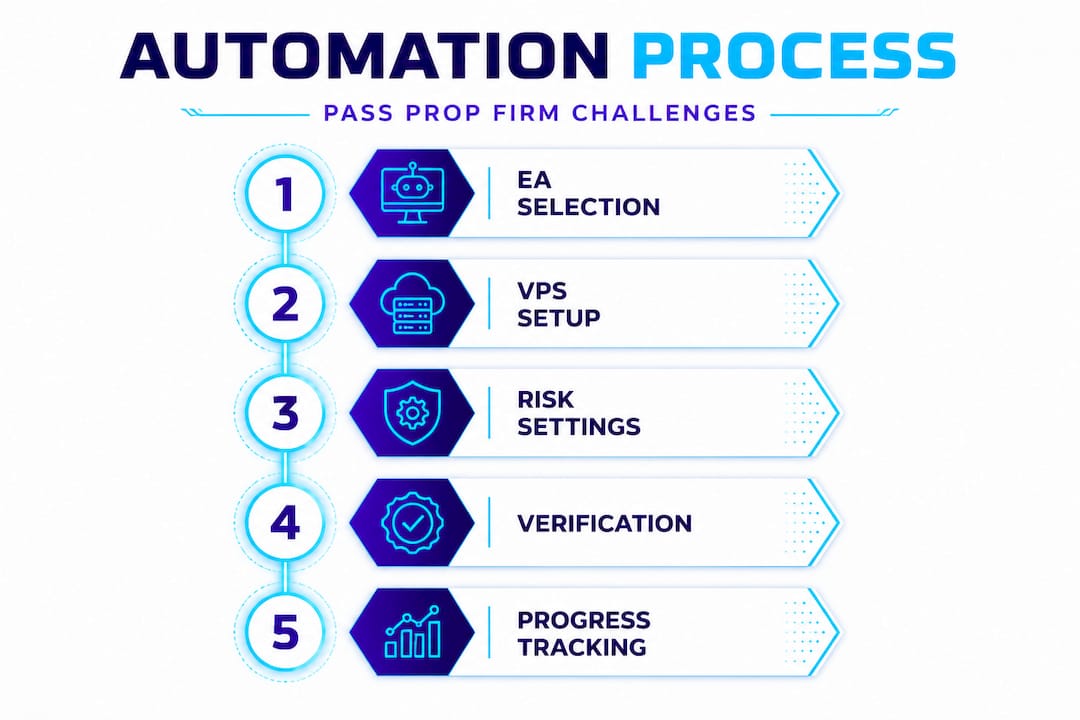
Benchmarking performance. Before paying for a challenge, run your EA on a demo account that mirrors the challenge conditions exactly: same starting balance, same drawdown rules, same profit target. Track the results over at least 20 to 30 trading days. If your EA hits the profit target while respecting all drawdown and consistency limits within that period, you have evidence that it’s ready. If it doesn’t, diagnose the failure before paying a challenge fee.
Avoiding fee traps. Low pass and payout rates at many firms mean that without a verified, consistent edge, you could spend more on repeat challenge fees than you ever earn in funded payouts. Track your total spend on challenge fees against your total funded payouts as a business metric. If the ratio is negative after six months, something needs to change, whether that’s the firm, the EA, or the strategy.
Verifying firm trustworthiness. Not every prop firm that markets itself aggressively actually pays out. Cross-reference payment proof on-chain for crypto-paying firms, check Trustpilot and independent trading forums, and look for verified payout screenshots from real traders. Firms with consistent payout track records will have a long public history of verified payments.
Here is a progress tracking checklist for every challenge week:
- Daily drawdown respected (no breach of EA halt threshold)
- Consistency rule monitored (no single day exceeds 35-40% of target)
- News filter active during all major economic releases
- Slippage between demo and live environments reviewed weekly
- Lot sizing checked against current balance (dynamic sizing functioning correctly)
- VPS uptime confirmed at 99%+
| Metric | Target | Review frequency |
|---|---|---|
| Daily drawdown usage | Below 3.5% (if cap is 5%) | Daily |
| Consistency ratio | No day above 35% of target | Daily |
| News filter activation | 100% of major events | Per release |
| Live vs demo slippage | Within 1 pip average | Weekly |
| VPS uptime | 99%+ | Weekly |
Explore prop firm challenge setups to see structured configurations used by traders who have passed multiple challenge phases. Understanding VPS for EA efficiency also helps you benchmark infrastructure quality against industry expectations.
Pro Tip: Build a simple spreadsheet log for every challenge attempt: date, firm, EA version, result, and failure point if applicable. After three to five attempts, patterns in your failures will become obvious and fixable.
The truth most traders miss about prop firm automation
Here’s the uncomfortable reality: most traders who buy a highly rated EA and deploy it on a challenge without preparation still fail. The EA didn’t fail them. Their process did.
The industry is full of traders chasing the latest “passing hack,” the magic parameter set, or the EA that supposedly guarantees a funded account. That mindset is the problem, not the solution. Elite traders win consistently through strict discipline and smart technology use, not by luck or shortcuts.
Automation is not a substitute for understanding the rules. It is an enforcement mechanism for a disciplined process you’ve already built. An EA cannot save you if you don’t know your firm’s trailing drawdown mechanics, haven’t tested for demo-live slippage, or haven’t accounted for consistency caps. The technology amplifies what you bring to it.
The second hidden danger is over-optimization obsession. Traders spend weeks tweaking EA parameters to produce a flawless backtest, then act surprised when real-market conditions produce different results. Forward testing on live demo accounts, using the actual challenge firm’s server, is the only reliable validation method. Backtests are hypotheses. Forward tests are evidence.
Treat prop firm trading as a structured business. That means challenge fees are operating costs, not gambling stakes. It means EA selection follows a documented criteria framework, not impulse. It means choosing the right MetaTrader EA is a methodical decision based on verified performance data. The traders who build sustainable income from prop firms treat every component of their setup with the same rigor a professional fund manager applies to a real portfolio.
Discipline isn’t glamorous. It doesn’t generate the kind of social media content that gets likes. But it’s the actual differentiator between traders who pass challenges repeatedly and those who keep paying fees with nothing to show for it.
Take your prop firm trading further with automated solutions
The frameworks in this guide give you a strong starting point, but the right tools can significantly accelerate your path to funded trading. At FxShop24, we curate and test advanced automated trading systems specifically designed with prop firm compliance in mind, so you’re not starting from scratch when configuring drawdown limits, news filters, or dynamic risk sizing.
Whether you’re exploring MT4/MT5 trading automation for the first time or upgrading to a more robust setup, our product range includes EAs with lifetime updates, unlimited licenses, and documented performance on prop firm challenge accounts. If you want to compare options side by side before committing, our detailed breakdown of top prop firm trading EAs gives you verified performance data and compliance feature summaries to make an informed decision.
Frequently asked questions
What are the most important prop firm rules traders must follow?
Key rules include strict drawdown limits, profit consistency caps, news trading blackout windows, and managing trailing drawdown rules along with demo-to-live slippage differences. Ignoring any one of these is enough to disqualify an otherwise profitable account.
How do automated EAs help traders pass prop firm challenges?
EAs enforce mechanical rule compliance, precision risk sizing, and consistent execution, eliminating the emotional errors that cause most challenge failures. Combined with dynamic risk sizing via VPS, they produce the kind of consistent results prop firm evaluators reward.
Why are pass rates and payouts so low at many prop firms?
Firms set deliberately high standards for consistency and risk discipline to screen for genuine skill, and some prioritize fee revenue over actually funding traders, making due diligence on firm selection as important as strategy quality.
How can I track progress and verify if a prop firm is trustworthy?
Use on-chain payout verification for crypto-paying firms, cross-reference independent community reviews, and track your own trading metrics weekly against the firm’s published benchmarks. Firms with verifiable payout records and transparent track records are always the safer choice.
Recommended
- Prop Firm Rules Decoded: A Guide For Automated Traders
- Are Prop Firm EAs Dead? Do MT4 Robots Still Pass Challenges In 2025? | FxShop24 Marketplace
- How To Choose The Best MetaTrader EA For Prop Firm Challenges | FxShop24 Marketplace
- The Ultimate Guide To Prop Firm EAs: 5 Steps To Pass Any Challenge In 2025 | FxShop24 Marketplace