



11
Mar
How to choose trading robots for forex and gold in 2026
Forex and gold trading demands constant attention, quick decisions, and zero emotional interference, yet most traders struggle to maintain discipline around the clock. Automated trading bots solve this by executing strategies 24/7 without hesitation or fatigue. This guide walks you through selecting the right trading robots for MT4 and MT5 platforms, ensuring you maximize performance while minimizing risk through evidence-backed evaluation and testing methods.
Table of Contents
- Understanding Trading Robots And Their Core Benefits
- Preparing To Choose: Key Criteria For Evaluating Trading Robots
- Executing Your Choice: Step-By-Step Guide To Selecting And Testing Trading Robots
- Verifying And Optimizing Your Trading Robot For Sustained Success
- Explore Top Trading Robots And Tools To Enhance Your Forex And Gold Trading
- Frequently Asked Questions
Key takeaways
| Point | Details |
|---|---|
| Trading robots eliminate emotional bias | Automated execution follows rules perfectly, removing fear and greed from trading decisions. |
| Performance metrics guide selection | ROI, Sharpe ratio, and maximum drawdown reveal true profitability and risk levels. |
| Platform compatibility matters | Ensure your chosen robot works seamlessly with your MT4 or MT5 setup. |
| Testing prevents costly mistakes | Backtesting and forward testing validate strategies before risking real capital. |
| Ongoing optimization sustains success | Regular monitoring and updates keep robots aligned with evolving market conditions. |
Understanding trading robots and their core benefits
Forex robots automate trading based on coded strategies, operating on platforms like MetaTrader 4 (MT4) and MetaTrader 5 (MT5). These expert advisors (EAs) analyze market data, identify opportunities, and execute trades without human intervention. By encoding specific entry and exit rules, robots replicate consistent decision-making processes that manual traders struggle to maintain.
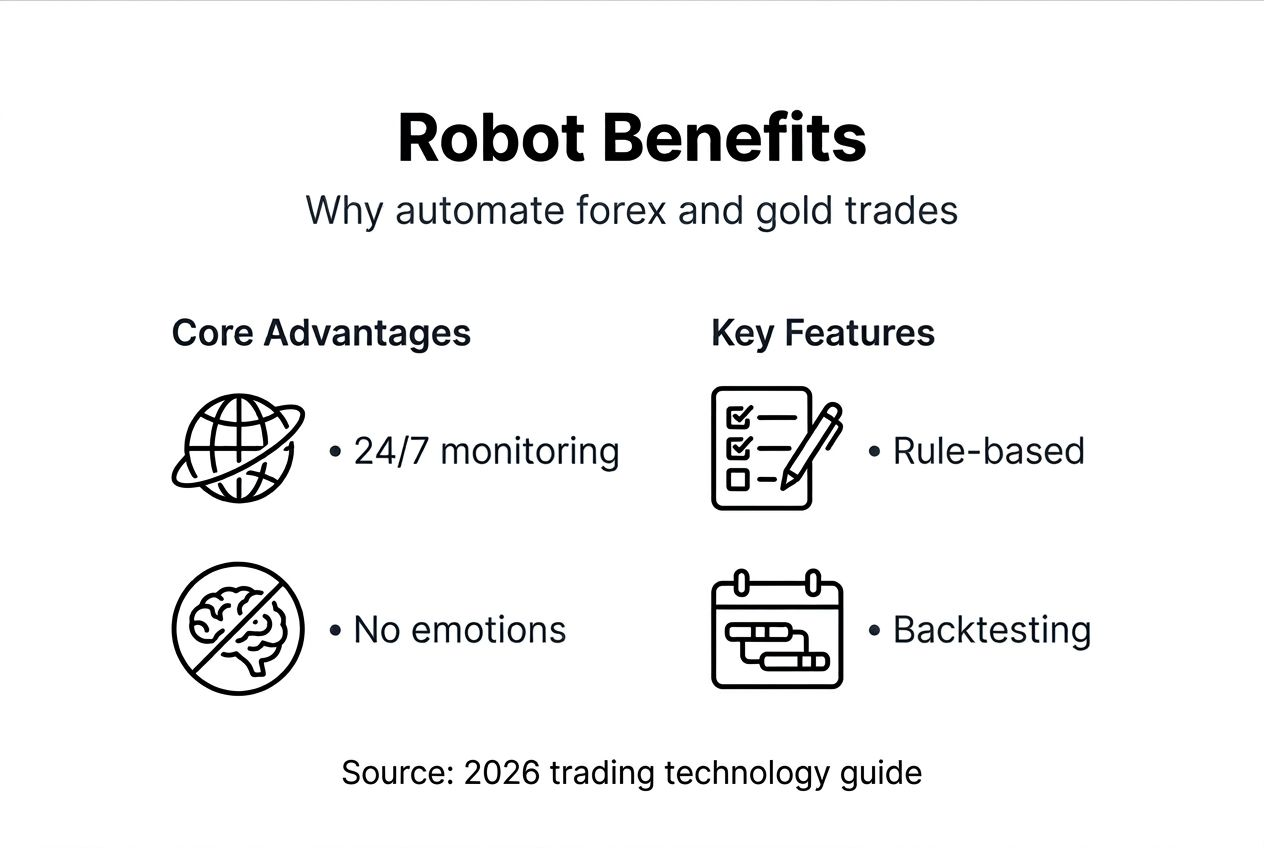
The advantages extend beyond convenience. Key reasons traders use automated bots include 24/7 monitoring, emotion-free trading, lightning-fast execution, and perfect rule-following. While you sleep or focus on other tasks, your robot scans multiple currency pairs and gold markets simultaneously. This continuous operation captures opportunities that arise outside traditional trading hours, especially crucial in forex markets that never close during weekdays.
Rule-based strategies form the backbone of reliable robot performance. Instead of making impulsive decisions during volatile periods, robots stick to pre-programmed logic. This consistency helps maintain discipline during market swings when human traders typically make costly emotional mistakes. Whether you trade momentum breakouts, mean reversion patterns, or grid strategies, robots execute your plan exactly as designed.
Pro Tip: Match your robot’s risk parameters to your personal tolerance levels before going live. A high-frequency scalper might generate profits but cause stress if you prefer conservative approaches.
Understanding advantages of ai trading bots for forex traders helps you recognize which features matter most for your trading goals. Some robots incorporate machine learning to adapt strategies, while others follow static rules. Both approaches work depending on market conditions and your preference for control versus automation.
Preparing to choose: key criteria for evaluating trading robots
Platform compatibility determines whether a robot will function at all. MT4 and MT5 use different programming languages, so an EA built for one won’t work on the other without modification. Check your broker’s platform version first, then filter robot options accordingly. MT5 offers more timeframes and built-in indicators, but MT4 remains popular for its simplicity and widespread third-party support.
Strategy types vary widely in approach and market conditions they handle best:
- Machine learning-based robots adapt to changing patterns by analyzing recent price behavior and adjusting parameters automatically
- Momentum strategies capitalize on trending markets, buying strength and selling weakness
- Mean reversion systems profit from price returning to average levels after extreme moves
- Grid trading places multiple orders at set intervals, profiting from range-bound consolidation
It is possible to find an effective algorithmic trading strategy that generates superior signals for specific market conditions. No single strategy dominates all scenarios, so understanding your typical market environment guides better selection.
Performance metrics separate marketing hype from genuine profitability. Trading-oriented measures like ROI, Sharpe Ratio, and Maximum Drawdown assess model performance, bridging predictive accuracy with real financial outcomes. ROI shows total profit percentage over a period. Sharpe ratio reveals return per unit of risk taken, with values above 1.0 considered decent and above 2.0 excellent. Maximum drawdown indicates the largest peak-to-trough decline, warning you about worst-case scenarios.

| Metric | What It Measures | Good Target |
|---|---|---|
| ROI | Total profit percentage | Above 30% annually |
| Sharpe Ratio | Risk-adjusted returns | Above 1.5 |
| Maximum Drawdown | Largest account decline | Below 20% |
| Win Rate | Percentage of profitable trades | Above 55% |
Pro Tip: Prioritize Sharpe ratio over raw ROI when comparing robots. A 50% return with 10% drawdown beats 80% returns with 40% drawdown for sustainable long-term growth.
Evaluating these metrics against historical data predicts how robots might perform with your capital. A robot showing 200% ROI but 60% drawdown risks wiping out your account during adverse conditions. Learn how to evaluate trading robots using comprehensive metric analysis to avoid common selection pitfalls.
Executing your choice: step-by-step guide to selecting and testing trading robots
Start your selection process with thorough research and verification:
- Identify top-rated robots through trusted review sites, trading forums, and vendor platforms with verified user feedback
- Request detailed backtesting reports showing at least 12 months of historical performance across different market conditions
- Verify the robot’s strategy aligns with your risk tolerance and trading objectives
- Check vendor reputation, support quality, and update frequency to ensure ongoing improvements
Backtesting reveals how a robot would have performed using historical data. Run tests across multiple currency pairs and timeframes to assess consistency. Look for steady equity curves without dramatic spikes or crashes. Smooth growth indicates robust logic, while erratic results suggest curve-fitting or lucky periods that won’t repeat.
Forward testing simulates live conditions without risking real money. Demo accounts let you observe robot behavior in current markets, catching issues backtests miss. Markets evolve constantly, so strategies performing well historically might struggle now. Run forward tests for at least one month, covering various market phases including trends, ranges, and high volatility events.
Machine learning models, particularly Multi-Layer Perceptron (MLP), can achieve ROI values up to 334.24% and 299.44% in forex trading when properly optimized. These impressive returns come from sophisticated pattern recognition, but they require careful validation to avoid overfitting to past data.
Selection criteria for your final choice should include:
- Consistent positive results across backtesting and forward testing periods
- Reasonable drawdown levels that won’t trigger emotional panic or account liquidation
- Clear documentation explaining strategy logic and parameter settings
- Active vendor support with regular updates addressing market changes
- Compatibility with your broker’s execution speed and spread conditions
Pro Tip: Diversify across multiple robots trading different strategies and asset pairs. This reduces dependency on any single approach and smooths overall account performance.
Understanding how to choose forex trading bot specifics helps you navigate technical specifications and marketing claims effectively. Focus on verifiable performance data rather than promotional videos showing cherry-picked winning trades.
Verifying and optimizing your trading robot for sustained success
Ongoing monitoring prevents gradual performance decay as markets shift. Track weekly and monthly results against your robot’s historical benchmarks. Watch for declining win rates, increasing drawdowns, or longer losing streaks than backtests showed. These signals indicate strategy effectiveness fading and requiring adjustment.
Key metrics to monitor regularly include:
- Monthly ROI compared to backtest averages
- Current drawdown percentage versus historical maximum
- Win rate trends over rolling 30-day periods
- Profit factor showing gross profit divided by gross loss
Market dynamics change constantly due to economic cycles, central bank policies, and global events. A momentum strategy thriving during trending markets might hemorrhage capital during choppy consolidation. Review your robot’s performance against current market regime, adjusting position sizes or temporarily pausing strategies misaligned with conditions.
| Optimization Approach | Advantages | Disadvantages |
|---|---|---|
| Manual parameter tweaking | Full control over changes | Time-consuming, requires expertise |
| Automated adaptive updates | Responds quickly to market shifts | Risk of over-optimization |
| Hybrid monitoring with selective intervention | Balances automation with human oversight | Requires ongoing attention |
Feature-augmented multivariate LSTM models outperform baseline methods in forex forecasting by incorporating engineered indicators. Adding technical indicators like RSI, moving averages, or gold price correlations as input features can significantly enhance prediction accuracy. Consider robots that allow custom indicator integration for improved adaptability.
Avoid common optimization pitfalls that destroy profitability. Overfitting occurs when tweaking parameters to perfectly match past data, creating strategies that fail on new data. Combat this by validating changes on out-of-sample periods your original tests never touched. Stale models using outdated market relationships need regular retraining on recent data to maintain relevance.
Explore comprehensive resources on guide to optimizing trading robots for detailed techniques balancing performance improvement with overfitting prevention. Small, incremental adjustments based on statistical significance outperform dramatic overhauls chasing recent winners.
Explore top trading robots and tools to enhance your forex and gold trading
Finding reliable trading robots requires trusted sources offering transparent performance data and expert evaluation. FxShop24 specializes in curated collections of high-quality expert advisors designed specifically for MT4 and MT5 platforms, focusing on forex and gold markets where you need proven solutions.
Access detailed guides explaining types of trading robots metatrader platforms support, helping you understand which strategy categories match your trading style. Whether you prefer scalping, swing trading, or grid systems, comprehensive resources break down technical specifications into actionable selection criteria.
Expert evaluation frameworks at FxShop24 teach you how to evaluate trading robots using the same metrics professional traders rely on. Learn to spot marketing exaggerations versus genuine performance through step-by-step assessment protocols. These tutorials shorten your learning curve dramatically, helping you avoid costly beginner mistakes.
Optimization support ensures your robots maintain peak performance as markets evolve. Detailed guide to optimizing trading robots tutorials demonstrate parameter adjustment techniques, backtesting validation methods, and adaptive strategy modifications that keep your systems profitable long-term.
Frequently asked questions
What is a trading robot and how does it work?
Trading robots are software programs executing trades automatically using coded strategies on platforms like MT4 and MT5. They analyze market conditions, identify opportunities matching their rules, and place orders without human intervention, operating 24/7 to capture opportunities across all trading sessions.
How do I ensure my trading robot is profitable?
Conduct thorough backtesting using historical data spanning at least one year, then validate with forward testing on demo accounts. Analyze key metrics including ROI, Sharpe ratio, and maximum drawdown. Monitor ongoing performance weekly and optimize settings as market conditions shift to maintain edge.
Can I use one trading robot for all forex and gold trading?
No single robot fits every market effectively. Different asset classes and currency pairs exhibit unique characteristics requiring specialized strategies. Diversify across multiple robots tailored to specific markets to reduce risk and improve adaptability across varying conditions.
What are common mistakes to avoid when choosing trading robots?
Avoid selecting robots without verified backtesting reports or ignoring maximum drawdown warnings. Never skip forward testing on demo accounts before risking real capital. Don’t rely solely on past performance without ongoing monitoring and optimization as markets evolve continuously.