
25
Jan
Why Trust Trading Robots for Forex Success
Choosing when and how to automate your forex and gold trades can feel like a complex puzzle for retail traders everywhere. Automated trading robots for MetaTrader platforms promise speed, discipline, and precision, executing orders in milliseconds and eliminating human emotions from decision making. Yet, research shows that while these robots offer a mechanical advantage in discipline, combining automation with manual oversight can actually improve overall profitability. Understanding how trading robots work and their real-world limitations is key for anyone looking to boost consistency and manage risk in volatile financial markets.
Table of Contents
- What Are Trading Robots And How They Work
- Types Of Forex And Gold Trading Robots
- Performance Metrics And Reliability Standards
- Risks And Limitations Of Automated Trading
- Legal And Security Considerations For Users
Key Takeaways
| Point | Details |
|---|---|
| Automation Reduces Emotional Trading | Trading robots execute predefined strategies, eliminating emotional biases that can lead to poor trading decisions. |
| Market Conditions Impact Performance | Trading robots perform best in consistent market conditions; be prepared to adjust strategies during sudden changes. |
| Rigorous Testing is Essential | Evaluate robots using meaningful performance metrics, focusing on results across varied market environments. |
| Legal and Security Awareness is Crucial | Ensure compliance with regulations and protect your trading data by using strong security practices and legitimate brokers. |
What Are Trading Robots and How They Work
Trading robots, also called execution algorithms, are automated programs that execute trades based on predefined strategies you set before the market opens. Rather than sitting at your screen watching price movements, these robots monitor markets continuously and execute orders automatically when specific conditions are met. Think of them as tireless trading assistants that follow your exact instructions with mechanical precision, never getting tired, emotional, or distracted.
The core function of trading bots centers on speed and discipline. Once you establish your trading strategy and the robot parameters in your MetaTrader platform, the system becomes locked into that approach. This automation imposes discipline by removing the emotional element from trading decisions. Your robot will not panic sell during a market dip or get greedy during a rally. It executes your predetermined plan exactly as coded, which helps eliminate the behavioral biases that cost most retail traders thousands in losses annually. The speed advantage is equally significant. A robot executing trades in milliseconds can capture opportunities that would be impossible for a human trader to react to manually.
However, this mechanical reliability comes with a tradeoff. Since robots operate on predetermined instructions, they cannot learn or adjust on the fly. If market conditions shift dramatically, your robot continues following its original strategy unless you manually reprogram it. This means robots work best in consistent, predictable market conditions. Recent research on execution algorithms shows that combined use of robots and manual trading may improve overall profitability compared to using robots alone, suggesting the ideal approach often involves letting your automation handle routine executions while you monitor for market regime changes.
Pro tip: Start with a conservative robot strategy on a demo account for at least 30 trading sessions before committing real capital, allowing you to observe how your chosen algorithm performs across different market conditions without financial risk.
Types of Forex and Gold Trading Robots
Trading robots come in several distinct flavors, each built around different trading methodologies and market analysis approaches. Understanding these types helps you choose the right automation strategy for your specific goals. Some robots focus purely on price action, while others blend multiple analytical frameworks to make trading decisions. The most sophisticated modern robots integrate technical, fundamental, and sentiment analysis to forecast market movements and identify optimal entry and exit points.
Technical Analysis Robots operate by analyzing historical price data, chart patterns, and mathematical indicators like moving averages, RSI, and MACD. These bots scan for setups that have worked repeatedly in the past and execute when those conditions reappear. For gold trading specifically, technical robots excel at identifying support and resistance levels on XAUUSD charts. They react quickly to price breaks and trend reversals, making them reliable for consistent, rule-based trading. Many traders favor these robots for their straightforward logic and ease of backtesting results.
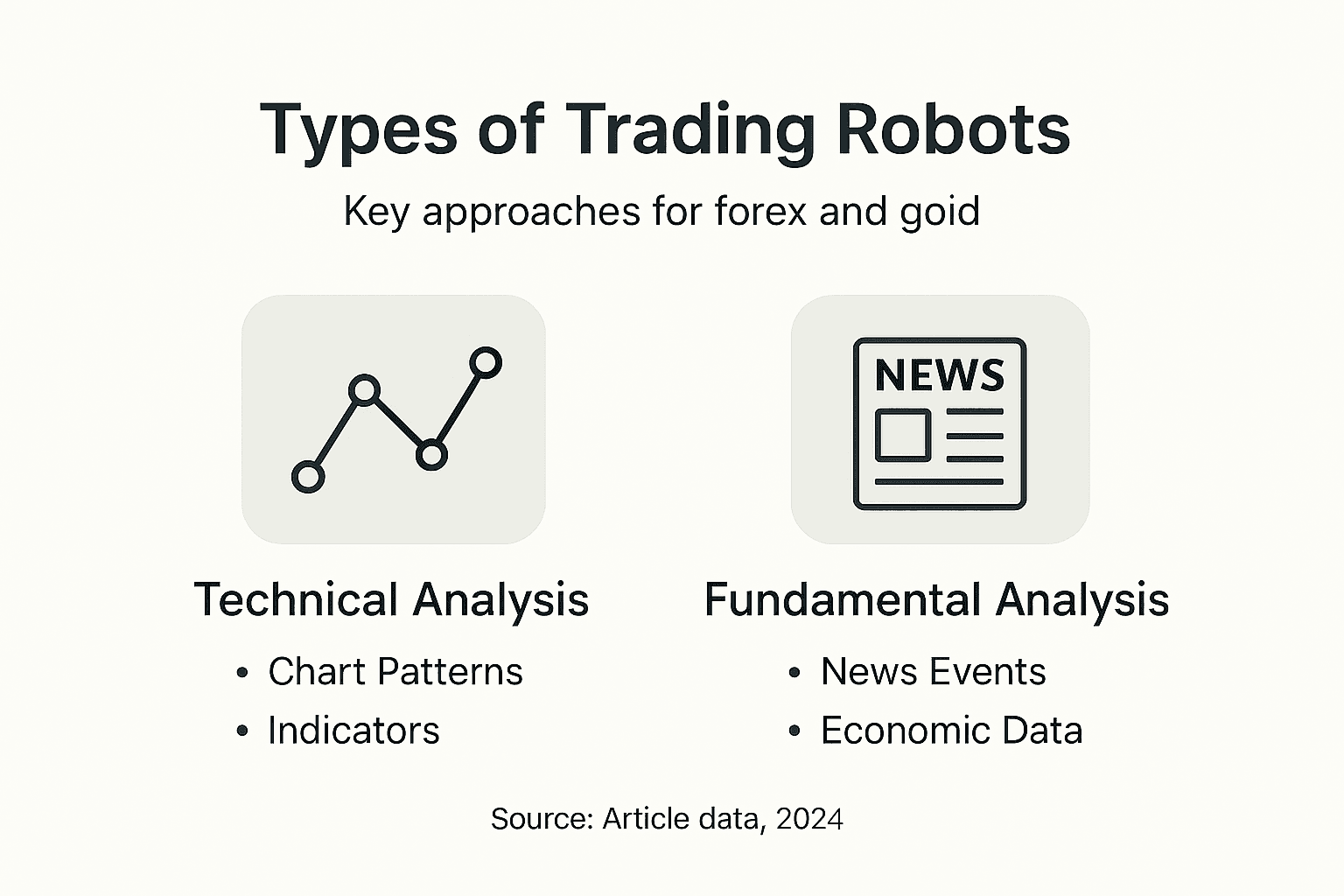
Fundamental Analysis Robots take a different approach by monitoring economic news, interest rate decisions, employment reports, and other macroeconomic factors that drive currency and precious metal values. These robots adjust their trading bias based on which economic data is being released and what market expectations are. For instance, a gold robot might increase bullish positions ahead of weaker US economic data or rising inflation signals. Fundamental robots require more sophisticated coding since they must integrate real-time news feeds and economic calendars.
Hybrid and AI-Powered Robots combine multiple analysis types for enhanced decision-making. Some employ machine learning techniques that allow them to refine their strategies based on recent market performance. Others blend sentiment analysis, which gauges market psychology from social media, news tone, and trader positioning, alongside traditional indicators. These advanced robots can adapt more flexibly than single-methodology bots, though they require more computing power and careful optimization.
Arbitrage and Grid Trading Robots operate with completely different mechanics. Rather than predicting price direction, grid bots and arbitrage systems profit from price inefficiencies and repetitive oscillations. Grid robots place multiple buy and sell orders at predetermined intervals, profiting from small price movements. Arbitrage bots exploit temporary price differences between different brokers or trading pairs.
Pro tip: Test each robot type on a demo account using real market data from the last 6 months, focusing on how each handles the specific market conditions you typically trade, rather than selecting based on historical backtest results alone.
Here’s a comparison of the main types of trading robots and their unique characteristics:
| Robot Type | Core Analysis Method | Typical Strength | Key Limitation |
|---|---|---|---|
| Technical Analysis | Price patterns, charts | Fast rule execution | Lags during sudden news |
| Fundamental Analysis | Economic news feeds | Responsive to events | Slower reaction time |
| Hybrid/AI-Powered | Combined, machine learning | Adapts to market shifts | Requires significant resources |
| Arbitrage/Grid | Price discrepancies | Profits in sideways markets | Risk spikes in volatile moves |
Performance Metrics and Reliability Standards
Not all trading robots perform equally, and claims of astronomical returns should immediately raise red flags. What separates reliable robots from overhyped ones comes down to how thoroughly they’ve been tested and what metrics are used to evaluate them. A robot that looks incredible on paper might collapse in real-world trading when actual spreads, slippage, and commissions are factored in. This is why rigorous performance analysis using tick-level data including real spreads, slippage, and commissions is absolutely essential for avoiding misleading backtest results.
When evaluating a trading robot, you need to focus on specific, meaningful metrics rather than just total return percentages. The Sharpe ratio measures your risk-adjusted returns, telling you how much profit you earned per unit of risk taken. The Sortino ratio goes deeper by only penalizing downside volatility, giving you a clearer picture of actual trading quality. Maximum drawdown shows the worst losing streak your robot experienced, which matters because a 50% drawdown means you need 100% gains just to break even. Win rate indicates the percentage of winning trades, while profit factor divides total profits by total losses to show if winners are significantly larger than losers. A robot with a 40% win rate isn’t necessarily bad if each winner is three times larger than each loser.
Reliability requires testing across multiple market conditions and broker environments. A robot that dominated a calm trending market in 2022 might fail spectacularly during choppy sideways action or during geopolitical shocks. You should verify performance during bull markets, bear markets, high volatility periods, and low volatility periods. Testing with multiple brokers reveals whether results depend on favorable spreads or realistic trading costs. Many robot developers cherry-pick their best results while hiding losses during specific market regimes. Legitimate performance claims include drawdown periods, losing months, and full statistics across varying conditions.
Beyond the numbers themselves, consider the testing methodology. Forward testing on live market data matters more than backtesting on historical data because markets change. Look for robots that have undergone prop firm verification or third-party performance audits. Check whether the developer discloses actual trading results from real accounts or only theoretical backtests.
Pro tip: Request or find verified performance records showing at least 12 consecutive months of real trading results, including all losing months, before trusting any robot with significant capital.
Consider these essential reliability metrics when evaluating trading robots:
| Metric | What It Measures | Why It Matters |
|---|---|---|
| Sharpe Ratio | Risk-adjusted returns | Gauges performance versus risk |
| Maximum Drawdown | Largest loss streak | Shows recovery challenge needed |
| Win Rate | Percent of successful trades | Indicates trade consistency |
| Profit Factor | Profits over losses | Confirms reward relative to risk |
Risks and Limitations of Automated Trading
Automated trading sounds perfect in theory, but reality introduces complexities that no robot can fully navigate. The biggest risk stems from the fact that trading robots operate within rigid parameters set during calmer market periods. When unprecedented events occur—geopolitical shocks, sudden policy changes, or market panic—your robot continues executing its predetermined strategy without understanding context. Automated trading systems face significant challenges including model overfitting and inability to interpret sudden market shifts, which can lead to catastrophic losses in rare but critical moments. A robot trained on three years of normal market data has never seen a 1000-pip move in gold prices within minutes, so it cannot adapt when one occurs.
Technical failures present another serious concern. Your robot depends on continuous internet connectivity, stable broker connections, and properly functioning MetaTrader platforms. A power outage, internet disruption, or broker server issue could leave your open positions unprotected or trigger unwanted entries at the worst possible moments. Some traders have experienced robots opening trades during news releases when spreads widened dramatically, turning what should be small losses into account-destroying drawdowns. Additionally, AI trading systems confront challenges including data quality issues, algorithmic bias, and security threats that expose traders to risks despite automation efficiencies. A robot trained on biased historical data might systematically misidentify trading opportunities in unfamiliar market conditions.
Overfitting represents a particularly insidious risk. This occurs when you optimize a robot’s parameters so heavily to past market data that it performs brilliantly on historical backtests but fails miserably in live trading. You adjust the stop loss by 5 pips here, the entry threshold by 0.2 there, and suddenly your robot shows 200% annual returns on 2020-2023 data. Then it loses money on actual 2024 trading. Many traders experience this heartbreak after spending weeks perfecting their robot’s settings.
Market correlation risks also matter. When multiple traders use similar robots with identical or similar logic, everyone’s algorithm reacts to the same signals simultaneously. This creates flash crash scenarios where prices move violently for seconds as thousands of robots execute simultaneously, then reverse just as quickly. You might get filled at catastrophic prices before you even realize what happened.
Pro tip: Set strict maximum daily loss limits and maximum drawdown stops before running any robot, then enforce them rigidly by temporarily disabling the robot when those limits are breached, rather than hoping the robot will recover on its own.
Legal and Security Considerations for Users
When you deploy a trading robot with real money, you enter a space where legal responsibility and security become critically important. Your robot acts as your agent in the market, executing trades on your behalf, which means you remain fully liable for all trades it generates, regardless of whether you directly authorized each individual transaction. If your robot executes trades that violate your broker’s terms of service or applicable financial regulations, you cannot claim the robot acted independently. You are accountable. This legal reality makes choosing a legitimate broker and understanding their automation policies non-negotiable before deploying any expert advisor.
Cybersecurity presents an equally serious concern. Your MetaTrader account credentials, trading capital, and API keys represent valuable targets for hackers. AI-powered security systems on trading platforms enhance customer trust through advanced detection and regulatory compliance measures, protecting both your account and your data from unauthorized access. However, this responsibility extends beyond your broker’s security infrastructure to your own practices. Using weak passwords, running robots on unsecured computers, or entering credentials on suspicious websites can compromise everything. Many traders have lost accounts to credential theft because they prioritized convenience over security.
Regulatory compliance varies significantly by your location and your broker’s jurisdiction. Some countries classify retail forex trading as gambling and restrict it heavily, while others regulate it as financial services. If you operate a robot that engages in market manipulation, layering, spoofing, or other prohibited trading practices, you could face legal consequences regardless of whether the robot acted automatically. Additionally, maintaining records of all trades executed by your robot is typically required for tax purposes. Your robot generates a transaction trail that tax authorities may audit. Document everything. Some traders have faced unexpected tax bills because they failed to properly track robot-generated trading activity.
Broker selection influences both legal and security outcomes. Licensed and regulated brokers in jurisdictions like the UK, Australia, or the European Union maintain higher security standards and regulatory oversight than unregulated offshore brokers. Unregulated brokers may disappear with your funds or manipulate prices to liquidate your account. They offer minimal legal recourse. Always verify your broker’s licensing status and regulatory standing before funding your account or deploying any automated system.
Pro tip: Use a dedicated email address and strong, unique password for your trading account, enable two-factor authentication if available, and never share your account credentials, API keys, or recovery phrases with anyone, regardless of how trustworthy they appear.
Unlock Forex Success with Trusted Trading Robots
The challenges of automating trading without emotion or hesitation are real. As the article points out, finding reliable robots that perform consistently across changing market conditions is crucial. You want expert advisors that eliminate human error yet remain adaptable enough to support your trading goals without exposing you to hidden risks like overfitting or technical failures. At FxShop24, we understand how important speed, discipline, and verified performance metrics are for genuine Forex and gold traders seeking trustworthy automation solutions.
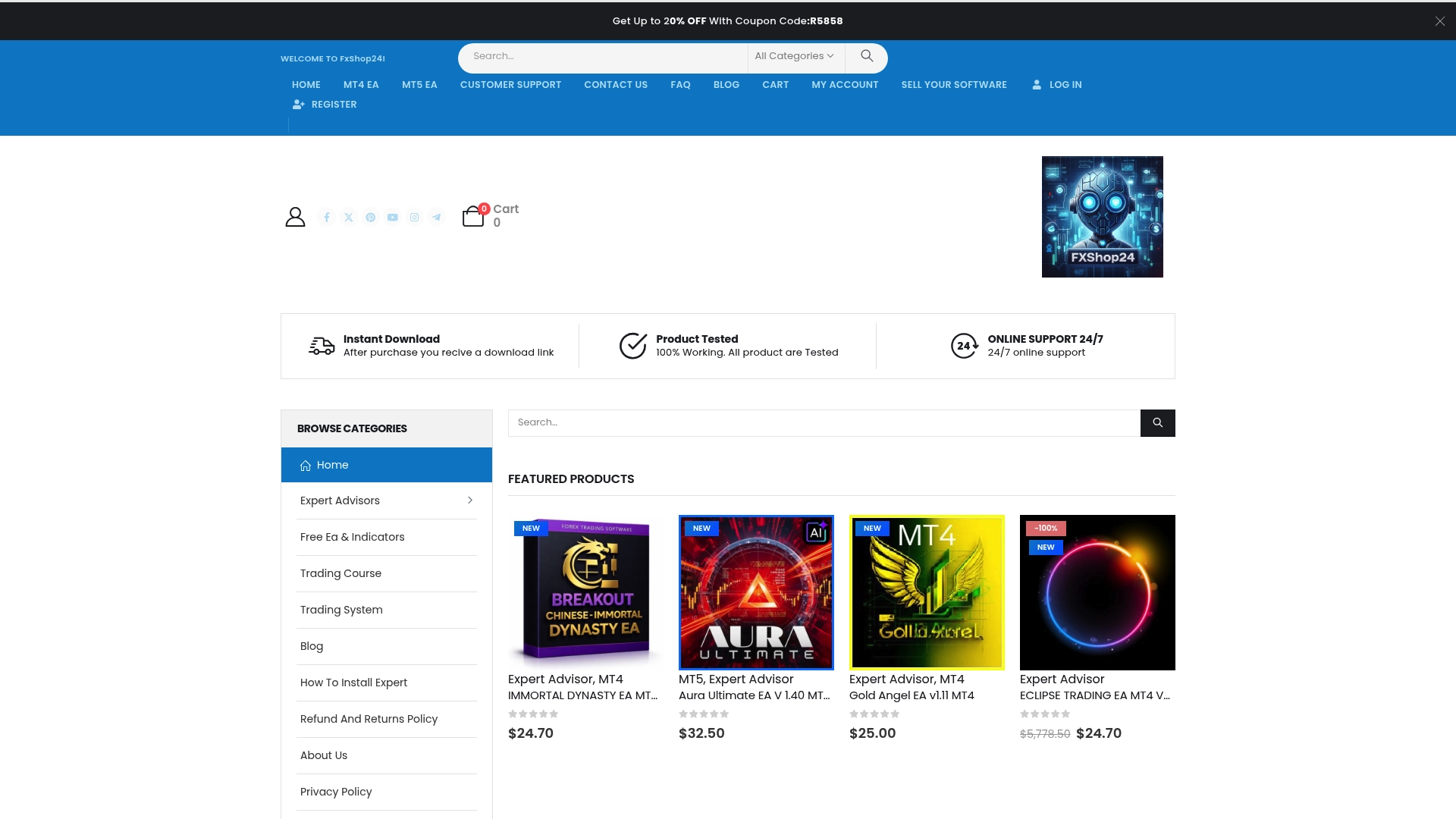
Discover our wide selection of tested and prop firm-ready expert advisors designed to match the strategies highlighted such as technical, fundamental, and AI-powered robots. Start with beginner-friendly options to experience automated trading securely, then step up to advanced systems backed by real verified results. With instant downloads and lifetime updates, we provide the tools you need to trade intelligently and confidently. Visit FxShop24 now to explore tools that bring your automation strategies to life and take control of your Forex growth today.
Frequently Asked Questions
What are trading robots and how do they work?
Trading robots are automated programs that execute trades based on predefined strategies set by the trader. They monitor the markets continuously and execute orders automatically when specific conditions are met, helping to eliminate emotional biases in trading decisions.
What types of trading robots are available for forex trading?
There are several types of trading robots, including technical analysis robots, fundamental analysis robots, hybrid and AI-powered robots, and arbitrage/grid trading robots. Each type employs different strategies and methodologies to make trading decisions based on market conditions.
How can I evaluate the performance of a trading robot?
When evaluating a trading robot, focus on meaningful metrics such as the Sharpe ratio, maximum drawdown, win rate, and profit factor. It’s essential to also verify that the robot has been tested across multiple market conditions and broker environments for reliable performance results.
What are the risks associated with using trading robots?
Risks include model overfitting, technical failures, and the inability of robots to react to sudden market changes. Automated trading systems can also face challenges like cybersecurity threats and legal liabilities if they execute trades that violate broker policies or regulations.
Recommended
- Stop Losing Money: 10 Forex Trading Bot Mistakes That Kill Accounts (And How To Fix Them) | FxShop24 Marketplace
- What Is Forex Automation: Transforming Modern Trading
- Are Forex Trading Bots Dead? Do People Still Pass Prop Firm Challenges With EAs? | FxShop24 Marketplace
- From Demo To Real: Transitioning Safely With Expert Advisors | FxShop24 Marketplace
Author