

2
Jul
Gold Scalping Bot Behavior: What Traders Must Know
TL;DR:
- Gold scalping bots execute rapid, short-term trades on XAUUSD by detecting momentum shifts with EMA crossovers and price action signals. Their success relies on precise timing, low-latency execution, and trading during high-liquidity market sessions, while adapting to different market regimes. Proper broker selection, session control, and discipline are essential for profitable live trading with these bots.
Gold scalping bot behavior is defined as the automated execution of frequent, short-duration trades on XAUUSD, targeting 5–25 pip moves within seconds to minutes. In the industry, these programs are formally called expert advisors (EAs) when deployed on MetaTrader 4 or MetaTrader 5. They operate on M1 and M5 charts, using momentum detection and micro-trend logic to enter and exit positions before the market reverses. Understanding what is gold scalping bot behavior means understanding three things equally: the signal logic, the execution environment, and the market timing. Get any one of those wrong, and a bot that looks profitable in testing will bleed money live. Fxshop24 builds its entire product catalog around EAs that address all three.
What is gold scalping bot behavior at the signal level?
Gold scalping bots identify trade opportunities through a combination of technical indicators and price action confirmation. The most common signal stack uses an EMA 9/21 crossover on the 1-minute chart to detect a momentum shift, then waits for a confirming price action trigger such as an engulfing candle or a swing break before executing. This two-step filter reduces false entries caused by random noise on short timeframes.
The timing of entry matters more than most traders realize. Entering a trade during the formation phase of a signal, rather than waiting for full confirmation, captures 40–60% more of the total price move. That difference is significant when your entire target is only 10–15 pips. Bots that wait for a closed candle to confirm a signal are systematically late.
Volatility filters add another layer of signal quality control. A bot may detect an EMA crossover but suppress the trade if the Average True Range reading is too high or too low. High ATR signals erratic, news-driven moves that are hard to scalp cleanly. Low ATR signals a dead market where the target pip move may never materialize.
| Signal Type | Trigger | Typical Use Case |
|---|---|---|
| EMA crossover | EMA 9 crosses EMA 21 on M1 | Momentum shift detection |
| Engulfing candle | Full-body candle closes over prior candle | Price action entry confirmation |
| Swing break | Price closes beyond recent swing high or low | Breakout entry trigger |
| ATR filter | ATR above or below defined threshold | Volatility gate to suppress bad entries |
| Breakout detection | Price exits a defined range boundary | Range-to-trend transition signal |
Pro Tip: Formation-entry bots consistently outperform confirmation-entry bots on short timeframes. If your EA waits for a fully closed candle before entering, you are already giving up a meaningful portion of the move you are trying to capture.
What impact does the trading environment have on bot performance?
Infrastructure quality determines net profitability more than indicator choice. Execution costs including spread, commission, and slippage consume 20–40% of gross profits on scalping trades. A bot targeting a 10-pip gain on a broker with a 2.5-pip spread and 0.5-pip average slippage is already starting each trade 3 pips in the hole. That math compounds across dozens of trades per day.
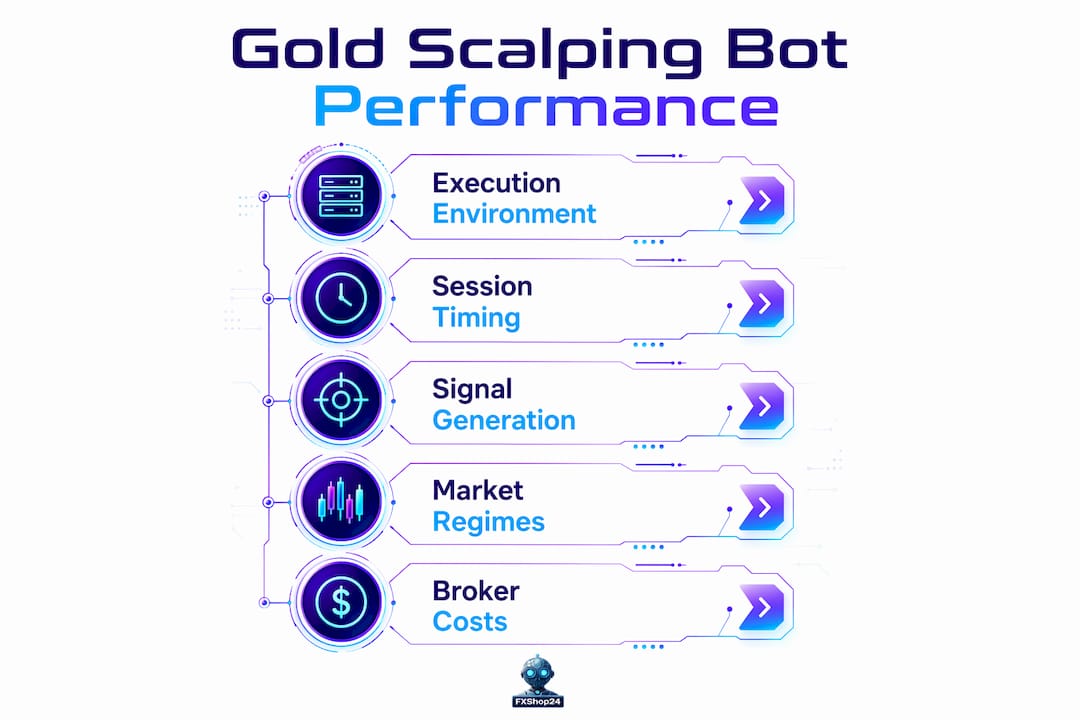
Raw-spread or ECN accounts are not optional for scalping bots. They are the minimum viable environment. Standard accounts with fixed spreads of 2–3 pips on XAUUSD make net-positive scalping nearly impossible at the pip targets these bots use. A single 25-pip spread spike during a news event can negate an entire move and turn a winning signal into a losing trade.
Latency compounds the spread problem. A bot running on a home PC with a 200-millisecond round-trip to the broker’s server will experience consistent slippage on fast-moving markets. Virtual private servers (VPS) located in the same data center as the broker’s execution engine reduce that latency to under 5 milliseconds. That difference shows up directly in fill quality.
| Cost Factor | Impact on a 10-Pip Target Trade | Net Result |
|---|---|---|
| 1-pip spread | 10% of gross profit consumed | Manageable on ECN accounts |
| 2.5-pip spread | 25% of gross profit consumed | Borderline unprofitable |
| 0.5-pip slippage | Additional 5% erosion | Compounds with spread |
| High-latency fill | 1–2 pip extra slippage | Turns marginal trades into losses |
| News spike spread | Can reach 10–25 pips | Wipes entire target move |
Pro Tip: Never run a gold scalping bot during scheduled high-impact news events. The spread widens unpredictably, slippage spikes, and the bot’s signal logic was not designed for that kind of price behavior. Pause the EA at least 5 minutes before and after major releases.
When and why do gold scalping bots trade during specific sessions?
Gold scalping bots limit activity to high-liquidity windows because liquidity directly controls spread width and signal reliability. The two optimal windows are the London open (08:00–12:00 UTC) and the London-New York overlap (13:00–17:00 UTC). During these periods, institutional order flow is highest, spreads are tightest, and price moves with enough momentum to reach scalping targets cleanly.

Outside these windows, the gold market thins out. Asian session XAUUSD often moves in choppy, low-directional ranges where breakout signals produce fakeouts and EMA crossovers generate noise rather than tradeable momentum. A bot running 24 hours a day will accumulate losing trades during these dead hours that erase the gains made during the productive sessions.
Well-designed scalping EAs include session timer logic that automatically pauses trading outside the defined windows. This is not a convenience feature. It is a core risk control. Fxshop24’s Midas Bot EA for MT4 is one example of a product built around session-aware execution, limiting activity to the London-New York overlap where liquidity conditions support its strategy.
The practical session controls built into advanced gold scalping bots include:
- Session start and end timers that activate and deactivate the bot automatically
- Maximum daily trade limits that cap exposure once a set number of trades is reached
- Daily profit and loss cutoffs that shut the bot down after hitting a target or a loss ceiling
- News filter integration that pauses trading around scheduled economic events
- Weekend close logic that exits all positions before Friday’s market close to avoid gap risk
Limiting active trading to 2–3 hours per day during peak liquidity produces better results than running the bot continuously. Fewer trades with higher quality setups outperform high-frequency trading in low-quality conditions.
How do advanced gold scalping bots adapt to different market regimes?
Gold does not behave the same way every day. A bot that performs well in a trending market will struggle in a range-bound session, and both will fail during a volatility spike driven by geopolitical news. Regime detection logic solves this by classifying the current market phase and adjusting the bot’s behavior accordingly.
The three primary regimes a well-built scalping bot recognizes are trend-following, range-bound, and high-volatility cooldown. In trend mode, the bot widens its targets slightly and trails stops. In range mode, it tightens entries and targets the range boundaries. In cooldown mode, it stops trading entirely until conditions normalize. No single scalping logic works across all three phases, which is why fixed-parameter bots that run 24/5 without adaptation consistently underperform.
Cooldown timers are one of the most underrated features in scalping bot design. After a losing streak or a drawdown threshold is hit, the bot pauses for a defined period, typically 30–60 minutes. This prevents the bot from compounding losses by continuing to trade in conditions its signal logic cannot read correctly.
The adaptive features that separate high-quality gold scalping bots from basic ones include:
- Regime classifier that identifies trend, range, or volatile market phase in real time
- Dynamic stop placement based on recent swing points rather than fixed pip values
- Cooldown timer that pauses trading after consecutive losses or drawdown limits
- Trade cap per session that prevents overtrading during low-quality signal periods
- Adaptive lot sizing that reduces position size during drawdown and scales back up during recovery
- Volatility gate that suppresses entries when ATR exceeds a defined threshold
- Drawdown circuit breaker that shuts the bot down entirely if daily loss exceeds a set percentage
You can explore how these features appear in practice by reviewing gold scalping EAs built specifically for XAUUSD on MT4 and MT5.
What are the practical challenges of using gold scalping bots?
Gold is a macro-sensitive instrument. Discipline and emotional control are as critical as bot configuration, because the temptation to override a bot during a losing streak is constant. Traders who manually close trades early or disable the EA mid-session break the statistical edge the bot was designed to exploit.
Backtesting results routinely overstate live performance. Backtests ignore spreads, latency, and slippage that consume 20–40% of gross profits in real execution. A backtest showing a 30% annual return may deliver 15–18% live, or turn negative entirely on a high-spread broker. Always forward-test on a demo account with real-time spreads before committing capital.
The most common failure causes for gold scalping bots in live trading are:
- Overtrading caused by running the bot outside its optimal session windows
- Ignoring volatility filters, leading to entries during news spikes or dead markets
- Broker mismatch, using a standard-spread account instead of an ECN or raw-spread account
- Emotional override, manually closing trades or changing settings mid-session
- Insufficient capital, running too large a lot size relative to account balance
- No drawdown limit, allowing the bot to continue trading through extended losing streaks
Gold scalping bots are not set-and-forget systems. They require weekly performance reviews, broker execution audits, and periodic parameter adjustments as market conditions shift. Treating them as passive income machines is the fastest path to a blown account.
Pro Tip: Check your broker’s average spread on XAUUSD during your target trading hours before deploying any scalping EA. Log the spread every 15 minutes for a week. If it regularly exceeds 1.5 pips during the London-New York overlap, find a different broker before you start.
Key Takeaways
Gold scalping bot behavior is defined by rapid signal execution, strict session timing, and execution environment quality, and all three must align for a bot to be net-profitable in live trading.
| Point | Details |
|---|---|
| Core behavior | Bots target 5–25 pip moves on XAUUSD using EMA crossovers and price action confirmation on M1/M5 charts. |
| Execution costs matter most | Spread, slippage, and commissions consume 20–40% of gross profits, making broker choice critical. |
| Session timing is a risk control | Limiting activity to London and London-New York overlap windows reduces noise and improves signal quality. |
| Regime adaptation is required | Bots without trend, range, and cooldown mode logic consistently underperform across changing market conditions. |
| Backtests mislead | Live results routinely fall short of backtest projections due to real-world execution friction. |
The uncomfortable truth about gold scalping bots
Gold scalping is one of the most demanding automated strategies you can run. I have seen traders deploy technically sound EAs and still lose money because they chose the wrong broker, ran the bot during Asian session dead hours, or panicked and overrode the logic after three consecutive losses.
The bots themselves are not the problem. They execute rules without emotion, which is their entire value. The problem is that bots fail at reading broader market context and sudden risk sentiment shifts. When gold gaps 40 pips on a geopolitical headline, the bot’s EMA crossover logic is irrelevant. The market has changed the rules mid-game, and the bot does not know it.
What actually works is treating a gold scalping EA as a disciplined execution engine, not a strategy generator. You set the conditions. You choose the broker. You define the session windows and the drawdown limits. The bot handles the execution. That division of labor is where the edge lives. Traders who understand this run their bots as part of a system. Traders who do not understand it run their bots as a lottery ticket.
Patience matters here too. The best gold scalping sessions produce 3–5 clean trades. If your bot is taking 20 trades a day, something is misconfigured. Quality over quantity is not a philosophy. It is a math problem.
— Fxshop24
Fxshop24’s gold scalping EA catalog
Fxshop24 carries a deep inventory of automated trading systems built specifically for gold and forex markets on MT4 and MT5. Every product in the catalog is selected for its risk control architecture, session filtering capability, and real-world execution performance.
Whether you need a low-risk scalper for XAUUSD, a regime-aware EA with cooldown logic, or a full trading system with built-in drawdown limits, Fxshop24 has tested options across all categories. Products ship as instant downloads with lifetime updates and unlimited licenses, so you are not locked into a subscription when market conditions change and you need to adapt. Browse the full catalog at Fxshop24 and filter by strategy type, platform, and risk profile to find the EA that matches your execution environment.
FAQ
What is gold scalping bot behavior in simple terms?
Gold scalping bot behavior is the automated process of entering and exiting XAUUSD trades within seconds to minutes, targeting 5–25 pip moves using momentum signals and price action confirmation on short timeframes.
How does a scalping bot work on gold markets?
A scalping bot monitors M1 and M5 charts for EMA crossovers and price action triggers, then executes trades automatically when conditions match its signal rules, exiting once the pip target or stop loss is hit.
Why does broker choice matter so much for gold scalping bots?
Execution costs including spread, slippage, and commission consume 20–40% of gross profits on scalping trades, so a high-spread broker can turn a profitable strategy into a losing one without changing a single bot setting.
What sessions are best for running a gold scalping bot?
The London open (08:00–12:00 UTC) and the London-New York overlap (13:00–17:00 UTC) offer the highest liquidity, tightest spreads, and most reliable momentum signals for gold scalping bots.
Can gold scalping bots adapt to changing market conditions?
Advanced scalping bots use regime detection logic to switch between trend-following, range-bound, and cooldown modes, pausing trading when market conditions fall outside the parameters the signal logic was designed for.