



13
Jun
How to Manage Trading Risk for Long-Term Profits
TL;DR:
- Effective trading risk management combines layered rules—position sizing, stop-loss placement, and drawdown limits—to protect accounts and ensure long-term survival. Proper discipline, psychological control, and automation tools like Fxshop24’s systems help traders adhere to these rules consistently. The key to success lies in respecting each risk rule absolutely, not just understanding it theoretically.
Trading risk management is a rule-based, layered system that controls how much capital you lose per trade, per day, and across drawdown thresholds to protect your account and extend your trading career. The industry standard, followed by top prop firms and professional traders alike, combines position sizing, stop-loss placement, daily loss limits, and drawdown protocols into one unified defense. According to TradeZella’s 2026 guide, a trader should never risk more than 1% of total account equity on a single trade, with a hard daily stop of 2 to 3%. The goal of this system is not to eliminate risk. As TradeThatSwing defines it, the primary goal is to control risk exposure at every level to protect long-term career survival.
How to manage trading risk with position sizing
Position sizing is the single most powerful variable you control before entering any trade. It determines how much of your account you put at risk, and getting it wrong even once can set your equity back weeks or months.
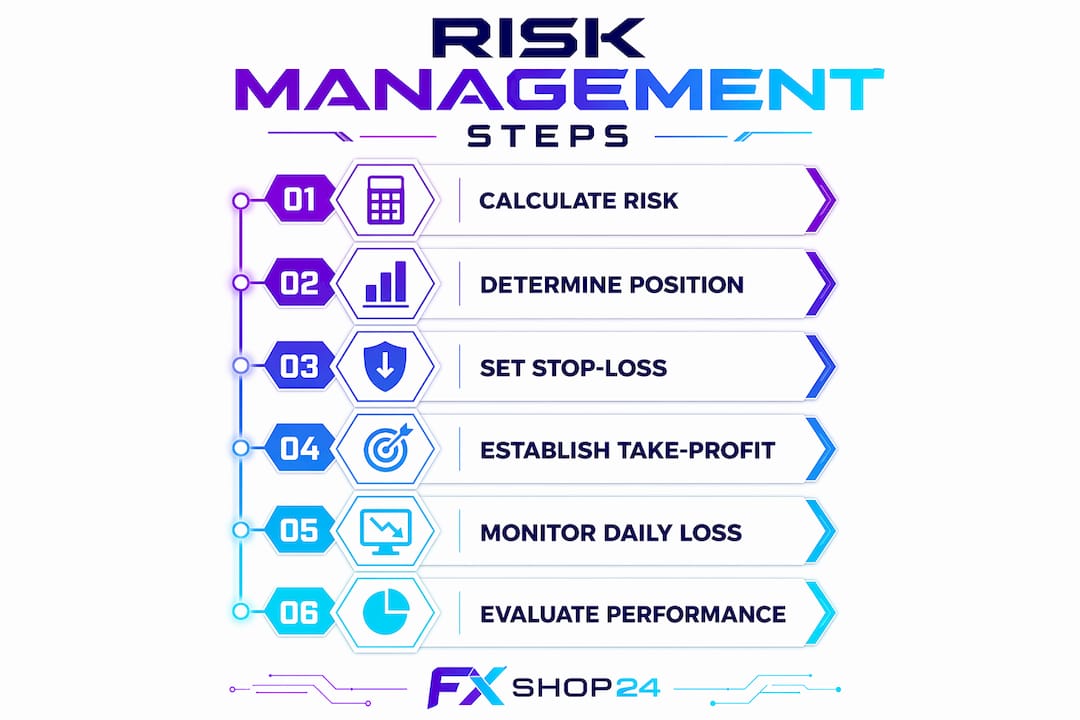
The standard method professional traders use follows three steps:
- Determine your risk amount. Multiply your total account balance by 1%. On a $10,000 account, that is $100 per trade. This figure is your maximum acceptable loss on any single position.
- Identify your stop-loss distance. Measure the distance in pips or points between your entry price and your stop-loss level. On a EUR/USD trade, that might be 20 pips.
- Calculate your position size. Divide your risk amount by your stop-loss distance. Using the example above: $100 divided by $2 per pip (standard lot value) equals a 0.5 lot position. This formula keeps every trade within your defined risk boundary regardless of market volatility.
The 1% rule exists for one specific reason: survival through losing streaks. Even a trader with a 50% win rate will face runs of 5, 8, or 10 consecutive losses. At 1% risk per trade, 10 straight losses reduce a $10,000 account to roughly $9,044. At 5% risk per trade, the same streak leaves you with $5,987. The math is unforgiving, and the 1% rule is what keeps you in the game long enough for your edge to produce results.
Leverage complicates position sizing for forex and gold traders. A 1:100 leverage account can hold a position 100 times larger than the margin required, which means a small price move creates an outsized loss. Always calculate position size based on the actual dollar risk, not the margin requirement. The leverage ratio is irrelevant to your risk calculation if you use the formula correctly.
Pro Tip: Calculate your position size before you place the order, not after. Pre-entry calculation removes the temptation to size up based on conviction or excitement about a setup.
How to set stop-loss and take-profit levels that actually work
A stop-loss order is a predefined exit point that closes your trade automatically when the market moves against you by a specified amount. A take-profit order closes your trade when it reaches your target. Both must be set before you enter the trade, not adjusted mid-position based on emotion.
Effective stop placement relies on technical logic, not arbitrary dollar amounts. The most reliable methods include:
- Support and resistance levels. Place your stop just below a key support level on a long trade or just above resistance on a short. The market has already shown it respects these zones.
- Average True Range (ATR). The ATR indicator measures recent volatility. A stop placed at 1.5 to 2 times the ATR gives the trade room to breathe without exposing you to excessive loss.
- Structure-based stops. Place stops beyond the most recent swing high or low. If price breaks that structure, your trade thesis is invalidated regardless of your opinion.
The risk-reward ratio connects stop placement directly to profitability. A minimum 1:2 risk-reward ratio means your target profit is at least twice your maximum loss on every trade. This ratio is the foundation of positive expectancy. A trader winning only 40% of trades at a 1:2 ratio still generates net profit over time. A trader winning 60% of trades at a 1:1 ratio barely breaks even after spreads and commissions.
Poor stop placement is one of the most common errors retail traders make. Placing a stop at a round number like 1.2000 on EUR/USD invites stop hunting by institutional players who know retail orders cluster at those levels. Placing a stop too tight, inside the normal noise of price action, guarantees premature exits on winning trades.

Pro Tip: Never move your stop-loss further away from entry to avoid being stopped out. That is not risk management. That is hope dressed as strategy.
Why daily loss limits and drawdown management are crucial to preserve capital
Daily loss limits are the circuit breakers of professional trading. A daily loss limit caps the total amount you can lose in a single trading session, typically set at 2 to 3% of account equity. Once that threshold is hit, you stop trading for the day. No exceptions.
The data behind this practice is clear. Traders who implement formal daily loss limits see maximum drawdowns 34% lower than those who trade without them. That reduction is not from avoiding bad trades. It comes from preventing the spiral of revenge trading and emotional overtrading that follows a losing session.
Drawdown management extends this logic across longer time horizons. Professional traders use a graduated protocol based on account drawdown thresholds:
| Drawdown Level | Action Required |
|---|---|
| 5% from peak | Reduce position size to 75% of normal |
| 10% from peak | Reduce position size to 50% of normal |
| 20% from peak | Stop trading completely and review system |
This table reflects the graduated drawdown management protocol used by professional traders and required by most prop firms. Each threshold triggers a specific, non-negotiable response. The logic is simple: when your system is underperforming, you reduce exposure until you understand why.
“Risk management is about surviving variance to let your edge play out. Stop-losses must be treated as immutable rules.” — TradersSecondBrain
The best practice after hitting your daily limit is to close all positions, shut the platform, journal the losses, and stop trading for the day. This protocol prevents tilt, which is the emotional state where traders abandon their rules and begin making increasingly large, impulsive bets to recover losses. Tilt is where accounts go to die.
How trading psychology shapes your ability to execute risk management
Risk management is 80% psychology and 20% math. Every trader reading this already knows the 1% rule. Most traders still break it. The gap between knowing and doing is entirely psychological.
Fear, greed, and ego are the three forces that undermine risk execution. Fear causes premature exits before take-profit targets are reached. Greed pushes traders to increase position size after a winning streak, right before a drawdown. Ego makes traders move stop-losses to avoid admitting a trade is wrong. Each of these behaviors destroys the mathematical edge that proper risk management creates.
Practical tools for maintaining trading psychology discipline include:
- Trade journaling. Record every trade with entry reason, position size, stop placement, and emotional state. Patterns in your losses will become visible within weeks.
- Platform shutdown after daily limit. Physically closing your trading platform after hitting your daily stop removes the temptation to “make it back.” The market will be there tomorrow.
- Pre-session routine. Review your rules, your risk parameters, and your watchlist before the session opens. Traders who enter sessions with a written plan execute with significantly more consistency.
- Post-loss cooling period. After any loss that triggers an emotional reaction, wait 15 minutes before placing another trade. Most revenge trades are placed within 5 minutes of a loss.
The discipline required for consistent risk execution is not a personality trait. It is a skill built through repetition and structured habits. Traders who treat their rules as non-negotiable during live trading, rather than guidelines to be adjusted based on feel, are the ones who survive long enough to become profitable.
Common mistakes in trading risk management and how to avoid them
Most traders understand risk management in theory. The mistakes happen in execution, and they tend to cluster in predictable patterns.
- Risking more than 1% per trade. Sizing up because a setup “looks perfect” is the most common and most damaging error. No setup has a 100% probability. The 1% rule applies to every trade without exception.
- Moving stop-losses mid-trade. Widening a stop to avoid being stopped out converts a defined-risk trade into an open-ended loss. If your stop is hit, your thesis was wrong. Accept it.
- Ignoring daily loss limits. Traders who break risk rules most often do so after losses, not before them. The daily limit exists precisely for the moments when you feel most compelled to ignore it.
- Failing to reduce risk after drawdowns. Trading at full size during a 10% drawdown compounds the problem. The graduated protocol exists to reduce exposure when your system is underperforming.
- Ignoring position correlation. Two long positions in EUR/USD and GBP/USD are not two separate 1% risks. Correlated positions must be treated as one larger position to avoid hidden overexposure. The same applies to multiple gold positions or correlated commodity trades.
Key takeaways
Effective trading risk management requires a layered system combining position sizing, stop-loss discipline, daily loss limits, and drawdown protocols, executed consistently through psychological control.
| Point | Details |
|---|---|
| Use the 1% rule | Never risk more than 1% of account equity per trade to survive losing streaks. |
| Set stops before entry | Place stop-loss and take-profit levels at technical markers before entering any trade. |
| Apply daily loss limits | Cap daily losses at 2 to 3% and shut the platform once that threshold is reached. |
| Follow drawdown protocols | Reduce position size at 5% and 10% drawdowns; stop trading completely at 20%. |
| Treat psychology as a skill | Journaling, pre-session routines, and cooling periods build the discipline math alone cannot provide. |
What I’ve learned about risk management after years in the markets
Most traders come to risk management looking for a formula. They want a number, a rule, a calculation that makes the uncertainty go away. What I’ve found, working with traders across retail and prop firm environments, is that the math is the easy part. The hard part is respecting your stop when the trade is 5 pips away from your level and you’re convinced it’s going to reverse.
The mindset shift that separates surviving traders from those who blow accounts is treating every rule as inviolable, not as a guideline. Your stop-loss is not a suggestion. Your daily limit is not a target. These are the walls of the system, and the moment you start negotiating with them mid-trade, you’ve already lost.
The layered approach to risk, combining position sizing, stop placement, daily limits, and drawdown thresholds, does something the individual rules cannot do alone. It creates redundancy. If you size correctly but place a poor stop, the daily limit catches the damage. If you have a bad day, the drawdown protocol prevents it from becoming a bad month. No single rule is enough. The system only works when all layers are active simultaneously.
Journaling changed how I think about risk more than any book or course. When you write down every trade, including your emotional state and whether you followed your rules, the data becomes undeniable. You stop arguing with your own performance and start fixing the specific behaviors that cost you money.
— Fxshop24
How Fxshop24 helps you automate and enforce your risk management
Knowing the rules is one thing. Executing them without hesitation in live market conditions is another challenge entirely. Fxshop24 builds and curates automated trading systems designed to embed risk management directly into your trade execution, removing the emotional variable from position sizing, stop placement, and drawdown monitoring.
Fxshop24’s expert advisors for MT4 and MT5 include built-in position sizing calculators, automatic stop-loss placement, and daily loss limit enforcement. These tools apply your risk parameters on every trade without exception, which is exactly what human traders struggle to do under pressure. Explore the full range of automated futures trading systems at Fxshop24 to find solutions that match your trading style, account size, and risk tolerance. Prop firm traders will find systems pre-configured to meet challenge drawdown requirements out of the box.
FAQ
What is the 1% rule in trading risk management?
The 1% rule means you never risk more than 1% of your total account equity on a single trade. On a $10,000 account, your maximum loss per trade is $100, regardless of how strong the setup appears.
How do I calculate position size for a trade?
Divide your risk amount (1% of account equity) by your stop-loss distance in dollar terms. If you risk $100 and your stop is worth $2 per pip, your position size is 0.5 lots. Calculate this before entering the trade.
What is a good risk-reward ratio for trading?
A minimum 1:2 risk-reward ratio is the industry standard. This means your profit target is at least twice your stop-loss distance, which allows you to be profitable even with a win rate below 50%.
How does a daily loss limit protect my trading account?
A daily loss limit caps your total losses in one session, typically at 2 to 3% of account equity. Traders who use formal daily limits see maximum drawdowns 34% lower than those who trade without them, primarily by preventing emotional overtrading after losses.
Why do traders fail at risk management even when they know the rules?
Risk management failure is primarily psychological, not mathematical. Fear, greed, and ego cause traders to break rules they fully understand, which is why journaling, platform shutdown protocols, and pre-session routines are as important as the formulas themselves.
Recommended
- Master Risk Management In Automated Trading MT4 MT5
- The 1% Risk Rule: How Top Prop Firm Traders Use Money Management EAs To Pass Every Challenge | FxShop24 Marketplace
- How To Scale A Trading Account FAST In 2025 (Proven System) | FxShop24 Marketplace
- The Power Of Take Profit In Trading | FxShop24 Marketplace