
24
Jun
Forex Trading Automation Trends 2026: What Traders Need to Know
TL;DR:
- In 2026, algorithmic and automated systems generate 85% of daily forex trading volume, dominating the market. Traders must focus on hybrid AI-human models, infrastructure, and risk controls to succeed, rather than relying solely on traditional expert advisors. Proper implementation includes VPS usage, walk-forward analysis, and diversified strategies for reliable live trading results.
Forex trading automation in 2026 is defined by one clear shift: 85% of daily forex volume is now generated by algorithmic and automated systems, across a market producing $9.6 trillion in daily turnover. That number reframes every conversation about trading strategy. Manual execution is no longer the baseline. Automation is. The question for retail and professional traders is no longer whether to automate, but which forex trading automation trends 2026 demands you understand to stay competitive. This article covers the top trends, tools, and implementation strategies shaping the market right now.
1. What are the top forex trading automation trends reshaping the market in 2026?
The dominant shift in 2026 is away from fully autonomous bots and toward hybrid AI-human decision-support systems. AI augments human judgment rather than replacing it. That distinction matters because it changes how you design, monitor, and trust your automated setup.
The major trends driving the market right now include:
- Hybrid AI-human models: Algorithms handle execution and pattern recognition. Traders set parameters, review signals, and override when needed. Emotional bias drops without removing human oversight.
- Conversational AI agents: Interactive Brokers now offers agentic trading with Claude integration, letting traders place market and limit orders through a conversational interface without exposing API keys directly.
- Adaptive algorithms: Fixed rule-based systems are losing ground to models that adjust trade logic dynamically based on live market conditions. A trending market and a ranging market require different thresholds. Adaptive systems apply them automatically.
- Portfolio-based automation: Running a single Expert Advisor is increasingly seen as a concentration risk. Traders now combine multiple uncorrelated EAs to smooth equity curves and reduce drawdown.
- VPS and kill-switch architecture: Reliable infrastructure is now a core part of strategy design, not an afterthought.
- Advanced analytics dashboards: Platforms embed behavioral tracking, drawdown monitoring, and performance breakdowns directly into the trading interface.
Pro Tip: If your current setup runs a single EA on a home PC, you are carrying infrastructure risk that has nothing to do with your strategy. A VPS with a kill-switch is the minimum viable setup for serious automation in 2026.
2. Which automated forex trading systems and software lead in 2026?

Expert Advisors (EAs) remain the backbone of retail forex automation, particularly on MetaTrader 4 and MetaTrader 5. The key distinction in 2026 is between rule-based EAs and adaptive AI systems. Rule-based EAs differ from adaptive AI systems in one critical way: adaptive models learn from live data and require ongoing recalibration, while rule-based EAs execute fixed logic regardless of market conditions.
The main categories of automated trading systems active in 2026:
- Trend-following EAs: Execute trades in the direction of established momentum. Work best in directional markets.
- Mean reversion systems: Bet on price returning to a statistical average. Perform well in ranging conditions.
- Breakout strategies: Enter trades when price clears defined support or resistance levels.
- News-based algorithms: React to economic releases using pre-programmed logic or NLP-driven sentiment scoring.
- AI Trading Bots: Use machine learning to classify market regimes and adjust parameters in real time.
- Trade Assistants: Tools like Trade Assistant V10.27 MT4 handle position sizing, partial closes, and trailing stops within MetaTrader.
For traders choosing between platforms, the comparison below covers the key decision points:
| Feature | No-code platforms | Full-code API platforms |
|---|---|---|
| Skill required | Low | High |
| Customization | Limited | Full |
| Best for | Retail beginners | Professional quants |
| Examples | MT4/MT5 EA builders | Python-based broker APIs |
| Backtesting depth | Moderate | Extensive |
Pro Tip: Backtesting alone is not enough. Walk-forward analysis tests your strategy on unseen data in sequence, which is the only reliable way to know if your EA holds up outside the data it was built on.
3. How can traders effectively implement automated forex trading strategies in 2026?
Setting up automation correctly requires more than installing an EA and walking away. The implementation process has distinct phases, and skipping any one of them is the most common reason automated strategies fail in live markets.
- Choose your platform based on control needs. MT4 suits traders who want a proven, widely supported environment with a large EA library. MT5 adds more order types and asset classes. cTrader appeals to traders who want cleaner API access and a more modern interface.
- Set up a VPS for 24/7 uptime. A VPS minimizes latency and eliminates the risk of missed trades from power outages or internet drops. For any EA trading around news events or Asian session opens, this is non-negotiable.
- Build in kill-switch mechanisms. Multi-layered risk controls including kill-switches and system health monitoring are the difference between a bad week and an account-ending event. Set maximum daily loss limits that halt the EA automatically.
- Run walk-forward analysis before going live. Overfitting a strategy to historical data causes live market failure. Walk-forward analysis validates real-world robustness by testing on data the model has never seen.
- Test across multiple market regimes. Run your strategy through trending, ranging, and high-volatility periods in backtesting. A system that only works in one regime is fragile.
- Transition from demo to live gradually. Start with minimum lot sizes on a live account before scaling. Demo results and live results diverge due to slippage, spread widening, and execution delays.
- Schedule regular system reviews. Markets change. An EA optimized for 2024 conditions may underperform in 2026 without recalibration. Monthly reviews catch drift before it becomes drawdown.
Pro Tip: The traders who lose money on automation almost always share one habit: they set it and forget it. Treat your EA like a junior trader. Check in regularly, review its decisions, and retrain it when conditions shift.
4. What emerging AI technologies are setting new standards for forex automation?
The AI trading platform market was valued at $11.26 billion in 2024 and is projected to reach $69.95 billion by 2034 at a 20.04% compound annual growth rate. That trajectory reflects how deeply AI is embedding itself into every layer of trading infrastructure, not just execution.
The technologies driving this shift include:
- Natural Language Processing (NLP): NLP tools analyze real-time market sentiment from news feeds, central bank statements, and social data. They translate qualitative signals into quantitative inputs that algorithms can act on.
- Dynamic market regime classification: Adaptive AI models detect whether the market is trending, ranging, or in a volatility spike, then apply the appropriate trading logic automatically.
- Behavioral analytics dashboards: Advanced analytics embedded in platforms give traders visibility into drawdown patterns, trade frequency, and risk-adjusted returns at a level that was not accessible to retail traders before 2024.
- Secure API integrations: The Claude integration at Interactive Brokers is a model for where broker technology is heading. Traders interact with their accounts through conversational AI without credentials being exposed in the process.
- Emotional bias reduction at scale: Automated systems enforce consistent, rule-based decisions at a speed and discipline that human traders cannot replicate under pressure.
The table below maps each technology to its primary trading benefit:
| AI Technology | Primary Benefit |
|---|---|
| NLP sentiment analysis | Faster reaction to news events |
| Regime classification | Avoids wrong-condition trades |
| Behavioral analytics | Identifies performance leaks |
| Conversational AI agents | Secure, accessible order management |
| Adaptive algorithms | Consistent performance across market cycles |
The future of forex automation runs through these technologies. Traders who understand how each layer works will make better decisions about which tools to adopt and when.
Key takeaways
Forex trading automation in 2026 requires combining adaptive AI systems, disciplined risk controls, and regular human oversight to perform consistently across changing market conditions.
| Point | Details |
|---|---|
| Automation dominates volume | 85% of daily forex volume is algorithmic, making automation the market standard, not the exception. |
| Hybrid models outperform pure bots | AI-human systems reduce emotional bias while keeping a human in the loop for oversight. |
| Infrastructure matters as much as strategy | A VPS and kill-switch setup prevents execution failures that have nothing to do with your EA’s logic. |
| Walk-forward analysis is non-negotiable | Backtesting alone creates overfitted strategies. WFA validates performance on unseen data. |
| Portfolio diversification reduces drawdown | Combining multiple uncorrelated EAs smooths equity curves better than any single strategy. |
Fxshop24’s take on what automation actually demands from traders
Automation is not a shortcut. That is the uncomfortable truth most vendors will not tell you. After working with traders across skill levels, the pattern is consistent: the ones who succeed with EAs treat automation as a system to manage, not a machine to trust blindly.
The biggest mistake I see is VPS neglect. Traders spend weeks selecting and backtesting an EA, then run it on a home PC with a consumer internet connection. One power outage during a news event erases weeks of gains. Infrastructure is not glamorous, but it is where accounts are protected or lost.
Overfitting is the second major failure point. A strategy that looks perfect on five years of historical data often falls apart in the first month of live trading. Walk-forward analysis is the only honest test. If your EA cannot pass it, it is not ready.
The traders who get the most from automation are the ones who use it to remove emotion from execution while staying actively engaged in strategy oversight. They run diversified EA portfolios, review performance monthly, and recalibrate when market conditions shift. That combination of disciplined automation and active management is what separates consistent returns from expensive lessons.
— Fxshop24
Automated trading tools and resources at Fxshop24
Fxshop24 offers a curated selection of Expert Advisors, AI trading bots, and trading system indicators built for MT4 and MT5. Every product is tested for prop firm compatibility and comes with lifetime updates and installation support.
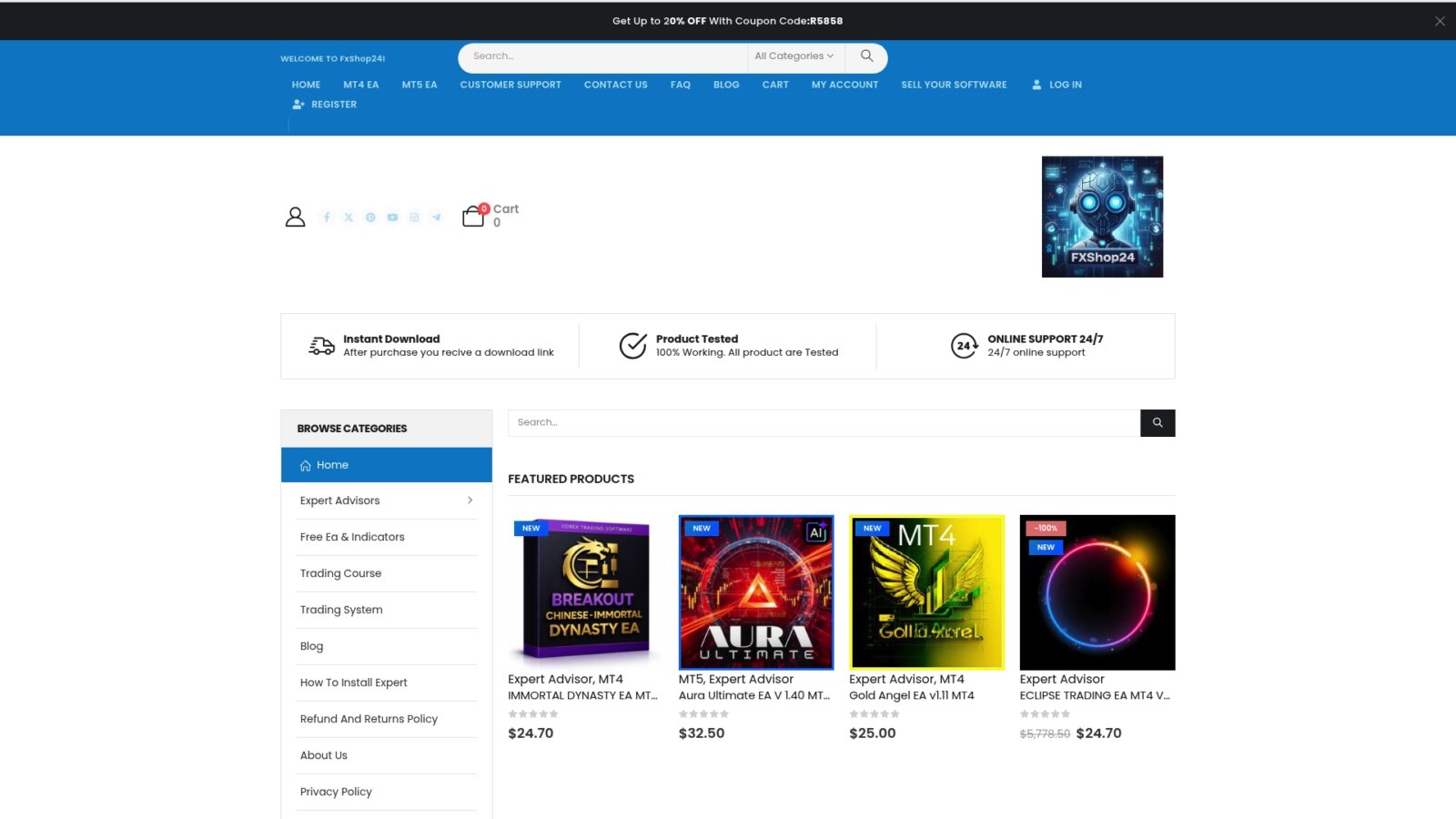
Traders researching 2026 forex trading technology can find detailed breakdowns of automated trading systems for MT4 and MT5 across every major strategy type. For traders ready to act on the trends covered here, the Fxshop24 marketplace covers the full range of tools from entry-level EAs to advanced AI-powered bots. Setup guides, optimization walkthroughs, and strategy comparisons are available alongside every product to help you move from research to live trading with confidence.
FAQ
What percentage of forex trading is automated in 2026?
About 85% of daily forex trading volume is generated by algorithmic and automated systems as of 2026. The market produces $9.6 trillion in daily turnover, making automation the dominant mode of participation.
What is the difference between a rule-based EA and an adaptive AI trading system?
A rule-based EA executes fixed logic regardless of market conditions. An adaptive AI system classifies live market regimes and adjusts its trading thresholds dynamically, which improves performance across different market cycles.
How do I automate forex trading safely in 2026?
Run your EA on a VPS for 24/7 uptime, set kill-switch limits to cap daily losses, and validate your strategy with walk-forward analysis before going live. Transitioning from demo to live with minimum lot sizes reduces early-stage risk.
What is walk-forward analysis and why does it matter?
Walk-forward analysis tests a trading strategy on sequential blocks of unseen data to confirm it was not overfitted to historical results. It is the most reliable method for validating that an automated strategy will hold up in live market conditions.
Are hybrid AI-human trading models better than fully autonomous bots?
The 2026 trend strongly favors hybrid models. Fully autonomous bots remove human oversight entirely, which increases risk when market conditions shift unexpectedly. Hybrid systems use AI for execution and pattern recognition while keeping a trader in the loop for parameter oversight and risk management.