

21
Jun
Prop Firm Trading Checklists: Your 2026 Success Guide
TL;DR:
- A prop firm trading checklist ensures traders follow firm rules to stay compliant and funded. It covers risk limits, position sizing, order rules, journal entries, and daily trading procedures. Using automated tools alongside manual checklists enhances discipline and compliance under pressure.
A prop firm trading checklist is a structured set of rules and verification steps that keeps traders compliant, disciplined, and funded throughout every evaluation phase. Firms like FTMO and Lucid Trading enforce strict daily loss limits, drawdown caps, and execution rules that disqualify traders who skip even one step. Tools like Tradervue and TradeZella help automate compliance tracking, but the checklist itself is the foundation. Without it, even a profitable strategy fails under pressure. This guide breaks down every checklist category you need to pass evaluations and protect your funded account in 2026.
1. What are the core components of a prop firm trading rules checklist?
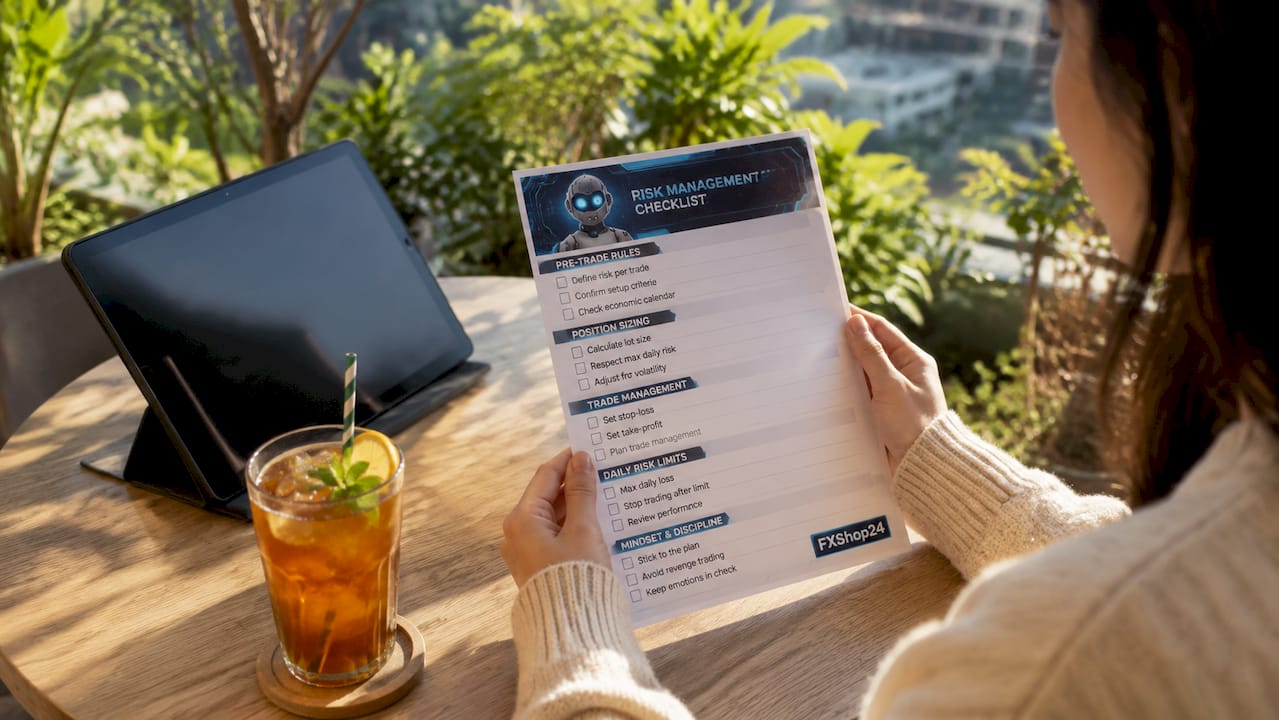
A prop firm trading rules checklist covers every rule your firm enforces, translated into daily, trade-by-trade actions. Missing one item is not a minor oversight. It is often the direct cause of a failed evaluation.
Daily loss limits and drawdown rules
- Never exceed your firm’s daily loss limit. FTMO, for example, sets this at 5% of account equity.
- Track trailing drawdown separately from daily loss. Some firms use a trailing high-water mark, not a fixed starting balance.
- Stop trading the moment you hit your personal daily loss threshold, not just the firm’s limit.
Position sizing and risk per trade
- Risk per trade should stay between 0.5% and 1% of account equity. On a $100,000 account, that means $500 to $1,000 per trade.
- Calculate lot size before every entry. Never estimate.
- Account for spread and slippage when sizing positions on volatile pairs.
Order placement and stop-loss requirements
- Place a stop-loss on every trade before entry. Many prop firms disqualify accounts that hold open trades without stops.
- Use limit orders where possible to control entry price and reduce slippage.
- Confirm the correct symbol suffix for your broker’s server before placing any order.
Trade journal and prohibited behaviors
- Log every trade immediately after execution: entry price, stop-loss, take-profit, and rationale.
- Avoid prohibited strategies such as news trading, grid trading, or martingale systems unless your firm explicitly permits them.
- Check your firm’s rulebook for restrictions on holding trades over weekends or through major economic events.
Minimum trading day requirements
- Most firms require 12–15 minimum trading days to complete an evaluation. Plan low-risk maintenance trades to meet this requirement without chasing profits.
- Spread your trading activity across the evaluation period. Front-loading profits then going quiet raises compliance flags.
2. How to build and use a prop firm risk management checklist effectively
Risk management in prop trading is not about avoiding losses. It is about controlling exactly how much you lose and when you stop. A personal risk management rulebook converts vague firm guidelines into clear, stress-proof instructions you follow automatically.
Apply the 60% rule to every session
Aggregate daily risk should never exceed 60% of your daily loss limit. On a $100,000 account with a $5,000 daily limit, your maximum aggregate risk per session is $3,000. The remaining 40% acts as a buffer for slippage, gap losses, or unexpected volatility. This rule alone prevents the most common single-day account blowouts.
Calculate your daily loss budget from drawdown room
- Identify your current drawdown room. This is the distance between your current equity and your firm’s maximum drawdown floor, not your total account balance.
- Set your daily max loss at 25–30% of available drawdown room. If you have $2,500 of drawdown room, your daily budget is $625 to $750.
- Stop trading the moment you hit that number. No exceptions.
- Reset the calculation each morning based on your updated equity.
Pro Tip: Calculate drawdown room first thing each morning before you open a chart. Traders who skip this step often risk far more than they realize because they anchor to total account size instead of actual available buffer.
Build your personal risk rulebook
A personal risk rulebook should specify exact stop-loss distances, maximum correlated exposure across pairs, scaling rules for winning streaks, news trading restrictions, and how you handle weekend positions. Effective risk rulebooks include all of these categories in writing. Vague mental rules collapse under pressure. Written rules do not.
Review your rulebook monthly. Track which hours and instruments generate losses, then adjust your rules to reflect what the data shows. Monthly rule compliance scoring improves discipline and keeps your checklist aligned with current market conditions.
3. What should your daily and pre-session trading checklists include?
Skipping any pre-trade checklist item increases the risk of failing evaluations. The items below are non-negotiable for every session.
Platform and account verification
- Confirm server time matches your broker’s trading hours.
- Verify the correct symbol suffix is loaded (for example, XAUUSD vs. XAUUSD.m).
- Check that your EA or manual order type settings match your intended execution method.
- Confirm your account balance, equity, and current drawdown position before placing any trade.
Economic calendar and news filters
- Review the economic calendar every morning before the session opens.
- Block trades around CPI, NFP, and Fed speeches. These events cause slippage that can breach daily loss limits in seconds.
- Set a hard rule: no new positions within 30 minutes before or after a high-impact news release.
Journal setup and session review
- Open your trade journal before your first trade. Pre-fill the date, account state, and session goal.
- Review your previous session’s trades for rule violations, not just profit or loss.
- Note any patterns in your losses. Recurring mistakes at specific times or on specific pairs are data, not bad luck.
Trade filters and cooldown triggers
- Set a maximum spread threshold before entering any trade. Wide spreads eat into stop-loss buffers.
- Define a cooldown rule: after two consecutive losing trades, pause for at least 30 minutes before re-entering the market.
- Set a hard stop-trading trigger at your daily loss budget. Once hit, close the platform.
Pro Tip: Treat your pre-session checklist like a pilot’s pre-flight check. A commercial pilot does not skip steps because the weather looks fine. You should not skip steps because the market looks calm.
4. Manual vs. automated checklist tools: which approach works best?
The right checklist tool depends on your trading style, experience level, and how much pressure you perform under. Both manual and automated approaches have real tradeoffs.
| Approach | Strengths | Weaknesses | Best For |
|---|---|---|---|
| Manual (Google Sheets) | Fully customizable, no cost, builds discipline | Time-consuming, error-prone under stress | Beginners building habits |
| Tradervue | Automated trade import, performance analytics | Subscription cost, limited MT4 native integration | Intermediate traders tracking patterns |
| TradeZella | Visual dashboards, rule compliance tracking | Learning curve, requires consistent data entry | Traders focused on evaluation compliance |
| MT4/MT5 Risk Management EA | Enforces rules automatically, no manual input | Requires setup and testing, not all EAs are prop-firm safe | Experienced traders using automated systems |
Automated tools like Tradervue and TradeZella import trade data and monitor risk compliance more reliably than manual methods under pressure. That reliability matters most during drawdown periods, when emotional decision-making peaks.
Key considerations when choosing your tool:
- Manual Google Sheets work well for traders who are still building their checklist habits. The act of filling in each field manually reinforces the rule.
- Tradervue and TradeZella both offer performance breakdowns by instrument, time of day, and trade type. This data directly supports monthly rulebook reviews.
- Automated risk management EAs compatible with MT4 and MT5 enforce position sizing and daily loss limits without requiring manual input. They remove the human error factor entirely.
- Digital checklists and automated compliance monitoring reduce mistakes during high-stress trading periods. The more pressure you are under, the more automation earns its place.
For traders newer to prop firm evaluations, a detailed compliance workflow paired with a manual checklist builds the discipline that automation later reinforces.
Key takeaways
A prop firm trading checklist is the single most reliable tool for passing evaluations and protecting funded accounts because it converts firm rules into automatic, repeatable actions.
| Point | Details |
|---|---|
| Apply the 60% daily risk rule | Never risk more than 60% of your daily loss limit in one session to buffer for slippage. |
| Size risk from drawdown room | Base your daily loss budget on available drawdown room, not total account equity. |
| Complete pre-session checks | Verify platform settings, news events, and journal setup before placing any trade. |
| Use automated tools under pressure | Tradervue, TradeZella, or risk management EAs enforce rules when emotions run high. |
| Review and update monthly | Score your rule compliance monthly and adjust your rulebook based on loss patterns. |
What I have learned from years of watching traders fail their evaluations
Most traders fail prop evaluations not because their strategy is wrong. They fail because they do not follow their trading plan under pressure. That is the uncomfortable truth this industry rarely states plainly.
The traders I see succeed consistently are not the ones with the most sophisticated setups. They are the ones who treat their checklist as non-negotiable. They do not skip the pre-session review because they are confident. They do not ignore the daily loss budget because they are on a winning streak. They follow the list every single time.
The most common mistakes I observe are predictable. Traders ignore their daily loss limit after a string of wins. They skip journal entries during busy sessions. They trade through high-impact news events because the setup looks too good to pass up. Every one of these mistakes is a checklist failure, not a strategy failure.
My advice: build your checklist before you start your first evaluation, not during it. Adapt it monthly based on what your trade data shows. And treat rule compliance as a skill you practice, not a box you check once.
— Fxshop24
Explore prop firm-ready automated tools at Fxshop24
Fxshop24 offers a curated selection of automated trading tools built for MT4 and MT5 traders who need to stay compliant under prop firm rules. The marketplace includes risk management expert advisors that enforce daily loss limits and position sizing automatically, removing the manual error risk that derails most evaluations.
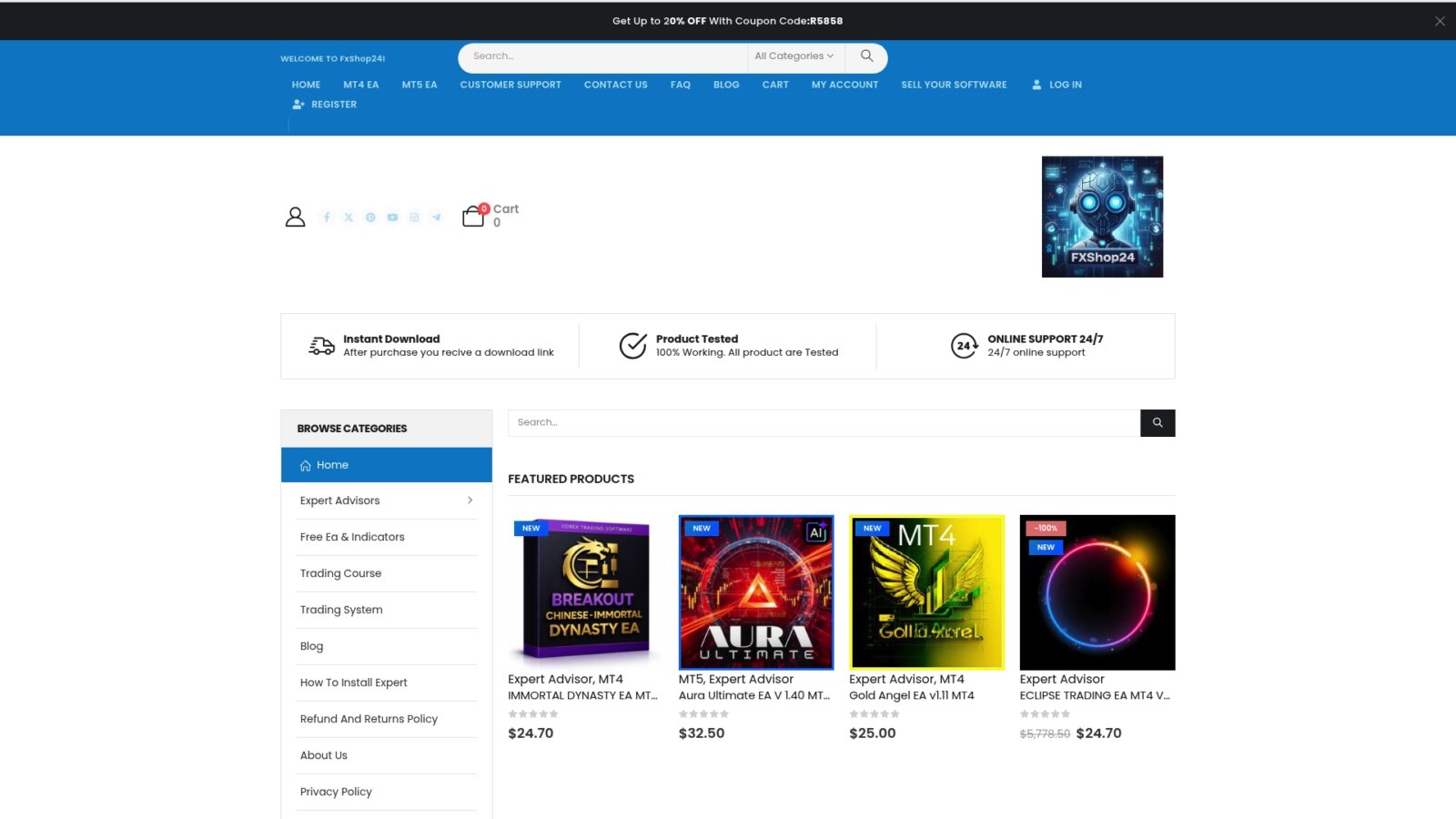
Traders looking for a complete solution can browse automated futures trading systems designed specifically for prop firm environments. Each tool comes with lifetime updates and unlimited licenses, so your setup stays current as firm rules evolve. Fxshop24 also covers essential forex trading tools that pair with manual checklists to build a full compliance workflow from day one.
FAQ
What is a prop firm trading checklist?
A prop firm trading checklist is a structured list of rules and verification steps a trader follows before, during, and after each session to stay compliant with their firm’s evaluation requirements.
How many items should a prop trading checklist include?
A complete checklist covers at least five categories: daily loss limits, position sizing, platform verification, news filters, and trade journaling. Each category should have specific, measurable criteria.
What is the 60% rule in prop firm risk management?
The 60% rule states that your aggregate daily risk should never exceed 60% of your firm’s daily loss limit, reserving the remaining 40% as a buffer for slippage and gap losses.
Should I use manual or automated checklists for prop firm trading?
Beginners benefit most from manual checklists because the process builds discipline. Experienced traders should add automated tools like Tradervue, TradeZella, or MT4/MT5 risk management EAs to enforce rules under pressure.
How often should I update my prop firm trading checklist?
Update your checklist at least once per month. Review which instruments and trading hours generate losses, then adjust your rules to reflect that data.