


27
Apr
Master order execution in forex: strategies for reliable fills
TL;DR:
- Order execution issues like slippage and re-quotes can erode trading profits before a trade begins.
- Different forex broker models (Market Maker, STP, ECN) impact trade speed, transparency, and spread costs.
- Using automation tools and monitoring execution metrics can significantly enhance order fill quality and profitability.
Most traders spend months perfecting their strategy, only to watch profits disappear at the moment of entry. The culprit is rarely the signal. It’s execution. Slippage, re-quotes, and delayed fills can quietly drain 10 to 30 percent of your edge before a trade even has a chance to work. Whether you’re running a manual system or deploying expert advisors (EAs) on MT4 or MT5, understanding how orders actually get filled, and why they sometimes don’t, is one of the most practical improvements you can make to your trading operation.
Table of Contents
- What is order execution in forex?
- Exploring forex order execution models: Market Maker, STP, and ECN
- Types of forex orders and their execution risks
- Slippage, latency, and advanced order execution pitfalls
- How to enhance order execution using automation on MT4 and MT5
- Why most traders undervalue order execution (and how you can get ahead)
- Take your order execution to the next level with MT4/MT5 tools
- Frequently asked questions
Key Takeaways
| Point | Details |
|---|---|
| Execution models matter | Whether your broker uses Market Maker, STP, or ECN systems greatly impacts your trading costs and fill reliability. |
| Order type affects risk | Market, limit, stop, and stop-limit orders each carry distinct fill probabilities and slippage risks. |
| Slippage can be measured | Tracking average slippage and fill rates over time helps you identify broker or strategy issues before they hurt profits. |
| Automation boosts execution | Smart use of EAs and execution analytics on MT4/MT5 platforms can dramatically improve order consistency. |
| Small improvements add up | Even minor gains in order execution can meaningfully boost overall trading returns over hundreds of trades. |
What is order execution in forex?
Order execution is the complete process of how your trade instruction moves from your platform to the market and gets filled at a price. It sounds simple. In practice, it’s anything but.
Every time you click “buy” or “sell,” a chain of events fires off: your broker receives the request, routes it through their system, finds a matching price from a liquidity provider, and confirms the fill. That chain can take milliseconds or seconds, and the difference matters enormously, especially during volatile sessions.
Several factors shape how well that chain performs:
- Broker model: Whether your broker is a Market Maker, STP, or ECN determines who is on the other side of your trade and how quickly it processes.
- Liquidity depth: Thin liquidity means fewer matching orders, which increases the chance of partial fills or slippage.
- Trading session: The London and New York overlap offers the deepest liquidity. The Asian session and rollover periods are thinner and riskier for large orders.
- Technology: Your internet connection, the broker’s server location, and the EA’s code all affect execution latency.
Understanding market, limit, and stop orders is the foundation here. Each order type interacts with the execution chain differently, and choosing the wrong one in the wrong conditions is a common, costly mistake.
The most frustrating execution problems traders face are slippage (filling at a worse price than requested), re-quotes (broker asks you to accept a new price), and partial fills (only part of your order gets executed). Each of these can erode a profitable setup before it even starts.
“Execution quality is not a broker feature. It’s a performance variable that compounds across every trade you take.”
Pro Tip: Before going live with any broker, test their execution speed on a demo account during a major news event like NFP. If you see re-quotes or fills more than 3 pips off your requested price, that broker will cost you real money.
Forex order execution models include Market Maker (DD), STP (NDD), and ECN/DMA, each determining how orders are handled, spreads, slippage, and potential conflicts of interest.
Exploring forex order execution models: Market Maker, STP, and ECN
Understanding why timing and fills vary starts with knowing how your broker processes orders. The three main models each come with different tradeoffs in speed, transparency, and cost.
Market Maker (Dealing Desk): The broker takes the opposite side of your trade internally. This creates a potential conflict of interest since they profit when you lose. The upside is instant fills and fixed spreads, which can be useful for beginners or traders who prioritize predictability.
STP (Straight Through Processing): Your order routes directly to liquidity providers without a dealing desk. Spreads are variable and typically tighter than Market Maker spreads, and there is no internal conflict. The broker earns through markup on the spread.
ECN (Electronic Communication Network): Your order enters a pool of liquidity from banks, institutions, and other traders. You get raw interbank spreads, often 0.0 to 0.3 pips, plus a commission of roughly $3 to $7 per lot. There is no conflict of interest, and execution is the fastest and most transparent of the three.
| Feature | Market Maker | STP | ECN |
|---|---|---|---|
| Spreads | Fixed (1.5 to 3.5 pips) | Variable, marked up | Raw (0.0 to 0.3 pips) |
| Commission | None | None | $3 to $7 per lot |
| Conflict of interest | Yes | Minimal | None |
| Execution speed | Fast, instant fills | Moderate | Fastest |
| Best for | Beginners, low volume | Intermediate traders | Scalpers, high frequency |
| Slippage risk | Low (fixed spreads) | Moderate | Low to moderate |
Key considerations when choosing between these models:
- If you’re running an EA with high trade frequency, ECN is almost always the better fit.
- STP brokers can be a solid middle ground if you’re not yet trading at high volume.
- Market Makers are not inherently bad, but you need to understand the difference in order types and how each interacts with fixed spread environments.
Pro Tip: Scalpers and EA traders should prioritize true ECN brokers. The raw spreads and lack of dealer intervention mean your orders reach the market faster and with less manipulation risk. Always verify ECN claims by checking whether the broker charges a per-lot commission. No commission usually means no true ECN.
Types of forex orders and their execution risks
Now that you understand the main execution models, let’s look at how different order types impact the quality and reliability of your fills.
Market orders execute immediately at the current Bid/Ask but carry slippage risk. Limit orders fill at a specified price or better but may not fill at all. Stop orders trigger a market order on breakout and carry slippage risk. Stop-limit orders combine both, offering price control but with the risk of missing the fill entirely.

Here’s how each order type maps to fill probability and risk:
| Order type | Fill probability | Main risk | Best use case |
|---|---|---|---|
| Market order | Very high | Slippage | Immediate entries, news plays |
| Limit order | Moderate | No fill | Precise entries, range trading |
| Stop order | High on trigger | Slippage on breakout | Breakout strategies |
| Stop-limit | Lower | Missed fill | Controlled breakout entries |
Practical ranking for common scenarios:
- Breakout trading: Use stop orders, but expect some slippage. Widen your stop-loss slightly to account for it.
- Range trading: Limit orders give you price control. Set them just inside key support or resistance levels.
- News trading: Market orders are the only realistic option for speed, but size down to manage slippage impact.
- EA-driven strategies: Combine limit and stop orders based on the strategy logic. Avoid pure market orders unless the EA is specifically designed for low-latency environments.
“Slippage is the price you pay for speed during volatile sessions.”
Partial fills are another underappreciated risk. When you place a large order in a thin market, the broker may only fill part of it at your requested price. The remainder fills at progressively worse prices. This is especially relevant for prop firm traders managing larger position sizes.
Slippage, latency, and advanced order execution pitfalls
Even with the right order type, hidden execution risks can still erode your returns. Here’s what traders often overlook.
Slippage happens when the price moves between the moment you submit your order and the moment it fills. It spikes during low-liquidity periods like the Asian session and rollover, and during high-impact news events like NFP releases. During these windows, spreads widen and order books thin out, meaning your fill can be several pips away from your intended price.
Latency is the time delay between your order being sent and being received by the broker’s server. Geographic distance matters. A trader in Southeast Asia connecting to a broker server in London will experience more latency than one using a VPS (Virtual Private Server) co-located near the broker. Even a 50-millisecond difference can affect fill quality in fast markets.
Advanced pitfalls that most traders never consider:
- Last look: Some brokers reserve the right to reject your order after reviewing it, even after you’ve received a quote. This is common in certain STP and ECN models and can cause unexpected re-quotes.
- Asymmetric slippage: If your broker consistently gives you negative slippage (fills worse than requested) but never positive slippage (fills better than requested), that’s a red flag. Good brokers show both directions.
- AI-driven broker intervention: In 2026, many brokers use AI and heuristics to detect latency arbitrage and fast EA strategies. If flagged, your orders may face added delays or rejections.
- Spread widening: During volatile events, spreads can widen 10x or more. A normally 0.3-pip spread on EUR/USD can jump to 3 or 4 pips during a major announcement.
To measure your own execution quality, track these metrics over a minimum of 100 trades: average slippage per trade, fill rate (target above 95 percent), and average execution time (target under 500 milliseconds). Most MT4/MT5 brokers provide trade logs that let you calculate these manually or with a spreadsheet.
Pro Tip: Use the tools available for optimizing MT4/MT5 automated trading to build an execution log directly into your EA. Logging entry price vs. requested price on every trade gives you real data to benchmark broker performance over time. You can also optimize an MT4 EA to reduce unnecessary order requests that trigger broker-side scrutiny.
How to enhance order execution using automation on MT4 and MT5
Understanding risks is half the battle. The next step is using technology and automation to consistently win it.
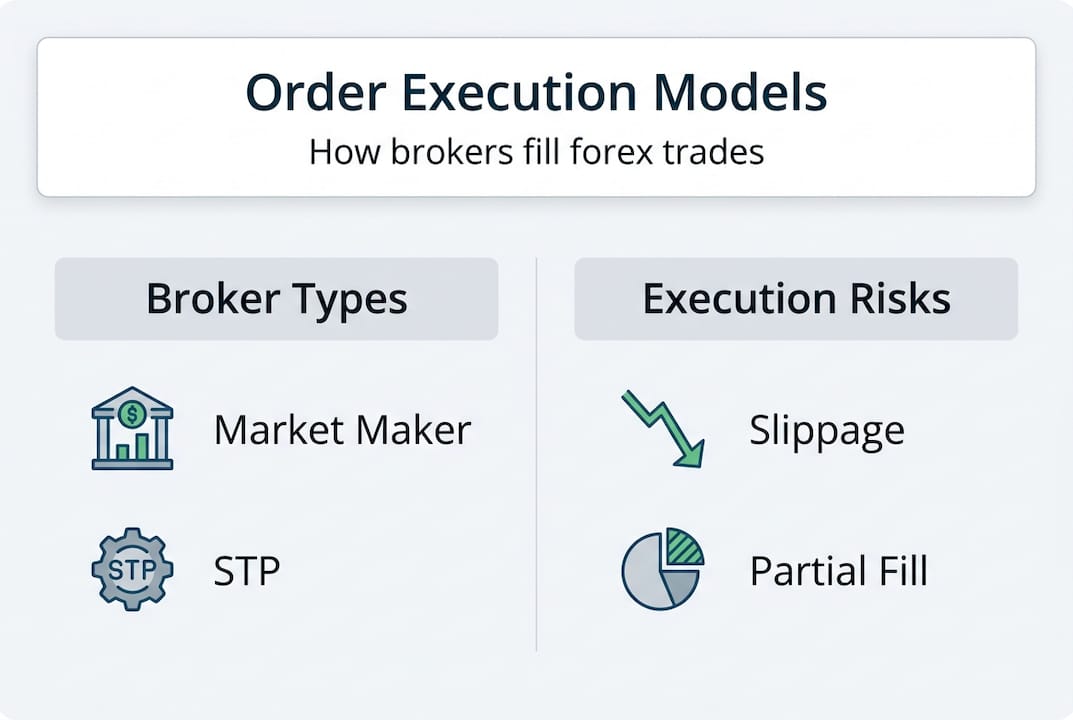
Automated trading through EAs removes the single biggest source of execution delay: human reaction time. When a signal fires, an EA submits the order in milliseconds. But automation only improves execution if it’s set up correctly and paired with the right broker environment.
Here’s a step-by-step process to build a stronger execution setup:
- Choose the right broker for your EA type. High-frequency or scalping EAs need true ECN brokers. EAs that trade less frequently can work well on STP. Avoid Market Makers for any EA that relies on tight spreads or fast fills.
- Use a VPS close to your broker’s server. Latency drops dramatically when your EA runs on a server in the same data center as your broker. Most brokers publish their server locations. Match them.
- Set execution parameters in your EA. Configure maximum slippage tolerance, order retry logic, and lot size limits. An EA that retries indefinitely during a news spike will fill at terrible prices.
- Monitor execution logs weekly. Pull your trade history and compare requested vs. actual fill prices. If average slippage creeps above 1 pip consistently, investigate whether it’s broker-side or EA-side.
- Test order types in your strategy. Some strategies perform better with limit entries rather than market orders. Backtesting with realistic slippage settings helps you identify which order type fits your edge.
Brokers in 2026 are increasingly using AI tools to flag and delay aggressive EA behavior. This means your automation setup needs to be smart, not just fast. Building in small randomized delays between order submissions, avoiding round-number lot sizes, and trading across multiple sessions can all reduce the chance of being flagged.
Pro Tip: Explore a structured forex automation workflow to connect your EA logic, broker selection, and execution monitoring into a single repeatable system. Traders who treat automation as a complete workflow, not just a plug-and-play tool, consistently outperform those who don’t. You can also boost profits with automation by regularly reviewing and adapting your EA settings based on live execution data.
Why most traders undervalue order execution (and how you can get ahead)
Here’s an uncomfortable truth: most traders, including experienced ones at prop firms, treat slippage as an unavoidable tax. They accept it, move on, and never measure it. That mindset is leaving real money on the table.
The traders who consistently outperform over the long run are not always the ones with the best signals. They’re the ones who obsess over the gap between their theoretical edge and their actual results. Execution quality is the biggest driver of that gap.
Meticulous tracking changes everything. Maintaining a trading journal that logs fill quality alongside P&L forces you to see patterns. Maybe your EA fills perfectly during London hours but bleeds 1.5 pips of slippage during New York close. That’s actionable data. Shift your trading window and reclaim that edge.
Building relationships with your broker’s support team is also underrated. Many brokers offer better execution conditions, tighter spreads, or dedicated server access to high-volume clients. You don’t get that by being passive. Ask for it.
The habit of optimizing trading robots on a regular schedule, not just at launch, is what separates disciplined operators from casual traders.
Pro Tip: Run a full execution quality audit every three months. Compare your fill rate, average slippage, and execution speed against the benchmarks above. If anything drifts, investigate before it compounds.
Take your order execution to the next level with MT4/MT5 tools
If the strategies above resonated with you, the next step is putting the right tools in place to make them work consistently. Knowing what to fix is only valuable when you have the means to fix it.
At FxShop24, we offer a full range of resources to help you close the gap between strategy and execution. Start by reviewing the essential MT4/MT5 trading tools that support better order management and analytics. If you’re evaluating automation options, our breakdown of automated trading systems for MT4/MT5 will help you match the right system to your execution goals. For traders ready to deploy a cutting-edge solution today, the AI Trading Bot V3.0 is built for prop firm compatibility and reliable fills across both platforms.
Frequently asked questions
What is the difference between market, limit, and stop orders in forex execution?
Market orders fill instantly at the current price but risk slippage. Limit orders fill only at a set price or better, and stop orders trigger a market order when price hits a specified level.
How can I measure the quality of my order execution?
Track average slippage, fill rate, and execution speed across 100 or more trades to get a reliable picture of broker performance. Target a fill rate above 95 percent and execution under 500 milliseconds.
Why does slippage happen during high-volatility news events?
During major news, spreads can widen 10x and liquidity drops sharply, causing orders to fill at significantly worse prices than requested.
Can automated trading improve order execution reliability?
Yes. EAs on MT4 and MT5 remove human delay from the execution chain, submit orders in milliseconds, and can be configured with slippage limits and retry logic to protect fill quality.