



16
Apr
What Is Prop Trading? How Firms and Retail Traders Profit
TL;DR:
- Proprietary trading allows firms and skilled traders to profit using their own capital, with retail traders accessing firm funding through evaluations. Success depends on strict discipline, understanding firm rules, and leveraging automation wisely. Most traders fail due to overleveraging, rule violations, and poor risk management, despite the potential for high returns.
Most traders assume every market participant risks their own money. That assumption is wrong, and it costs people real opportunities. Proprietary trading is when a firm or financial institution trades using its own capital rather than client funds, and today that model has expanded far beyond Wall Street. Retail traders can now access firm capital through structured evaluation programs, keeping the majority of profits they generate. This article breaks down exactly how prop trading works, who participates, what the real success rates look like, and how automation is reshaping performance outcomes for traders at every level.
Table of Contents
- What proprietary trading really means
- How prop trading works: Institutional vs. retail models
- Key rules, edge cases, and psychological factors in prop trading
- Performance benchmarks, real-world results, and why most traders fail
- Technology, automation, and how top performers excel
- The uncomfortable truth most prop trading articles won’t tell you
- Supercharge your prop trading performance with proven tools
- Frequently asked questions
Key Takeaways
| Point | Details |
|---|---|
| Prop trading explained | Proprietary trading involves firms using their own capital for direct profit instead of managing client funds. |
| Retail vs. institutional models | Retail traders access simulated capital with profit splits while firms earn fees and enforce strict risk rules. |
| Most fail quickly | Only a small percentage of traders succeed in prop firms, with overleveraging being the top reason for failure. |
| Automation offers edge | Automated strategies and algorithmic tools increasingly help top performers manage risk and stay compliant. |
| Success needs more than tech | Discipline, psychological control, and understanding of firm rules are just as critical as having the right trading tools. |
What proprietary trading really means
Prop trading, short for proprietary trading, is a model where a firm deploys its own money in the markets rather than acting as a broker or agent for clients. The firm takes on all the risk and keeps all the reward. No client accounts, no commissions earned from managing someone else’s portfolio. Just direct market exposure with the firm’s balance sheet.
According to the Wikipedia explanation of proprietary trading, this model has existed in major banks and hedge funds for decades, where dedicated desks trade equities, fixed income, currencies, and derivatives to generate internal profit centers. These institutional desks employ quantitative analysts, algorithmic traders, and experienced market professionals.
But the landscape has shifted dramatically. A new category of firm emerged specifically to give retail traders access to firm capital through a structured challenge and evaluation process. These are called retail prop firms, and they operate very differently from banks.
Here is what defines the prop trading model across both worlds:
- Institutional prop trading: Banks and hedge funds use their own balance sheets, employing traders directly with salaries and bonuses tied to performance.
- Retail prop trading: Independent firms provide simulated or real capital to traders who pass an evaluation, with profits split between trader and firm.
- No client funds involved: In both models, the firm is not managing investor money. It is trading its own capital or providing it to traders under contract.
- Profit motive: The firm’s primary goal is direct market profit, not fee income from clients.
“Proprietary trading is when a firm or financial institution trades its own capital rather than client funds, aiming to generate direct profits for itself.”
The prop trading advantages for retail traders are significant. You trade with far more capital than you personally own, and your downside risk is limited to the challenge fee rather than your life savings. That asymmetry is what makes this model so attractive to skilled traders who lack large starting capital.
Now that you know what prop trading is, let’s break down exactly how it works for both firms and retail traders.
How prop trading works: Institutional vs. retail models
The mechanics of prop trading differ sharply depending on whether you are inside a major institution or working through a retail prop firm. Understanding these differences is essential before you commit to either path.

In the institutional model, the firm hires traders directly. Those traders receive a salary, access to the firm’s capital, and sophisticated tools. Profits flow entirely to the firm, and traders earn bonuses based on their desk’s performance. Losses come directly off the firm’s books. There are no evaluation challenges, but the hiring bar is extremely high.
The retail model works very differently. Traders keep 70 to 90% of profits via profit splits, with firms earning from fees and their share of gains. This structure has democratized access to significant trading capital for skilled retail traders worldwide.
Here is how the retail prop trading process typically works:
- Pay the challenge fee: Traders purchase an evaluation account, usually ranging from $100 to $600 depending on the capital tier.
- Pass the evaluation phase: Meet profit targets (often 8 to 10%) without breaching drawdown limits over a set period.
- Complete the verification phase: Some firms add a second phase with lower profit targets to confirm consistency.
- Receive the funded account: Access simulated or real capital and begin live trading under the firm’s rules.
- Request payouts: Once profit thresholds are met, traders withdraw their share of profits on a scheduled cycle.
| Feature | Institutional model | Retail prop model |
|---|---|---|
| Capital source | Firm’s balance sheet | Firm-provided (simulated or real) |
| Trader risk | Career and bonus | Challenge fee only |
| Profit split | Salary plus bonus | 70 to 90% to trader |
| Entry requirements | Degree, interviews, track record | Pass evaluation challenge |
| Regulation | Heavily regulated | Contract-based, less regulated |
Understanding how prop firms operate in the retail space is critical before you spend money on a challenge.
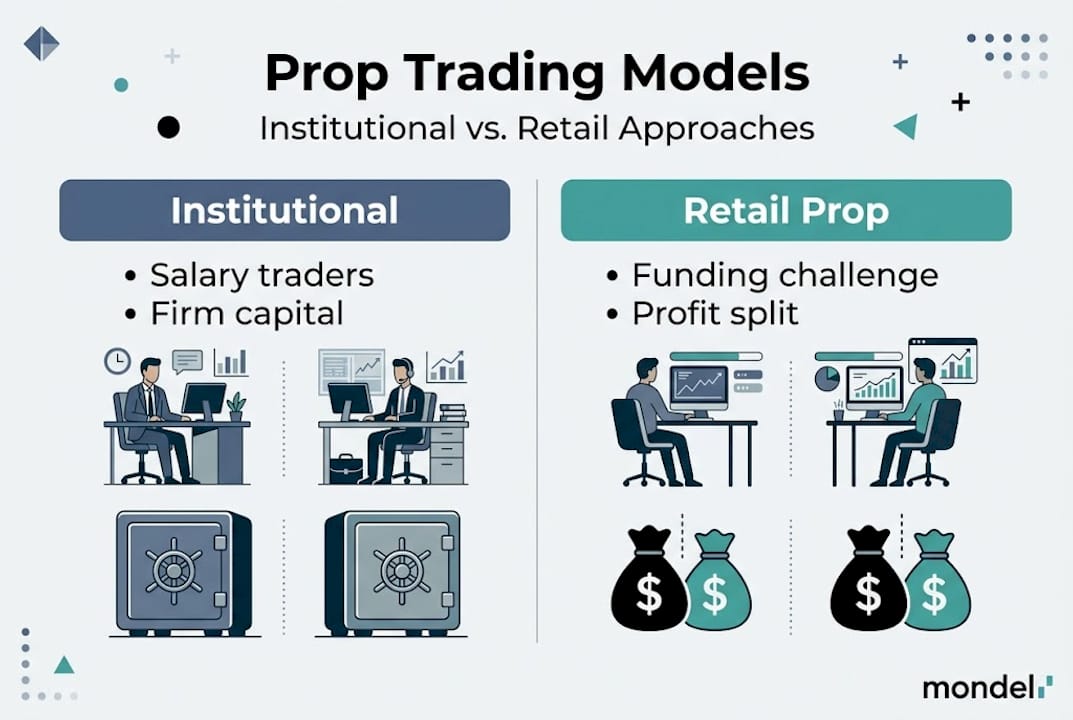
Pro Tip: Always read the full rulebook before starting a challenge. Many traders fail not from poor trading but from misunderstanding rules around news trading, lot sizing, or weekend holding restrictions.
Key rules, edge cases, and psychological factors in prop trading
Operational differences noted, it is equally important to recognize the unique risks and psychological dynamics that prop traders face every single day.
Prop firms enforce strict consistency rules to prevent traders from gambling their way to a payout. Common restrictions include:
- Daily loss limits: Often 4 to 5% of account balance per day. Breach it once and the challenge ends.
- Maximum overall drawdown: Typically 8 to 12% from the starting balance or peak equity.
- Consistency rules: No single day exceeding 40% of total profits, preventing one lucky trade from distorting the record.
- Instrument and time restrictions: Some firms ban trading during major news events or overnight sessions.
- Prohibited strategies: Martingale, grid trading without approval, and latency arbitrage are often banned outright.
The psychological dimension is genuinely surprising to most new prop traders. Trading with firm capital removes the fear of losing personal savings, which sounds like a pure advantage. But it introduces a different kind of pressure: the fear of rule violations. Traders who were previously relaxed about position sizing suddenly freeze up when one wrong trade could end their funded account.
The Volcker Rule historically restricted bank prop desks in the US after 2008, limiting how much proprietary risk banks could take. Retail prop firms operate outside this framework, functioning through private contracts rather than banking regulation.
Pro Tip: Treat prop firm challenge rules like a trading system in themselves. Document every rule, build a pre-trade checklist, and verify compliance before entering any position.
Edge cases trip up even experienced traders. Challenge resets cost money. Payout restrictions sometimes delay withdrawals. And rule interpretations vary between firms. Read every term before you fund a challenge account.
Performance benchmarks, real-world results, and why most traders fail
Having reviewed the challenges and nuances, let’s examine the numbers and see how traders actually perform in prop environments.
The retail prop trading industry reached $2.5 billion in 2023 and is projected to grow to $10 billion by 2028. That growth reflects genuine demand, but the success statistics tell a sobering story.
| Metric | Benchmark |
|---|---|
| Pass rate on first attempt | 5 to 15% |
| Traders who ever receive a payout | 7% |
| Elite firm annual returns | 15 to 30% |
| Top performer annual returns | 50%+ |
| Average monthly return (successful traders) | 5% |
| Funded traders losing in 3 months | 85% |
“90% of failures in prop trading stem from overleveraging, with 85% of funded traders losing their accounts within three months.”
The most common pitfalls are predictable:
- Overleveraging: Taking position sizes that are too large relative to the account, amplifying both gains and losses.
- Revenge trading: Chasing losses after a bad session, leading to compounding drawdowns.
- Rule violations: Ignoring news restrictions or holding positions overnight when prohibited.
- Inconsistency: Performing well in the challenge but abandoning the same discipline once funded.
For context, CFD trading benchmarks show that even among experienced retail traders, consistent profitability over 12 months is rare. Prop trading amplifies both the opportunity and the consequences of poor discipline.
Exploring prop firm challenge secrets used by successful traders reveals one consistent theme: those who pass treat the challenge as a professional assignment, not a gambling session.
Technology, automation, and how top performers excel
With these realities in mind, automation and smart technology often make the difference between success and repeated challenge failures.
Algorithmic trading and AI-powered systems have become standard tools for serious prop traders. Automated trading solutions used in prop environments include high-frequency trading strategies, volatility arbitrage, and systematic trend-following systems, with backtests showing Sharpe ratios above 2 in well-designed models.
Here is how technology gives top performers an edge:
- Removes emotional decision-making: Algorithms execute based on rules, not fear or greed.
- Enforces consistency: Automated systems apply the same logic to every trade, every session.
- Manages risk automatically: Position sizing, stop-loss placement, and drawdown controls can be hard-coded.
- Scales across instruments: A single EA (Expert Advisor) can monitor multiple pairs simultaneously without fatigue.
That said, prop firms are not naive. Exploitative algorithms are banned at most firms, including latency arbitrage bots and tick scalpers that exploit platform delays. Traders using automation must verify that their systems comply with firm-specific rules before running them on a funded account.
For those exploring futures trading automation or reviewing trends in trading automation, the pattern is consistent: technology works best when it supports a disciplined strategy, not when it replaces one. You can also explore algorithmic trading strategies specifically designed for forex and gold markets.
Pro Tip: Before running any EA on a prop challenge, backtest it against the firm’s specific rules, including drawdown limits and consistency requirements. A profitable EA that violates daily loss rules will still fail your challenge.
Reviewing algorithmic trading software options alongside prop firm compatibility requirements is a smart starting point for any serious trader.
The uncomfortable truth most prop trading articles won’t tell you
Everyone talks about the profit splits and the funding amounts. Very few talk about what it actually takes to stay funded.
Here is what we have observed: traders who chase prop funding as a shortcut almost always blow up. They see the 80% profit split and imagine easy money. They ignore the consistency rules, overleverage on a hot streak, and lose the account within weeks. Automation does not fix this. An EA running on a poorly disciplined account still violates drawdown rules. The tool is only as good as the framework around it.
The traders who actually succeed combine three things: strict emotional discipline, mechanical risk controls, and incremental technology use. They start with smaller challenge tiers, prove their edge, and scale up. They treat every rule as non-negotiable. They use automation to reinforce their process, not to bypass the work of becoming a skilled trader.
Most content about prop trading oversells the opportunity and underplays the psychological grind. The benefits of prop trading are real, but they only materialize for traders who treat this like a profession, not a lottery ticket.
Supercharge your prop trading performance with proven tools
If you are ready to apply these lessons, finding the right tools can dramatically improve your prop trading journey. FxShop24 offers a curated range of MT4 and MT5 Expert Advisors, trading systems, and automation tools built specifically for prop firm environments.
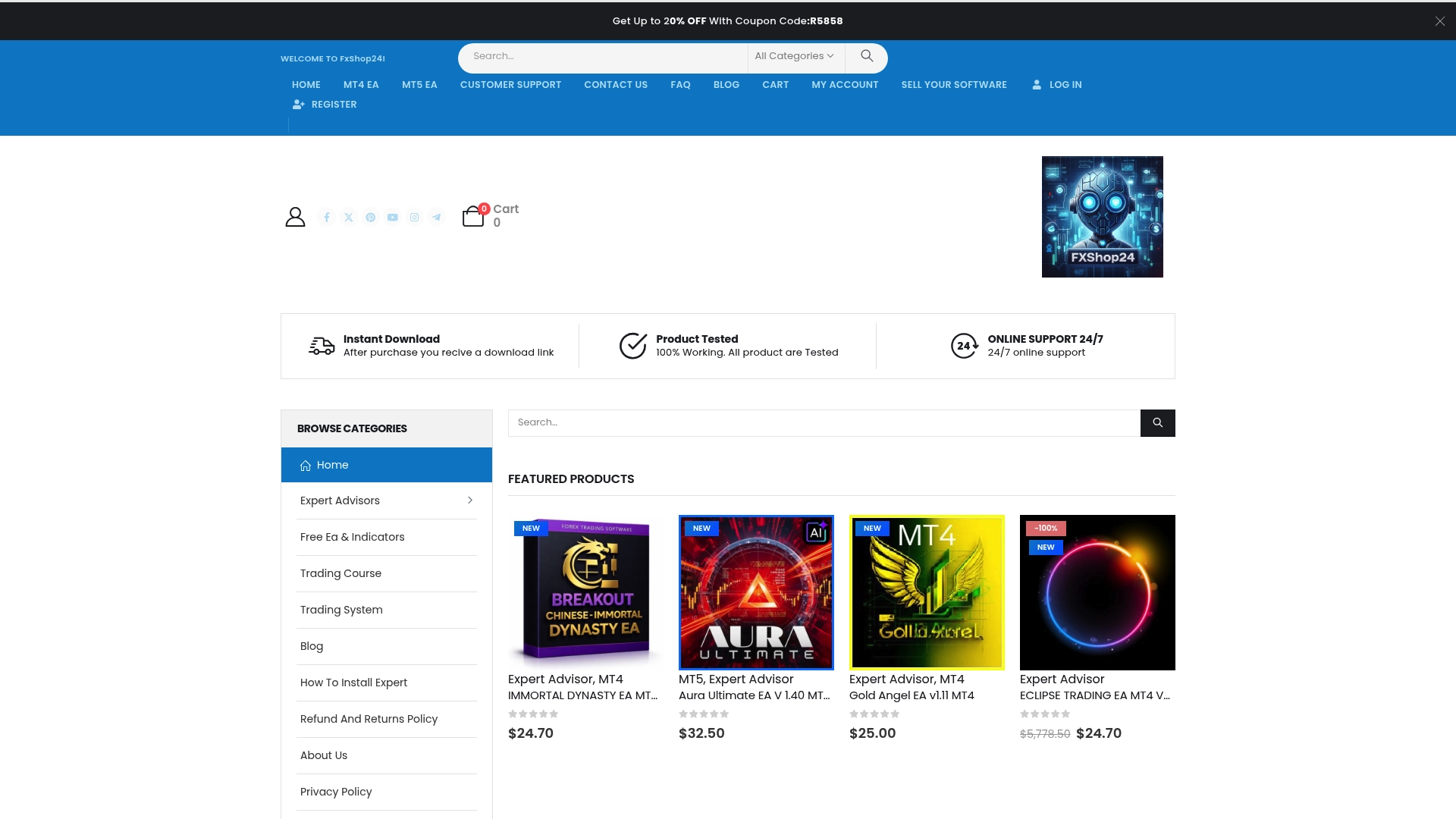
Our EAs are tested against real prop firm rules, including drawdown limits and consistency requirements, so you are not flying blind when you run automation on a challenge account. Whether you want to explore automated futures trading systems or understand the full advantages of prop trading before committing, FxShop24 has the resources, tools, and guides to support your journey from evaluation to funded trader.
Frequently asked questions
Is prop trading legal for retail traders in the US and globally?
Yes, retail prop trading is legal in most countries. Retail prop firms operate through private contracts rather than banking licenses, making them legal but less regulated than traditional brokerages.
What percentage of prop traders actually get paid out?
Only about 7% of retail prop traders ever receive a payout, with the majority failing due to overleveraging or breaking firm rules before reaching a withdrawal threshold.
Can you use trading bots or algorithms in prop firm challenges?
Most prop firms allow algorithmic trading as long as it is not exploitative. Prop firms ban exploitative algos like latency arbitrage, but standard EAs and systematic strategies are generally permitted with firm approval.
How do profit splits in prop trading typically work?
Retail prop firms structure payouts so that traders keep 70 to 90% of the profits they generate, with the firm retaining the remainder as its share of the arrangement.
What’s the most common mistake traders make with prop firms?
Overleveraging is the single biggest reason traders fail prop firm challenges. 90% of failures trace back to position sizes that are too large relative to the account’s drawdown limits, causing rapid blow-ups.