
10
Apr
Scalping Techniques Overview: Boost Forex Trading Results
TL;DR:
- Scalping involves rapid trades targeting small profits within seconds to minutes, requiring discipline and precision.
- Effective risk management and low transaction costs are crucial for long-term profitability in scalping.
- Automated EAs, properly configured and monitored, can enhance consistency and reduce emotional fatigue in scalping.
Many traders assume scalping is the fastest route to consistent forex profits. Put in a few quick trades, collect small wins, and repeat. The reality is sharply different. Scalping demands precision, discipline, and the right tools working in sync. Without those, transaction costs and emotional fatigue will quietly drain your account before you realize what went wrong. This guide breaks down the core scalping techniques, the role of Expert Advisors (EAs) on MT4 and MT5, and the risk management practices that separate sustainable scalpers from those who burn out fast.
Table of Contents
- What is scalping in forex trading?
- Popular scalping techniques and entry strategies
- Critical risk management for scalping success
- Essential tools and EA setups for scalping on MT4 & MT5
- A fresh perspective: Why many traders struggle with scalping (and how to do it smarter)
- Automate your scalping journey with the right EAs and tools
- Frequently asked questions
Key Takeaways
| Point | Details |
|---|---|
| Scalping defined | Scalping captures small, frequent profits through rapid trades and precise execution. |
| Automated vs manual | Automated EAs can improve consistency but require proper setup and monitoring. |
| Risk matters most | Spreads and overtrading can erase scalping gains, so strict risk rules are critical. |
| Tools drive results | The right EAs, tools, and broker choice optimize your scalping success. |
What is scalping in forex trading?
Scalping is a high-frequency trading style where you open and close positions within seconds to minutes, targeting small profit increments per trade. Instead of riding a trend for hours or days, scalpers aim for 2 to 10 pips per trade and repeat the process dozens of times in a single session. The appeal is real: frequent small wins, controlled per-trade exposure, and a strategy that can be fully automated.
But the appeal comes with serious trade-offs. Spread and slippage can erode potential profits and create additional pressures that swing traders never face. When your profit target is 5 pips and your broker charges a 1.5-pip spread, you are already starting each trade at a 30% deficit. That math adds up fast.
Here is what makes scalping fundamentally different from other forex strategies:
- Speed: Positions are held for seconds to a few minutes, not hours
- Volume: Scalpers execute far more trades per session than swing or position traders
- Precision: Entry and exit points must be tight, with little room for error
- Automation: EAs are almost essential for consistent execution at scale
- Cost sensitivity: Every pip of spread or slippage directly cuts into your edge
“The ideal scalper is not the fastest trader in the room. They are the most disciplined one.”
The ideal trader profile for scalping is someone detail-oriented, emotionally steady, and patient enough to accept that results compound over many trades rather than one big winner. If you want to build on smart scalping fundamentals before going deeper, that context will help you apply everything in this guide more effectively. You should also understand that scalping EA secrets often come down to execution quality, not just signal logic.
One of the most common misconceptions is that scalping carries low risk because each trade targets only a few pips. That is wrong. The risk comes from trade frequency, compounding errors, and the psychological weight of watching dozens of positions open and close every session.
Popular scalping techniques and entry strategies
Now that you know the scalping basics, it is time to explore the main techniques and the practical ways traders enter and exit markets.
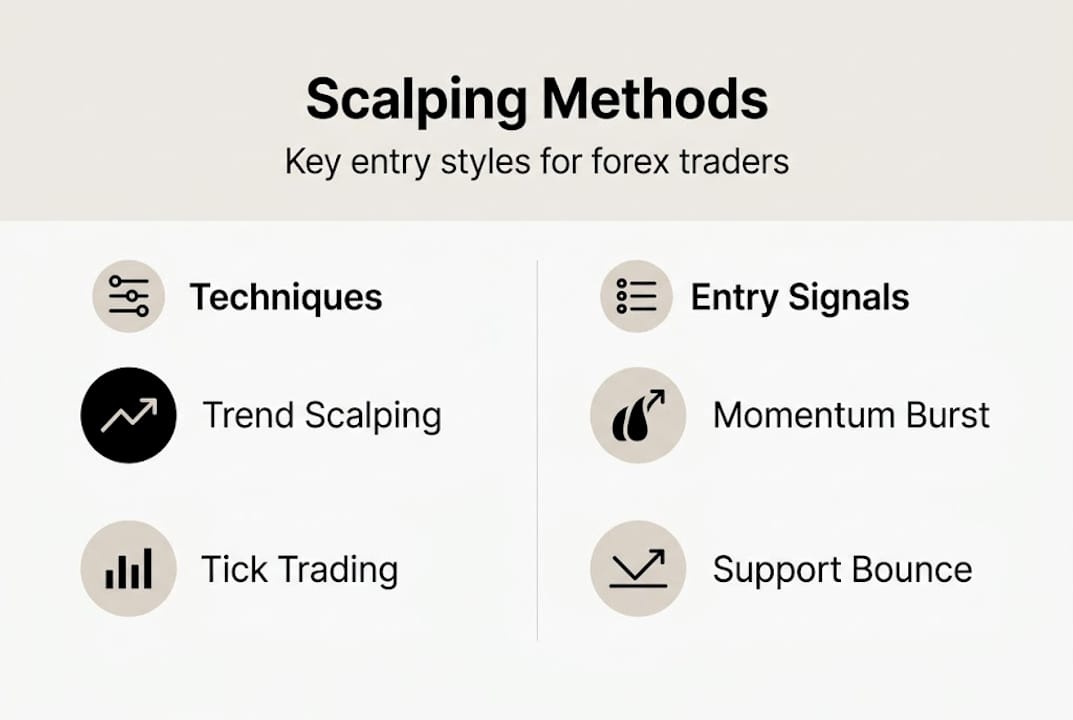
There are four primary scalping approaches used by active forex traders:
- Tick scalping: Entering and exiting on micro-movements in price, often using one-minute or tick charts
- News scalping: Exploiting volatility spikes around major economic releases like NFP or CPI reports
- Trend scalping: Riding short bursts within a confirmed intraday trend using momentum signals
- Range scalping: Fading price at established support and resistance levels in low-volatility conditions
Each method has its own entry logic. Momentum bursts work best with trend scalping. Support and resistance bounces are the backbone of range scalping. Breakout triggers are common in news scalping, though they require extremely fast execution.
| Technique | Best market condition | Key indicator | Risk level |
|---|---|---|---|
| Tick scalping | High liquidity, tight spreads | Volume, price action | High |
| News scalping | Pre-release volatility | Economic calendar | Very high |
| Trend scalping | Clear intraday direction | Moving averages, RSI | Medium |
| Range scalping | Sideways, low volatility | Bollinger Bands, S/R | Medium |
Manual scalping gives you flexibility and real-time judgment, but it is physically exhausting and prone to inconsistency. Automated scalping using EAs removes emotional interference and executes at machine speed. The trade-off is that EAs need proper configuration and ongoing monitoring. You can review automated strategy examples to see how different approaches are structured in practice.
Pro Tip: If you are new to automated scalping, start with a well-documented EA like the Diamond Scalping Forex system on a demo account. Verify that its logic matches your preferred technique before going live.
Scalping is not suitable for beginners because it demands the kind of discipline and stress tolerance that only comes with experience. Overtrading is the most common failure mode, and it hits hardest when traders are manually executing dozens of positions per session without a structured plan.
Critical risk management for scalping success
After reviewing the entry strategies, it is essential to address the biggest challenge most scalpers face: effective risk management.
Transaction costs are the silent killer in scalping. A 1.2-pip spread on a 5-pip target equals a 24% cost impact before the trade even moves in your favor. Multiply that across 30 trades per day and you understand why broker selection and cost control are non-negotiable.

Here is a practical breakdown of how spread impacts profitability at different target levels:
| Profit target (pips) | Spread (pips) | Cost impact | Trades needed to break even |
|---|---|---|---|
| 3 | 1.2 | 40% | Very high |
| 5 | 1.2 | 24% | High |
| 10 | 1.2 | 12% | Moderate |
| 15 | 1.2 | 8% | Lower |
Beyond spreads, here are the core risk controls every scalper needs:
- Fixed stop-loss per trade: Never leave a scalping position without a hard stop, even if it is just 3 to 5 pips
- Daily loss limit: Set a maximum drawdown threshold per session and stop trading when you hit it
- Position sizing: Risk no more than 0.5% to 1% of your account per trade, not per session
- Trade frequency cap: Limit the number of trades per hour or session to prevent fatigue-driven errors
- Slippage monitoring: Track actual fill prices vs. expected prices to spot broker-side issues early
Pro Tip: Use your EA’s built-in controls for automated trading risk controls rather than relying on manual oversight. Automation removes the temptation to override your own rules under pressure.
Emotional overtrading is the most underrated risk in scalping. After a losing streak, many traders increase position size to recover losses faster. This is the exact moment discipline matters most. If you are exploring how to grow capital responsibly, the guide on scaling your trading account offers a structured framework worth reviewing. For traders interested in crypto scalping, the Bitcoin scalping EA applies similar risk principles to a higher-volatility market.
Essential tools and EA setups for scalping on MT4 & MT5
Managing risk sets the stage for success, but much also depends on using the right tools and configurations for reliable execution.
Not every EA is built for scalping. Speed, stability, and broker compatibility are the three features that matter most. An EA that works beautifully in backtesting but lags during live execution is worse than trading manually. Here is what to look for:
- Low-latency execution: The EA must send orders in milliseconds, not seconds
- Broker compatibility: Confirm the EA works with your broker’s execution model, ECN or market maker
- Tick data support: EAs that process tick-level data make better decisions on short timeframes
- Customizable parameters: Spread filters, slippage limits, and session filters should all be adjustable
- VPS hosting: A Virtual Private Server keeps your EA running 24/5 without internet interruptions
Key stat: Automated scalping tools with proper discipline controls can turn small, consistent wins into meaningful capital growth, provided traders avoid overleveraging and overtrading.
Backtesting is necessary but not sufficient. Always run forward tests on a demo account for at least four to six weeks before going live. Backtests can be curve-fitted to historical data, making results look better than they actually are. Forward testing in real market conditions reveals how the EA handles slippage, spread widening, and news volatility.
You can explore the best free scalping EAs available for MT4 to compare features before committing to a paid solution. For a broader view of what your trading setup should include, the guide on essential trading tools MT4/MT5 covers the full stack from indicators to execution infrastructure.
One-click trading panels, custom tick charts, and session-based filters are all tools that give manual scalpers an edge. For EA users, the priority is configuration quality over feature quantity. A simple EA with tight risk controls will outperform a complex one with poor parameter management.
A fresh perspective: Why many traders struggle with scalping (and how to do it smarter)
You have learned the core methods and tools. Now let us step back for a frank look at why many traders do not reach consistent scalping success.
The honest answer is not method. It is mindset. Most traders who fail at scalping have read the same strategies you just reviewed. They know what tick scalping is. They understand spread impact. But knowing and executing under real market pressure are two completely different things.
Psychological fatigue is massively underestimated. After 20 trades in two hours, your decision-making degrades even if you do not feel it. This is where high-frequency trading practices diverge from retail scalping. Institutional systems do not get tired. Yours does.
Automating for discipline is not about replacing skill. It is about protecting your strategy from yourself. The traders who succeed long-term treat each trade as one data point in a large sample, not a standalone event. Systems win. Individual trades are just inputs.
Automate your scalping journey with the right EAs and tools
Ready to take your scalping to the next level? FxShop24 offers a curated selection of EAs and automation tools built specifically for MT4 and MT5 traders who want reliable, tested execution.
Whether you are looking for a proven entry-level solution like the EA Forex Scalper MT4 or want to understand the full range of types of automated trading systems available, the platform has resources to match your experience level. If you want to go deeper on strategy logic before choosing a tool, the scalping EA strategy insights guide covers what top MT4 traders actually use. Every product comes with installation support, lifetime updates, and unlimited licenses.
Frequently asked questions
Is scalping suitable for beginners in forex trading?
No. Scalping requires discipline and stress tolerance that most beginners have not yet developed, and the risk of overtrading is especially high for inexperienced traders.
How much do spreads and slippage affect scalping profits?
Significantly. A 1.2-pip spread on a 5-pip target reduces your profit margin by 24%, which means trading costs must be tightly controlled to stay profitable over time.
Which brokers are best for scalping with EAs on MT4/MT5?
The best brokers for EA-based scalping offer raw spreads below 0.5 pips, fast order execution under 50 milliseconds, and no restrictions on scalping strategies or EA usage.
What is the difference between manual scalping and using an EA?
Manual scalping depends on your real-time judgment and reaction speed, while an EA automates entries and exits consistently but still requires proper configuration and periodic monitoring.
How can I automate risk management in my scalping strategy?
Configure your EA with hard stop-loss levels, take-profit targets, daily drawdown limits, and trade frequency caps so that risk decisions are enforced automatically without emotional interference.
Recommended
- Bitcoin Scalping V2.1 MT4 | FxShop24 Marketplace
- Smart Scalping In 2025: How To Use EAs And Indicators For Faster Profits On MT4 & MT5 | FxShop24 Marketplace
- Diamond Scalping Forex V1.2 | FxShop24 Marketplace
- Scalping EA Secrets Revealed: What Top MT4 Traders Don’t Want You To Know | FxShop24 Marketplace
- How to build trading skills: a step-by-step guide