


25
Feb
Why Use Trading Systems: Boosting Forex Success
Manual trading can leave even the most disciplined trader exhausted and vulnerable to mistakes. The sheer speed and complexity of the Forex and gold markets demand more than human effort alone. Automated trading systems (ATS) use real-time data and predefined algorithms to execute trades consistently and efficiently, minimizing emotion and error. If you want a reliable way to manage trades on MT4 or MT5 while pursuing better performance, understanding these systems is your next logical step.
Table of Contents
- What Are Trading Systems in Forex
- Types of Automated Trading Solutions
- Major Benefits of Automated Trading Systems
- Managing Risks and Limitations with EAs
- Choosing the Right System and Avoiding Pitfalls
Key Takeaways
| Point | Details |
|---|---|
| Automated Systems Enhance Trading Efficiency | Trading systems operate 24/5, capitalizing on opportunities without human intervention. They execute trades based on predefined rules, ensuring consistency and speed. |
| Emotional Decision-Making is Eliminated | Automated systems remove the influence of emotions, allowing disciplined execution of trading strategies in all market conditions. |
| Different Types of Trading Systems Suit Various Traders | Rule-based, machine learning, and hybrid systems cater to different trading styles and adaptability needs, enabling traders to select a system that matches their approach. |
| Vigilance is Required Despite Automation | Regular monitoring of automated systems is essential to manage risks and ensure they perform well across varying market conditions, avoiding common pitfalls like overfitting. |
What Are Trading Systems in Forex
Trading systems in forex are rule-based programs that execute trades automatically without constant human intervention. They follow predefined algorithms to identify and capitalize on market opportunities using real-time data.
Automated trading systems (ATS) eliminate the guesswork from currency trading by applying consistent logic to every trade. Instead of staring at charts all day, you set the rules once and let the system work 24/5 while you sleep or focus on other tasks.
How Automated Systems Work
At their core, trading systems process massive amounts of market data every second. They scan price movements, identify patterns matching your criteria, and execute trades instantly when conditions align.
The process looks like this:
- Monitor multiple currency pairs simultaneously across different timeframes
- Analyze real-time market data against your predefined trading rules
- Generate buy or sell signals when criteria are met
- Execute trades automatically at exact prices
- Manage position sizing and risk automatically
Core Benefits of Trading Systems
Consistency matters more than you’d think. Automated trading systems remove emotion from every decision, meaning your system trades the same way in a rising market or a falling one—without fear or greed interfering.
Human traders struggle with discipline. You might skip a trade because you’re tired, or hold a losing position too long hoping it reverses. Systems don’t have those weaknesses.
Key advantages include:
- Execute trades 24/5 without your presence
- Process data faster than any human could
- Apply identical logic to every trade
- Reduce costly emotional decisions
- Backtest strategies before risking real money
Modern Trading Systems Use Advanced Technology
Recent advances have transformed basic rule-based systems into sophisticated tools. Machine learning-driven systems now analyze complex relationships in financial data and adapt to changing market conditions, not just follow static rules.
Your trading system can learn from new patterns and improve its forecasting accuracy over time. This capability separates modern forex systems from outdated mechanical approaches.
Why Forex Markets Need Automated Systems
The forex market trades 24 hours daily across multiple time zones. A single currency pair can generate hundreds of trading opportunities each day—far too many for any human to catch manually.
Trading systems capture these micro-opportunities consistently, turning small edges into meaningful profits over hundreds of trades.
Automated systems transform raw market data into profitable trades by eliminating human error and emotion from every decision.
Pro tip: Start with a system designed for your trading style and market conditions—whether you prefer quick scalps, daily swings, or longer-term trends. Your chosen system should match your risk tolerance and the currency pairs you trade most.
Types of Automated Trading Solutions
Automated trading solutions come in several distinct varieties, each designed to handle different trading styles and market conditions. Understanding these types helps you choose the right system for your goals.
Rule-Based Systems
Rule-based systems execute trades using fixed algorithms that never change. You set specific conditions—like “buy when the 20-period moving average crosses above the 50-period moving average”—and the system follows that logic every single time.
These systems offer predictability and simplicity. You know exactly what your system will do in any market condition because the rules remain constant.
Key characteristics include:
- Execute based on predetermined technical indicators
- No adaptation to changing market conditions
- Highly transparent and easy to understand
- Ideal for traders with defined, proven strategies
- Fast execution with minimal computational overhead
Machine Learning and AI-Driven Systems
Machine learning models represent the evolution of automated trading. Rather than following fixed rules, these systems learn from historical data and adapt dynamically as market conditions shift.
AI-powered systems use deep learning, reinforcement learning, and sentiment analysis to improve trading outcomes over time. They can process vast amounts of alternative data sources and identify subtle market signals that humans would miss.
Advantages include:
- Adapt to changing market conditions automatically
- Learn from new patterns continuously
- Process complex relationships in financial data
- Optimize execution with reduced human intervention
- Capture opportunities across multiple timeframes and frequencies
Hybrid Systems Combining Multiple Approaches
Hybrid systems blend the best of both worlds. They integrate technical analysis with AI capabilities to enhance predictive power while maintaining the transparency of rule-based approaches.
A hybrid system might use fixed rules to generate initial signals, then apply machine learning to filter those signals and optimize entry and exit timing. This combination provides flexibility and scalability for various trading styles.
Choosing the Right Type for You
Your choice depends on your experience level, risk tolerance, and market focus. Rule-based systems work well if you have a tested strategy you trust. ML-driven systems suit traders who want continuous optimization and adaptation.
Hybrid approaches offer a middle ground—combining proven technical methods with modern AI improvements. Consider whether you trade forex pairs, gold, or both, and whether you prefer quick scalps or longer-term positions.
Here’s a quick comparison of the main automated trading system types:
| System Type | How It Works | Adaptability | Ideal User |
|---|---|---|---|
| Rule-Based | Executes strict, fixed rules | Low; does not adjust to market changes | Those with a proven strategy |
| Machine Learning | Learns from data, adapts over time | High; adjusts to new trends | Users seeking optimization |
| Hybrid | Combines rules and AI filtering | Moderate; blends logic and adaptability | Traders desiring transparency and flexibility |
The best trading solution matches your strategy, risk profile, and the markets you trade—not the most sophisticated technology.
Pro tip: Test your chosen system type on historical data using backtesting before deploying real capital. This reveals how the system handles different market conditions and helps you understand realistic performance expectations.
Major Benefits of Automated Trading Systems
Automated trading systems deliver tangible advantages that transform how retail traders operate in forex and gold markets. These benefits compound over time, turning small edges into meaningful profits.
Eliminate Emotional Decision-Making
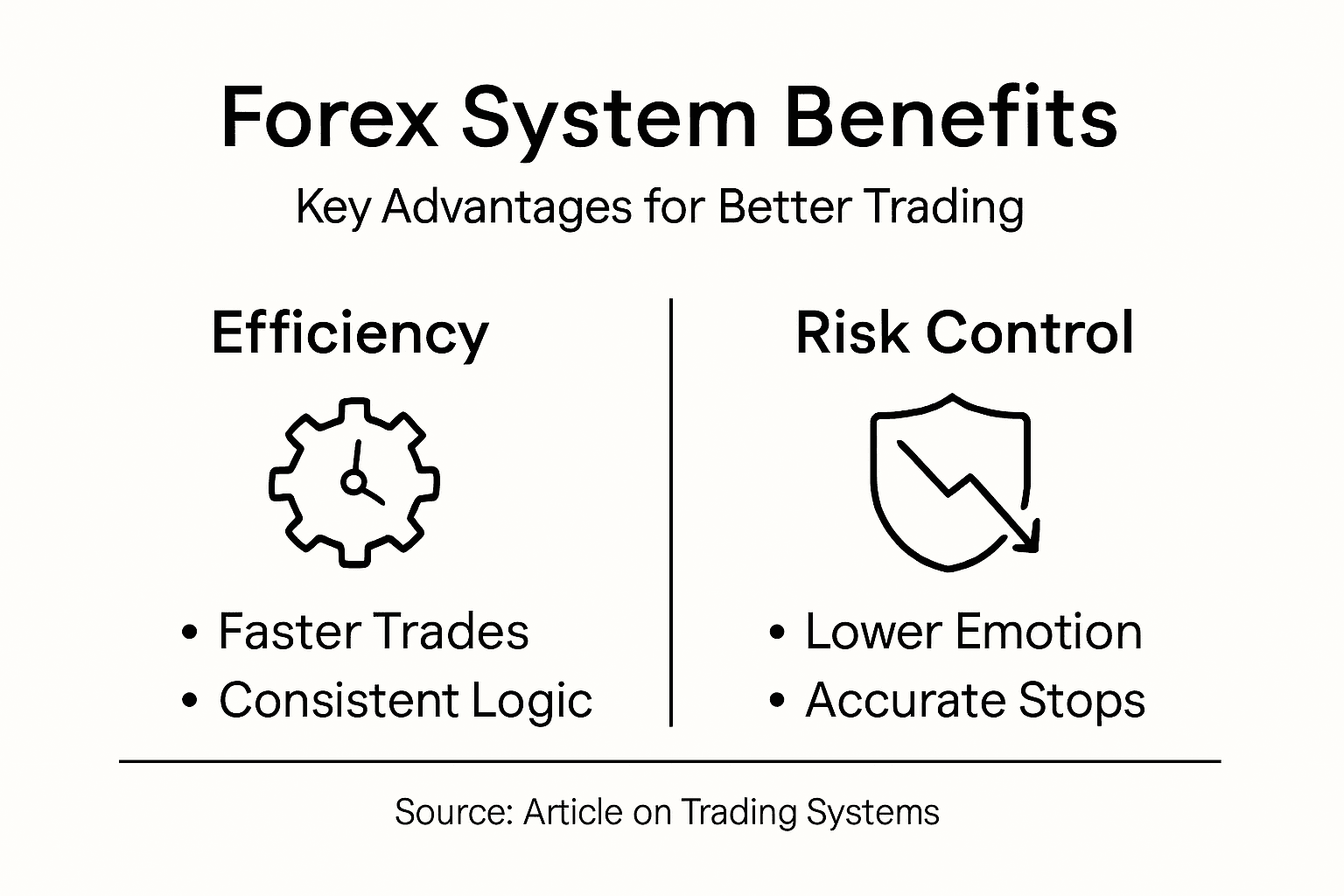
Emotion destroys trading accounts. Fear keeps you out of winning trades, greed extends losses, and hope blinds you to reality. Automated systems execute every trade with identical discipline, regardless of market conditions or recent losses.
Your system doesn’t panic when price drops 50 pips. It doesn’t hold a losing position hoping for a recovery. It follows your rules exactly as programmed, every single time.
Key emotional benefits:
- Execute trades without fear or hesitation
- Stick to your trading plan during volatile markets
- Avoid impulsive decisions that derail strategy
- Maintain consistency across hundreds of trades
- Remove second-guessing from the equation
Faster Execution and Better Pricing
Speed matters in forex. A human trader takes seconds to analyze, decide, and execute. An automated system processes the same decision in milliseconds, often capturing better entry and exit prices.
This speed advantage compounds across hundreds of trades monthly. Faster execution of trades reduces slippage, improves fill quality, and captures fleeting opportunities that manual traders miss entirely.
Trade Multiple Strategies Simultaneously
Manual traders manage one strategy at a time. Automated systems run multiple strategies across different currency pairs and timeframes simultaneously without breaking a sweat.
You might run a scalping system on EUR/USD, a swing system on GBP/USD, and a longer-term trend system on gold—all operating independently while you sleep. This simultaneous management of multiple strategies improves diversification and reduces risk concentration.
Enhanced Risk Management and Accuracy
Machine learning-based systems implement advanced risk techniques that adapt to market volatility. Position sizes scale automatically based on recent price action, protecting your account during choppy conditions while maximizing exposure during calm periods.
Automated systems also identify complex patterns in market data that human analysis would miss. This pattern recognition translates into higher win rates and better overall profitability.
Critical advantages include:
- Dynamic position sizing based on volatility
- Consistent risk per trade regardless of emotion
- Pattern recognition across vast datasets
- Reduced human errors in trade execution
- Continuous adherence to risk rules
Work 24/5 Without Your Presence
Forex markets never sleep. Opportunities occur at 3 AM, during news events, and across time zones you’re not awake to monitor. Your automated system trades around the clock, capturing opportunities while you live your life.
This around-the-clock operation generates trading volume and exposure that no manual trader could possibly achieve.
Automated systems transform small, consistent edges into substantial profits by eliminating emotion and capturing opportunities at machine speed.
Pro tip: Monitor your system’s performance weekly, but resist the urge to tweak rules after a few losing trades. Most systems need 50-100 trades to show true profitability. Excessive adjustments based on short-term results destroy what made the system work in the first place.
Managing Risks and Limitations with EAs
Expert Advisors deliver powerful automation, but they come with real risks that demand your attention. Understanding these limitations separates successful traders from those who lose accounts to unchecked EA problems.
Market Volatility and Flash Crash Risk
When many EAs execute simultaneously, they can amplify market movements in unexpected ways. During volatile news events or thin liquidity periods, increased market volatility can trigger cascading sell-offs or spike moves that catch your EA off guard.
Your system might experience slippage far worse than backtested expectations. A stop loss set at 50 pips could execute 200 pips away during extreme volatility, devastating your account in seconds.
Key volatility risks include:
- Extreme slippage during news releases
- Flash crash events that gap past stop losses
- Liquidity drying up during market stress
- Unexpected price spikes in minor currency pairs
- Weekend gap risk when markets reopen
Operational Risks and Technical Failures
Connection failures happen. Your broker disconnects, your VPS crashes, or MetaTrader freezes at the worst possible moment. An EA running on unstable infrastructure creates exposure you can’t control.
Always use a dedicated Virtual Private Server, maintain backup internet connectivity, and test your EA’s ability to recover from disconnections. A system that can’t reconnect and close trades automatically becomes a liability.
Overfitting and Strategy Degradation
Backtesting looks perfect because you tested the strategy against historical data it never actually traded in real-time. This overfitting means your EA performed great on old data but fails on new market conditions.
A system that earned 40% annually on 2023 data might lose money on 2024 conditions. Market regimes change constantly. Your EA’s parameters optimized for trending markets fail during ranging consolidations.
Leverage Amplifies Everything
Leverage multiplies both gains and losses. A 2% daily loss with 10:1 leverage becomes a 20% account drawdown. Most retail traders underestimate how quickly leverage destroys accounts during consecutive losing days.
Start with conservative position sizing and lower leverage until you prove the EA works consistently. Your first 100 trades should feel boring, not exciting.
Monitoring and Adjustment Requirements
EAs require ongoing attention. Set up alerts for unusual activity, monitor drawdowns weekly, and track win rates across market conditions. An EA performing well for 3 months might deteriorate in month 4 as market conditions shift.
You cannot simply deploy an EA and ignore it. Regular monitoring catches problems early:
- Weekly equity curve reviews
- Monthly performance analysis across market types
- Seasonal pattern changes
- Parameter adjustments when conditions shift
- Account balance rebalancing
Data Quality and Model Transparency
Poor quality data in backtesting produces unreliable results. If your broker’s historical data contains gaps or errors, your EA’s backtest becomes fiction. Real-world performance will disappoint dramatically.
Also understand what your EA does. Black-box systems you don’t understand create psychological distance from your trading. You won’t trust the system during inevitable drawdowns.
EAs are powerful tools, but unmanaged EA trading destroys accounts faster than manual trading ever could.
Pro tip: Set maximum daily loss limits and hard stops on your EA before going live. If the system loses 2% of your account in a single day, shut it down and investigate what happened. This simple rule prevents small mistakes from becoming account-ending disasters.
Here is a summary of common risks and their impact when using automated trading systems:
| Risk Category | Possible Cause | Example Impact |
|---|---|---|
| Market Volatility | Flash crashes, news events | Large, sudden losses beyond stop loss |
| Technical Failures | VPS or broker disconnections | Unattended open trades, missed exits |
| Overfitting | Excessive optimization | Good in backtest, poor live performance |
| Leverage Misuse | High position scaling | Small loss turns into large drawdown |
| Poor Data Quality | Gaps or bad history | Inaccurate system results, false confidence |
Choosing the Right System and Avoiding Pitfalls
Selecting a trading system demands careful evaluation. The wrong choice wastes money and time; the right one compounds your profits for years. This section teaches you what separates winners from expensive mistakes.
Evaluate System Reliability and Track Record
Don’t trust marketing claims. Real performance comes from documented trading history across multiple market conditions, not promises from developers. A system showing 5 years of consistent profitability means more than a 6-month demo account.
Look for systems with transparent track records verified by third parties or prop trading firms. Backtested results mean nothing without forward-testing proof in live conditions.
Key evaluation criteria:
- Minimum 2-3 years documented performance
- Verified trading records (not just backtest results)
- Performance across bull and bear markets
- Drawdown history and recovery speed
- Win rate and average win-to-loss ratio
- Prop firm compatibility and approval status
Understand System Adaptability and Complexity
Overfitting destroys most systems. A complex EA optimized to perfection on historical data fails miserably on new market conditions. Simple systems with 3-5 core rules outperform complex ones with dozens of parameters.
Evaluating system adaptability means testing how the system performs across different market regimes—trending markets, ranging markets, high volatility periods, and low volatility zones.
If a system only works in specific conditions, it’s a niche tool, not a core trading engine. You need systems that function reasonably well across varying market conditions.
Conduct Rigorous Backtesting and Forward Testing
Backtesting reveals potential, but forward testing reveals reality. Always test a system on out-of-sample data—market data the system never “saw” during optimization.
The testing sequence should be:
- Backtest on historical data with robust optimization
- Test on out-of-sample historical data (last 6-12 months)
- Demo trade for 100+ trades minimum
- Live trade with minimum position size
- Scale up only after consistent profitability
Avoid Data Snooping and Curve Fitting
Data snooping means tweaking system parameters until historical data looks perfect. This creates false confidence. Real trading will devastate these over-optimized systems.
Avoid systems with excessive parameters. More parameters equal more ways to fit past data while failing on future data. A system with 15+ tweakable settings is likely over-fitted and unreliable.
Transparency and Understanding Your System
You should understand what your system does and why. Black-box systems you don’t comprehend create psychological barriers when losses occur. You won’t trust the system during inevitable drawdowns.
Ask the developer:
- What market conditions does this system trade best in?
- What causes drawdowns and how long do they typically last?
- How does the system adapt to changing volatility?
- What happens during news events?
- Can you modify parameters or is it locked?
Match System to Your Trading Style
A scalping system generating 100 trades daily suits someone monitoring charts constantly. A swing system with 2-3 trades weekly fits someone with a day job.
Also match the currency pairs and markets to what you want to trade. A system optimized for EUR/USD might fail on GBP/JPY or gold. Test systems on your preferred trading instruments.
The best trading system isn’t the most profitable one you find—it’s the one you understand, trust, and will actually use consistently.
Pro tip: Before committing real money, paper trade your chosen system for at least 50 consecutive trades. Paper trading costs nothing and reveals whether you’ll psychologically stick with the system during its inevitable losing streaks.
Elevate Your Forex Trading with Proven Automated Systems
If you are facing the challenge of emotional trading and inconsistent results discussed in “Why Use Trading Systems: Boosting Forex Success” then it is time to harness the power of automated expert advisors that trade with precision 24/5. Many traders struggle with missed opportunities and slow execution. At FxShop24 you can explore a wide range of tested trading systems and AI-powered robots designed to eliminate guesswork and deliver consistent strategy execution. These solutions match the article’s emphasis on rule-based and adaptive machine learning systems that reduce errors and manage risk efficiently.
Take control of your trading today and start benefiting from premium trading systems that come with lifetime updates and unlimited licenses. Visit FxShop24 now to find your ideal expert advisor tailored for forex and gold markets. Don’t let emotional decisions hold back your profits unlock automated precision with real-time execution backed by robust backtesting. Join thousands of traders elevating their success with cutting-edge automation available instantly through our platform. Start your journey toward disciplined and profitable trading now.
Frequently Asked Questions
What are trading systems in forex?
Trading systems in forex are automated, rule-based programs that execute trades without the need for constant human intervention. They utilize predefined algorithms to identify market opportunities and execute trades automatically.
How do automated trading systems improve trading outcomes?
Automated trading systems improve trading outcomes by executing trades with consistent logic, eliminating emotional decision-making, processing vast amounts of market data quickly, and allowing traders to operate 24/5 without being physically present.
What are the different types of automated trading solutions?
The main types of automated trading solutions include rule-based systems, which follow fixed algorithms; machine learning and AI-driven systems, which adapt to changing market conditions; and hybrid systems, which combine elements of both approaches for enhanced flexibility and transparency.
How can traders manage risks when using expert advisors (EAs)?
Traders can manage risks when using EAs by setting maximum daily loss limits, utilizing a stable trading infrastructure, regularly monitoring performance, and ensuring they understand the system’s parameters and market conditions under which it operates.