5
Feb
What Is a Trading System: Powering Automated FX Success
Every retail forex trader and automated trading enthusiast knows the challenge of making fast, emotion-free decisions in unpredictable markets. With so many strategies and systems promising results, understanding the real meaning and core principles of a trading system becomes essential for anyone aiming for consistency and prop firm compatibility. This guide breaks down how rule-based systems transform trading into a disciplined, objective process and highlights what to look for when selecting or building your own approach.
Table of Contents
- Trading System Meaning and Core Principles
- Manual Versus Automated Trading Approaches
- Popular Trading System Types and Strategies
- How Trading Systems Work in Forex and Gold
- Benefits, Limitations, and Common Pitfalls
Key Takeaways
| Point | Details |
|---|---|
| Objective Decision Making | Trading systems minimize emotional interference by establishing rule-based strategies for executing trades. |
| Manual vs. Automated | Traders can choose between manual methods that offer flexibility and automated systems that ensure speed and precision. |
| Types of Trading Strategies | Popular trading strategies like Momentum and Mean Reversion each have unique advantages and risk management principles. |
| Benefits and Limitations | While trading systems provide speed and emotional neutrality, they can also suffer from technical vulnerabilities and require regular oversight. |
Trading System Meaning and Core Principles
A trading system represents a structured approach to executing financial transactions by applying predefined rules and algorithmic strategies. These systematic frameworks aim to transform subjective trading decisions into objective, repeatable processes. Comprehensive market analysis enables traders to implement disciplined strategies that minimize emotional interference.
The core principles of trading systems revolve around several critical elements:
- Objective Decision Making: Eliminating emotional impulses from trading choices
- Rule-Based Execution: Establishing clear entry and exit criteria
- Risk Management: Implementing consistent position sizing and loss mitigation strategies
- Technical Analysis Integration: Utilizing quantitative indicators and computational models
At their fundamental level, trading systems transform complex market dynamics into actionable signals. Trading system definitions emphasize the importance of creating unambiguous mechanisms for generating buy and sell signals through technical indicators and algorithmic approaches.
Modern trading systems leverage advanced computational techniques to analyze market data rapidly, identifying potential opportunities with precision and consistency. These systems can range from simple moving average crossover strategies to complex machine learning models that adapt to changing market conditions.
Pro tip: Always backtest your trading system using historical data to validate its potential performance and understand its statistical reliability before deploying real capital.
Manual Versus Automated Trading Approaches
Trading approaches have evolved dramatically, presenting traders with two distinct methodologies: manual trading and automated trading. Comparative trading algorithms reveal significant differences in how these approaches manage market interactions and decision-making processes.
Manual trading strategies involve direct human intervention, characterized by:
- Trader-driven decision making
- Real-time market interpretation
- Flexibility in strategy adaptation
- Opportunity for intuitive insights
- Complex emotional and psychological factors
In contrast, automated trading systems offer a systematic approach to market engagement. These computational frameworks eliminate human emotional interference and execute trades based on predefined mathematical rules and algorithms. Forex automation techniques enable traders to implement consistent strategies with remarkable precision and speed.

The primary distinctions between manual and automated approaches extend beyond mere execution methods. Manual traders rely on personal experience, market sentiment, and real-time analysis, while automated systems leverage statistical models, historical data patterns, and programmed logic to generate trading signals. Hybrid models are increasingly emerging, combining the strengths of both approaches to optimize trading performance.
Here’s a side-by-side summary comparing manual and automated trading approaches:
| Aspect | Manual Trading | Automated Trading | Hybrid Models |
|---|---|---|---|
| Decision Basis | Human analysis | Algorithmic logic | Combines both |
| Speed | Limited by user | Millisecond execution | Fast with manual checks |
| Flexibility | Adaptable in real time | Follows set rules | Strategic overrides possible |
| Emotional Impact | High influence | Minimized influence | Balanced approach |
| Monitoring Need | Continuous by trader | Systematic oversight | Requires both |
Pro tip: Consider developing a systematic approach that integrates both manual oversight and automated execution to balance technological efficiency with human strategic insight.
Popular Trading System Types and Strategies
Trading strategies represent sophisticated approaches to market engagement, each designed to capitalize on unique market dynamics. Algorithmic trading techniques demonstrate the complexity and diversity of modern trading methodologies, ranging from technical analysis to advanced computational models.
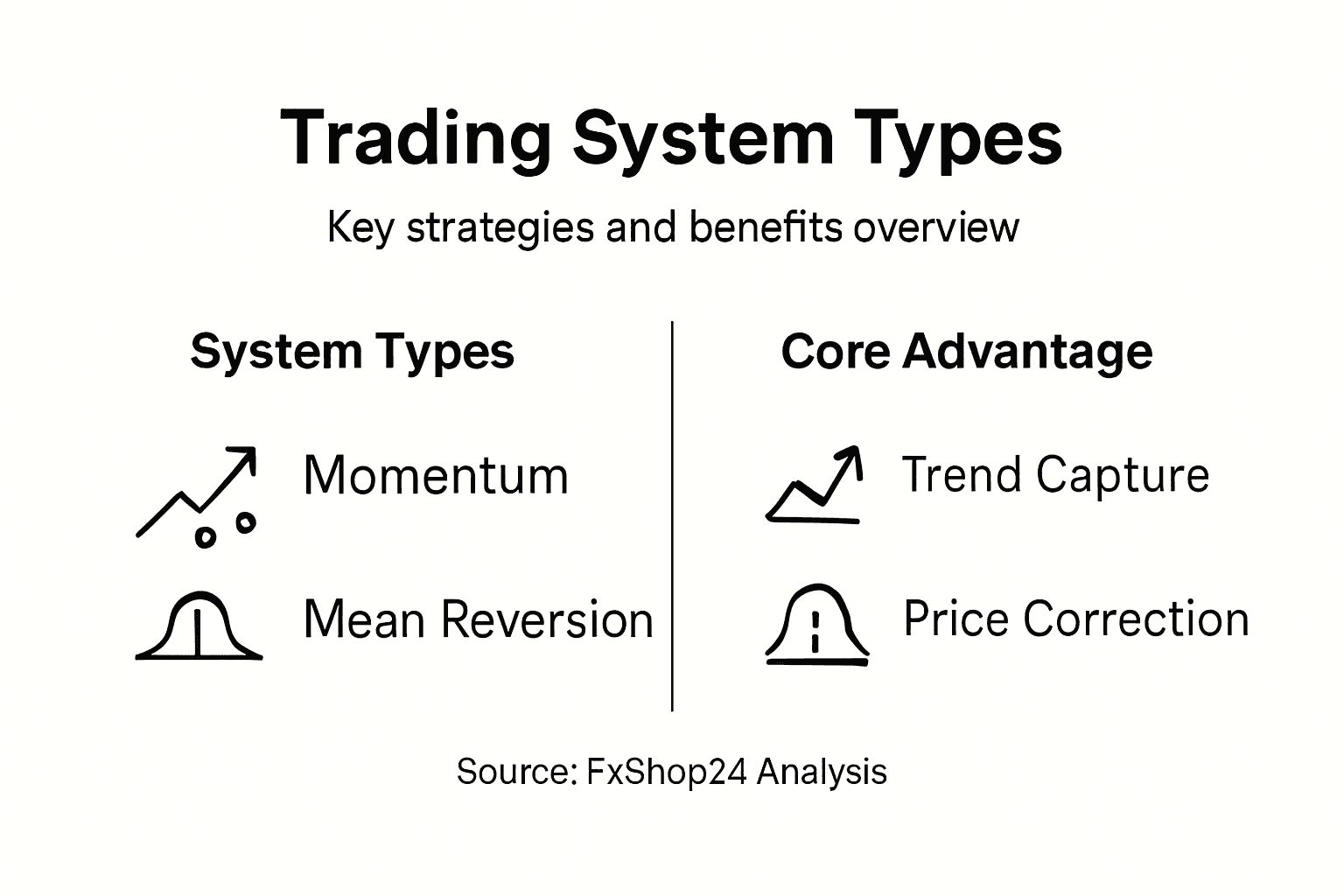
The most prevalent trading system types include:
- Momentum Trading: Capitalizing on existing market trends
- Mean Reversion: Betting on price returning to historical average
- Arbitrage: Exploiting price differences across markets
- High-Frequency Trading: Executing multiple trades at microsecond speeds
- Machine Learning Systems: Adaptive strategies using predictive algorithms
Each strategy incorporates unique risk management principles and computational frameworks. Examples of trading systems reveal intricate mechanisms for generating consistent trading signals, balancing mathematical precision with market adaptability.
Advanced trading systems increasingly leverage machine learning and artificial intelligence to develop predictive models. These sophisticated approaches analyze massive datasets, identifying subtle market patterns that traditional methods might overlook. By combining quantitative analysis, statistical modeling, and real-time data processing, modern trading systems can adapt dynamically to changing market conditions.
This table consolidates main trading system types and their unique value:
| System Type | Core Objective | Unique Advantage |
|---|---|---|
| Momentum | Follow market trends | Captures strong moves |
| Mean Reversion | Target price rebounds | Profits from corrections |
| Arbitrage | Exploit price gaps | Low-risk capital use |
| High-Frequency | Microsecond trading | Maximizes tiny opportunities |
| Machine Learning | Adaptive pattern finding | Learns from new data |
Pro tip: Always validate your trading strategy through rigorous backtesting and paper trading before committing real capital to ensure consistent performance across different market scenarios.
How Trading Systems Work in Forex and Gold
Automated trading systems transform financial markets by converting complex market analysis into systematic execution strategies. Forex trading algorithms integrate sophisticated computational techniques to analyze real-time market data and generate precise trading decisions across forex and gold markets.
The core operational components of trading systems include:
- Data Acquisition: Collecting real-time market price feeds
- Signal Generation: Analyzing technical and fundamental indicators
- Risk Management: Implementing predefined position sizing rules
- Execution Logic: Automating trade entries and exits
- Performance Tracking: Monitoring system efficiency and returns
In forex and gold markets, these systems employ multiple analytical approaches. Automated trading techniques leverage complex algorithms that simultaneously process multiple market variables, from price momentum to macroeconomic indicators, enabling rapid decision-making with minimal human intervention.
Advanced multi-agent computational platforms analyze intricate market dynamics, especially in gold trading where geopolitical factors and economic sentiments play crucial roles. These systems dynamically adjust strategies by processing massive datasets, identifying subtle market patterns that human traders might overlook. By combining statistical analysis, machine learning, and real-time data processing, modern trading systems can adapt instantaneously to changing market conditions.
Pro tip: Develop a comprehensive understanding of your trading system’s underlying algorithm and continuously validate its performance through rigorous backtesting and controlled risk management.
Benefits, Limitations, and Common Pitfalls
Trading systems represent powerful technological solutions that simultaneously offer remarkable advantages and significant challenges. Automated trading risks reveal a complex landscape of potential benefits and potential drawbacks that traders must carefully navigate.
The key benefits of trading systems include:
- Speed and Efficiency: Executing trades faster than human capabilities
- Emotional Neutrality: Removing psychological biases from trading decisions
- Consistent Strategy Application: Maintaining disciplined approach across market conditions
- Multitasking Capabilities: Managing multiple markets simultaneously
- Precise Risk Management: Implementing strict position sizing rules
However, trading systems are not without significant limitations. These computational frameworks can suffer from technical vulnerabilities, such as algorithmic failures, data inconsistencies, and potential over-optimization that might produce unreliable results. The danger lies in developing systems that perform exceptionally well in historical backtests but fail to adapt to real-world market dynamics.
The most critical pitfalls emerge when traders become overly reliant on automated systems without maintaining proper oversight. Successful trading systems require continuous monitoring, periodic strategy recalibration, and a deep understanding of underlying market mechanisms. Traders must recognize that no algorithm can completely eliminate market uncertainty or guarantee consistent profitability.
Pro tip: Implement a robust validation process that includes regular performance reviews, stress testing, and maintaining manual intervention capabilities to mitigate potential systemic risks.
Unlock the Power of Automated Trading Systems Today
Trading systems bring objectivity and precision to forex and gold trading by eliminating emotional bias and applying rule-based execution. If you are seeking to streamline your trading strategy with proven algorithmic tools, FxShop24 offers a comprehensive selection of expert advisors and automated trading software designed to meet these exact needs. From AI-powered trading robots to prop firm-ready expert advisors, our solutions empower you to embrace consistency, efficiency, and advanced risk management methods discussed in this article.
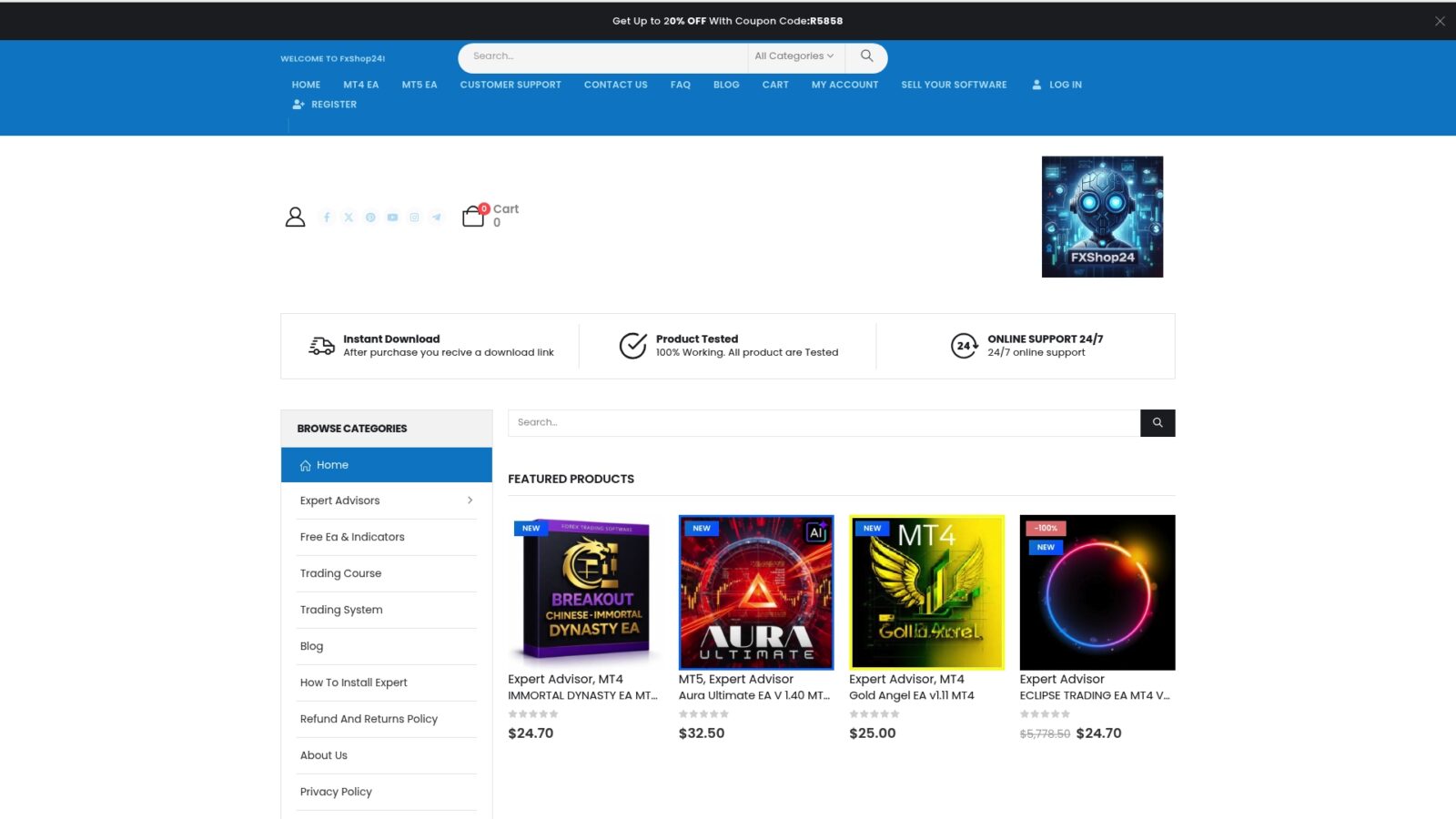
Take control of your trading performance now by exploring our premium offerings at FxShop24. Equip yourself with expertly tested, lifetime-updated systems instantly delivered for MetaTrader 4 and MetaTrader 5 platforms. Don’t delay your path toward disciplined, emotion-free trading—discover the future of forex and gold automation and elevate your strategy today. Visit automated trading software and start transforming your trades with cutting-edge systems designed for success.
Frequently Asked Questions
What is a trading system?
A trading system is a structured approach to executing financial transactions based on predefined rules and algorithmic strategies, aiming to make objective trading decisions and minimize emotional influences.
How do automated trading systems work?
Automated trading systems analyze real-time market data and generate trading signals using complex algorithms. They execute trades based on these signals without human intervention, enhancing speed and efficiency.
What are the main advantages of using a trading system?
The key advantages include speed and efficiency in trade execution, removal of emotional biases, consistent strategy application across market conditions, and the ability to manage multiple markets simultaneously.
What are common pitfalls to avoid with automated trading systems?
Common pitfalls include over-reliance on automated systems without oversight, potential technical vulnerabilities, and the risk of developing overly optimized systems that may not perform well in real-world conditions.