17
Oct
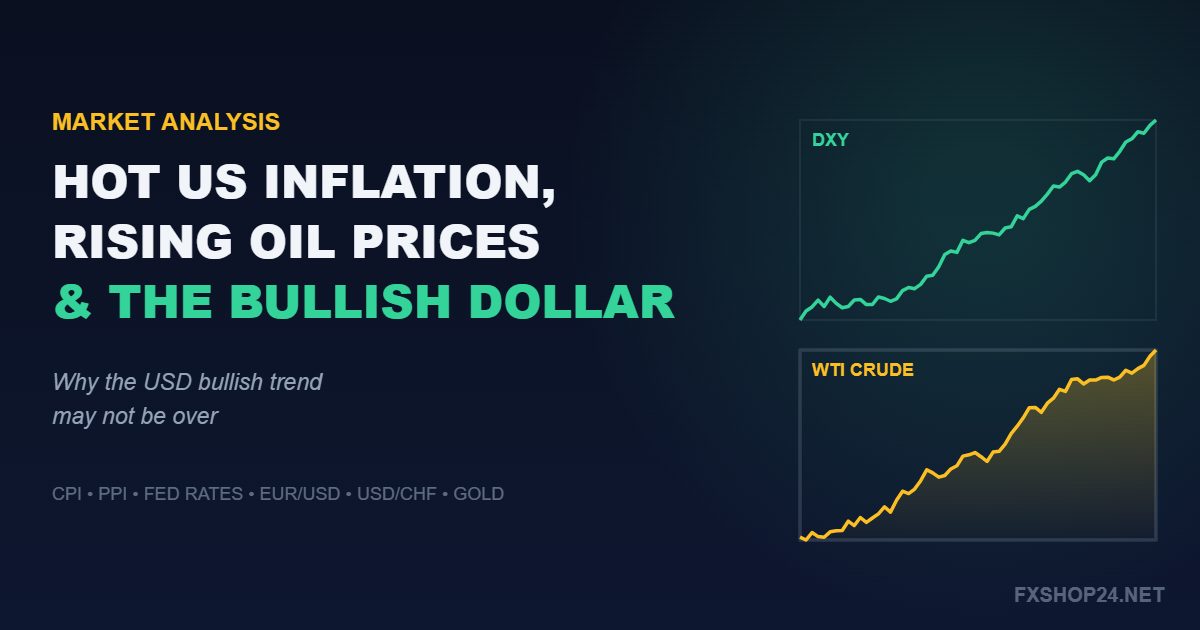
Hot US Inflation, Rising Oil Prices and the Dollar: Why the USD Bullish Trend May Not Be Over
The US dollar weakened after a hotter-than-expected inflation report, but the market reaction may not tell the whole story. With oil prices rising and inflationary pressures spreading into core CPI, the Federal Reserve could face renewed pressure to keep interest rates higher for longer.
Don't Fight the Fed: The Bigger Picture Behind the Dollar
One of the oldest rules in financial markets is simple: Don't fight the Federal Reserve.
For Forex traders, this means paying close attention to the relationship between inflation, monetary policy and the US dollar. When inflation remains stubbornly high, the Federal Reserve may be forced to maintain restrictive monetary conditions or consider further interest rate increases. This can support the dollar by making US assets more attractive to investors.
The latest inflation data discussed in this analysis delivered an important signal. Both CPI and PPI were reported as stronger than expected, raising questions about whether inflationary pressures are beginning to intensify again.
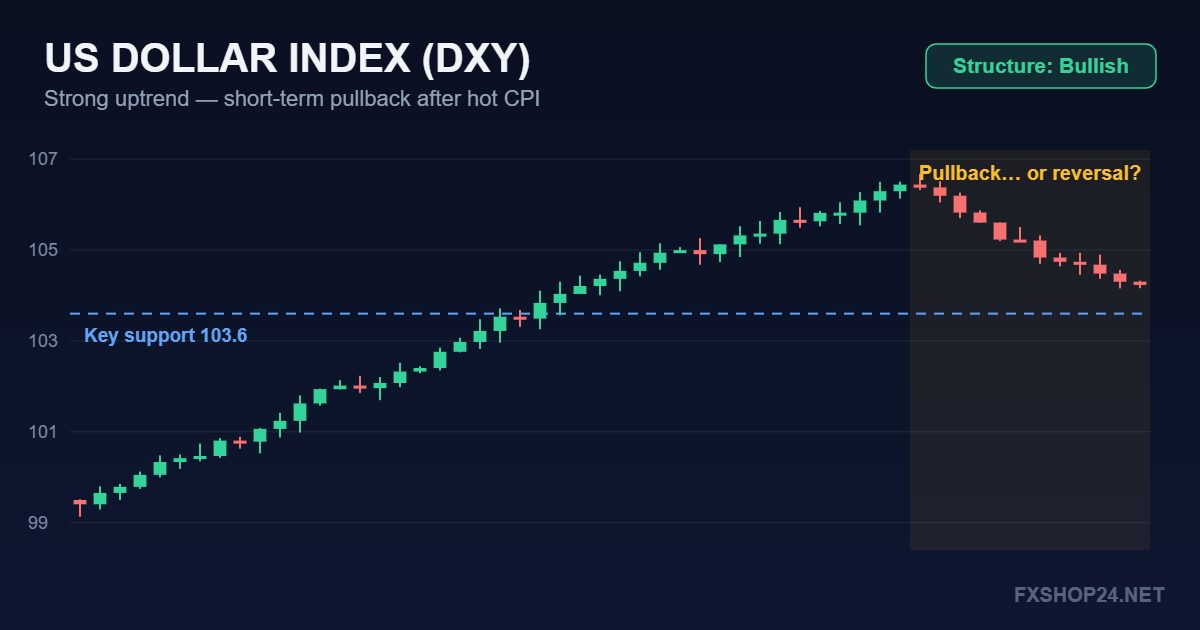
Yet the dollar moved lower following the CPI release.
At first glance, this reaction appears contradictory. If stronger inflation increases the possibility of higher interest rates, shouldn't the dollar strengthen?
Not necessarily. Understanding this apparent contradiction requires looking beyond the headline price action and examining market positioning, bond yields and the broader macroeconomic environment.
1. Why Did the Dollar Fall After a Hot CPI Report?
Markets do not respond to economic data in isolation. Their reactions are also influenced by what investors have already priced in before an announcement.
When traders become heavily positioned for a particular outcome, even news that supports the prevailing trend can trigger a short-term reversal.
This is the classic buy the rumour, sell the fact dynamic.
If investors had already accumulated substantial long-dollar positions ahead of the inflation report, the release could have provided an opportunity to take profits. As those positions were unwound, the dollar could weaken even though the underlying data remained supportive of a more hawkish Federal Reserve.
Another possible contributor was a pullback in technology and artificial-intelligence-related market positioning. A shift toward safer assets, including US Treasury bonds, could put downward pressure on bond yields and, in turn, weigh on the dollar.
The essential lesson is that the market's immediate reaction to economic data does not always reflect the fundamental implications of that data.
A short-term decline in the dollar does not automatically mean that the macroeconomic outlook has turned bearish.
2. The Detail in Core CPI That Traders Should Not Ignore
Headline figures often receive the most attention, but the underlying numbers can provide a more useful picture of inflationary momentum.
In the CPI release discussed in the analysis, monthly core inflation was reported at 0.3%. However, the unrounded figure was approximately 0.335%, meaning the result was much closer to 0.4% than the rounded headline suggested.
That distinction matters because core inflation excludes food and energy prices, helping economists and policymakers assess broader inflationary pressures beyond the most volatile components.
A stronger core CPI reading can indicate that inflation is becoming more persistent and less dependent on fluctuations in energy prices.
For the Federal Reserve, this is particularly important. A temporary increase in gasoline or oil prices may be easier to tolerate than a broader acceleration in the cost of goods and services.
If higher energy costs begin to feed into the wider economy, inflation becomes more difficult to control.
This is the distinction traders should monitor: is inflation being driven primarily by a temporary energy shock, or is it becoming embedded in the broader price structure?
The second scenario would create a more significant challenge for monetary policy.
3. Why Rising Oil Prices Could Change the Fed's Outlook
Oil prices play a crucial role in the inflation outlook.
When crude oil becomes more expensive, the impact initially appears in headline inflation through higher fuel, transportation and energy costs. Central banks generally try to look through short-term energy shocks because these price movements can reverse relatively quickly.
However, the situation becomes more complicated when elevated energy prices persist.
Businesses facing higher transportation, production and operating costs may eventually pass those expenses on to consumers. Over time, this can create additional inflationary pressure across the economy.
Inflation expectations also matter. If consumers and businesses begin to anticipate persistently higher prices, their spending, pricing and wage-setting decisions may reinforce inflationary momentum.
This creates a potential chain reaction:
Higher oil prices → higher headline inflation → rising business costs → broader inflationary pressure → increased pressure on the Federal Reserve.
The longer energy prices remain elevated, the greater the risk that an initially concentrated price shock will spread into core inflation.
That is why the oil market deserves close attention alongside CPI and PPI.
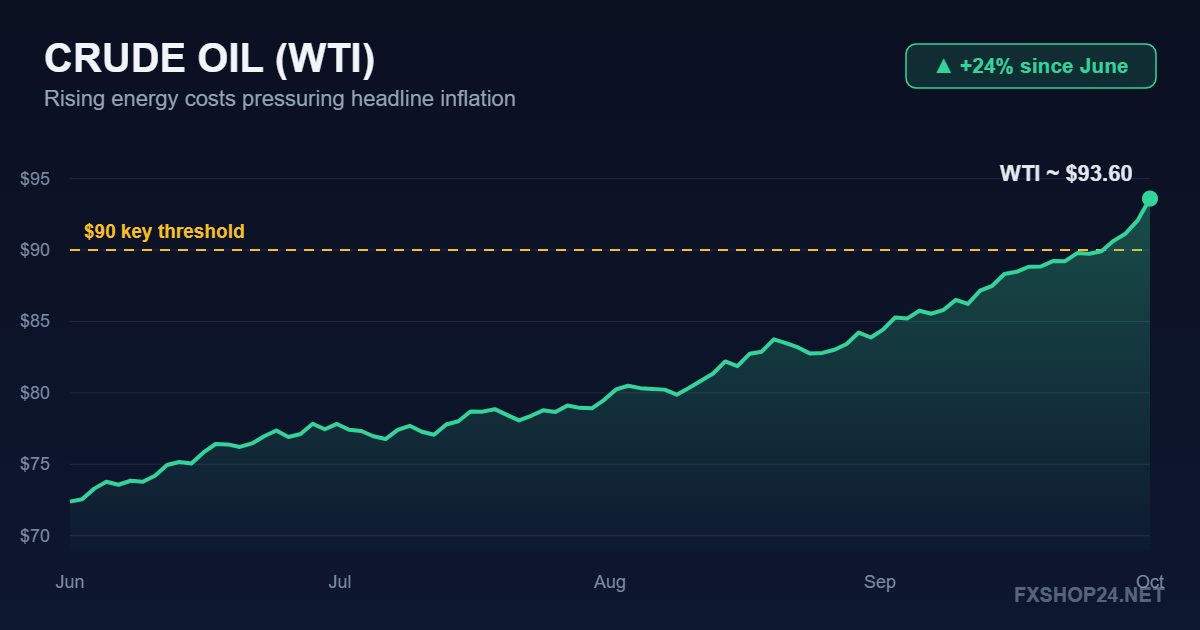
In the analysis, oil prices above $90 per barrel were identified as a particularly important threshold to watch. The critical question is not simply whether oil reaches that level, but whether elevated prices persist long enough to influence the broader inflation outlook.
4. Could the Federal Reserve Be Forced to Raise Interest Rates Again?
The possibility of another Federal Reserve rate hike depends on how incoming inflation data evolve and how policymakers assess the balance between price stability and economic growth.
At the time of the analysis, market-implied probability for a rate increase at the October 28 FOMC meeting was approximately 17%.
That relatively low probability created an interesting asymmetry in expectations.
If the market was already assigning only a small chance to a rate increase, further downward repricing toward zero would have limited room to run. Conversely, a sequence of persistently strong inflation readings, particularly alongside elevated oil prices, could cause investors to assign a greater probability to renewed monetary tightening.
A repricing of interest rate expectations could support the US dollar as traders adjusted their positions to reflect a more hawkish Federal Reserve.
This does not mean a rate hike was inevitable. Market probabilities can change quickly, and central bank decisions depend on the full range of available economic evidence.
Nevertheless, the key issue for currency traders is whether the market has underestimated the possibility that inflation could force the Fed to maintain or intensify its restrictive stance.
If expectations shift in that direction, the dollar could regain upward momentum.
5. A Dollar Pullback or the Beginning of a Major Reversal?
This is the central question for Forex traders.
After a strong rally, markets rarely move in a straight line. Long positions accumulate, profits build and traders eventually reduce exposure. The result can be a correction that appears, on a price chart, to signal a major trend reversal.
Technical indicators may reinforce that impression. A break in market structure or the formation of a potential topping pattern can suggest that selling pressure is increasing.
However, technical analysis cannot be considered in isolation from the fundamental environment.
If inflation remains elevated, oil prices continue to rise and interest rate expectations shift toward a more hawkish Fed, the underlying macroeconomic forces may still favor the dollar.
Under those circumstances, the recent decline could represent a temporary correction rather than the beginning of a sustained bearish trend.
The distinction is critical:
- A pullback occurs when a market retraces part of its previous move while the underlying trend remains intact.
- A reversal occurs when the forces driving the existing trend weaken or change sufficiently to support a sustained move in the opposite direction.
The challenge is determining which scenario is developing before the market makes it obvious.
That requires combining fundamental analysis with technical confirmation.
6. Fundamental Analysis for Direction, Technical Analysis for Timing
A useful trading framework separates two different questions.
First, fundamental analysis helps determine the direction in which a market is more likely to move. Inflation, central bank policy, energy prices, bond yields and relative economic conditions provide the broader context.
Second, technical analysis helps identify potential entry points, support and resistance levels, trend structures and invalidation points.
For example, if the macroeconomic outlook remains supportive of the US dollar, a technical retest of a previous support zone could provide an opportunity to assess a potential long position.
However, a bullish fundamental outlook is not a reason to buy at any price. Traders still need to consider the quality of the setup, the potential reward relative to the risk and the possibility that the fundamental thesis may be wrong.
This approach also helps avoid a common mistake: interpreting every countertrend move as evidence that the broader macroeconomic thesis has failed.
The objective is not to predict every short-term fluctuation. It is to identify the dominant forces in the market and use price action to find opportunities that align with those forces.
7. Why USD/CHF Could Offer an Interesting Setup
Within the broader dollar outlook, USD/CHF was identified in the analysis as a pair worth monitoring.
The rationale was not simply that the dollar might strengthen. The pair was also showing a trending structure with a potential retest, creating a possible opportunity to combine the macroeconomic outlook with technical confirmation.
If the dollar's fundamental drivers remain supportive, a technical setup in USD/CHF could offer a way to participate in renewed dollar strength.
However, a potential setup is not the same as a confirmed trading signal. The market could extend its pullback, invalidate the technical structure or respond differently to upcoming economic releases.
Traders should therefore wait for their predefined entry conditions rather than entering a position solely because the macroeconomic narrative appears convincing.
Position sizing, stop-loss placement and risk management remain essential, particularly ahead of major central bank decisions and inflation releases.
8. Why the Dollar Could Outperform the Euro
The relative impact of higher energy prices is another important consideration when comparing major currencies.
The United States and the euro area do not have identical energy-market structures. The United States is a major energy producer and exporter, while the euro area is more dependent on energy imports.
As a result, a sustained increase in oil and other energy prices can create different economic challenges for the two regions.
Higher energy costs can put pressure on European businesses and consumers, affect the region's trade balance and complicate the European Central Bank's policy decisions.
The United States is not immune to higher energy prices. American consumers and businesses also face increased costs, and a rise in oil prices can create significant domestic inflationary pressures.
Nevertheless, if rising energy prices increase expectations of further Federal Reserve tightening while simultaneously weighing on the European economic outlook, the relative policy and growth implications could favor the dollar over the euro.
This is why Forex traders should evaluate not only whether a central bank may raise interest rates, but also why it might do so and how those reasons affect each currency's economy.
The EUR/USD outlook, for example, depends on the relative evolution of US and European inflation, growth, energy exposure and monetary policy—not simply on the direction of either central bank's interest rates in isolation.
9. What This Means for Gold
The same macroeconomic framework has implications for gold.
Gold is often viewed as an alternative asset during periods of uncertainty, but it does not necessarily benefit from every increase in inflation.
When persistent inflation increases expectations of tighter US monetary policy, Treasury yields and the opportunity cost of holding a non-yielding asset can rise. A stronger dollar can also create additional headwinds for gold, which is priced internationally in US dollars.
Consequently, gold can face selling pressure even while inflation remains elevated.
The relationship is not automatic. Gold can also respond to real yields, geopolitical risks, central bank purchases, investor demand and changes in risk sentiment.
The key distinction is between gold appearing cheap after a decline and gold becoming fundamentally attractive.
A lower price alone does not establish that a market has reached a bottom. Traders looking for a durable bullish gold outlook should assess whether the underlying drivers are turning more supportive, rather than assuming a recovery must follow a substantial decline.
10. Key Signals to Watch in the Coming Sessions
The dollar outlook will depend on whether the inflation and monetary-policy narrative continues to develop in the same direction.
Several indicators deserve particular attention:
- Oil prices: A sustained move higher would increase the risk that energy costs continue feeding into broader inflation.
- Core CPI and PPI: Further evidence of persistent inflation would make it more difficult for the Federal Reserve to dismiss rising prices as a temporary energy-related phenomenon.
- Fed rate expectations: If markets begin pricing in a greater probability of another rate increase, the dollar could receive renewed support. A decline in those expectations would weaken this part of the bullish thesis.
- US Treasury yields: Changes in yields can help reveal whether the market is reassessing the outlook for monetary policy and whether safe-haven demand is influencing the bond market.
- Dollar price action: Technical levels and trend structure can help distinguish a normal correction from a more consequential change in direction.
No single indicator should determine a trading decision. The strongest signals emerge when fundamental developments, market expectations and price action begin pointing in the same direction.
Conclusion: Do Not Confuse Short-Term Price Action With the Fundamental Trend
The dollar's decline following a hot inflation report may appear inconsistent with the economic data, but short-term market reactions often reflect positioning, profit-taking and changes in bond-market dynamics as much as the underlying fundamentals.
The more important question is whether inflationary pressure is becoming persistent enough to alter the Federal Reserve's policy outlook.
If oil prices remain elevated and higher energy costs begin feeding into core inflation, markets may need to reconsider the possibility of further monetary tightening. A shift in those expectations could provide renewed support for the US dollar.
That does not guarantee an immediate recovery. The dollar could experience additional weakness before the broader trend resumes, and the inflation outlook could change as new data arrive.
For traders, the practical approach is to use fundamental analysis to establish a directional bias and technical analysis to identify potential entries and manage risk.
The main takeaway is straightforward: a weaker dollar after a strong CPI report does not, by itself, prove that the bullish dollar trend is over.
Until the fundamental backdrop changes materially, a corrective move should not automatically be mistaken for a major reversal.
Market commentary disclaimer: This article is for informational and educational purposes only. It does not constitute investment advice or a recommendation to buy or sell any financial instrument. Economic forecasts and market conditions can change, and trading Forex, commodities and other financial instruments involves substantial risk.