


20
Feb
7 Key Benefits of AI Trading Bots for Forex Traders
Staying profitable in the global forex market often feels like an endless challenge. Emotional decisions, missing opportunities when you are asleep, and slow trade execution can all eat away at your results. Even the most disciplined traders struggle to keep up with constant price swings and unpredictable volatility.
The right tools can flip this equation in your favor. AI-powered trading bots now offer traders the ability to automate complex strategies, execute trades in fractions of a second, and eliminate costly human mistakes. These automated systems can manage multiple accounts, maintain strict risk controls, and take advantage of forex action around the clock.
You are about to uncover the most practical, actionable ways that AI and automation can make your forex trading more reliable and efficient. Get ready to discover exactly how these advances can help you build consistency, minimize emotional risks, and seize trading opportunities you would otherwise miss.
Table of Contents
- 1. Automate Trading for Consistent Results
- 2. Eliminate Emotional Trading Decisions
- 3. Enhance Trading Speed and Execution
- 4. Manage Multiple Accounts Effortlessly
- 5. Reduce Risk Through Better Risk Management
- 6. Access 24/7 Market Opportunities
- 7. Easily Test and Optimize Trading Strategies
Quick Summary
| Takeaway | Explanation |
|---|---|
| 1. Automate to Remove Emotions | AI trading bots execute trades based on predetermined rules, eliminating emotional influences that can lead to inconsistent decision-making. |
| 2. Enhance Execution Speed | Bots can react instantly to market changes, reducing slippage and capturing opportunities before they vanish, unlike manual trading. |
| 3. 24/7 Market Monitoring | AI trading systems operate continuously, ensuring you never miss trading opportunities across different global markets, even while you sleep. |
| 4. Improved Risk Management | Automated systems enforce strict risk parameters to control losses and ensure consistent position sizing, protecting accounts from emotional errors. |
| 5. Efficient Multi-Account Management | Using AI helps manage multiple trading accounts simultaneously, allowing for diversification without significantly increasing workload. |
1. Automate Trading for Consistent Results
Manual trading introduces one major problem: your emotions and inconsistency. When you’re watching price charts all day, fatigue sets in, discipline wavers, and suddenly you’re making trades that contradict your own strategy. AI trading bots eliminate this variability by executing trades based on predetermined rules, day after day, without deviation.
Why Consistency Matters in Forex
Forex markets move 24 hours a day across different sessions. You can’t monitor charts for all of them, but a trading bot can. Machine learning models in forex market trading process large volumes of data to make informed trading decisions consistently and timely, which directly leads to more reliable trading outcomes. The bot doesn’t skip setups because it’s tired. It doesn’t second-guess entries because of fear. It simply executes.
This automation supports trading across multiple securities with the same precision, meaning you maintain consistent methodology whether you’re trading EUR/USD, GBP/USD, or gold pairs.
Here’s what consistency delivers:
- Reduced human error through rule-based execution
- Uniform performance across different market conditions
- 24/7 monitoring without fatigue or emotional interference
- Backtested results that repeat reliably in live trading
- Discipline enforcement that keeps you aligned with your strategy
AI trading bots eliminate the variability caused by manual trading, leading to more uniform and reliable performance in markets.
How AI Creates Predictable Trading Patterns
AI algorithms in financial markets streamline trading by automating decision processes using complex data processing techniques. This isn’t random automation. The bot learns from historical price action, identifies patterns that work, and replicates those patterns with mathematical precision.
When you set up a trading robot on MetaTrader 4 or MetaTrader 5, you’re essentially cloning your best trading day repeatedly. Every time your specific conditions align, the bot fires. Every time. No hesitation, no exceptions.
Your actual trading edge becomes magnified because it’s applied consistently rather than sporadically. If your strategy wins 55% of the time, consistency ensures you capture that full 55% instead of missing trades when you’re busy, sleeping, or simply distracted.
Real-World Application for Your Trading
Suppose you identify that GBP/USD breaks above the 4-hour moving average with strong volume at the London open. That’s your edge. Manually catching this setup means waking up at the right time, being mentally sharp, and executing without hesitation. With an AI bot, you define the rules once, and the bot executes hundreds of times without deviation.
The compounding effect becomes significant over months. Consistency removes the performance dips caused by emotional trading days. Your account grows at a more predictable rate because drawdowns stay smaller and wins remain proportional.
Pro tip: Before deploying any bot live, backtest your strategy over at least 2 years of historical data to confirm that consistent rule-based execution actually produces the results you expect, then start with a small live account to validate performance across real market spreads and slippage.
2. Eliminate Emotional Trading Decisions
Every forex trader knows the feeling. You’re watching a trade move against you, your stomach tightens, and suddenly you’re closing out a position that your strategy says to hold. Emotions hijack your trading logic. AI trading bots don’t have that problem because they operate without fear, greed, or hesitation.
The Cost of Emotional Trading
When you trade manually, you’re battling your own neurobiology. Fear triggers when a trade drops 50 pips. Greed kicks in when you see a quick profit. These impulses push you toward irrational decisions that directly contradict your trading plan. You panic sell winners or hold losers hoping they bounce back. This emotional trading destroys long-term profitability.
Algorithmic trading systems reduce the impact of human emotions by automating order execution based on pre-established rules. Instead of making split-second emotional choices, the bot follows your predetermined criteria every single time. Your strategy gets executed exactly as you designed it, regardless of market noise or psychological pressure.
This discipline prevents the most damaging trading mistakes:
- Panic selling when temporary volatility spooks you
- Revenge trading after a loss to quickly recoup money
- Holding losers too long because you refuse to accept the loss
- Closing winners early because you’re afraid the profit will evaporate
- Overtrading on tilt after emotional decisions
AI-powered trading removes emotional biases by using rule-based and data-driven decision-making frameworks, enabling more rational and detached trade entries and exits.
How Rule-Based Trading Protects Your Account
Your trading strategy exists for a reason. You backtested it, refined it, and identified the conditions where it works. But when you’re in front of the charts watching your money fluctuate, that objectivity vanishes. Emotions override logic.
A trading bot doesn’t care about the recent loss. It doesn’t hesitate because of volatility. AI-powered trading mitigates fear, greed, and hesitation by enforcing your rules automatically. If your strategy says to enter at a specific price with a 30-pip stop loss, the bot enters at that price with that exact stop. No negotiation. No second-guessing.
This mechanical consistency prevents suboptimal reactions that damage portfolio performance. You follow your plan instead of being derailed by market psychology. Over a month of trading, this discipline compound into meaningful differences in your returns.
Practical Reality for Retail Traders
Consider a real scenario. You set up a trading bot to scalp EUR/USD during the London open with a 20-pip profit target. The bot executes 15 trades that day. Twelve wins, three losses. Manual trading? You might close five winners early at 10 pips because you’re nervous about giving back profits. You might hold one loss for 50 pips because you “know” it will bounce. You might skip three good setups because you’re tired or distracted.
With the bot, all 15 trades execute according to your strategy. Your actual edge gets fully realized instead of being diminished by emotional interference. That’s the real power here.
Different emotional triggers create different problems:
- During winning streaks, you might risk too much money because confidence is high
- After losses, you might trade too conservatively and miss good opportunities
- During choppy markets, you might override your strategy because “conditions feel different”
- When tired, you make careless mistakes in position sizing or entry timing
- When stressed, you deviate from your plan searching for quick wins
None of these scenarios matter when a bot executes your strategy. It doesn’t get overconfident or demoralized. It simply executes rules.
Pro tip: Set your bot’s position size and risk parameters conservatively, then remove yourself from watching the trades in real-time, because observing every tick actually triggers the emotional responses you’re trying to avoid.
3. Enhance Trading Speed and Execution
In forex markets, speed is money. By the time you see a price move on your chart, analyze it, and click to open a position, the opportunity may already be halfway gone. AI trading bots operate on a completely different timeline, executing trades in milliseconds while you’re still reaching for your mouse.
The Speed Advantage That Matters
Forex moves fast. A significant breakout can happen and retrace 20 pips in the time it takes you to manually enter a trade. AI and machine learning systems dramatically increase the speed of data processing and trade execution compared to human capabilities. These systems analyze millions of data points instantly and execute trades in fractions of a second, seizing fleeting opportunities that manual traders simply cannot capture.
When you’re competing against algorithmic traders and institutional players, speed becomes a real edge. A bot doesn’t deliberate. It doesn’t hesitate. The moment your conditions are met, the position opens. This matters especially during volatile news releases or market gaps where price discovery happens rapidly.
Consider what happens at speed:
- Microsecond reaction times to price changes and signals
- Instant analysis of multiple timeframes simultaneously
- Simultaneous entry and stop placement in a single operation
- No manual entry delays caused by clicking or keyboard input
- Consistent execution across all market sessions without fatigue
Machine learning algorithms enhance trade execution speed by immediately responding to real-time market data and signals, reducing slippage and execution delays.
How Speed Reduces Slippage and Improves Fills
Slippage is the gap between your intended entry price and your actual fill price. When you manually trade, this gap widens during volatile conditions. The more time between when you decide to trade and when you actually execute, the more market movement can work against you.
Machine learning algorithms respond instantly to real-time market data, which directly reduces slippage and execution delays. Your bot sees the signal and executes your trade before the market has time to move significantly. Over dozens of trades, this reduction in slippage compounds into meaningful improvements in your actual returns versus backtested results.
Here’s a concrete example. You’re scalping EUR/USD waiting for a breakout above resistance at 1.0850. When price touches that level, a human trader might see the break a second later, click their entry button, and get filled at 1.0856 instead of 1.0850. That’s six pips of slippage already. A trading bot sees the exact moment of the break and executes at 1.0850 or 1.0851, capturing the full edge of your trade setup.
Multiply that six-pip advantage across 20 trades per week. That’s 120 pips of slippage recovered monthly, which translates directly to profit improvement without changing your strategy at all.
Real-World Execution Benefits
Speed advantages appear in several practical scenarios:
- Scalping strategies that rely on capturing 5-15 pip moves depend entirely on execution speed
- News trading where prices gap instantly and your bot can execute before you see the news headline
- Market breakouts where your bot enters the exact moment conditions are met, not 2 seconds later
- Volatility expansion trades that capture the first moments of a move before spreads widen
- Multiple timeframe confirmations analyzed and executed faster than any human could coordinate
You’re also trading across all market sessions. Your bot executes with identical speed during the Asian session as it does during New York hours. Human traders get tired, distracted, or unavailable during certain times. Your bot maintains peak execution performance 24 hours a day.
This speed advantage becomes especially valuable when combined with the other benefits of automation. Your bot isn’t just fast, it’s consistently fast, emotionally neutral, and disciplined all at once. That combination is powerful.
Pro tip: Test your trading bot’s execution speed on a demo account first, watching actual entry fills compared to your signal timing, so you understand the real slippage you’ll experience before deploying real money.
4. Manage Multiple Accounts Effortlessly
Managing one trading account demands constant attention. Managing five or ten accounts manually becomes impossible. Yet many serious traders want to diversify across different strategies, risk levels, or account types. This is where the real power of AI trading bots emerges: you can run multiple automated accounts simultaneously without multiplying your workload.
Why Multi-Account Management Changes Your Trading Business
Think about what happens when you try to manually manage multiple accounts. You’re checking Account A for signals while Account B needs attention. By the time you execute on one account, the setup on another has already passed. You’re mentally exhausted, making mistakes, and missing opportunities across your portfolio.
AI trading bots facilitate management of multiple accounts simultaneously by executing pre-programmed strategies across different portfolios without additional manual input. This scalability allows you to diversify efficiently while reducing the operational overhead that would normally come with managing multiple accounts. Instead of your workload multiplying by five when you have five accounts, your workload stays essentially the same because the bots handle the execution.
This creates a genuine scaling opportunity. You’re no longer limited by how many charts you can watch or how many decisions you can make per day. Your trading capacity expands dramatically.
Multi-account automation enables several realistic trading scenarios:
- One strategy across different account sizes to test capital scaling
- Different strategies on different accounts to reduce correlation and overall portfolio risk
- Risk-tiered accounts where one account trades aggressively while another is conservative
- Currency pair diversification with specialized bots for different forex pairs or gold
- Proprietary trading firm accounts alongside personal accounts under unified management
Automation and algorithmic trading enable handling of numerous trading accounts through centralized AI-driven control systems that minimize human workload and error.
How Centralized Control Works
Centralized AI-driven control systems streamline multi-account management by applying consistent decision frameworks and order execution to each account. Imagine you’ve developed a winning strategy for GBP/USD scalping. You can deploy that exact same bot logic to five different accounts with five different starting balances, all running simultaneously. The bot monitors each account independently but applies the same rules consistently to all of them.
This consistency across accounts matters because it removes one major source of trading errors: inconsistent execution. When you trade manually across multiple accounts, you inevitably execute slightly differently on each one. You enter Account A at a slightly better price but Account B at a worse price. You hold a position longer on one account than another. These inconsistencies degrade your results.
A bot eliminates this variation. It executes identically across all accounts, which means your strategy performs as designed on every single account without degradation from human inconsistency.
Practical Account Management Scenarios
Consider realistic situations where multi-account management becomes invaluable.
You have a primary trading account worth $10,000 and access to a proprietary trading firm account with $50,000 buying power. Instead of splitting your attention between both, you deploy the same trading bot to both accounts. The bot trades both with identical discipline and timing. Your personal account grows steadily while you’re simultaneously building a track record with the prop firm.
Or you’ve developed two strategies. One works beautifully for gold trading, another for currency pairs. You set up two different bots on separate accounts. One bot runs gold strategies exclusively while the other runs forex strategies. Your portfolio is diversified across different markets and trading approaches, yet you’re only monitoring performance dashboards instead of actively trading both.
Here’s what multi-account automation accomplishes:
- Diversification across strategies reduces the impact if one approach fails
- Testing at different scales lets you run the same strategy on small and large accounts
- Risk compartmentalization means one account’s loss doesn’t cascade to others
- Proportional position sizing where each account scales positions based on its balance
- Unified reporting where you track total portfolio performance across all accounts
The time savings are extraordinary. Managing five manually-traded accounts might require two hours daily. Managing five automated accounts requires 15 minutes to check performance dashboards and ensure bots are functioning normally.
Pro tip: Start with two accounts running the same bot strategy, carefully monitoring both for at least one month to confirm consistent performance before expanding to additional accounts, because detecting bot issues early prevents cascading losses across multiple accounts.
5. Reduce Risk Through Better Risk Management
Risk management separates professional traders from account-blowing amateurs. Yet most retail traders manage risk poorly because emotions interfere with rational decision-making. AI trading bots enforce strict risk parameters automatically, ensuring your positions never exceed your predetermined limits regardless of market conditions or psychological pressure.
The Risk Management Problem You Face
You know your risk tolerance. You’ve calculated that you can afford to lose $500 per trade without jeopardizing your account. But then a trade moves against you by 60 pips, and suddenly you’re facing a $750 loss. You hold the position hoping it bounces because the loss feels too large to accept. Now it’s $1,200. This is how accounts blow up.
Algorithmic trading executes trades that adhere to strict risk parameters, mitigating exposure during volatile market conditions. Your bot doesn’t negotiate with itself. If your stop-loss is set at 40 pips, the position exits at 40 pips. No exceptions, no hesitation, no hoping for a bounce.
This enforcement of risk discipline is worth more than most traders realize. The difference between letting a position run 100 pips against you versus exiting at your predetermined 40-pip stop is the difference between a profitable month and a devastating drawdown.
AI-driven risk management prevents several critical mistakes:
- Position size overshooting when confidence is high
- Stop-loss removal when a trade moves against you
- Risk per trade creeping upward as you experience wins
- Averaging down on losing positions hoping for reversal
- Overleveraging during winning streaks
AI systems dynamically adjust positions based on real-time risk assessments and enforce stop-loss limits, reducing systemic risks from human error and market volatility.
How Dynamic Risk Management Works
Explainable AI in algorithmic trading supports improved risk management through transparency and real-time risk assessments. Modern trading bots don’t just place static stop-losses. They monitor real-time volatility, market conditions, and account equity, then adjust position management dynamically.
Here’s how this works in practice. You set your bot to risk a maximum of 2% of your account balance per trade. If your account is $10,000, that’s $200 risk per trade. But when the market becomes extremely volatile, the bot recognizes increased risk and automatically reduces position size. It might trade 0.5 lots instead of 1 lot when volatility spikes, maintaining your 2% risk even though volatility has increased.
Conversely, when market conditions are calm and predictable, the bot can increase position size slightly, capturing larger moves without increasing risk beyond your parameters. This dynamic adjustment is impossible for manual traders because it requires constant monitoring and mathematical calculations that your brain simply can’t do in real-time.
Practical Risk Management Implementation
Effective bot-based risk management involves setting clear parameters before trading begins. You decide your answers to these critical questions:
- How much can I risk per trade as a dollar amount or percentage
- What’s my maximum drawdown tolerance before stopping trading
- How should positions size scale as my account grows or shrinks
- When should the bot exit if conditions deteriorate
- What’s my daily loss limit before stopping all trades
Once you establish these parameters, the bot enforces them mechanically. If your daily loss limit is $500 and you’ve already lost $450 that day, the bot will either reduce position size on the next trade or skip it entirely. You never have to make that difficult decision when you’re already frustrated from losses.
This enforcement prevents the pattern where traders lose money, then over-trade trying to recover quickly, then lose more money in the attempt. The bot breaks this cycle by forcing you to accept predetermined limits.
Key risk management benefits include:
- Maximum loss containment through predetermined stop-losses
- Account protection via daily and monthly loss limits
- Consistent position sizing relative to account balance
- Risk-reward enforcement ensuring favorable odds on every trade
- Volatility adaptation adjusting exposure when markets are unstable
Consider a real scenario. You’re trading gold with $5,000. You set your bot to risk 1% per trade ($50) with a maximum daily loss of $300. Your bot trades 15 times that day. The first ten trades win. The eleventh loses $50. Trades 12 through 15 also lose $50 each. You’ve lost $200 total. Your bot continues trading because you haven’t hit your $300 daily limit.
Now imagine manual trading in the same scenario. After losing $200 across five losing trades in a row, you’re frustrated and angry. You throw caution aside and risk $100 on the next trade trying to recoup losses quickly. It loses. You’re now at $300 loss and desperate. This emotional spiral is exactly what automated risk management prevents.
Pro tip: Set your risk parameters conservatively on day one (like 1% per trade), run your bot for one full month, then review actual drawdowns and results before considering increasing risk parameters, because realistic stress-testing prevents overconfidence in your strategy.
6. Access 24/7 Market Opportunities
Forex never sleeps. While you’re sleeping, trading happens in Tokyo, London, and Sydney. While you’re at your day job, major moves occur in currency pairs. Manual traders miss these opportunities simply because they can’t be glued to charts 24 hours a day. AI trading bots have no such limitation.
The Global Forex Market Never Closes
Unlike stock markets that have specific trading hours, forex operates around the clock across different time zones. The Asian session opens while the American session closes. The London session overlaps with both. Gold trades continuously. This constant activity creates opportunities, but also a problem for manual traders.
You can’t possibly monitor all these sessions. You’d need to wake up at 2 AM to catch the Asian open, then stay awake through the European session, then trade the New York session during your business hours. That’s not trading. That’s sleep deprivation.
AI-driven trading bots operate continuously without fatigue, enabling traders to capture trading opportunities in forex markets globally 24/7. Your bot doesn’t get tired. It doesn’t need coffee or sleep. It monitors the Tokyo session with the same precision it monitors New York. This non-stop operation ensures that market moves during off-hours or across different time zones are never missed.
The advantage this creates is enormous. Institutional traders have teams working different shifts to cover global markets. Retail traders with AI bots get the same 24/7 coverage with a single bot running on their computer.
Here’s what 24/7 trading captures:
- Asian session breakouts while you sleep
- London open volatility whether you’re working or not
- New York session momentum exactly when you’d want to trade
- Overnight gaps that create new trading opportunities
- Economic news reactions across all time zones
Automated AI trading systems can monitor and trade across global forex markets around the clock, benefiting from price movements occurring outside regular business hours.
How Continuous Monitoring Works
Automated AI trading systems consistently observe and act on market signals at any hour without manual intervention. Your bot runs on your VPS or trading server, analyzing charts and executing trades whether you’re awake or asleep, working or on vacation.
Imagine your GBP/USD breakout strategy. You’ve identified that when GBP/USD breaks above the daily resistance during the London open, it typically continues higher. But the London open happens at 8 AM GMT. If you’re in New York, that’s 3 AM your time. You’re not waking up for that. Your bot, however, is watching exactly at 3 AM. The moment the breakout occurs, your bot enters the trade. You wake up to find a profitable position that was captured while you slept.
This isn’t hypothetical. This is the reality for thousands of traders using automated systems. They’re capturing opportunities across multiple sessions without being present for any of them.
The mechanics are straightforward. Your bot runs on a VPS (virtual private server) or your computer if it stays on 24/7. The server stays connected to MetaTrader 4 or MetaTrader 5. It monitors your specified chart and timeframes continuously. When your trading conditions are met, it executes immediately, regardless of what time it is.
Real-World Multi-Session Trading
Consider how a single trading day actually looks with a 24/7 bot. You trade EUR/USD scalping during London open, gold during New York open, and GBP/USD breakouts during Asia open. Without automation, you’d need to wake up for Asia, work through London, then trade again during New York. That’s a 24-hour commitment.
With a bot, you set your three strategies on three separate bots or one bot with different entry conditions for different sessions. The bot handles everything. You might check results once per day, but you’re not actively trading across multiple sessions.
Different sessions offer different characteristics:
- Asian session tends to be quiet with lower volatility, good for range trading
- London open creates explosive volatility, ideal for breakouts
- New York session brings high volume and trending moves
- Overlap periods between sessions offer increased volatility and opportunity
- Off-hours between sessions are quiet but set up moves for the next session
A well-designed bot exploits these session characteristics automatically. During the quiet Asian session, it might trade tighter ranges with smaller stop-losses. During the volatile London open, it might trade larger moves with bigger profit targets. All of this happens without you being present.
The compounding effect is significant. If you capture just three profitable opportunities per week that happen outside your normal waking hours, that’s an extra 156 opportunities per year. Most manual traders never even know these opportunities existed.
You’re also eliminating the problem of jet lag and travel. Want to take a vacation? Your bot keeps trading. Business travel has you in a different time zone? Your bot adapts instantly. Your bot doesn’t experience fatigue from changing schedules or time zone disruption.
Pro tip: Test your bot on one currency pair and one specific trading session (like the London open) for two weeks before expanding to multiple sessions, because session-specific behaviors require careful validation before committing capital across different time zones.
7. Easily Test and Optimize Trading Strategies
Most trading strategies fail because traders never properly test them before risking real money. They get an idea, feel confident, deploy it live, and watch their account deteriorate. AI trading bots and backtesting platforms solve this problem by allowing you to validate strategies against years of historical data before deploying a single dollar.
Why Testing Separates Winning Traders from Losers
Your trading idea might sound brilliant. You’ve identified what looks like a perfect pattern. You feel confident it will work. But confidence isn’t data. Feelings aren’t facts. The only way to know if your strategy actually works is to test it extensively against historical price action.
Deep learning and other AI techniques enable traders to backtest trading strategies extensively using historical market data. These simulations help optimize algorithm parameters to improve profit potential and reduce risk. You can test a strategy across 5 years of data in minutes, discovering exactly how it performed in different market conditions without risking a penny.
Compare this to manual testing. Without backtesting tools, you’d need to manually check charts, record trades, calculate results, and repeat this process for every variation of your strategy. That might take weeks or months. With AI backtesting, you test dozens of variations in the same amount of time, finding the optimal parameters before going live.
This advantage changes everything. You’re no longer guessing. You’re trading based on evidence.
Backtesting reveals critical information:
- Win rate under different market conditions
- Average winning and losing trade sizes
- Maximum drawdown during historical periods
- Profit factor showing profit relative to losses
- Strategy behavior during trends versus ranges
Machine learning models allow for rapid iterative testing and refinement of trading strategies, improving the ability to adapt trading approaches to changing market conditions.
How Backtesting Actually Works
Machine learning models enable rapid iterative testing and refinement of trading strategies by training on past market data. The process is straightforward. You define your trading rules. The backtesting system applies those rules to historical price data. It calculates what would have happened if you’d traded that strategy during that time period.
Here’s a concrete example. You’ve developed a EUR/USD strategy that enters when the price breaks above the 4-hour moving average with increasing volume. You backtest this strategy against 10 years of EUR/USD data. The system applies your exact rules to every single 4-hour candle over those 10 years, recording every trade that would have occurred.
When testing completes, you see detailed statistics. Your strategy generated 847 trades with a 56% win rate. Average winning trade was 45 pips. Average losing trade was 30 pips. Maximum drawdown was $1,800. Profit factor was 1.85. This data tells you exactly what to expect when trading live.
Now here’s where optimization becomes powerful. You notice that your strategy performs better during trending markets than ranging markets. So you add a filter to only take trades when volatility is above the 20-period average. You backtest again with this new rule. Now your win rate jumps to 61% and profit factor increases to 2.15. You’ve improved your strategy through data-driven optimization.
You can continue iterating. Try different moving average periods. Test different volume thresholds. Experiment with entry and exit timeframes. Each iteration is tested instantly against 10 years of data. You’re refining your strategy based on evidence rather than hunches.
Practical Optimization Process
The optimization workflow looks like this:
- Define your base strategy with specific entry and exit rules
- Backtest against historical data to get baseline results
- Identify weaknesses in specific market conditions
- Test parameter variations to address those weaknesses
- Validate improvements to confirm they’re real, not lucky
- Deploy only the most robust version to live trading
Testing protects you from several critical mistakes. Many strategies look good during bull markets but collapse during corrections. Backtesting reveals this. Some strategies work beautifully on daily timeframes but fail on 4-hour charts. Testing shows this before you lose money. A strategy might work great on EUR/USD but fail on GBP/USD. Testing different pairs exposes this.
The depth of information available from proper backtesting is extraordinary:
- Profit and loss statements for the entire test period
- Trade-by-trade breakdown showing entry, exit, and P&L for each trade
- Monthly and yearly results revealing seasonal patterns
- Drawdown analysis showing your largest losing streak
- Risk-adjusted returns accounting for volatility
- Strategy behavior across different market conditions
Consider a realistic scenario. You backtest your gold trading strategy across the last 5 years. Results look great with 58% win rate and 2.0 profit factor. But when you examine the results more closely, you notice 75% of your profits came during 2 months of extreme volatility. During normal market conditions, the strategy barely broke even. This insight is invaluable. Now you know your strategy is volatile-condition dependent. You can either add volatility filters or accept that this strategy will have very uneven monthly results.
Without backtesting, you’d discover this painful truth by losing real money in quiet market conditions. With backtesting, you discover it in seconds and can adjust your approach beforehand.
Pro tip: When backtesting, always test on data that your strategy hasn’t seen before by splitting historical data into training and validation sets, because optimizing on the entire dataset creates overfitting that makes strategies fail in live trading.
Below is a table summarizing the key concepts and benefits of employing AI trading bots in the context of automated Forex trading as discussed in the article.
| Key Aspect | Description | Benefits |
|---|---|---|
| Automating Trading | AI trading bots execute trades based on pre-defined rules, eliminating emotional decision-making. | Consistency, reduced human error, and adherence to strategy. |
| Speed and Execution | Automated systems execute trades in milliseconds. | Minimized slippage and maximized market opportunities. |
| Risk Management | Implements strict rules for stop-loss and position size. | Prevents overtrading and manages exposure effectively. |
| Multi-Account Management | Operates on multiple accounts simultaneously. | Enables scalability and diversification without additional effort. |
| 24/7 Market Coverage | Continuously monitors the market across all time zones. | Captures trading opportunities outside of normal hours. |
| Strategy Optimization | Backtesting and data analyses validate strategies before live implementation. | More robust and effective trading plans. |
Discover Consistency and Control with FxShop24’s AI Trading Solutions
Manual forex trading often struggles against emotions, inconsistent execution, and missed fast-moving market opportunities. This article highlights how AI trading bots deliver disciplined, emotion-free trades with lightning-fast execution and 24/7 market coverage. If you want to eliminate guesswork, reduce emotional mistakes, and capture every profitable moment in forex and gold markets, automated tools designed for MetaTrader 4 and MetaTrader 5 are your answer.
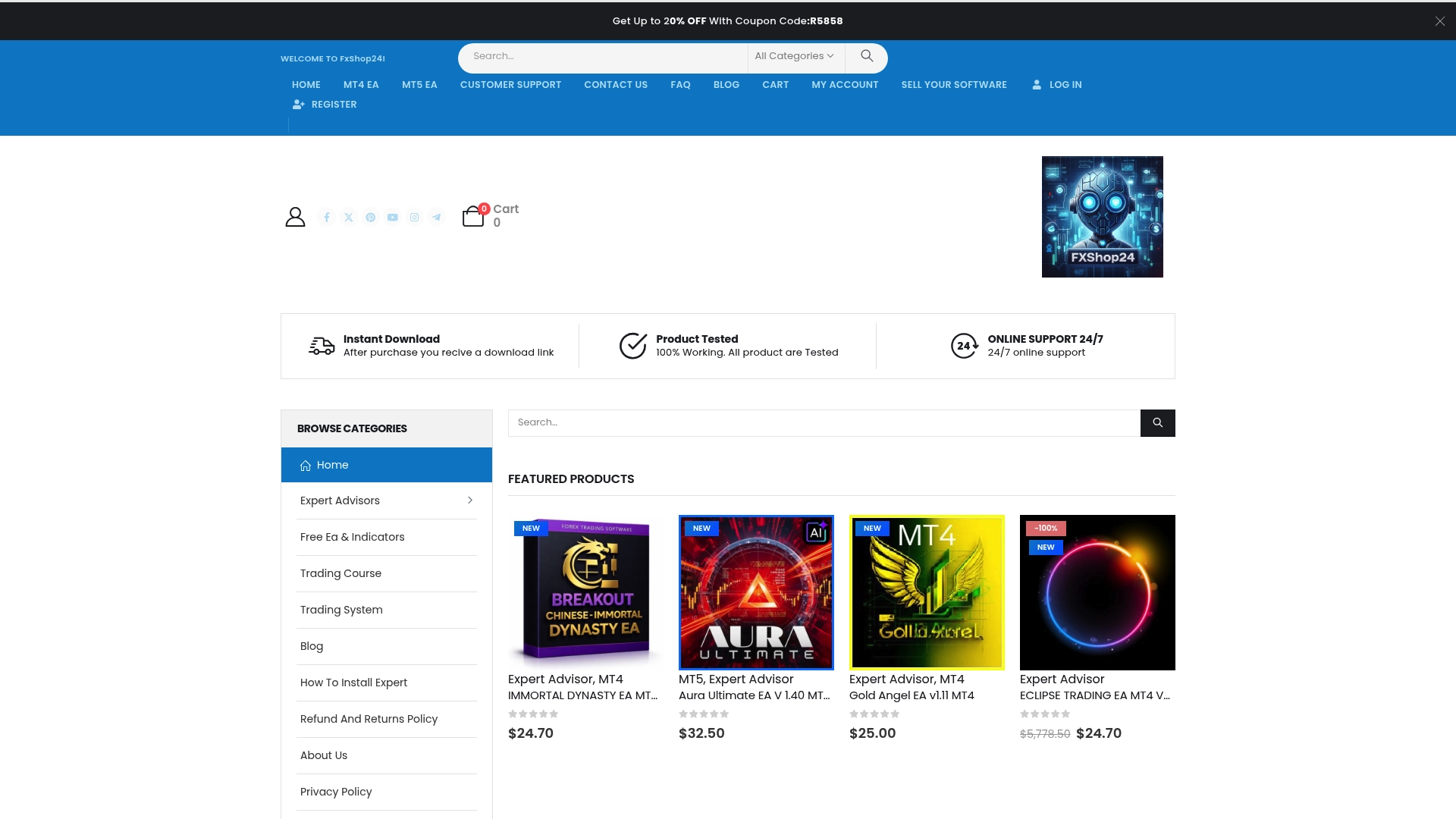
Explore FxShop24’s extensive selection of tested AI-powered Expert Advisors, proprietary trading bots, and cutting-edge indicators available instantly at FxShop24. Start building a consistent, emotion-proof trading strategy today with lifetime updates and unlimited licenses that fit your style. Don’t wait to transform your trading performance. Visit automated trading solutions on FxShop24 and take control of your profits now.
Frequently Asked Questions
What are the main benefits of using AI trading bots for Forex trading?
AI trading bots automate trading processes, reducing emotional decision-making and ensuring consistent strategy application. By maintaining discipline and executing trades without hesitation, these bots help traders achieve more reliable outcomes over time.
How do AI trading bots improve execution speed in Forex markets?
AI trading bots execute trades in milliseconds, minimizing the time between seeing a signal and placing a trade. This speed advantage allows traders to seize opportunities quickly, capturing potential profits that manual traders might miss due to delays.
Can AI trading bots help manage multiple Forex accounts?
Yes, AI trading bots can effectively manage multiple accounts simultaneously without increased workload. By automating execution across accounts, traders can diversify their strategies and reduce operational overhead, improving overall trading efficiency.
How does using AI trading bots enhance risk management?
AI trading bots enforce strict risk parameters automatically, preventing traders from exceeding their predetermined risk limits. By consistently applying these rules, traders can minimize losses and protect their accounts from emotional trading mistakes.
What is the process for testing a trading strategy with AI bots?
To test a strategy, define your trading rules and use the backtesting function available in AI trading systems. This allows you to analyze historical data to see how the strategy would have performed, making it possible to optimize parameters before deploying real capital.
Recommended
- Stop Losing Money: 10 Forex Trading Bot Mistakes That Kill Accounts (And How To Fix Them) | FxShop24 Marketplace
- Comparing Grid, DCA, And Arbitrage Bots: Which One’s For You? | FxShop24 Marketplace
- Are Forex Trading Bots Dead? Do People Still Pass Prop Firm Challenges With EAs? | FxShop24 Marketplace
- 7 Types Of AI Trading Tools Every Forex Trader Should Know
- 7 Best AI Tools for Entrepreneurs: Essential Guide | siift
- 7 Essential Steps to Automate Your AI Business Systems
- Zen van Riel - Senior AI Engineer | AI Engineer Blog