


20
Sep
Are Forex Trading Bots Dead? Do People Still Pass Prop Firm Challenges With EAs?
Ever notice how every few months, someone declares that "forex robots are finished" right before another trader posts their prop firm payout using an EA? The reality isn't nearly as dramatic as the headlines suggest. Forex trading bots aren't dead, they're evolving, and yes, people are still passing prop firm challenges with Expert Advisors. But the game has changed completely.
The "Death" of Forex Bots: Separating Myth from Reality
Let's kill this narrative right away: forex trading bots are more sophisticated in 2025 than they've ever been. AI-powered systems now analyze market patterns at speeds no human can match, adapt to changing conditions through machine learning, and execute trades with precision that would make veteran traders jealous.
The confusion comes from outdated information. Five years ago, most EAs were basic grid systems or simple moving average crossovers. Today's top-tier robots incorporate advanced algorithms, sentiment analysis, and adaptive risk management that responds to real-time market volatility.

Modern forex bots offer distinct advantages:
- 24/7 market monitoring without fatigue or emotional interference
- Lightning-fast execution that capitalizes on microsecond opportunities
- Backtesting capabilities that analyze years of data in minutes
- Risk management automation that prevents catastrophic losses
- Multi-timeframe analysis across dozens of currency pairs simultaneously
The key difference? Today's successful EAs aren't just following pre-programmed rules: they're learning and adapting.
The Prop Firm Challenge: Where Most EAs Hit Reality
Here's where things get interesting. While forex bots continue thriving in private accounts, prop firm challenges present unique obstacles that expose the weaknesses of poorly designed systems.
The brutal truth: Most EAs fail prop firm challenges not because they can't generate profits, but because they can't handle the psychological and technical constraints of evaluation programs.
Prop firms impose strict rules that traditional backtests never account for:
- Daily loss limits that can disqualify accounts instantly
- Maximum drawdown thresholds that grid strategies frequently breach
- Consistency requirements that punish high-risk, high-reward approaches
- Time constraints that pressure EAs to perform within specific timeframes
- News event restrictions that many automated systems ignore
Why backtests lie: Your EA might show 300% returns over five years, but if it hits a 10% daily loss once during a prop challenge, game over. Backtests don't simulate the pressure of real money evaluation or the specific risk parameters that prop firms enforce.
Success Stories: The EAs That Actually Work
Despite these challenges, experienced traders are consistently passing prop firm evaluations with carefully selected EAs. The difference lies in understanding what works and what doesn't.
Successful prop firm EAs share common characteristics:
- Conservative risk management with built-in daily loss limits
- News event filters that halt trading during high-impact releases
- Drawdown protection that scales position sizes based on account health
- Consistent lot sizing that avoids aggressive martingale strategies
- Clear exit strategies with predefined stop losses
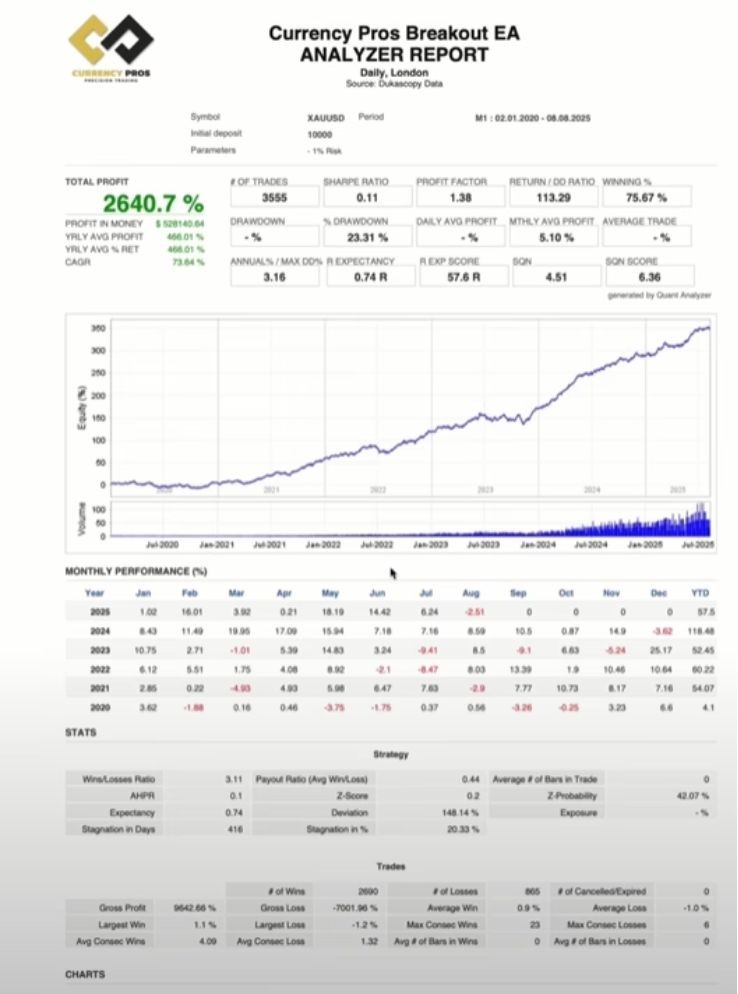
Take a look at performance data from proven systems: notice the steady equity curve without dramatic spikes or crashes. This isn't coincidence. Prop-firm-approved EAs prioritize consistency over spectacular returns because passing the challenge matters more than maximizing short-term profits.
The Fatal Mistakes That Kill EA Performance
Understanding why EAs fail prop challenges is crucial for selecting systems that actually work. These patterns appear repeatedly among failed evaluation attempts:
Grid and Martingale Logic: These strategies work until they don't. One bad market move can trigger a cascade of losing positions that breach maximum drawdown limits instantly.
Hidden Stop Loss Systems: Many EAs advertise "no stop loss" approaches that actually use hidden exit logic. Prop firms often detect and disqualify these strategies.
High-Frequency Trading: Excessive trade frequency increases spread costs and news event exposure, creating unnecessary risk during evaluation periods.
Fixed Lot Sizing: EAs that don't adjust position sizes based on account balance often risk too much per trade, violating prop firm risk management requirements.
Trader Interference: The biggest killer isn't technical: it's psychological. Traders who manually intervene when their EA takes losses often break the system's logic and guarantee failure.
Selecting EAs for Prop Firm Success
Not all Expert Advisors are created equal, especially for prop firm challenges. Here's how to identify systems with genuine potential:
Look for transparency: Legitimate developers provide detailed strategy explanations, live trading statements, and realistic performance expectations. Avoid EAs that promise unrealistic returns or refuse to explain their trading logic.
Verify risk management: Successful prop firm EAs include built-in daily loss limits, maximum drawdown protection, and position sizing that aligns with challenge requirements.
Check news event handling: Your EA should automatically stop trading or reduce risk during high-impact news releases. NFP, FOMC meetings, and central bank announcements can destroy evaluation accounts in minutes.
Test consistency metrics: Focus on systems that show steady monthly returns rather than explosive growth followed by major drawdowns. Prop firms value consistency above all else.
Validate support and updates: Choose EAs from developers who provide ongoing support and regular updates. Market conditions change, and your EA should adapt accordingly.
The Human Element: Why Pure Automation Isn't Enough
Here's what the "robots will replace traders" crowd gets wrong: the most successful prop firm candidates combine EA automation with human oversight. Pure automation can handle execution and risk management, but human judgment remains crucial for strategy selection and market adaptation.
The winning combination includes:
- Strategic oversight to select appropriate EAs for current market conditions
- Risk monitoring to ensure EA performance aligns with challenge requirements
- Market awareness to manually halt trading during extraordinary events
- Performance analysis to identify when EAs need adjustment or replacement
Looking Ahead: The Evolution Continues
Forex trading bots aren't dying: they're becoming more sophisticated and specialized. The future belongs to hybrid approaches that combine artificial intelligence with human expertise, particularly in challenging environments like prop firm evaluations.

Emerging trends include:
- AI-powered market sentiment analysis that improves entry timing
- Adaptive risk management that adjusts to changing volatility conditions
- Cross-asset correlation strategies that diversify beyond traditional forex pairs
- Cloud-based optimization that continuously improves EA performance
The traders passing prop firm challenges today aren't using basic robots: they're leveraging advanced systems designed specifically for evaluation requirements. Success demands careful EA selection, proper risk management, and the wisdom to combine automation with human judgment.
Forex trading bots are very much alive in 2025. The question isn't whether they work: it's whether you're using the right ones for your specific goals. Choose wisely, manage risk appropriately, and remember that the best EA is the one that consistently gets you funded.