



12
Jun
Forex Trends in 2026: What Retail Traders Must Know
TL;DR:
- Forex trends in 2026 are dominated by central bank policy divergence, energy-driven inflation, and geopolitical stalemates that favor range-bound trading strategies. Traders should focus on policy signals, energy-linked volatility, and behavioral shifts, adjusting their approaches accordingly. Automated tools designed for volatile, range-bound markets can improve performance amid these complex conditions.
Forex trends in 2026 are defined by a collision between persistent inflation, central bank policy divergence, and geopolitical tensions that together reshape currency valuations and trading opportunities across every major pair. The USD, EUR, GBP, and JPY are all moving under distinct pressures, and the traders who understand those pressures will find edges that others miss. This is not a year for passive strategies or fixed forecasts. The market rewards those who read policy signals accurately and adjust their approach when conditions shift.
How forex trends in 2026 are shaped by central bank policy divergence
Central bank decisions are the single most powerful driver of currency movements in 2026, and the divergence between major institutions has never been more pronounced. The Federal Reserve, the European Central Bank, and the Bank of England are each operating on different timelines, and that gap creates persistent volatility in EUR/USD and GBP pairs.

Markets currently price a 60% chance of a 25bp Fed hike by year-end, while the ECB is expected to raise rates by 25bp at its June 11 meeting, and the Bank of England holds its rate at 3.75%. That three-way split means every central bank communication carries outsized weight for traders positioned in EUR/USD or GBP/USD.
The Fed’s situation deserves particular attention. Markets are hyper-sensitive to perceptions of central bank independence, and Fed Chair Warsh’s tone at his first June meeting is under intense scrutiny for policy clues. This means the USD can move sharply on rhetoric alone, independent of hard economic data. Retail traders who track only CPI prints and payroll numbers are missing the real catalyst.
Key policy factors shaping currency direction in 2026:
- Fed Chair Warsh’s communication style signals whether the Fed leans hawkish or accommodative, directly moving the DXY.
- ECB rate trajectory determines EUR/USD momentum. A 25bp hike with a dovish forward statement produces a very different EUR reaction than a hike with a hawkish tone.
- Bank of Japan’s cautious stance keeps the yen under pressure from yield differentials, amplifying volatility in JPY crosses.
- Forward guidance language now matters more than the rate decision itself. Read the statement, not just the headline number.
Pro Tip: Set calendar alerts for Fed, ECB, and BoJ meeting dates and monitor the press conference transcripts in real time. The first 10 minutes of a Fed chair Q&A session can move EUR/USD by 50 to 80 pips before most retail traders react.
How does inflation affect currency values in 2026?
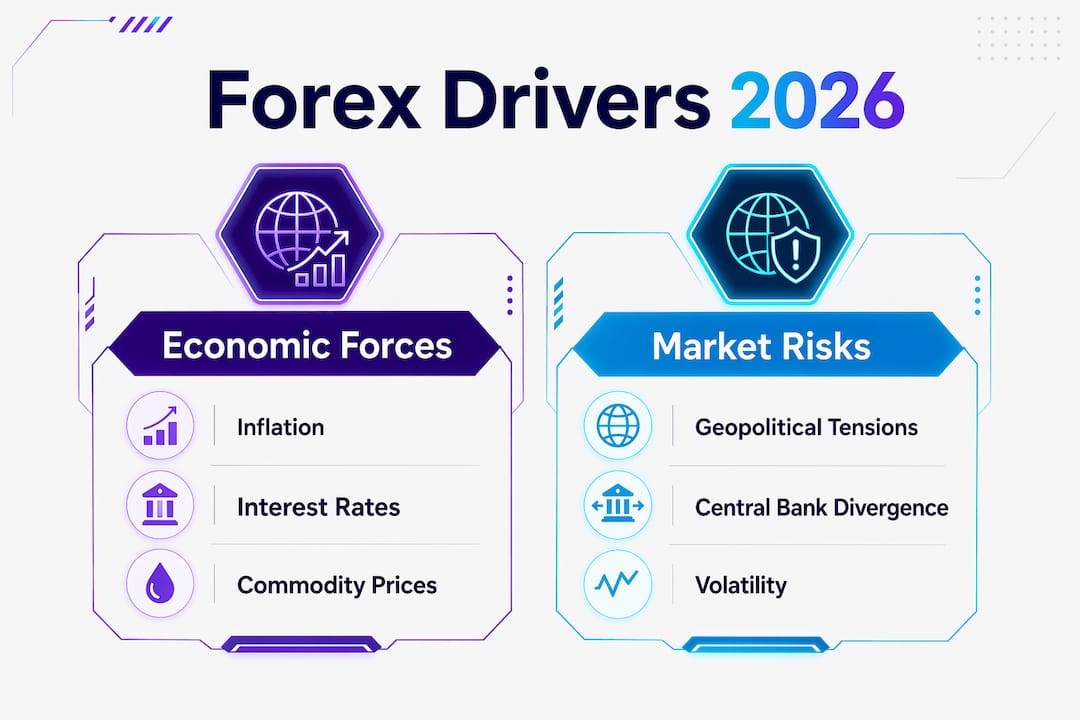
Persistent inflation and energy price volatility driven by Middle East tensions are among the most consequential market forces of 2026. This creates a direct feedback loop: energy spikes push inflation higher, inflation resets bond yield expectations upward, and rising yields reprice currency pairs across the board.
The mechanism works like this:
- Energy price spike. A supply disruption in the Middle East sends crude oil higher, lifting inflation expectations in import-dependent economies like the eurozone and Japan.
- Bond market reaction. Global bond market jitters over inflation and rising term premia trigger sharp selloffs in fixed income, signaling sustained inflation risk.
- Safe-haven demand. Investors rotate into USD and gold, strengthening the dollar and pressuring commodity-linked currencies.
- Central bank response. The Fed and ECB face pressure to maintain or tighten policy, which narrows the window for rate cuts and keeps yield differentials elevated.
“Market strategists describe 2026 as a collision between persistent inflation and market resilience, creating a complex FX environment where neither bulls nor bears can hold a clean trend for long.” — Convera FX Outlook
The currency pair most exposed to this dynamic is AUD/JPY. Australia’s economy benefits from commodity exports when energy prices rise, while Japan suffers from import cost inflation. That asymmetry makes AUD/JPY a live barometer of the energy-inflation cycle. Traders watching energy price shocks should treat AUD/JPY as a leading indicator, not just a trading vehicle. For a deeper look at how energy cycles interact with specific pairs, Fxshop24 covers AUD/JPY volatility dynamics in detail.
What are the major currency pair forecasts for 2026?
Major bank forecasts place GBP/EUR at 1.13 to 1.18, GBP/USD at 1.33 to 1.40, and EUR/USD at 1.15 to 1.19 for 2026. These ranges reflect the tug-of-war between dollar strength, European rate hikes, and UK economic resilience. The USD Index entered June 2026 at 99.0, up from 98.1 in April, confirming a gradual dollar recovery.
| Currency pair | 2026 forecast range | Primary driver |
|---|---|---|
| GBP/EUR | 1.13 to 1.18 | UK growth vs. ECB rate path |
| GBP/USD | 1.33 to 1.40 | BoE hold vs. Fed hike risk |
| EUR/USD | 1.15 to 1.19 | ECB hike pace vs. USD safe-haven demand |
| AUD/JPY | High volatility | Energy prices and carry trade risk |
| USD Index (DXY) | Near 99 to 100 | Inflation, geopolitics, Fed tone |
The USD’s dual role as both a yield-bearing currency and a safe haven is what makes it so difficult to fade in 2026. When risk appetite falls due to geopolitical escalation, traders buy USD. When inflation keeps yields elevated, traders also buy USD. That double support explains why the DXY recovered to the 100 level despite global growth concerns.
The yen sits at the opposite end of that spectrum. Japan’s yield curve control policy keeps domestic rates suppressed, and the resulting yield gap with the US and Australia makes JPY crosses like AUD/JPY and USD/JPY magnets for carry trade flows. But carry trade in 2026 is risky and highly sensitive to energy price shocks, with sudden liquidity gaps capable of triggering sharp corrective moves. Traders running carry positions in yen pairs need tighter stop-loss calibration than in previous years.
Pro Tip: For EUR/USD, watch the spread between US 10-year Treasury yields and German Bund yields. When that spread widens above 200 basis points, EUR/USD typically faces downward pressure regardless of ECB rate decisions.
The 2026 forex market predictions from Fxshop24 align with this consensus, noting that automation strategies must account for these forecast ranges rather than chasing breakouts beyond them.
How do geopolitical risks create forex trading challenges in 2026?
Geopolitical stalemates are not just background noise in 2026. They are a structural market condition. The Strait of Hormuz blockade keeps many FX pairs range-bound, directly challenging trend-following strategies that depend on sustained directional moves. This is the defining tactical problem for retail traders this year.
The practical consequences for trading are significant:
- Range-bound conditions compress breakout opportunities. Pairs like EUR/USD and GBP/USD spend more time oscillating within defined bands than trending cleanly in one direction.
- Risk-off USD surges occur rapidly and without warning when geopolitical escalation hits headlines. Traders holding short USD positions can face sudden 60 to 100 pip adverse moves within minutes.
- Trend-following expert advisors (EAs) built for 2024 or 2025 trending conditions underperform in 2026’s choppier environment. Mean-reversion and range-trading logic produces better results under current conditions.
- Liquidity gaps around energy price shocks create slippage risks that standard stop-loss orders do not fully protect against. Guaranteed stop orders or reduced position sizing are the practical responses.
- Sentiment shifts driven by diplomatic developments, not economic data, can reverse intraday trends within hours. Monitoring geopolitical news feeds alongside price action is no longer optional.
The range-bound FX conditions caused by prolonged geopolitical stalemates render many trend-following automated strategies ineffective. Traders should focus on range-trading and mean-reversion approaches, and EAs should be reconfigured or replaced to reflect this reality. Fxshop24’s guide on industry trends in automated trading addresses exactly this reconfiguration challenge for MT4 and MT5 users.
Key takeaways
Forex trends in 2026 require traders to prioritize central bank communication tone, energy-linked volatility, and range-based strategies over fixed directional forecasts.
| Point | Details |
|---|---|
| Central bank tone over data | Fed Chair Warsh’s rhetoric moves USD more than raw economic prints in 2026. |
| Inflation and energy linkage | Energy price spikes reset bond yields and safe-haven demand, directly repricing major pairs. |
| Currency pair forecast ranges | GBP/USD targets 1.33 to 1.40, EUR/USD 1.15 to 1.19, with DXY near 99 to 100. |
| Carry trade caution | AUD/JPY and USD/JPY carry trades face sharp reversals from energy-driven liquidity gaps. |
| Strategy reconfiguration | Range-trading and mean-reversion EAs outperform trend-following systems in 2026’s choppy conditions. |
What I’ve learned watching 2026 markets develop
The most underappreciated shift in 2026 is how little the raw numbers matter compared to tone and perception. Traders who obsess over CPI beats or payroll surprises are consistently getting caught off-guard because the real volatility catalyst is whether the market believes the Fed is independent, credible, and consistent. That is a qualitative judgment, not a quantitative one, and it requires a different kind of attention.
From what Fxshop24 has observed across trader behavior and EA performance data, the biggest mistake retail traders make right now is running 2024-era trend-following systems without adjustment. The market structure has changed. Geopolitical stalemates create ceilings and floors that technical breakout systems repeatedly fail against. The traders outperforming in 2026 are those who switched to mean-reversion logic and tightened their risk parameters around energy-linked events.
The central bank communication tone is the true catalyst for volatility, not the data itself. That insight should reshape how you allocate attention before and after every major central bank meeting. Read the statement. Watch the press conference. The number is almost secondary.
One more point worth making: energy-linked liquidity shocks are not predictable with standard technical analysis. When the Strait of Hormuz situation escalates, spreads widen and stops get hunted. The correct response is not a smarter indicator. It is smaller position sizing and wider stops on energy-correlated pairs during high-tension periods. Discipline in those moments separates traders who survive 2026 from those who give back months of gains in a single session.
— Fxshop24
Automate smarter with Fxshop24’s 2026-ready trading tools
The 2026 forex environment demands tools built for volatility, not just trend-following. Fxshop24 offers a full catalog of expert advisors and trading robots for MT4 and MT5, specifically designed to handle range-bound conditions, energy-linked volatility, and policy-driven price swings. Every EA comes with lifetime updates and unlimited licenses, so your system stays current as market conditions evolve.
Whether you need a mean-reversion EA calibrated for EUR/USD’s current range or a gold trading robot built for safe-haven demand spikes, Fxshop24 has tested and prop-firm-ready solutions. Explore the full range of automated trading systems on the Fxshop24 marketplace, or review the essential trading software guide to find the right tools for your 2026 strategy. Instant download, crypto payment accepted, and installation support included.
FAQ
What are the biggest forex trends in 2026?
The dominant forex trends in 2026 are central bank policy divergence, persistent inflation driven by energy price volatility, and geopolitical stalemates that keep major pairs range-bound. These forces combine to reward range-trading strategies and penalize fixed directional forecasts.
Which currency pairs offer the best opportunities in 2026?
Major bank forecasts place GBP/USD at 1.33 to 1.40 and EUR/USD at 1.15 to 1.19, making both pairs active trading ranges. AUD/JPY offers high volatility opportunities but carries significant carry trade risk tied to energy price shocks.
How does the Fed affect forex markets in 2026?
The Fed’s impact in 2026 comes primarily from communication tone rather than rate decisions alone. Markets price a 60% chance of a 25bp hike by year-end, but Fed Chair Warsh’s rhetoric at each meeting moves the USD independently of the data.
Why are trend-following strategies underperforming in 2026?
Geopolitical stalemates, including the Strait of Hormuz situation, keep FX pairs range-bound for extended periods. Trend-following EAs built for 2024 or 2025 conditions repeatedly fail against these structural ceilings and floors, making mean-reversion approaches more effective.
What is the safest approach to forex trading in 2026?
Reducing position size on energy-correlated pairs during geopolitical escalations, monitoring central bank communication tone over raw data, and using range-based or mean-reversion strategies are the most defensible approaches for retail traders in 2026.