



4
Jun
What Is Trade Copy Software? A 2026 Trader’s Guide
TL;DR:
- Trade copy software automatically replicates trades from a master account to multiple follower accounts in real time, enhancing trading efficiency and scalability. It differs from copy trading and social trading by providing private, owner-controlled trade replication with low regulatory exposure, depending on the setup. Deployment options include local systems for privacy and speed or cloud solutions for multi-broker management, with careful consideration of broker compatibility and risk controls.
Trade copy software is defined as a program that automatically replicates trades from one master account to multiple follower accounts in real time, without manual input after the initial setup. Think of it as a relay system: every trade you place on your primary account gets mirrored across every connected account within milliseconds. For traders managing multiple accounts, scaling a proven strategy, or operating within a prop firm environment, this technology is the difference between manual chaos and systematic execution. MetaTrader 4 (MT4) and MetaTrader 5 (MT5) are the dominant platforms where trade copy software runs, and tools like Fxshop24’s MT4/MT5 copier EAs represent the kind of solutions traders rely on today.
What is trade copy software and how does it work?
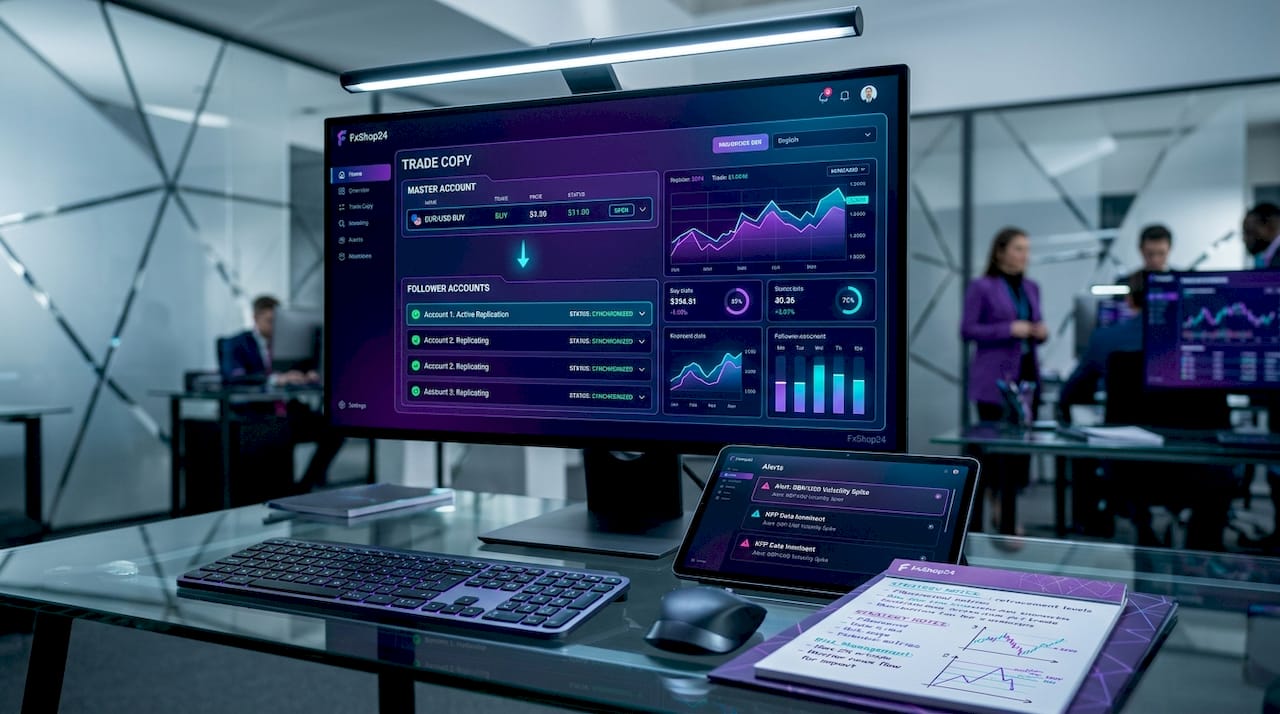
Trade copy software automatically duplicates trades from a master account to multiple follower accounts, mirroring core trade details such as symbol, order type, volume, stop loss, and take profit. The process follows a defined workflow: detect trade activity on the master account, apply filtering rules, scale the order size for each follower, then send execution instructions. This four-step sequence is what separates a trade copier from a simple alert system. An alert tells you to act; a copier acts for you.
How detection and execution actually happen
The software monitors the master account continuously, watching for any open, modify, or close event. Once detected, it applies your pre-configured rules: which instruments to copy, which to skip, and whether to apply a risk filter. Execution then travels to follower accounts via one of three methods: local communication on the same PC or VPS, a cloud relay, or a direct API connection. Copy latency depends on the connection method, with direct API approaches generally being the fastest and polling-based bridges adding the most overhead.
How trade scaling works
One of the most practical features in any trade copier is position scaling. Rather than copying the exact lot size from the master account, the software calculates a proportional size for each follower. The standard formula is: follower balance divided by master balance, multiplied by the master lot size. So if your master account holds $10,000 and a follower holds $5,000, a 1.0 lot trade on the master becomes a 0.5 lot trade on the follower. Scaling uses balance ratios or fixed multipliers, giving you precise control over risk exposure across every account.
Pro Tip: Always set a maximum lot size cap in your copier settings. Without it, a large master trade combined with a high multiplier can push a follower account into a position size that exceeds its margin capacity.
How does trade copy software differ from copy trading and social trading?
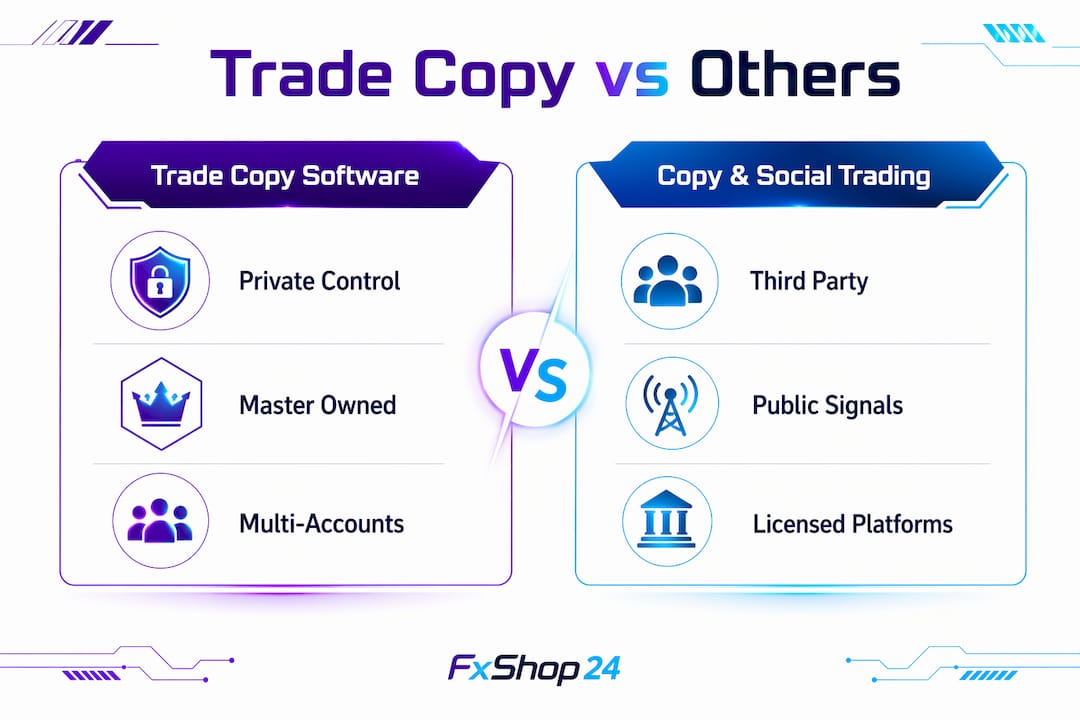
These three terms get used interchangeably online, but they describe fundamentally different models. Understanding the distinction matters for both performance and regulatory compliance.
Trade copiers replicate trades privately across accounts you own and control. You are the master. You are the follower. No third party is involved in the signal chain. Copy trading, by contrast, means subscribing to another trader’s signals through a marketplace. You follow someone else’s strategy, and the platform executes their trades in your account automatically. Social trading adds a community layer: rankings, comment feeds, performance statistics, and the ability to follow or unfollow signal providers like a social network.
The regulatory implications are significant. Automated copying with discretion triggers licensing requirements in many jurisdictions because it resembles discretionary asset management. Private account-to-account replication by the account owner typically does not. Platforms offering copy trading services often require financial services licenses; a trader running a local copier across their own MT4 accounts generally does not face the same threshold.
| Feature | Trade copy software | Copy trading | Social trading |
|---|---|---|---|
| Who controls the master? | You | Another trader | Another trader |
| Account ownership | All accounts are yours | Follower account is yours | Follower account is yours |
| Regulatory exposure | Low (private replication) | Higher (managed investment) | Higher (managed investment) |
| Community features | None | Minimal | Full rankings and feeds |
| Best use case | Scaling your own strategy | Following proven traders | Discovery and signal browsing |
Pro Tip: If your goal is to scale a strategy you already trade profitably, use a private trade copier. If you want to follow someone else’s signals, use a copy trading platform. Mixing the two models creates confusion about risk ownership.
What deployment options exist for trade copy software?
Trade copy software comes in two primary deployment models, and the right choice depends on your infrastructure, privacy needs, and the number of brokers involved.
Local trade copiers run entirely on your own PC or VPS without routing data through external servers. The master and follower accounts communicate directly within the same machine or local network. Key advantages include:
- Full data privacy with no third-party server access
- Lower latency since no internet relay is involved
- No subscription fees tied to cloud infrastructure
- Complete control over software updates and configuration
Local copiers operate on the same PC or VPS, which makes them ideal for traders running multiple MT4 or MT5 accounts at the same broker. The Fxshop24 local trade copier tutorial walks through exactly this kind of setup for traders managing accounts on the same machine.
Cloud-based trade copiers route signals through a remote server, enabling copying across different brokers, platforms, and geographic locations. Key advantages include:
- Copy trades across multiple brokers simultaneously
- Centralized management dashboard accessible from any device
- No need to keep a local PC running 24/7
- Easier scaling to large numbers of follower accounts
The tradeoff is real: cloud copiers introduce an additional latency point and create a dependency on the provider’s server uptime. For high-frequency strategies where execution speed is critical, a local copier on a low-latency VPS often outperforms a cloud solution. For multi-broker distribution or managing accounts for others, cloud infrastructure is the practical choice.
What should you consider when choosing and using trade copy software?
Selecting a trade copier is not just about features. The wrong choice creates technical failures, compliance violations, and unexpected losses. Here are the factors that matter most:
- Broker and platform compatibility. Master and follower accounts typically need to be at the same broker for the copier to function correctly. Cross-broker copying requires software with explicit multi-broker support, and even then, instrument naming differences can cause mismatches.
- Full trade lifecycle support. Testing should cover the entire sequence: entry, stop loss and take profit placement, partial closes, order modifications, and full closure. A copier that handles entries but drops partial closes will desynchronize your accounts over time.
- Risk management controls. Look for daily loss limits, maximum lot size caps, instrument filters, and equity-based stop rules. These features protect follower accounts from outsized drawdowns when the master takes an aggressive position.
- Prop firm rule compliance. Prop firms often restrict trade copying to your own accounts only. Copying signals from a third party or sharing your master signal with others is typically forbidden and can result in account termination.
- Latency and execution speed. For scalping or news-based strategies, even a 200ms delay in copying can turn a winning trade into a losing one on the follower account. Test execution speed under live conditions before committing.
Pro Tip: Local copiers can simulate manual execution to blend with broker policies that restrict automated actions. If your broker prohibits EAs but allows manual trading, this setting lets you copy trades while appearing compliant with platform rules.
You can also review the MetaTrader setup guide at Fxshop24 for a step-by-step walkthrough of configuring trade copier tools correctly from the start.
How trade copy software benefits prop firm traders and multi-account managers
Prop firm traders and multi-account managers represent the two groups that get the most direct value from trade copy software. The use cases are distinct but the underlying logic is the same: one strategy, multiple execution points.
For prop firm traders, the typical scenario involves passing an evaluation on one account and then scaling to a funded account. A trade copier lets you run the same strategy across both the evaluation and funded accounts simultaneously, or copy trades from a personal live account to a funded account in real time. Topstep notes that trade copiers multiply profits and losses across accounts, and you retain full risk responsibility for every position. This is a critical point: the copier automates execution, but risk management remains your obligation.
For multi-account managers, the value is pure efficiency. Instead of logging into four separate MT4 terminals and placing the same trade four times, you place it once and the copier handles distribution. Position sizing scales automatically per account balance, so each account receives a proportionally appropriate exposure. Fxshop24’s guide on scaling a trading account covers how this kind of leverage works in practice. The key distinction from copy trading platforms is that you maintain direct control and responsibility. No signal provider is involved. No third-party discretion is exercised. That distinction matters both for regulatory compliance and for prop firm compatibility.
Key takeaways
Trade copy software is the most direct tool for scaling a single trading strategy across multiple accounts without manual replication, and its value depends entirely on correct configuration, broker compatibility, and risk controls.
| Point | Details |
|---|---|
| Core definition | Trade copy software replicates trades from a master to follower accounts automatically in real time. |
| Scaling method | Follower positions are sized by balance ratio or fixed multiplier, not by copying exact lot sizes. |
| Key distinction | Private trade copiers differ from copy trading platforms in ownership, control, and regulatory exposure. |
| Deployment choice | Local copiers offer privacy and speed; cloud copiers enable multi-broker and remote management. |
| Prop firm compliance | Copy only your own accounts; third-party signal copying is typically prohibited by prop firms. |
Why trade copy software is infrastructure, not a shortcut
At Fxshop24, we see traders approach trade copy software from two very different angles. Some treat it as a shortcut to profits. Others treat it as infrastructure. The second group consistently gets better results.
A trade copier does not make a bad strategy profitable. It amplifies whatever you are already doing, including the losses. The traders who benefit most are those who have already validated a strategy on a single account and want to scale it without adding operational complexity. For them, a well-configured copier running on a stable VPS is as fundamental as the trading platform itself.
What concerns me about the current market is the number of copier products that prioritize feature lists over workflow clarity. A copier with 40 settings and no clear documentation on broker compatibility is a liability, not an asset. When evaluating any trade copying tool, I look at three things first: does it handle partial closes correctly, does it document its broker compatibility requirements explicitly, and does it offer a manual execution simulation mode for broker policy flexibility. If a product cannot answer those three questions clearly, it is not ready for live use.
The technology is also evolving. AI-driven risk filters that adjust copying behavior based on market conditions are appearing in newer products. That direction is promising, but the fundamentals remain unchanged: test every scenario before going live, start with small position sizes, and never assume the copier handles edge cases correctly until you have verified it yourself.
— FxShop24
Explore trade copier tools and automated trading solutions at Fxshop24
Fxshop24 offers a curated selection of trade copy software and expert advisors built specifically for MT4 and MT5 traders. Whether you need a local copier for same-broker account management or a full automated trading system for prop firm environments, the Fxshop24 marketplace covers both.
The MT4/MT5 trade copier EA at Fxshop24 comes with an unlimited license and lifetime updates, making it a practical choice for traders who want a one-time setup without recurring costs. For a broader view of how trade copiers fit into a full automation strategy, the automated trading systems guide covers every major tool type from EAs to signal-based systems. All products include instant digital delivery and installation support.
FAQ
What is trade copy software in simple terms?
Trade copy software is a program that automatically copies trades from one account (the master) to one or more other accounts (followers) in real time. You set it up once, and it handles execution without any manual input.
Does trade copy software work across different brokers?
Most trade copiers require the same broker and platform for master and follower accounts to function correctly. Cross-broker copying is possible but requires software with explicit multi-broker support and careful instrument mapping.
Is trade copy software allowed at prop firms?
Prop firms typically allow copying your own accounts but prohibit copying signals from third parties or sharing your master signal with other traders. Always verify the specific rules of your prop firm before setting up a copier.
How is trade copy software different from copy trading?
Trade copy software replicates trades privately across accounts you own and control. Copy trading means following another trader’s signals through a public marketplace, where a third party’s decisions drive your account activity.
What should I test before using a trade copier live?
Test the full trade lifecycle including entries, stop loss and take profit placement, partial closes, order modifications, and full closures. Skipping partial close testing is the most common cause of account desynchronization in live environments.
Recommended
- 7 Types Of Trading Software Every Forex Trader Should Know
- Trading System Installation Guide: Set Up Automated Trading 2026
- Local Trade Copier EA MT4 Tutorial: How To Copy Trades Instantly Between Accounts | FxShop24 Marketplace
- MT4 E MT5 Trade Copier EA Forex Expert Advisor, Metatrader Trading Robot Licenza Illimitata, Bot Di Trading Finanziario, Copylot Qualsiasi Bot Di Trading | FxShop24 Marketplace