
26
May
Why Digital Delivery for Trading Software Matters
TL;DR:
- Digital delivery eliminates setup delays, enabling traders to access and deploy software instantly across devices. It enhances security through centralized data storage and supports continuous platform updates without downtime. This shift improves trader flexibility, scalability, and overall performance, making traditional software delivery largely obsolete.
If you’ve ever purchased trading software and waited days for a physical license key or installation disc, you already understand the frustration that digital delivery eliminates. The question of why digital delivery for trading software has become the standard isn’t academic. It affects how fast you can act on an opportunity, whether your EA runs on your laptop in a hotel room, and whether your platform updates itself before market open or leaves you patching manually during a live position. The shift is real, measurable, and directly affects your performance as a trader.
Table of Contents
- Key takeaways
- Why digital delivery in trading software changed everything
- Core benefits traders actually experience
- Digital vs. traditional trading software delivery
- How digital delivery supports modern trader workflows
- My take on why this shift is irreversible
- Get the right software working for you now
- FAQ
Key takeaways
| Point | Details |
|---|---|
| Instant access post-purchase | Digital delivery removes setup delays, letting you start trading or testing immediately after buying. |
| Multi-device flexibility | Access your trading software from any device, anywhere, without reinstalling or managing local files. |
| Security without local risk | Sensitive data stays in centralized, compliant data centers instead of on your personal machine. |
| Lower cost and overhead | Elastic cloud resources mean you pay for what you use, cutting hardware and IT maintenance costs. |
| Continuous platform improvement | Web-native platforms deploy multiple updates daily without interrupting your active trading sessions. |
Why digital delivery in trading software changed everything
For most of trading’s desktop era, getting new software meant downloading a large installer, configuring a local environment, and waiting through a 15 to 30 minute setup process before you could even launch the platform. Web-based platforms remove these setup delays entirely, pushing updates to all users the moment a new version ships. That’s not a minor convenience. When your competitor is already running an updated algorithm while you’re waiting for a patch to finish installing, you’re starting every session behind.
The technical evolution that made this possible centers on three things: browser-native architecture, modern network protocols, and cloud infrastructure. Older desktop terminals required everything to live on your local machine. Today’s web platforms offload processing to distributed servers and communicate with your browser over protocols specifically built for speed.
From desktop installs to browser-native platforms
The transition wasn’t overnight. MetaTrader 4 and MT5 built their reputation on desktop clients because web technology simply wasn’t fast enough in the early 2000s to handle real-time price data reliably. That ceiling no longer exists. Execution latencies under 5ms are now achievable on modern web platforms using WebSocket and Server-Sent Events protocols, which effectively closes the speed gap that once made desktop terminals non-negotiable for serious traders.
Cloud platforms also use CDNs and edge computing to push market data closer to wherever you’re located physically. Sub-100ms market data delivery worldwide is now routine, not exceptional. That kind of geographic distribution was impossible with traditional installed software that depended entirely on your local hardware and internet connection quality.
Pro Tip: If you’re evaluating a trading platform and the vendor still requires a large local installation with no web or mobile access option, treat that as a signal the architecture is aging. Modern digital delivery should feel effortless from first click to first trade.
Core benefits traders actually experience
Understanding the mechanics is one thing. Feeling the impact in your daily trading workflow is another. Here’s how digital delivery directly improves trader outcomes:
Instant acquisition and deployment. After purchasing an expert advisor or trading system, digital delivery means you download and run it within minutes. Demo trading with virtual funds starts immediately, bypassing the broker onboarding steps that used to delay your first trade by days.
True multi-device access. Your account, settings, open positions, and trade history follow you across devices. Log in from your desktop at home, your tablet at the office, or a browser at a client meeting. No syncing, no file transfers, no version mismatches.
Universal versioning. Every user on a digital platform runs the same version at the same time. This eliminates a surprisingly common support problem where a trader’s locally installed software is two versions behind and generating errors the support team can’t reproduce.
Reduced IT overhead. Elastic cloud resources let firms pay only for actual consumed capacity. A small retail trader isn’t paying for server resources sized for an institutional desk. During high-volatility events, capacity scales up automatically, then contracts again when volume normalizes.
By 2026, leading cloud-native trading platforms handle 15,000 or more concurrent users with real-time data streaming, demonstrating the scale that digital delivery can sustain without degrading individual trader experience.
Digital vs. traditional trading software delivery
The clearest way to understand the gap is side by side. These aren’t theoretical differences. They show up in your actual trading day.
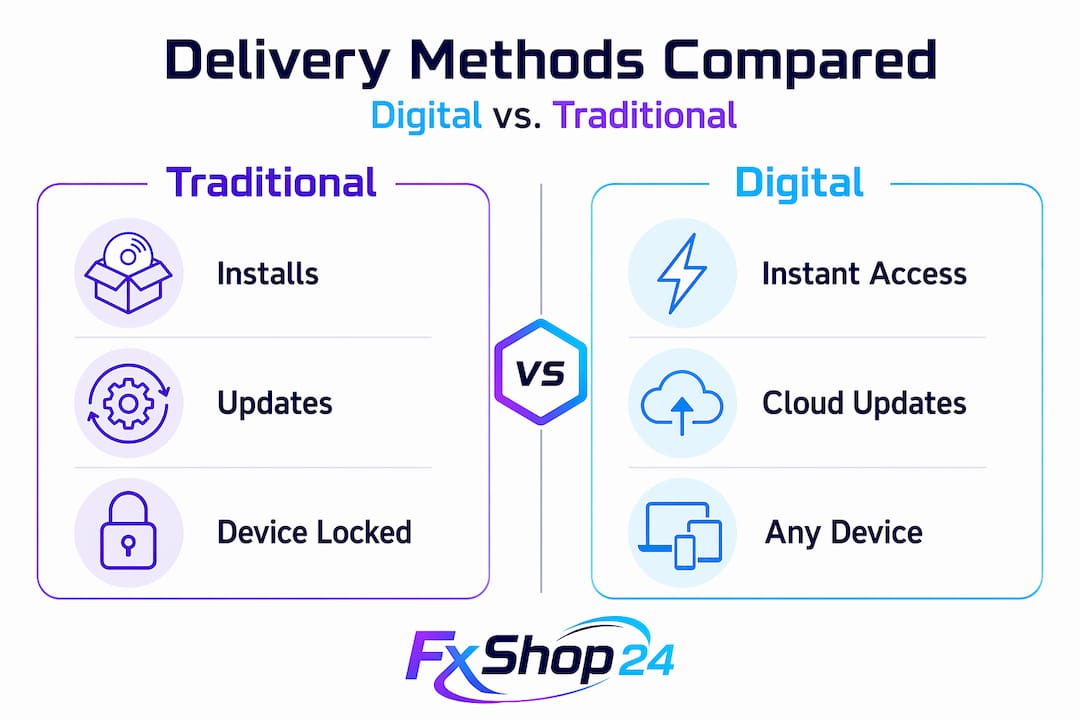
| Factor | Traditional delivery | Digital delivery |
|---|---|---|
| Setup time | 15 to 30 minutes per device | Seconds via browser login |
| Updates | Manual download and reinstall required | Deployed automatically with zero downtime |
| Device access | Single licensed machine | Any device, any location |
| Security | Local data storage with local vulnerabilities | Centralized SOC 2 compliant data centers |
| Cost model | Upfront license plus hardware costs | Pay-per-use or subscription, scales with demand |
| Support complexity | Version mismatches create unresolvable issues | Unified version eliminates mismatch errors |
Security deserves special attention here. Zero local data storage means your financial data, credentials, and trade history never sit on a device that could be stolen, hacked, or fail mechanically. Browser security sandboxes and centralized security patching add layers of protection that a personal laptop simply can’t replicate. SOC 2 compliant data centers handle sensitive data with the kind of governance that retail traders rarely have the resources to implement locally.
Pro Tip: When assessing trading software delivery options, ask vendors explicitly where your data is stored and whether they carry SOC 2 or equivalent compliance. It’s a fast way to separate serious providers from those cutting corners on infrastructure.
Traditional software also creates what developers call reconciliation disputes. When a trader’s local database gets out of sync with broker records, resolving commission and data mismatches can take days. Unified data model platforms prevent these conflicts entirely by maintaining a single source of truth that all parties access simultaneously.
How digital delivery supports modern trader workflows
The benefits of digital software for traders aren’t abstract. They map directly onto the ways traders actually operate today.
Prop firms and multi-account operators
Prop trading firms onboard dozens of new traders weekly. With traditional software, each new trader required a separate installation process, license verification, and local configuration. Digital delivery collapses that workflow. A new funded trader gets login credentials and is trading within the same session. Instant virtual fund access at the platform level means they can start proving their strategy in a simulator the moment they’re approved, not after a three-day onboarding sequence.
For multi-account operators running strategies across several accounts simultaneously, digital platforms eliminate the coordination overhead that comes with managing multiple local installations. One interface, one login, full visibility across all accounts.
Algorithmic and AI-powered trading integration
Digital delivery is also what makes modern AI-augmented trading tools viable. Expert advisors and automated systems that require frequent parameter updates or model retraining can be pushed to all users instantly through a digital delivery pipeline. There’s no manual update cycle to manage. Continuous improvements with zero downtime mean your EA is always running the current logic without you touching a settings file.
The scalability dimension matters here too. Modern web architectures use independent scaling for different services. A spike in market data demand doesn’t slow down order execution because each service scales on its own, keeping performance consistent under load. This architectural resilience is simply not achievable with monolithic desktop software.
Retail traders working globally
For the individual retail trader, the impact of digital trading software is felt most clearly when traveling or working across time zones. A position that needs managing at 3 AM is accessible from any browser. An automated trading system running on a cloud-hosted MT4 or MT5 environment doesn’t depend on your personal machine staying powered on and connected. The strategy runs whether your laptop is open or not.

My take on why this shift is irreversible
I’ve worked with enough traders navigating this transition to say clearly: the resistance to digital delivery is almost always about familiarity, not performance. Traders who spent years optimizing desktop setups naturally view any change with skepticism. I understand that instinct. But what I’ve seen, repeatedly, is that traders who make the switch stop asking “is this as fast as desktop?” within a week. The question disappears because the performance is there.
What doesn’t go away is the advantage. Traders who embraced digital delivery early have built workflows that are genuinely more flexible than those still managing local installations. They run EAs across multiple accounts without renting a VPS, access their platforms from any device without syncing files, and receive software updates that improve their tools without any action on their part.
The skepticism I hear most often is about security. My experience here is that the concern is inverted. A modern SOC 2 compliant trading data center provides far better protection than the average trader’s home network and personal laptop combined. The risk profile of keeping sensitive financial data locally is worse than centralizing it in infrastructure designed specifically for financial services security.
The question isn’t whether digital delivery is good enough. It surpassed traditional methods years ago. The real question is how much longer you want to manage the overhead of a model that’s been replaced.
— Fxshop24
Get the right software working for you now
The advantages of digital delivery only matter if the software you’re running is worth delivering. At Fxshop24, every product is available as an instant download immediately after purchase.
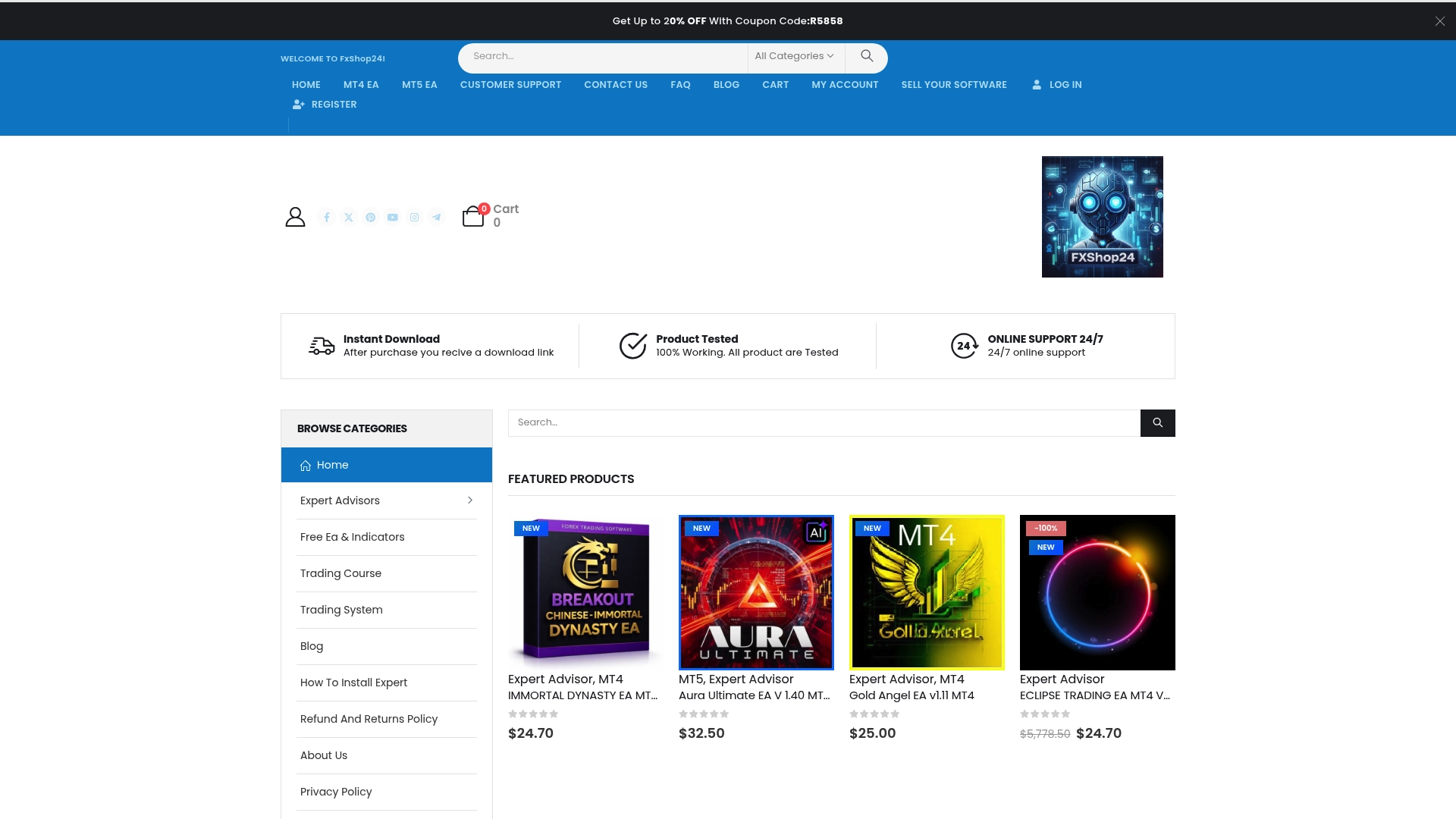
Whether you’re a retail forex trader, running a prop firm account, or scaling a multi-account gold trading operation, the catalog at Fxshop24 includes expert advisors and automated systems built for MT4 and MT5 that take full advantage of digital delivery. Browse automated futures trading systems designed for immediate deployment, or explore the full range of trading software types suited to your specific strategy. You can also learn more about using expert advisors to understand how EAs fit into a digitally delivered trading workflow. Every product ships with installation guidance and lifetime update support.
FAQ
What is digital delivery in trading software?
Digital delivery in trading software means software is distributed and accessed online rather than through physical media or manual downloads. After purchase, traders receive instant access to downloads or cloud-based platforms without waiting for shipping or manual installation.
Why is instant access important for traders?
Market conditions change fast. Instant access means you can deploy a new EA or trading tool the same day you purchase it, rather than waiting through shipping or lengthy setup processes that could cause you to miss opportunities.
Is digital trading software secure?
Yes. Web-native trading platforms store data in SOC 2 compliant data centers with no sensitive information held locally on your device. Browser security sandboxes and centralized patching provide stronger protection than most local machine setups.
How does digital delivery benefit prop firm traders?
Prop firm traders benefit from faster onboarding, instant access to demo environments with virtual funds, and the ability to manage funded accounts from any device without managing local software configurations.
Can digitally delivered EAs run when my computer is off?
Yes, if the EA is deployed on a cloud-hosted MT4 or MT5 environment. Instant download EAs can be installed on virtual private servers or cloud platforms that run continuously, independent of your personal hardware.