
26
Jun
Why Use Hedging Strategies to Protect Your Capital
TL;DR:
- Hedging involves taking offsetting positions to reduce investment risk without selling assets.
- It uses tools like options, futures, CFDs, and forwards to protect capital during market volatility.
Hedging is defined as taking an offsetting position in a financial instrument to reduce the risk of loss on an existing investment. Traders and investors use hedging strategies not to generate profit, but to protect capital from adverse price movements without liquidating positions. Tools like options, futures, contracts for difference (CFDs), and forwards are the standard instruments for this purpose. The core benefit of hedging is that it lets you stay invested through volatility while capping your downside exposure. This guide explains why use hedging strategies matters, how the mechanics work, what it costs, and when to apply it.
Why use hedging strategies to manage investment risk?
Hedging reduces downside risk during market volatility without forcing you to sell your underlying position. That distinction matters because selling triggers taxable events and transaction costs. A trader holding a long equity position ahead of a major economic announcement can buy put options to offset potential losses without exiting the trade.
Using derivatives like CFDs or options lets you neutralize exposure temporarily while avoiding capital gains taxes. This is especially valuable for long-term investors who want to maintain their investment thesis but need short-term protection. Selling and rebuying a position costs money and resets your tax basis. A hedge preserves both.
Currency exposure is one of the most common reasons traders hedge. A U.S. investor holding European equities faces euro-to-dollar risk on top of equity risk. A currency forward or a forex CFD can offset that exposure directly. Managing currency and interest rate risk is a standard part of global portfolio management.
Pro Tip: Think of a hedge the same way you think of car insurance. You pay a premium hoping you never need it. The cost is the price of certainty, not a sign of weakness.
Key scenarios where hedging delivers clear value:
- Short-term volatility events: Earnings releases, central bank decisions, or geopolitical shocks that create temporary but sharp price swings.
- Concentrated positions: When a single stock or sector represents an outsized share of your portfolio and selling would trigger large tax bills.
- Currency exposure: Holding foreign assets without hedging the exchange rate adds a second layer of uncontrolled risk.
- Commodity cost stabilization: Businesses with predictable input costs use hedges to lock in prices and protect margins.
What are the common hedging instruments and methods?
The four primary hedging instruments are options, futures, CFDs, and forward contracts. Each serves a different purpose and carries different costs, complexity, and liquidity profiles.

Options give the buyer the right, but not the obligation, to buy or sell an asset at a set price before a specific date. A trader holding 500 shares of a stock can buy put options at a strike price below the current market price. If the stock falls, the put gains value and offsets the loss on the shares. The cost is the premium paid upfront.
Futures lock in a price for a future transaction. Airlines buying oil futures to stabilize fuel expenses are the textbook example of this approach. The airline accepts a fixed cost today to eliminate the risk of a price spike later. This is hedging for budget certainty, not speculation.
CFDs allow traders to go short on an asset without owning it. A trader long on gold can open a short CFD position on gold to neutralize exposure during a period of expected weakness. CFDs are flexible and accessible on platforms like MetaTrader 4 (MT4) and MetaTrader 5 (MT5), but they carry overnight financing costs.
Forward contracts are customized agreements between two parties to exchange an asset at a future date and price. They are common in corporate finance for stabilizing costs and financial planning across international operations.
| Instrument | Primary use | Main cost | Complexity |
|---|---|---|---|
| Put options | Protect long equity positions | Premium paid upfront | Medium to high |
| Futures | Lock in commodity or index prices | Margin and rollover costs | Medium |
| CFDs | Short-term directional hedges | Spread and overnight fees | Low to medium |
| Forward contracts | Currency and commodity locking | Counterparty and spread | Medium to high |
Pro Tip: Before choosing an instrument, check the bid-ask spread and daily volume. Thinly traded derivatives can trap you in a position you cannot exit at a fair price.
What are the costs, risks, and limitations of hedging?
Hedging is not free, and treating it as a guaranteed safety net is a mistake. Premiums and spreads accumulate over time and directly reduce net returns. A hedge applied indiscriminately across an entire portfolio will erode performance even in calm markets.
The most overlooked limitation is the upside cap. If you buy put options on a stock and the stock rallies, the puts expire worthless. You paid for protection you did not need. That cost is real. Hedging should be reserved for clearly identified risks, not used as a blanket response to general uncertainty.
“Hedging transfers risk. It does not eliminate it. Traders who believe a hedge makes them immune to loss are the most exposed when markets move in unexpected ways.” — IG, Beginners Guide to Hedging Strategies
Asset correlations used for hedging are not static. During market shocks, correlations between assets can break down entirely. A hedge that worked during normal conditions may fail precisely when you need it most. The 2008 financial crisis demonstrated this clearly, as assets that were historically uncorrelated moved together sharply.
Key limitations every trader must understand:
- Liquidity risk: Low-volume derivatives can widen spreads dramatically under stress, making exit costly or impossible.
- Time decay: Options lose value as expiration approaches. A hedge that is not actively managed can become worthless before the risk event occurs.
- Correlation breakdown: Historical relationships between assets can fail during systemic shocks.
- Execution complexity: Specialist skills are required to manage strike prices, expiration dates, and premiums correctly. Errors in execution can make the hedge cost more than the loss it was meant to prevent.
How can traders apply hedging strategies effectively in 2026?
Effective hedging is tactical, not permanent. Hedging is most effective when implemented after establishing a core position and when a specific, identifiable risk event is on the horizon. Applying a hedge before you have a clear reason is just paying for insurance you do not need.
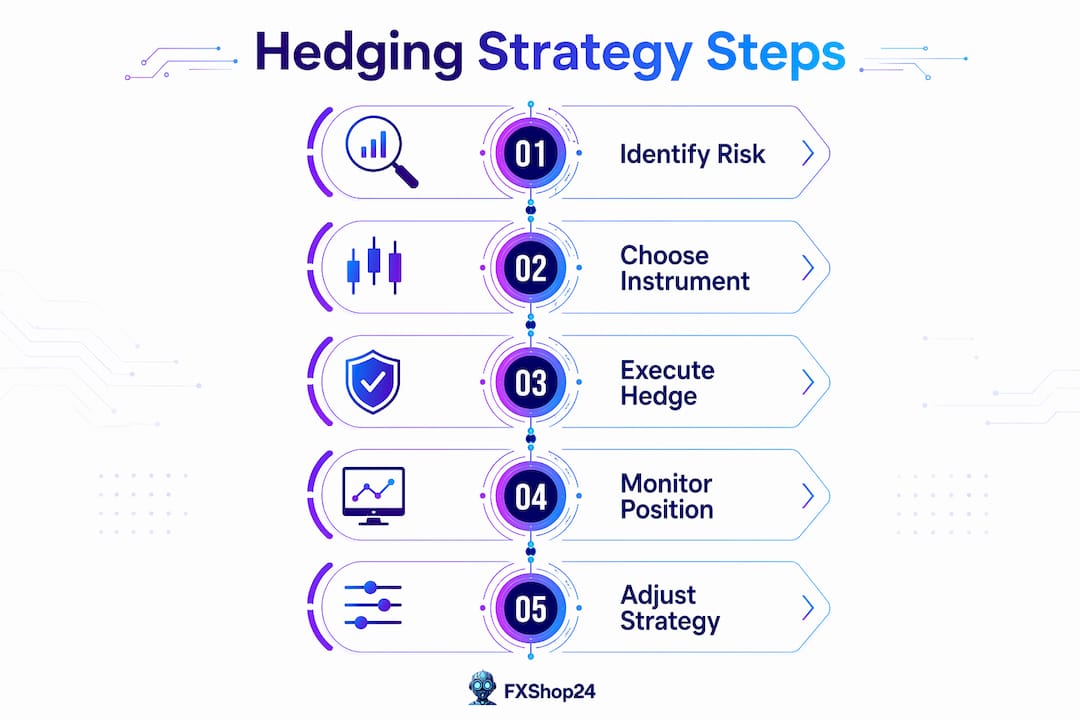
A practical framework for applying hedges in 2026:
- Identify the specific risk. Define whether the threat is price volatility, currency movement, commodity cost, or interest rate exposure. A vague sense of market unease is not a reason to hedge.
- Size the hedge correctly. A full hedge neutralizes all upside. A partial hedge, covering 50% of the position, balances protection with participation. Match hedge size to your actual risk tolerance.
- Choose the right instrument. Options work well for equity protection. Futures suit commodity and index exposure. CFDs offer flexibility for short-term currency or asset hedges on MT4 and MT5.
- Set a review schedule. Treating a hedge as passive leads to suboptimal outcomes. Time decay in options and shifting interest rates change hedge effectiveness weekly. Review and adjust regularly.
- Calculate the break-even cost. Know exactly how much the market must move against you before the hedge pays off. If the premium exceeds your likely loss, the hedge is not worth it.
Combining hedging with diversification across strategies produces better risk-adjusted outcomes than relying on either approach alone. Diversification reduces correlation risk across positions. Hedging addresses specific, concentrated exposures. Together, they form a complete risk management framework.
For traders managing global portfolios in 2026, currency hedging deserves special attention. The global funds management strategies that outperform consistently treat currency exposure as a separate, manageable risk rather than an unavoidable side effect of international investing.
Pro Tip: Use a hedge EA on MT4 to automate hedge execution during volatile sessions. Automated hedge tools remove emotional decision-making from the process and enforce discipline when markets move fast.
Key Takeaways
Hedging strategies protect capital by offsetting specific risks with derivatives, but they require active management, clear cost-benefit analysis, and disciplined execution to deliver real value.
| Point | Details |
|---|---|
| Hedging is defensive, not profitable | Use hedging to protect capital, not to generate returns on existing positions. |
| Costs reduce net returns | Premiums, spreads, and financing fees accumulate; apply hedges only to identified risks. |
| Correlations can break down | Asset relationships shift during market shocks, making hedges unreliable without active monitoring. |
| Instrument choice matters | Match the tool to the risk: options for equities, futures for commodities, CFDs for short-term exposure. |
| Active management is required | Review and adjust hedges regularly, as time decay and rate changes alter their effectiveness. |
The uncomfortable truth about hedging most traders ignore
Hedging is one of the most misunderstood tools in a trader’s kit. Traders come to it expecting a guarantee. What they get is a transfer of risk, not an elimination of it. That distinction sounds minor until you are holding an options position that expired worthless while the underlying moved against you anyway.
The traders I see struggle most with hedging are the ones who apply it reactively. They feel nervous, so they buy protection. But the cost of that protection is already priced into the market. By the time fear is visible, the hedge is expensive. The traders who benefit from hedging are the ones who plan it in advance, size it correctly, and treat it as one component of a broader risk framework.
The other mistake is treating hedging as a substitute for position sizing and diversification. A well-sized position in a diversified portfolio needs far less hedging than a concentrated bet. If you find yourself hedging constantly, the real problem is position construction, not market conditions.
Hedging works. But it works best when you use it surgically, with a clear cost-benefit calculation, a defined review schedule, and realistic expectations about what it can and cannot do.
— Fxshop24
Automated tools that support hedge execution on MT4 and MT5
Executing hedges manually under fast-moving market conditions is where most traders make costly errors. Timing, sizing, and instrument selection all need to happen quickly and correctly.
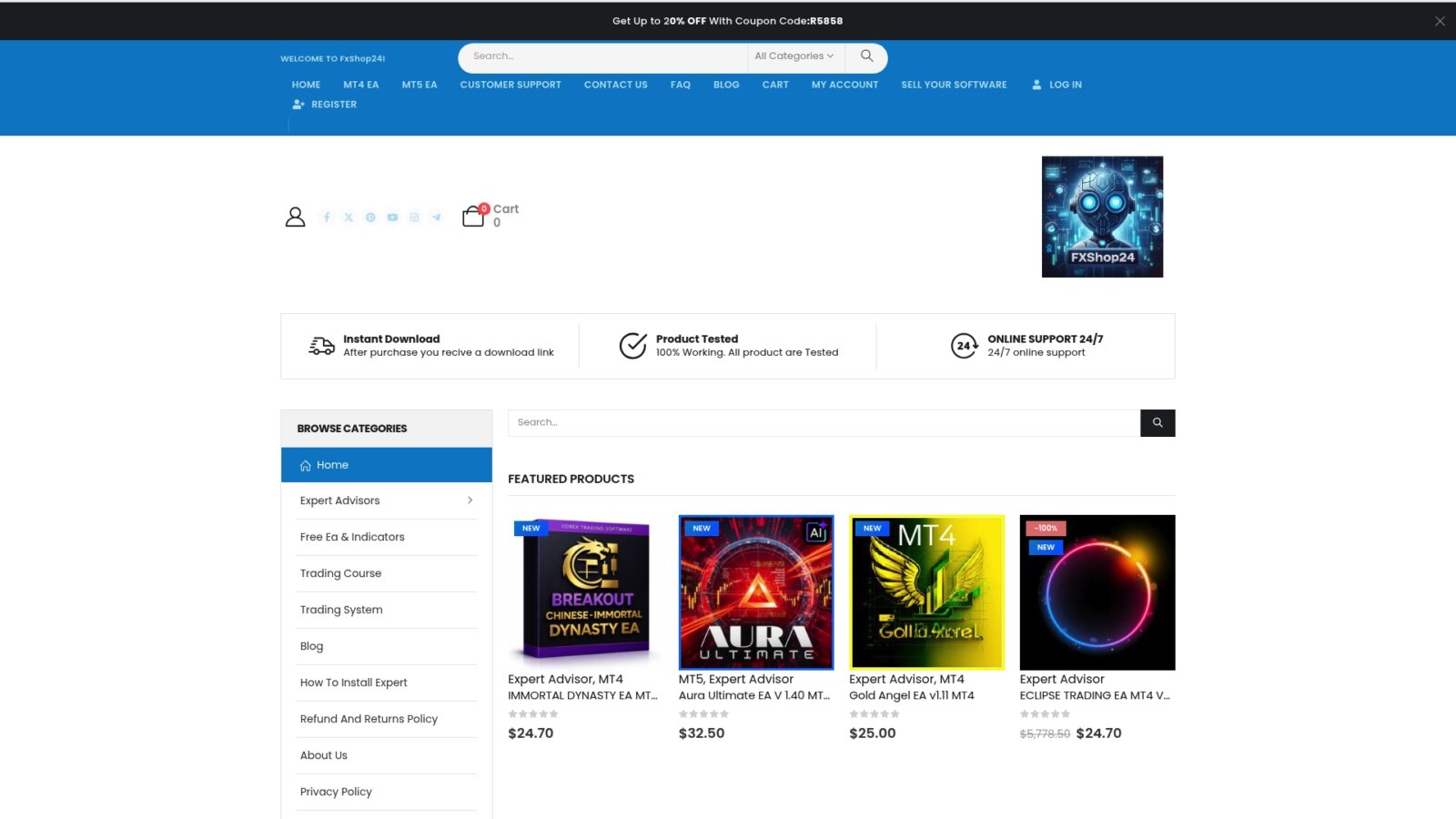
Fxshop24 offers a range of automated futures trading systems and expert advisors built for MT4 and MT5 that handle hedge execution with precision and speed. These tools remove the emotional component from the process and enforce your risk parameters automatically. Whether you need a hedge EA for choppy forex sessions or a full risk control system for gold trading, the Fxshop24 marketplace has tested, prop-firm-ready solutions with lifetime updates and unlimited licenses. Traders who want to apply the strategies covered in this article without manual execution errors will find the right tools there.
FAQ
What is the main purpose of hedging in trading?
Hedging protects an existing position from adverse price movements without requiring the trader to sell the asset. Its primary goal is risk reduction, not profit generation.
Is hedging worth it for retail traders?
Hedging is worth it when a specific, identifiable risk justifies the cost of the hedge. Applying it indiscriminately erodes returns through accumulated premiums and spreads.
What instruments are most commonly used for hedging?
Options, futures, CFDs, and forward contracts are the four standard hedging instruments. The right choice depends on the type of risk, the time horizon, and the trader’s available capital.
Can a hedge fail during a market crash?
Yes. Asset correlations used for hedging can break down during market shocks, causing simultaneous losses on both the hedge and the underlying position. Active monitoring is required to catch this early.
How does hedging differ from diversification?
Diversification spreads risk across uncorrelated assets to reduce overall portfolio volatility. Hedging targets a specific, concentrated risk with an offsetting position. Both approaches work best when used together.