
29
Jun
Why Gold Trading Differs from Forex: 2026 Guide
TL;DR:
- Gold trading involves speculating on a highly volatile commodity driven by sentiment and systemic risk rather than economic data. It requires separate strategies, risk controls, and mindsets compared to forex due to its larger daily price movements and different market drivers. Proper preparation, validation, and disciplined risk management are essential to profit from gold’s unique trading environment.
Gold trading is defined as speculating on the price of a physical commodity, XAU/USD, whose behavior is driven by global sentiment, safe-haven demand, and inflation expectations rather than the economic data and interest rate differentials that govern forex currency pairs. Understanding why gold trading differs from forex is not a matter of preference. It is a prerequisite for building strategies that actually work. Gold’s daily price moves can reach $30–50, creating profit potential and risk exposure that most forex traders are unprepared for. The World Gold Council and market data from 2026 confirm that gold and forex require separate playbooks, separate risk controls, and separate mindsets.
Why gold trading differs from forex: volatility and price movement
Gold is dramatically more volatile than major forex pairs, and that gap shapes every trading decision you make. Gold averages 300–500 pips per day in price range, while EUR/USD moves just 60–80 pips over the same period. That means gold can be 30–40 times more volatile on a daily basis than the most traded currency pair in the world. For retail traders, that volatility is both the opportunity and the danger.
| Instrument | Avg. daily range | Volatility profile | Spread range |
|---|---|---|---|
| XAU/USD (Gold) | 300–500 pips | Very high | 15–40 pips |
| EUR/USD | 60–80 pips | Moderate | Under 0.5 pips |
| GBP/USD | 80–120 pips | Moderate to high | 0.5–1.5 pips |
Forex pairs react to scheduled economic releases like non-farm payrolls, CPI prints, and central bank rate decisions. Gold reacts to all of those events plus geopolitical shocks, currency crises, and shifts in global risk appetite. A single geopolitical headline can send gold surging $40 in minutes while EUR/USD barely moves 30 pips. That asymmetry means a forex trader who steps into gold without adjusting their approach will face stop-outs they never anticipated.
Pro Tip: Set your gold position size based on the 500-pip daily range scenario, not the average. Sizing for the average leaves you exposed on high-volatility days.
What market drivers make gold behave differently than forex?
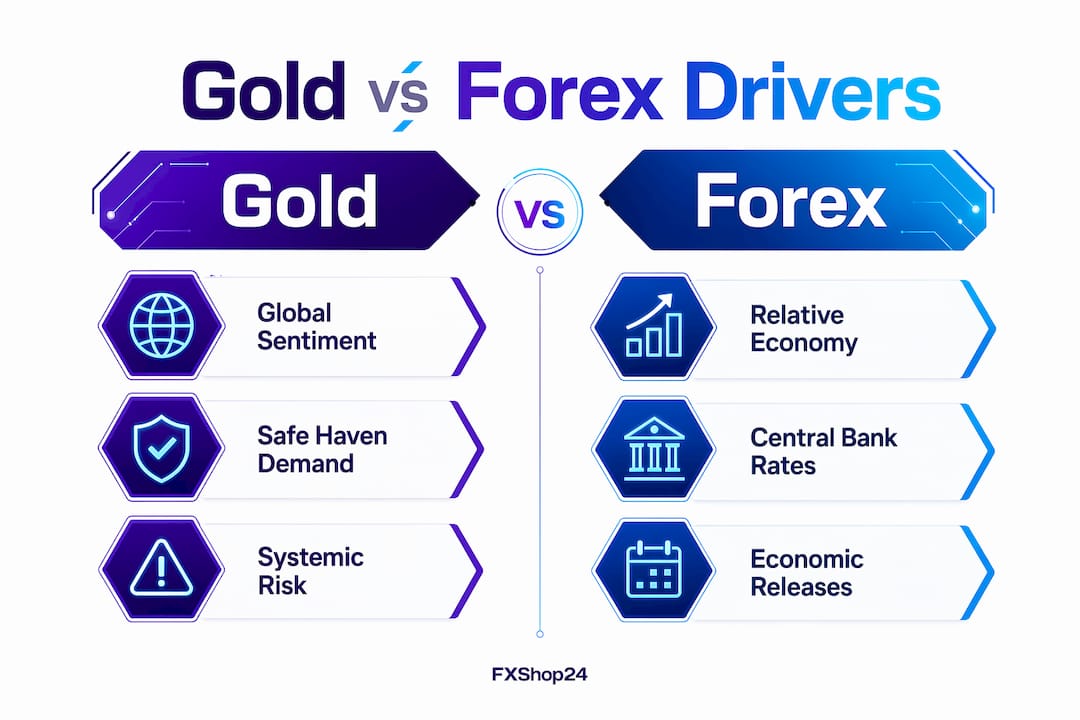
Forex pricing is built on relative economic strength between two countries. When the U.S. economy outperforms the eurozone, EUR/USD falls. When the European Central Bank raises rates faster than the Federal Reserve, EUR/USD rises. The logic is comparative and data-driven.

Gold does not follow that logic. Gold’s price reacts to global investor sentiment, safe-haven demand, and systemic risk. When financial systems look fragile, investors buy gold regardless of what any single economy is doing. Inflation expectations, negative real yields, and geopolitical tensions all push gold higher in ways that have no direct parallel in forex.
The U.S. dollar relationship adds another layer. Gold and the USD move inversely because gold is priced in dollars. A stronger dollar makes gold more expensive for buyers holding other currencies, which reduces demand and pulls the price down. This inverse correlation is permanent and structural, not cyclical.
Key drivers that separate gold from forex pairs:
- Safe-haven demand: Gold surges during banking crises, wars, and pandemics. Forex pairs shift based on relative economic damage, not blanket fear.
- Inflation expectations: Rising inflation lifts gold because it preserves purchasing power. Forex pairs respond to inflation only through central bank rate expectations.
- Negative real yields: When bond yields fall below inflation, gold becomes attractive as a store of value. Forex has no equivalent mechanism.
- Central bank reserves: Central banks hold gold as a reserve asset. Their buying and selling programs create long-term price floors and ceilings that have no forex equivalent.
How do transaction costs and liquidity affect gold versus forex trading?
Cost structure is one of the most underestimated differences between the two markets. EUR/USD spreads stay below 0.5 pips during peak hours, while XAU/USD spreads typically run 15–40 pips. That is not a small gap. For a scalper entering and exiting 10 trades per day, the cost difference between trading EUR/USD and XAU/USD can be the difference between a profitable strategy and a losing one.
Gold liquidity also behaves differently across sessions. Gold’s bid-ask spread widens during off-peak hours and around major news releases, increasing slippage risk. Forex liquidity, particularly in EUR/USD, stays relatively stable because the interbank market is enormous and globally distributed. Gold liquidity concentrates around the London and New York sessions, and thins out significantly during Asian hours.
For automated trading systems, these cost dynamics matter enormously. A bot calibrated for EUR/USD spreads will bleed capital on XAU/USD if its entry and exit logic does not account for the wider spread. Slippage on gold during a news spike can easily exceed the expected profit on a short-term trade.
Pro Tip: Run your gold trading bot during the London-New York overlap (1:00 PM–5:00 PM UTC). Spreads are tightest and liquidity is deepest during that window.
What strategies need to change when you switch from forex to gold?
Forex strategies do not transfer to gold without testing. Untested strategies on XAUUSD typically fail because gold’s momentum and volatility patterns are structurally different from any currency pair. Backtesting on historical XAU/USD data is not optional. It is the minimum requirement before risking real capital.
Here are the core adjustments every trader needs to make:
- Reduce lot sizes significantly. Gold volatility runs 3–5 times higher than typical forex pairs. Applying a forex lot size to a gold trade multiplies your dollar risk by that same factor. Start with a fraction of your normal size and scale up only after live performance confirms your edge.
- Backtest on XAU/USD data exclusively. A moving average crossover strategy that works on EUR/USD will produce different signals on gold because gold’s price structure is not mean-reverting in the same way. Validate every parameter on gold-specific data.
- Add session filters to automated systems. Gold bots need to know when to trade and when to stay out. A bot running during low-liquidity Asian hours on gold faces wider spreads and erratic price action. Session-filtered gold systems consistently outperform those running around the clock.
- Manage the psychology differently. Gold trading psychology involves managing fear and sentiment in ways that forex does not demand. A single news event can cause a $30 move in seconds. Forex traders trained on economic logic often freeze or overtrade when gold reacts to pure sentiment. Predefined rules and automated execution remove that emotional variable.
- Use volatility-adjusted stop losses. A 20-pip stop loss that works on EUR/USD will be triggered by normal noise on XAU/USD. Gold requires stops calibrated to its actual daily range, typically 80–150 pips minimum, depending on the timeframe.
The automated trading workflow for gold requires these adjustments built into the system before the first live trade. Retrofitting risk controls after a drawdown is always more expensive than building them in from the start.
How does gold serve a different role than currencies in a portfolio?
Gold is a non-yielding asset. It pays no interest, no dividend, and no coupon. That fact shapes its entire role in a portfolio. The World Gold Council’s 2026 strategic asset report confirms that gold functions as a hedge during periods of negative real interest rates and systemic uncertainty, not as a yield-generating position.
Forex trading, by contrast, is tactical. Traders capitalize on interest rate differentials through carry trades, or on economic divergence between countries. The goal is to profit from relative change. Gold’s goal is to preserve value when everything else is losing it.
“Gold loses appeal during rising rate environments because it yields nothing. Its power activates when real yields turn negative and systemic risk spikes.” — World Gold Council, 2026 Strategic Asset Report
This distinction matters for retail traders building a portfolio. Gold and forex serve different functions:
- Gold acts as a financial barometer during crises. It rises when confidence in financial systems falls.
- Forex reflects economic competition between nations. It rewards traders who correctly read policy divergence.
- Central bank buying creates structural demand for gold that has no parallel in forex. When central banks accumulate gold reserves, they create price floors that can persist for years.
Mixing gold and forex strategies without recognizing these different roles leads to misaligned risk management. A trader who treats XAU/USD like a fast-moving currency pair will consistently misread its signals.
Key takeaways
Gold and forex require completely separate strategies because their volatility, cost structures, market drivers, and portfolio roles are fundamentally different.
| Point | Details |
|---|---|
| Volatility gap is extreme | Gold averages 300–500 pips daily versus 60–80 pips for EUR/USD, requiring adjusted position sizing. |
| Drivers are structurally different | Gold responds to sentiment and systemic risk; forex responds to economic data and interest rate differentials. |
| Transaction costs favor forex | XAU/USD spreads of 15–40 pips far exceed EUR/USD’s sub-0.5-pip spreads, hurting scalpers and bots. |
| Strategies must be validated separately | Forex strategies cannot be assumed to work on gold without rigorous backtesting on XAU/USD data. |
| Portfolio roles differ | Gold hedges systemic risk; forex capitalizes on economic and policy divergence between countries. |
What trading gold has taught us at Fxshop24
The traders who struggle most with gold are experienced forex traders. That sounds counterintuitive, but it makes sense once you understand the mechanism. Forex builds habits around economic logic. You learn to read rate decisions, GDP prints, and employment data. Those habits create a mental model that feels reliable. Gold breaks that model without warning.
We have seen traders with years of profitable forex experience blow up gold accounts in weeks because they trusted their instincts instead of the data. Gold does not reward instinct. It rewards preparation and rules. The volatility is not random noise. It is structured around sentiment cycles, dollar dynamics, and macro risk events. But reading those cycles requires a completely different analytical framework than forex demands.
The most important lesson is this: treat gold as a separate instrument that happens to be available on the same platform as your forex pairs. Do not assume your edge transfers. Test it. Quantify it. Then trade it with position sizes that respect the daily range, not the daily range you are used to from EUR/USD.
Emotional control is also non-negotiable on gold. A $40 intraday move feels violent if you are used to EUR/USD. Automated systems remove the temptation to intervene mid-trade, which is why expert advisors built for gold consistently outperform manual discretionary trading on XAU/USD over time. The rules do not panic. You might.
— Fxshop24
Automated tools built for gold and forex traders
Retail traders who understand the differences between gold and forex are already ahead of most of the market. The next step is putting that knowledge into a system that executes without hesitation.

Fxshop24 offers a full catalog of automated futures trading systems built specifically for MetaTrader 4 and MetaTrader 5, covering both XAU/USD and major forex pairs. Each expert advisor is tested for prop firm compatibility and includes lifetime updates. Whether you need a gold bot with session filters and volatility-adjusted stops, or a forex EA calibrated for EUR/USD spreads, Fxshop24 has systems designed for the exact market conditions described in this article. Instant download, full installation support, and no recurring fees.
FAQ
What makes gold more volatile than forex pairs?
Gold averages 300–500 pips per day compared to 60–80 pips for EUR/USD. Its price reacts to global sentiment, geopolitical risk, and inflation expectations simultaneously, while forex pairs respond mainly to economic data and interest rate differentials.
Can I use my forex strategy on XAU/USD?
Forex strategies cannot be assumed to work on gold without rigorous validation. Gold’s momentum and volatility patterns are structurally different, so every strategy must be backtested specifically on XAU/USD data before live trading.
Why are gold trading costs higher than forex?
XAU/USD spreads typically range from 15–40 pips, compared to under 0.5 pips for EUR/USD. Gold liquidity also thins during off-peak sessions and news events, increasing slippage risk beyond what the spread alone suggests.
Why do gold bots differ from forex bots?
Gold bots require session filters, volatility-adjusted position sizing, and wider stop-loss parameters because gold volatility runs 3–5 times higher than typical forex pairs. A bot built for EUR/USD will overtrade and overspend on spreads if applied directly to XAU/USD.
Is gold trading safer than forex?
Gold is not safer. Its higher daily range creates greater profit potential and greater loss exposure than most forex pairs. Disciplined risk management, including reduced lot sizes and volatility-calibrated stops, is required to trade gold without excessive drawdown.