What Is Automated Trading and How It Transforms Forex
9
Jan
What Is Automated Trading and How It Transforms Forex
Automated trading now drives more than 70 percent of daily transactions in major American and European financial markets. For retail forex traders using MT4 or MT5, staying competitive means leveraging solutions that can process trades faster than any human and reduce emotional bias. This guide breaks down how automated trading systems work, the main strategies available, and the practical benefits for forex and gold markets so you can make informed decisions about enhancing your trading performance.
Automated trading systems execute trades significantly faster than humans, allowing traders to capitalize on fleeting market opportunities.
Algorithmic Strategies Variety
Traders can choose from various automated strategies, such as trend-following and arbitrage, each suited for distinct market conditions.
Risk Management Importance
Developing a robust risk management strategy is essential to mitigate potential losses associated with algorithmic failures or unexpected market conditions.
Backtesting Necessity
It is crucial to thoroughly backtest automated trading systems on historical data to validate performance before deploying them in live markets.
Defining Automated Trading and How It Works
Automated trading represents a sophisticated technological approach where computer algorithms execute financial transactions autonomously in forex and other markets. Algorithmic trading systems leverage computational technologies to analyze market conditions and execute trades without direct human intervention, transforming how traders interact with financial markets.At its core, automated trading operates through predefined algorithms that scan market data continuously, identifying potential trading opportunities based on specific parameters. These algorithms can execute trades within milliseconds - far faster than any human trader could manually process information. Modern systems utilize complex mathematical models that evaluate multiple market indicators simultaneously, such as price movements, trading volume, and historical trend patterns.The fundamental mechanics of automated trading involve several critical components. First, traders develop precise rules and conditions that define when trades should be executed. These rules might include specific price thresholds, moving average crossovers, or more advanced statistical arbitrage strategies. Once programmed, the trading algorithm continuously monitors market conditions, comparing real-time data against these predefined parameters and triggering trades automatically when exact conditions are met.Pro tip:Always backtest your automated trading algorithm using historical market data to validate its potential performance before risking real capital.
Types of Automated Trading Systems
Automated trading systems encompass several distinct strategies designed to optimize financial transactions across different market conditions. Algorithmic trading strategies can be categorized into specific approaches that target unique trading objectives, each with its own sophisticated methodology for market engagement.The primary types of automated trading systems include trend-following algorithms, which analyze historical price data to predict and capitalize on emerging market directions. Arbitrage systems represent another critical category, focusing on exploiting price discrepancies across different markets or exchanges. These algorithms can detect minute price differences and execute trades instantaneously, generating profits from market inefficiencies that human traders would struggle to identify.Additionally, advanced automated trading systems incorporate more complex strategies like volume-weighted average price (VWAP) and time-weighted average price (TWAP) algorithms. These sophisticated approaches help traders manage large order volumes by breaking trades into smaller segments and executing them strategically over specified time periods. Index fund rebalancing algorithms also play a crucial role, automatically adjusting portfolio compositions to maintain desired asset allocations and risk profiles.Here’s a comparison of popular automated trading strategies and their main characteristics:
Strategy Type
Typical Use Case
Data Inputs Required
Common Markets
Trend-Following
Capitalize on market momentum
Historical prices, trends
Forex, commodities
Arbitrage
Exploit price differences
Real-time cross-market prices
Forex, stocks, crypto
VWAP/TWAP Algorithms
Manage large order execution
Price, time, trading volume
Stocks, indices, large FX
Index Rebalancing
Adjust to maintain portfolio goals
Index weights, asset prices
ETFs, mutual funds
Pro tip:Select an automated trading system that aligns closely with your specific risk tolerance and investment goals, and always thoroughly backtest the algorithm before live implementation.
Automated Trading on MT4 and MT5 Platforms
MetaTrader platforms have revolutionized automated trading by providing robust environments for developing and executing sophisticated trading algorithms. Automated trading platforms like MT4 and MT5 offer traders powerful tools to implement complex trading strategies through Expert Advisors (EAs), transforming how individuals interact with financial markets.MT4 and MT5 differ significantly in their capabilities and programming environments. MetaTrader 4 remains the standard for forex trading, utilizing MQL4 programming language and providing a straightforward approach to automated trading. In contrast, MetaTrader 5 represents a more advanced platform, supporting MQL5 programming with enhanced features like multi-threaded backtesting, faster trade execution, and broader market asset support. This makes MT5 particularly attractive for traders seeking more sophisticated and versatile automated trading solutions across multiple financial instruments.The technical infrastructure of these platforms enables traders to develop, test, and deploy custom trading robots with remarkable precision. Traders can create Expert Advisors using integrated development environments, which allow for complex algorithmic strategy implementation. These EAs can analyze market conditions, execute trades, and manage risk parameters automatically, dramatically reducing human emotional interference and enabling consistent trading performance across different market conditions.The table below highlights key distinctions between MetaTrader 4 and MetaTrader 5 platforms for automated trading:
Feature
MetaTrader 4 (MT4)
MetaTrader 5 (MT5)
Programming Language
MQL4
MQL5
Asset Support
Primarily forex
Forex, stocks, futures, more
Backtesting
Single-threaded
Multi-threaded, faster analysis
Execution Speed
Slower compared to MT5
Faster, more precise
Market Depth
Limited
Advanced, greater detail
Pro tip:Before deploying any automated trading system on live markets, thoroughly backtest your Expert Advisor using historical data and run extensive simulations to validate its performance and risk management capabilities.
Key Benefits for Forex and Gold Traders
Automated trading represents a transformative approach for forex and gold traders, offering unprecedented opportunities to optimize investment strategies. Automated forex trading systems provide traders with powerful tools to execute sophisticated trading strategies with exceptional precision and efficiency.The primary advantages of automated trading include dramatically reduced emotional interference and consistent trade execution. Traditional manual trading often suffers from psychological biases like fear and greed, which can lead to irrational decision-making. Automated systems eliminate these human limitations by strictly following predefined trading rules and parameters. This approach ensures disciplined trading, where entry and exit points are determined by objective mathematical algorithms rather than subjective human impulses.Moreover, automated trading platforms enable traders to capitalize on market opportunities around the clock, spanning multiple global markets simultaneously. These sophisticated systems can analyze complex market data, identify potential trading signals, and execute trades within milliseconds - a speed impossible for human traders to match. Advanced algorithms can simultaneously monitor multiple currency pairs and gold market indicators, executing trades with remarkable accuracy and speed. This continuous market scanning and instant trade execution provide traders with a significant competitive advantage, allowing them to seize fleeting market opportunities that would otherwise be missed.Pro tip:Develop a comprehensive risk management strategy with clear stop-loss and take-profit parameters before implementing any automated trading system to protect your investment capital.
Risks, Limitations, and Common Pitfalls
While automated trading offers significant advantages, traders must remain aware of its inherent complexities and potential drawbacks. Machine learning trading risks highlight the critical need for understanding potential systemic vulnerabilities that could undermine trading performance and financial stability.One of the most significant risks involves the potential for algorithmic failure during unexpected market conditions. Trading algorithms are fundamentally programmed based on historical data and predefined parameters, which means they can struggle or completely break down when confronted with unprecedented market scenarios. Sudden economic events, geopolitical shifts, or extreme market volatility can expose algorithmic weaknesses, potentially leading to substantial financial losses if the system cannot adapt quickly or lacks robust risk management protocols.Furthermore, automated trading systems are susceptible to several technical and strategic limitations. Data quality becomes paramount, as algorithms depend entirely on the accuracy and comprehensiveness of input information. Inaccurate or incomplete market data can lead to flawed trading decisions, creating a cascading effect of potentially disastrous trades. Additionally, over-optimization represents another critical pitfall, where traders might develop algorithms that perform exceptionally well on historical data but fail dramatically when deployed in live market conditions. This phenomenon, known as curve fitting, can create a false sense of security and lead to significant financial risks.Pro tip:Implement rigorous backtesting protocols and maintain a conservative approach by starting with small capital allocations when first deploying any automated trading system.
Unlock the Power of Automated Trading with FxShop24
If you have struggled with manual trading emotions or faced challenges implementing reliable automated trading strategies on MT4 or MT5 platforms this is your opportunity to transform how you trade forex and gold. The article highlights crucial pain points like algorithmic failures and the need for tested, adaptable Expert Advisors designed for fast execution and risk management. At FxShop24 we specialize in delivering precisely those solutions: expert advisors and AI-powered trading robots that can help you overcome limitations like curve fitting and inconsistent backtesting results.Discover how easy it is to start streamlining your trades with FxShop24’s prop firm-ready EAs featuring lifetime updates and unlimited licenses. Don’t let emotional bias or market volatility control your portfolio any longer visit FxShop24 today to explore a wide range of automated trading tools that perfectly complement the concepts covered in the article. Elevate your forex and gold trading performance now with proven systems tailored to your goals.
Frequently Asked Questions
What is automated trading?
Automated trading refers to the use of computer algorithms to execute financial transactions in markets such as forex, allowing trades to be performed without human intervention.
How do automated trading systems work?
Automated trading systems operate by following predefined algorithms that continuously scan market data, identify trading opportunities based on specific criteria, and execute trades automatically.
What are the types of automated trading strategies?
Common types include trend-following algorithms, arbitrage systems, VWAP/TWAP algorithms, and index rebalancing strategies, each targeting unique trading objectives and market conditions.
What are the benefits of automated trading for forex traders?
Automated trading reduces emotional interference, enables consistent trade execution, and allows traders to capitalize on market opportunities 24/7 with high precision and speed.



 Additionally, advanced automated trading systems incorporate more complex strategies like volume-weighted average price (VWAP) and time-weighted average price (TWAP) algorithms. These sophisticated approaches help traders manage large order volumes by breaking trades into smaller segments and executing them strategically over specified time periods. Index fund rebalancing algorithms also play a crucial role, automatically adjusting portfolio compositions to maintain desired asset allocations and risk profiles.Here’s a comparison of popular automated trading strategies and their main characteristics:
 The primary advantages of automated trading include dramatically reduced emotional interference and consistent trade execution. Traditional manual trading often suffers from psychological biases like fear and greed, which can lead to irrational decision-making. Automated systems eliminate these human limitations by strictly following predefined trading rules and parameters. This approach ensures disciplined trading, where entry and exit points are determined by objective mathematical algorithms rather than subjective human impulses.Moreover, automated trading platforms enable traders to capitalize on market opportunities around the clock, spanning multiple global markets simultaneously. These sophisticated systems can analyze complex market data, identify potential trading signals, and execute trades within milliseconds - a speed impossible for human traders to match. Advanced algorithms can simultaneously monitor multiple currency pairs and gold market indicators, executing trades with remarkable accuracy and speed. This continuous market scanning and instant trade execution provide traders with a significant competitive advantage, allowing them to seize fleeting market opportunities that would otherwise be missed.Pro tip: Develop a comprehensive risk management strategy with clear stop-loss and take-profit parameters before implementing any automated trading system to protect your investment capital.
 Discover how easy it is to start streamlining your trades with FxShop24’s prop firm-ready EAs featuring lifetime updates and unlimited licenses. Don’t let emotional bias or market volatility control your portfolio any longer visit FxShop24 today to explore a wide range of automated trading tools that perfectly complement the concepts covered in the article. Elevate your forex and gold trading performance now with proven systems tailored to your goals.
 Additionally, advanced automated trading systems incorporate more complex strategies like volume-weighted average price (VWAP) and time-weighted average price (TWAP) algorithms. These sophisticated approaches help traders manage large order volumes by breaking trades into smaller segments and executing them strategically over specified time periods. Index fund rebalancing algorithms also play a crucial role, automatically adjusting portfolio compositions to maintain desired asset allocations and risk profiles.Here’s a comparison of popular automated trading strategies and their main characteristics:
 The primary advantages of automated trading include dramatically reduced emotional interference and consistent trade execution. Traditional manual trading often suffers from psychological biases like fear and greed, which can lead to irrational decision-making. Automated systems eliminate these human limitations by strictly following predefined trading rules and parameters. This approach ensures disciplined trading, where entry and exit points are determined by objective mathematical algorithms rather than subjective human impulses.Moreover, automated trading platforms enable traders to capitalize on market opportunities around the clock, spanning multiple global markets simultaneously. These sophisticated systems can analyze complex market data, identify potential trading signals, and execute trades within milliseconds - a speed impossible for human traders to match. Advanced algorithms can simultaneously monitor multiple currency pairs and gold market indicators, executing trades with remarkable accuracy and speed. This continuous market scanning and instant trade execution provide traders with a significant competitive advantage, allowing them to seize fleeting market opportunities that would otherwise be missed.Pro tip: Develop a comprehensive risk management strategy with clear stop-loss and take-profit parameters before implementing any automated trading system to protect your investment capital.
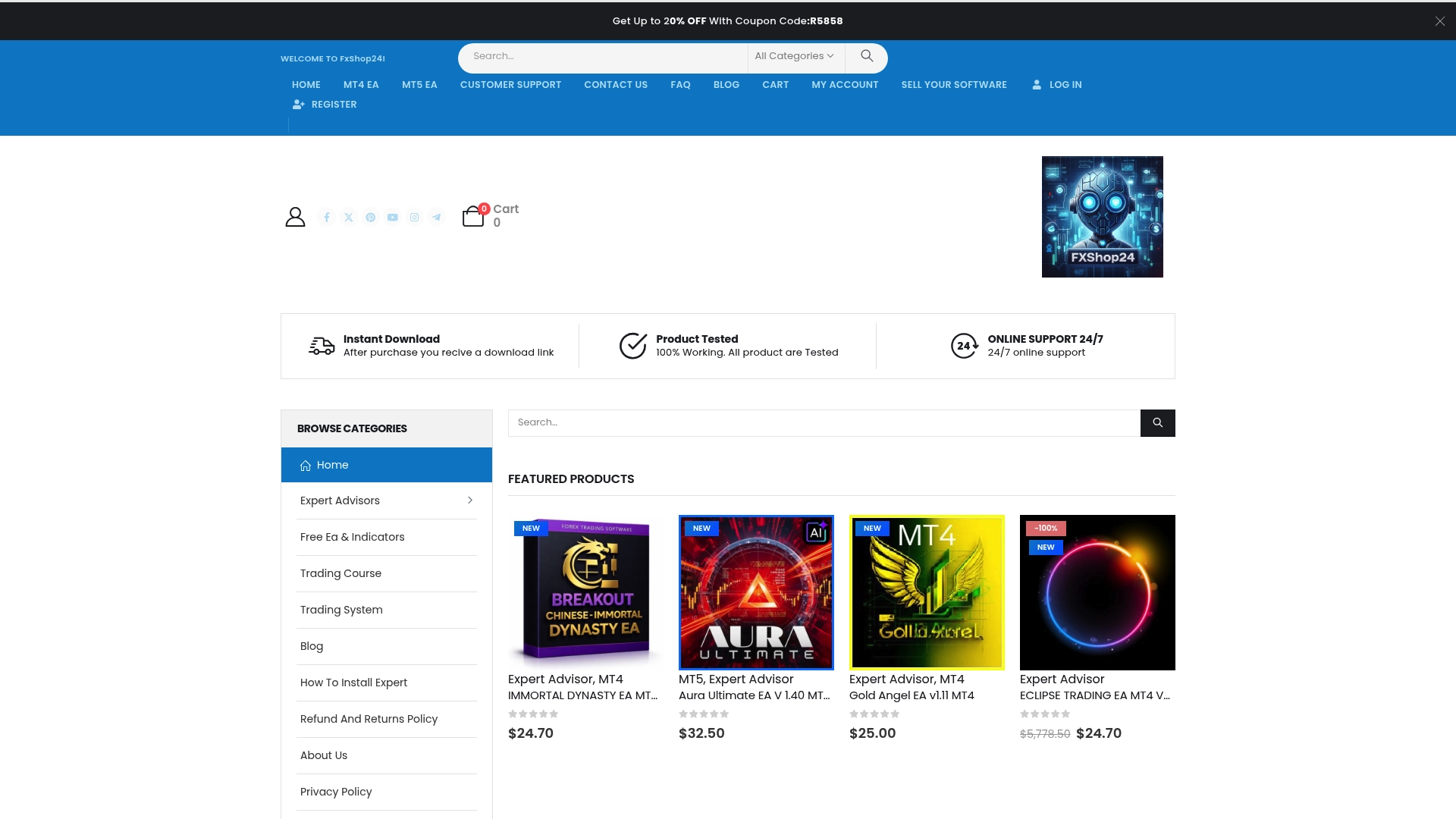 Discover how easy it is to start streamlining your trades with FxShop24’s prop firm-ready EAs featuring lifetime updates and unlimited licenses. Don’t let emotional bias or market volatility control your portfolio any longer visit FxShop24 today to explore a wide range of automated trading tools that perfectly complement the concepts covered in the article. Elevate your forex and gold trading performance now with proven systems tailored to your goals.