



2
Jun
Grid Trading Systems Defined: A Forex and Gold Guide
TL;DR:
- Grid trading is an automated strategy that profits from oscillations by placing buy and sell limit orders within a set range. Its success depends on proper parameter configuration, like market range, spacing, and stop loss placement, especially in trending markets. Carefully calibrated, it can generate systematic income in sideways forex and gold markets while minimizing risks.
Grid trading is defined as an automated strategy that places buy and sell limit orders at predetermined price intervals within a defined price range, profiting from oscillations rather than directional prediction. Platforms like Webull, Binance, and MetaTrader MT4/MT5 all support some form of this approach. For individual traders in forex and gold markets, understanding how these systems work, how to configure them, and where they fail is the difference between consistent income and unexpected drawdowns. This guide covers everything from core mechanics to risk management, with practical guidance tailored to forex and gold specifically.
How do grid trading systems work fundamentally?
A grid trading system places buy orders at regular intervals below the current price and sell orders at regular intervals above it, forming a structured grid across a defined price range. When price drops to a buy level, the order fills. When it bounces back up to the next sell level, that order fills too. The difference between those two levels is the profit captured per cycle.

The profit mechanism depends entirely on price oscillation. Grid trading profits from capturing the spread between adjacent buy and sell levels as price moves back and forth within the defined bounds, not from predicting which direction the market will move next. This is a fundamental shift in trading logic. You are not betting on direction. You are harvesting repetition.
Automation is what makes this practical. Once configured, the bot runs continuously, replacing filled orders with new ones at the same levels. A human trader cannot monitor and execute dozens of limit orders simultaneously across a 24-hour forex or gold market. An expert advisor (EA) on MT4 or MT5 can. This is why grid systems are particularly well-suited to markets like EUR/USD or XAU/USD, which frequently oscillate within recognizable ranges during low-volatility sessions.
The critical condition for effectiveness is a sideways or ranging market. When price trends strongly in one direction, the grid fills orders on one side only and accumulates an unbalanced position. That is where losses mount. Understanding this condition is not optional. It is the foundation of every deployment decision you make.
- Price enters the defined grid range.
- Buy orders below current price and sell orders above it are placed simultaneously.
- As price oscillates, orders fill in sequence and are replaced automatically.
- Each completed buy-sell cycle captures the grid spacing as profit.
- The process continues until price exits the range or a take profit/stop loss is triggered.
Pro Tip: Before deploying any grid system, check the 14-day price range of your target pair. If the range is smaller than your total grid span, you are likely in a trending phase and the strategy will underperform.
What are the key parameters and configuration settings?
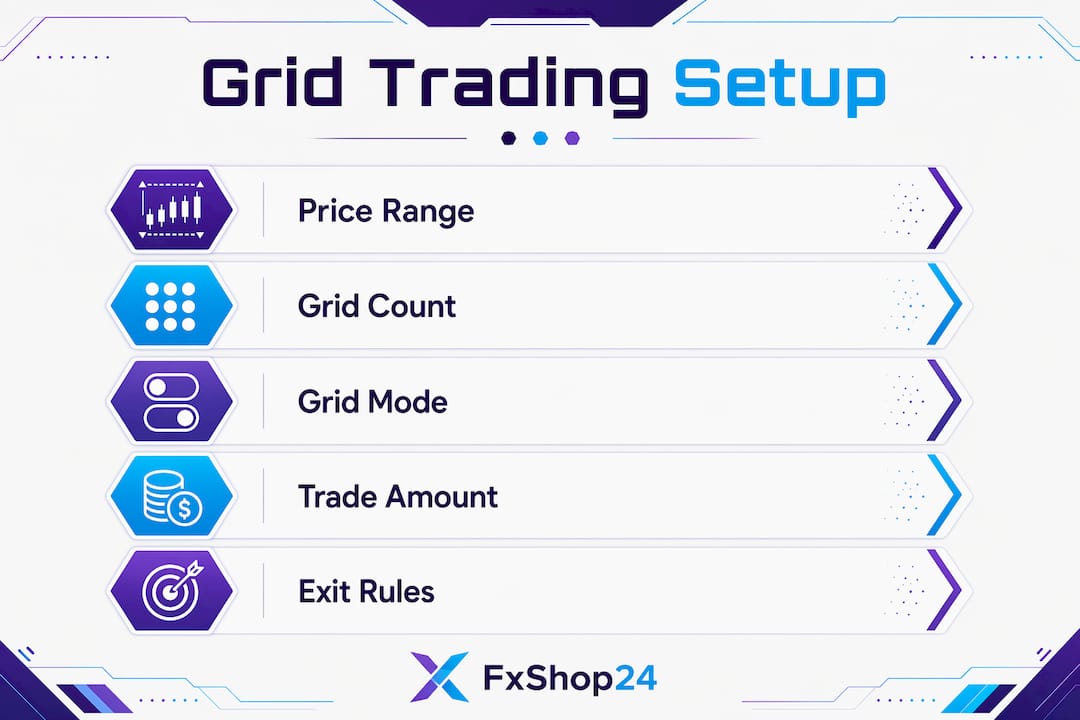
Every grid system runs on a set of core parameters. Getting these right determines whether the strategy is profitable or fee-negative from day one.
Lower and upper price boundaries define the range within which the grid operates. Set them too narrow and the grid fills too quickly, leaving capital idle. Set them too wide and individual grid levels are spaced so far apart that fills become rare. The boundaries should reflect realistic price behavior for the asset, based on historical oscillation data.
Grid count determines how many levels exist within the range. More levels mean tighter spacing and more frequent fills, but also smaller profit per fill. Fewer levels mean larger profit per fill but less trading activity. The right number depends on your capital, your fee structure, and the volatility of the asset.
Grid mode is one of the most consequential choices. Arithmetic grids use equal price spacing, meaning each level is the same dollar distance apart. Geometric grids use proportional spacing, where each level is a fixed percentage apart. For narrow, stable ranges like EUR/USD during Asian session hours, arithmetic works well. For gold, which can swing hundreds of dollars in a week, geometric spacing maintains proportionality as price moves and is generally the better choice.
| Parameter | Arithmetic grid | Geometric grid |
|---|---|---|
| Spacing type | Fixed dollar amount | Fixed percentage |
| Best for | Narrow, stable ranges | Wide or volatile ranges |
| Example asset | EUR/USD | XAU/USD (gold) |
| Risk profile | Predictable spacing | Proportional exposure |
Trade amount sets the position size per grid level. This directly controls capital allocation and risk exposure. Spreading capital too thin across too many levels reduces per-trade impact. Concentrating too much on a few levels increases inventory risk if price trends away.
Take profit and stop loss define when the entire strategy terminates. Stop loss and take profit set the strategy’s exit conditions, with “Sell All on Stop” as the default behavior on most platforms. These are not optional settings. They are the primary defense against catastrophic loss in trending markets.
Pro Tip: Set your take profit at a realistic gain target based on historical oscillation frequency, not on wishful thinking. A grid that runs for three weeks and hits its take profit is more valuable than one that runs indefinitely with no exit plan.
What types of grid trading systems exist?
Grid systems are not one-size-fits-all. Platforms offer spot grids, futures grids, infinity grids, and reverse grids, each suited to different market conditions and trader objectives.
- Spot grids are the most straightforward. You buy and sell the actual asset within a defined range. Capital is fully deployed, there is no leverage, and risk is limited to the capital allocated. Ideal for conservative traders in forex or gold.
- Futures grids use leverage and allow short-side exposure. This amplifies both profit potential and loss risk. A futures grid on gold with 5x leverage can generate significant returns in a ranging market, but a breakout trend can wipe the position quickly without a stop loss in place.
- Infinity grids have no upper price boundary and use proportional spacing to follow rising price trends. They are designed for assets expected to appreciate over time. The absence of an upper bound means the grid keeps placing sell orders as price rises, capturing gains continuously.
- Reverse grids flip the logic. They place sell orders below the current price and buy orders above it, profiting from downward oscillations. These are less common but useful in bearish ranging markets.
- Arithmetic vs. geometric spacing applies across all these types. The choice affects how capital is distributed across levels and how the grid behaves as price moves toward the boundaries.
For forex traders, spot grids on pairs like EUR/USD or GBP/USD during range-bound sessions are the most practical entry point. For gold traders, geometric spacing in a futures or spot grid accounts for the asset’s wider natural swings and higher per-unit price.
What are the key risks and limitations of grid trading?
Grid trading carries specific, well-documented risks that most new traders underestimate. Knowing them before deployment is not optional.
Trend breakout risk. If price moves strongly outside the grid range, the bot accumulates inventory at losing prices with no offsetting fills on the other side. Without a stop loss, this inventory accumulation can produce large losses in sustained trending markets.
Stop loss neglect. Stop loss placement 3 to 5% below the lowest grid line is the standard recommendation. Traders who skip this setting are exposed to unlimited downside if the market trends hard against their grid.
Fee drag. Grid spacing must be wide enough to overcome transaction fees. The rule of thumb is that grid spacing should be 3 to 4 times the trading fee per fill. With a 0.1% exchange fee, each grid level must capture at least 0.4% to remain profitable. This means a fee-positive grid on a tight forex pair requires careful calibration, not guesswork.
Capital lock-up. All allocated capital sits in open orders across the grid. It cannot be redeployed elsewhere while the grid runs. Traders who over-allocate to a single grid reduce their flexibility to respond to other opportunities.
Market condition shifts. A grid configured for a ranging market becomes a liability the moment a major economic event triggers a sustained trend. Monitoring is not passive. You need to check whether the market conditions that justified the grid still exist.
Pro Tip: Review your grid’s performance every 48 to 72 hours. If price has been consistently pressing against one boundary without reversing, that is a signal to reassess whether the grid is still in the right market environment. The stop-loss role in trading is especially critical here.
Diversification across multiple grids on uncorrelated pairs reduces the impact of any single grid failing. Running one grid on EUR/USD and another on XAU/USD, for example, spreads risk across assets with different volatility profiles and market drivers.
How to use grid trading effectively in forex and gold markets
Applying grid trading in forex and gold requires more than copying default settings from a platform tutorial. These markets have distinct volatility profiles, trading hours, and fee structures that directly affect grid performance.
- Use ATR to set your range. Volatility measures like ATR help adapt grid ranges to market conditions. Set your upper and lower bounds approximately 1.5 to 2 times the 14-day ATR above and below the current price. For gold, the 14-day ATR frequently exceeds $30 per ounce, which means your grid needs meaningful width to capture natural oscillations.
- Calibrate spacing to fees. On MT4 or MT5, broker spreads and commissions vary significantly. A grid spacing of 0.3% on a broker charging 0.15% per side is barely fee-positive. Calculate your break-even spacing before placing a single order.
- Match grid type to market phase. Arithmetic grids work for EUR/USD during Asian session consolidation. Geometric grids work better for gold during high-volatility sessions when price swings are proportionally larger.
- Use AI-assisted parameter tools where available. Platforms like SmartGrid AI on MT4 use OpenAI-powered recommendations to suggest grid parameters based on current market data. This reduces the guesswork in initial configuration.
- Monitor and adjust. Experienced traders use volatility indicators dynamically to adapt grid ranges as market conditions evolve. A grid set in January may need reconfiguration by March if volatility has shifted materially.
| Market | Recommended grid type | Key consideration |
|---|---|---|
| EUR/USD | Arithmetic spot grid | Tight spreads, stable range |
| XAU/USD (gold) | Geometric spot or futures grid | Wide ATR, higher per-unit value |
| GBP/USD | Arithmetic with wider bounds | Higher volatility than EUR/USD |
For traders comparing grid systems against other automated approaches, the grid vs. DCA vs. arbitrage breakdown at Fxshop24 is a useful reference for understanding where each strategy fits.
Key takeaways
Grid trading systems profit from price oscillation within a defined range, and their success depends on correct parameter configuration, fee-aware spacing, and non-negotiable stop-loss placement.
| Point | Details |
|---|---|
| Core definition | Grid systems place buy and sell orders at set intervals, profiting from oscillations not direction. |
| Grid mode matters | Use arithmetic grids for stable forex ranges and geometric grids for volatile assets like gold. |
| Stop loss is mandatory | Place stop loss 3 to 5% below the lowest grid line to limit drawdown in trending markets. |
| Fee-positive spacing | Grid spacing must be 3 to 4 times the per-fill fee to remain profitable over time. |
| ATR-based range setting | Use the 14-day ATR multiplied by 1.5 to 2 to set realistic upper and lower grid boundaries. |
What most traders get wrong about grid systems
After working with dozens of MT4 and MT5 grid configurations across forex and gold markets, the pattern I see most often is not a failure of the strategy itself. It is a failure of configuration discipline.
Traders spend hours debating grid count and spacing, then deploy with no stop loss because they assume the market will “come back.” It rarely does on the timeline they expect. The main vulnerability of grid systems is inventory accumulation during trends, and the only reliable defense is a stop loss set before the grid goes live, not after it starts losing.
The second most common mistake is ignoring fees. A grid that looks profitable on paper becomes fee-negative in practice because the spacing was set to look active rather than to clear costs. I have seen traders run 50-level grids on EUR/USD with a 20-pip total range, generating dozens of fills per day and still losing money because each fill barely covered the spread.
My honest recommendation: start with fewer levels, wider spacing, and a clear stop loss. Add complexity only after you have verified profitability on a demo account across at least two weeks of real market conditions. The automated trading advantages for forex and gold are real, but they require a disciplined setup process to materialize.
Grid trading is not passive income by default. It is systematic income when configured correctly.
— FxShop24
Explore grid trading EAs and automated systems at Fxshop24
Fxshop24 offers a curated selection of MT4 and MT5 compatible grid trading expert advisors, from entry-level spot grid bots to AI-powered systems like SmartGrid AI. Every product includes lifetime updates, unlimited licenses, and installation support, so you are not left configuring a complex system alone.
Whether you are new to grid strategies or looking to upgrade your current setup, the automated futures trading systems catalog at Fxshop24 covers prop firm-ready EAs, gold-optimized grid bots, and full documentation to get you live faster. Browse the marketplace and find a system matched to your risk profile and target market.
FAQ
What is grid trading in simple terms?
Grid trading is an automated strategy that places buy and sell orders at fixed price intervals within a set range, profiting each time price moves between two adjacent levels. It works best in sideways markets where price oscillates repeatedly.
What are the main grid trading system types?
The four main types are spot grids, futures grids, infinity grids, and reverse grids. Spot grids are the most conservative, while futures grids use leverage for higher exposure on both sides of the market.
How do I set the right grid range for forex or gold?
Use the 14-day ATR and set your upper and lower bounds 1.5 to 2 times that value above and below the current price. For gold, this typically means a range of $45 to $60 or more given its average daily volatility.
Why is stop loss placement critical in grid trading?
Without a stop loss, a grid bot accumulates losing inventory if price trends outside the grid range. Placing a stop loss 3 to 5% below the lowest grid line limits maximum drawdown and protects capital in trending markets.
What is the difference between arithmetic and geometric grid modes?
Arithmetic grids use equal dollar spacing between levels, suited to stable forex pairs. Geometric grids use percentage-based spacing, making them better for assets like gold where price swings are proportionally larger at higher price levels.