


11
Jan
Defining AI Trading Bots: What Every Trader Needs
Most american retail forex traders know that keeping up with global markets often depends on more than skill alone. With AI trading bots now responsible for over half of all trades in major financial markets, understanding these advanced systems has become essential for anyone serious about growing their MetaTrader performance. This guide demystifies how AI bots work, compares popular strategies, and shows how experienced traders are using technology to their advantage in a world where milliseconds can separate profit from loss.
Table of Contents
- Defining AI Trading Bots And Core Concepts
- Types Of AI Trading Bots For Forex And Gold
- Key Features And How AI Bots Work
- Real-World Applications In MetaTrader Platforms
- Risks, Misconceptions, And What To Avoid
Key Takeaways
| Point | Details |
|---|---|
| AI Trading Bots Enhance Trading Efficiency | These sophisticated programs automate financial transactions and analyze market data to identify opportunities instantly. |
| Diverse Bot Types for Various Strategies | AI trading bots are categorized into types like trend-following, mean reversion, and sentiment analysis to cater to different market conditions. |
| Continuous Learning Improves Performance | Machine learning algorithms enable AI trading bots to adapt and refine strategies over time based on historical performance. |
| Realistic Expectations and Risk Management Are Crucial | Traders should avoid misconceptions about guaranteed profits and prioritize risk assessment and continuous monitoring of bot performance. |
Defining AI Trading Bots and Core Concepts
AI trading bots represent sophisticated software programs designed to execute financial transactions automatically across global markets. These advanced algorithms leverage machine learning techniques to analyze complex market data, identify trading opportunities, and make split-second decisions without human intervention. Advanced AI trading techniques have transformed how traders approach financial markets by introducing unprecedented levels of computational precision and strategic analysis.
At their core, AI trading bots utilize complex mathematical models and statistical algorithms to process massive datasets from financial exchanges. These systems continuously learn from historical market patterns, price movements, trading volumes, and global economic indicators to develop predictive trading strategies. Unlike traditional manual trading approaches, AI bots can simultaneously monitor multiple currency pairs, analyze intricate market signals, and execute trades within milliseconds - capabilities far beyond human cognitive limitations.
The fundamental architecture of AI trading bots typically involves several critical components: data collection mechanisms, machine learning models, risk management protocols, and automated execution systems. Machine learning algorithms enable these bots to adapt and improve their strategies over time, learning from both successful and unsuccessful trades to refine their decision-making processes. Advanced neural networks and deep learning techniques allow these systems to recognize subtle market patterns that human traders might overlook, potentially generating more consistent trading performance.
Pro tip: Always start with small investment amounts when testing a new AI trading bot to understand its performance characteristics and risk management approach before committing significant capital.
Types of AI Trading Bots for Forex and Gold
AI trading bots in forex and gold markets are sophisticated technological solutions categorized by their strategic approaches and computational capabilities. Specialized trading bot strategies enable traders to leverage advanced algorithmic techniques designed for specific market conditions and asset classes. These bots are typically classified into distinct categories based on their operational methodologies, market focus, and analytical frameworks.

The primary types of AI trading bots for forex and gold markets include trend-following bots, mean reversion bots, arbitrage bots, and sentiment analysis bots. Trend-following bots identify and capitalize on sustained price movements, using machine learning algorithms to detect emerging market directions. Mean reversion bots operate on the principle that asset prices tend to return to historical average levels, executing trades when prices deviate significantly from established baselines. Arbitrage bots exploit price discrepancies across different exchanges, generating profits from temporary market inefficiencies.
Sentiment analysis bots represent a more advanced category, integrating natural language processing techniques to evaluate market sentiment from news sources, social media, and economic reports. Hybrid AI trading models combine multiple analytical approaches, integrating technical indicators, fundamental analysis, and machine learning predictions to create more robust trading strategies. These sophisticated systems can adapt dynamically to changing market conditions, offering traders unprecedented flexibility and computational trading capabilities across forex and gold markets.
Here is a summary comparing major types of AI trading bots used in forex and gold markets:
| Bot Type | Primary Market Focus | Strengths | Typical Limitations |
|---|---|---|---|
| Trend-Following | Forex and Gold | Captures sustained trends | Vulnerable during sideways markets |
| Mean Reversion | Forex and Gold | Profits from price corrections | Risky in strong trend phases |
| Arbitrage | Multi-exchange Assets | Exploits price differences | Dependent on market efficiency |
| Sentiment Analysis | News/Social Media | Reacts to market mood shifts | May misinterpret rapid sentiment |
| Hybrid Models | All asset classes | Combines several strategies | Complexity may increase errors |
Pro tip: Carefully evaluate an AI trading bot’s historical performance metrics and backtesting results before committing real capital, paying special attention to its performance during different market volatility scenarios.
Key Features and How AI Bots Work
AI trading bots operate through complex computational processes that transform market data into strategic trading decisions. Advanced bot operational mechanisms enable these sophisticated systems to continuously analyze financial markets, generating trading signals with remarkable precision and speed. The fundamental architecture of these bots involves multiple interconnected components designed to process, interpret, and act upon real-time market information.
The core functionality of AI trading bots centers around three primary stages: data collection, signal generation, and trade execution. During the data collection phase, bots aggregate massive volumes of market data from multiple sources, including price movements, trading volumes, economic indicators, and historical price patterns. Machine learning algorithms then analyze this data, identifying potential trading opportunities by detecting complex market patterns that human traders might miss. Signal generation involves sophisticated mathematical models that evaluate the collected data against predefined trading strategies, determining optimal entry and exit points with computational efficiency.
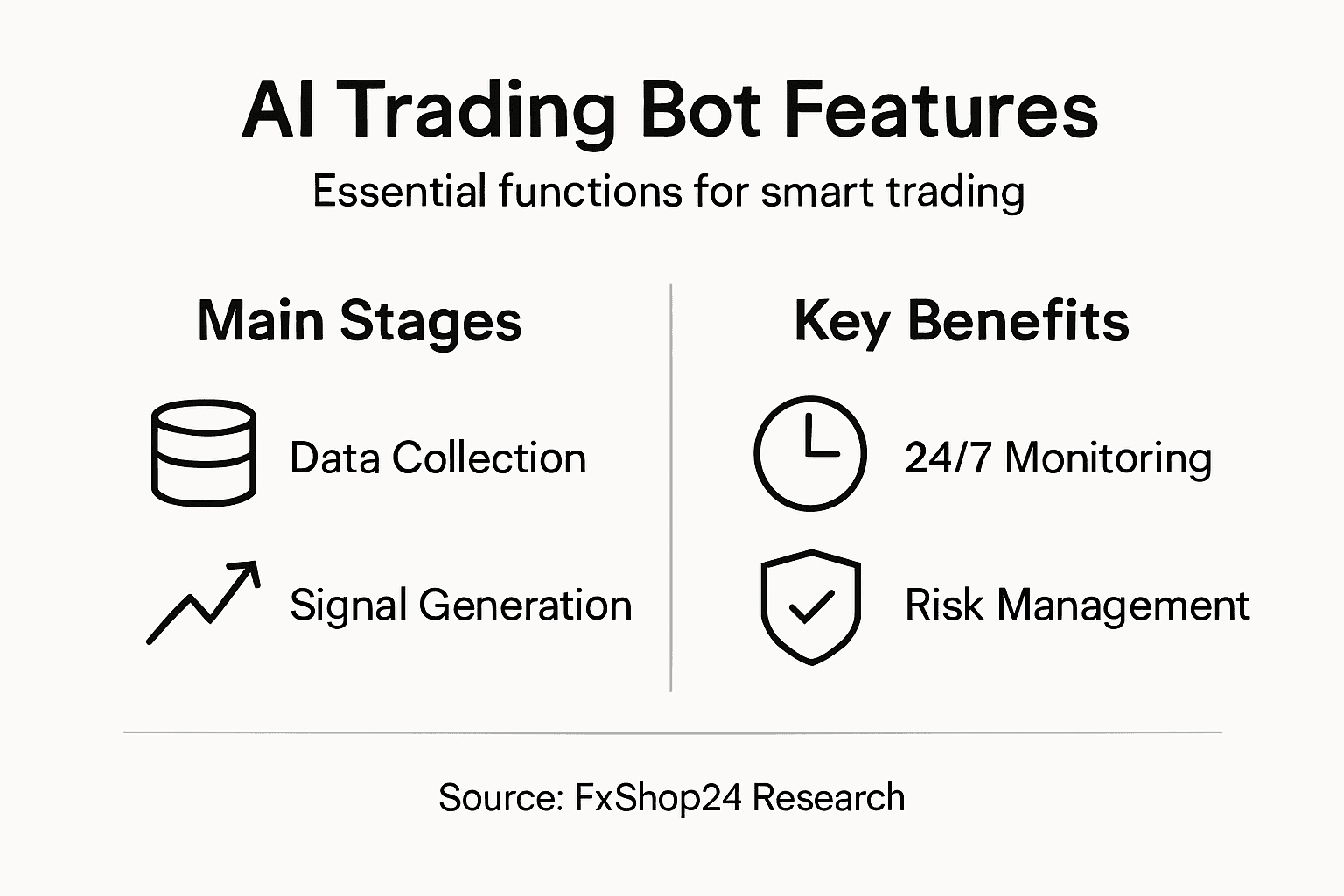
Key features of advanced AI trading bots include continuous 24/7 market monitoring, automated risk management, and adaptive learning capabilities. These systems implement advanced techniques like automated stop-loss mechanisms, portfolio rebalancing, and dynamic strategy adjustment based on real-time market conditions. Machine learning enables these bots to continuously improve their performance by analyzing previous trade outcomes, refining their algorithms, and developing more sophisticated trading approaches that can adapt to changing market dynamics. The ability to process vast amounts of information simultaneously gives AI trading bots a significant computational advantage over traditional manual trading methods.
This table highlights essential features of advanced AI trading bots and their impact on trading outcomes:
| Feature | How It Works | Impact on Trading |
|---|---|---|
| 24/7 Market Monitoring | Constant data analysis | Faster opportunity detection |
| Automated Risk Control | Built-in stop-loss/rebalancing | Limits losses automatically |
| Adaptive Learning | Refines strategy from trade history | Improved performance over time |
| Multi-Asset Support | Trades across various markets | Greater diversification |
| Millisecond Execution | Executes trades nearly instantly | Takes advantage of volatility |
Pro tip: Configure your AI trading bot with conservative initial risk parameters and gradually adjust settings as you gain confidence in its performance and understand its specific market behavioral patterns.
Real-World Applications in MetaTrader Platforms
MetaTrader platforms have become the primary technological infrastructure for deploying AI trading bots, offering traders sophisticated tools to automate and optimize their forex and gold trading strategies. Expert advisor installation methods enable traders to seamlessly integrate advanced AI trading algorithms into their existing trading environments. These platforms provide a robust ecosystem that supports complex trading automation across multiple currency pairs and precious metal markets.
In real-world applications, AI trading bots on MetaTrader platforms can be configured to execute various sophisticated trading strategies. Traders can implement trend-following algorithms that automatically identify and capitalize on sustained market movements, mean reversion strategies that exploit price fluctuations, and advanced sentiment analysis techniques that incorporate machine learning to interpret market signals. The MetaTrader environment allows for extensive customization, enabling traders to develop highly specialized bots tailored to specific market conditions, risk tolerances, and trading objectives.
The practical implementation of AI trading bots on MetaTrader involves multiple critical considerations, including algorithmic design, risk management parameters, and continuous performance monitoring. Successful traders leverage the platform’s advanced charting tools, historical data analysis capabilities, and robust backtesting environments to refine their AI trading strategies. The ability to integrate complex mathematical models, machine learning algorithms, and real-time market data processing makes MetaTrader an ideal platform for traders seeking to harness the power of computational trading technologies.
Pro tip: Always conduct extensive backtesting and start with minimal capital allocation when implementing a new AI trading bot on MetaTrader to validate its performance and understand its specific market behavioral patterns.
Risks, Misconceptions, and What to Avoid
AI trading bots are not infallible financial instruments, and traders must approach them with a critical and informed perspective. AI trading bot limitations reveal significant risks that can potentially undermine trading performance if not carefully managed. The primary misconception is that these automated systems guarantee consistent profits, when in reality they represent complex tools requiring sophisticated understanding and continuous monitoring.
One of the most critical risks involves the potential for overfitting, where AI algorithms become excessively tailored to historical market data that may not accurately predict future market conditions. Traders frequently encounter challenges such as data bias, where machine learning models inadvertently incorporate historical prejudices or incomplete market representations. These limitations can lead to unexpected trading outcomes, particularly during unprecedented economic events or sudden market volatility that fall outside the bot’s original training parameters.
Traders must be vigilant about several key misconceptions surrounding AI trading technologies. Understanding trading bot risks requires recognizing that no algorithm can completely eliminate market uncertainty. Technical failures, liquidity constraints, and regulatory changes can dramatically impact bot performance. Successful implementation demands continuous strategy refinement, realistic performance expectations, and a comprehensive risk management approach that includes regular performance audits, diversification of trading strategies, and maintaining human oversight to interpret complex market signals that algorithmic systems might misunderstand.
Pro tip: Develop a systematic approach to evaluating AI trading bot performance by establishing clear performance benchmarks, setting strict risk management parameters, and maintaining the flexibility to manually intervene when automated systems demonstrate unexpected behavior.
Unlock the Power of AI Trading Bots with FxShop24
Navigating the complexities of automated trading requires reliable tools that understand the challenges discussed in “Defining AI Trading Bots: What Every Trader Needs.” If you are concerned about mastering AI trading algorithms, managing risk, and optimizing performance across volatile forex and gold markets, FxShop24 offers tailored solutions to meet your goals. Our range of expert advisors and AI-powered robots are designed to adapt, continuously learn, and help you stay ahead with instant execution and sophisticated risk controls.
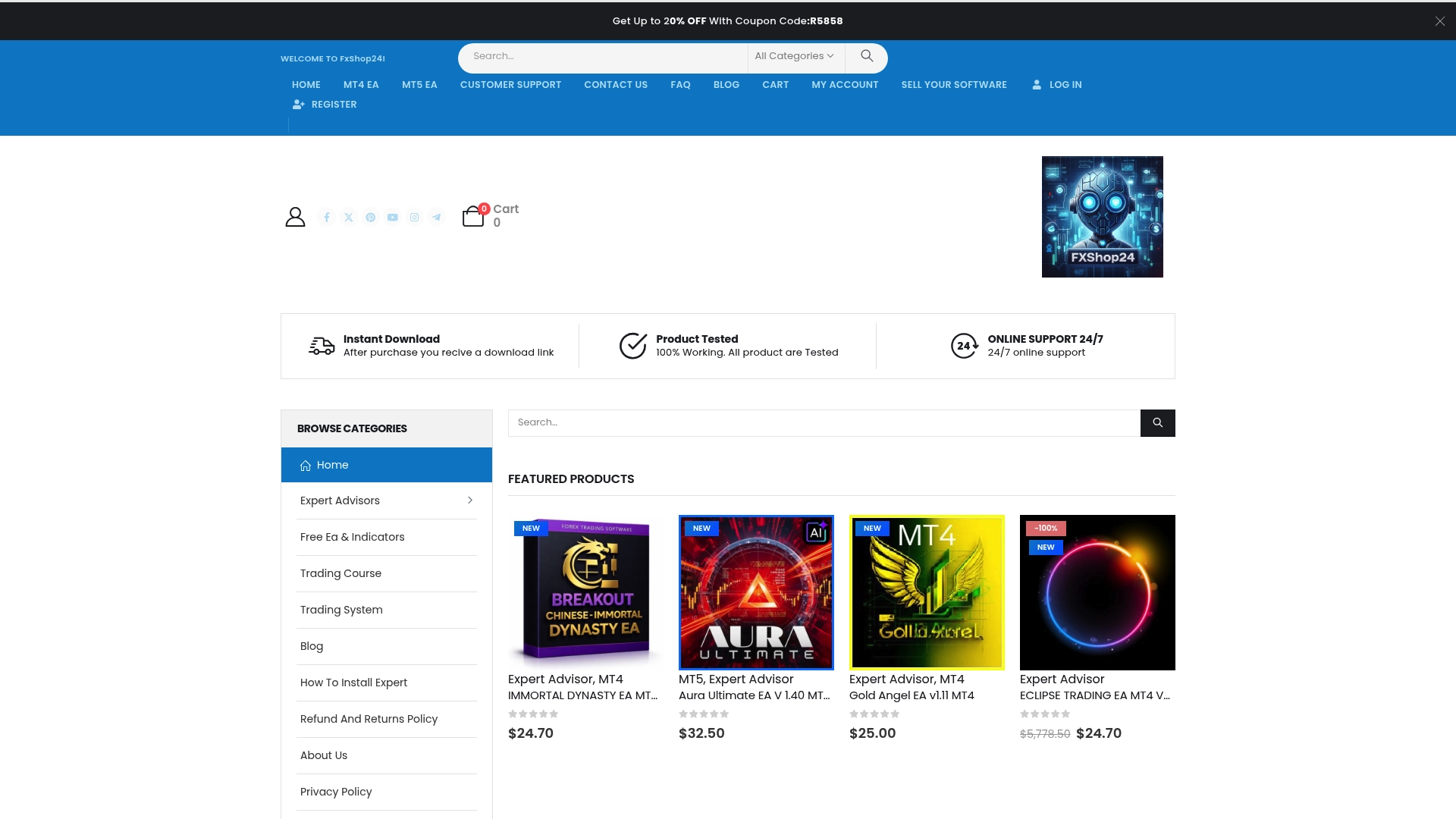
Take control of your trading journey today. Explore our premium automated trading systems optimized for MetaTrader 4 and MetaTrader 5 platforms. Join thousands of traders who trust FxShop24 for reliable, prop firm-ready EAs with lifetime updates. Discover how our tested AI trading bots can improve your strategy at FxShop24’s homepage and learn installation tips from our comprehensive guides like Expert Advisor Installation Methods. Don’t wait for the perfect trade to come to you. Start automating smarter now.
Frequently Asked Questions
What are AI trading bots?
AI trading bots are sophisticated software programs that automate financial transactions by analyzing market data, identifying trading opportunities, and executing trades without human intervention.
How do AI trading bots work?
AI trading bots operate through three main stages: data collection, signal generation, and trade execution. They aggregate vast amounts of market data, analyze it using machine learning algorithms, and execute trades based on predefined strategies.
What types of trading strategies do AI trading bots use?
AI trading bots utilize various strategies including trend-following, mean reversion, arbitrage, and sentiment analysis to make trading decisions based on market conditions.
What are the risks associated with using AI trading bots?
The risks include overfitting to historical data, data bias, technical failures, and market uncertainties. Continuous monitoring and realistic performance expectations are critical for managing these risks.