
27
Jun
Gold Trading Tools List: 9 Essential Tools for 2026
TL;DR:
- A complete gold trading tools list must include risk management software, macroeconomic dashboards, and sentiment trackers. Traders who ignore any of these often trade blindly and risk significant losses during volatile market conditions.
A complete gold trading tools list is defined by three core categories: risk management software, fundamental macroeconomic dashboards, and institutional sentiment trackers. Traders who skip any one of these categories trade blind. Professional gold strategies require all three working together to manage XAU/USD’s notoriously wide price swings. The CME FedWatch Tool, CFTC Commitments of Traders reports, and position sizing calculators are the named standards that separate disciplined traders from those who blow accounts on high-impact news days.
1. What belongs on a gold trading tools list
The gold trading tools list is not just a collection of chart indicators. It is a structured framework covering risk control, macro data, and market positioning. Traders who lack position sizing tools risk over-leveraging accounts by over 300% during high-impact news events. That single statistic explains why risk tools come first, not last.
Gold responds to interest rate expectations, real yields, central bank demand, and dollar strength. No single chart pattern captures all of those forces. A proper toolkit addresses each layer separately, then combines the signals before execution.
2. Position sizing and risk management tools
Dynamic position sizing is the most underrated tool in gold trading. Fixed lot sizes ignore the fact that XAU/USD moves far wider than major currency pairs on any given day. Volatility-based position sizing using the Average True Range (ATR) adjusts your exposure automatically when the market heats up.

Most professional traders risk no more than 1–2% of account equity per trade, regardless of how strong the setup looks. That rule preserves capital through losing streaks that even the best systems produce. A position sizing calculator applies that rule mechanically, removing the temptation to “just this once” increase size.
Key features to look for in a risk management tool:
- ATR-based lot calculation that scales position size with current volatility
- Equity percentage input so the 1–2% rule is enforced automatically
- Stop-loss distance field that calculates size from your actual chart stop, not a fixed pip value
- Real-time account balance sync so calculations reflect your live equity
Pro Tip: Run your position sizing calculator before you open the chart, not after you spot the trade. Deciding size after you are emotionally committed to a setup almost always produces oversized positions.
3. Fundamental macroeconomic dashboards
Gold price drivers live in the macro data, not on the price chart. The top-down approach starts with Fed rate expectations, real yields, and central bank demand before a trader ever looks at a candlestick. The CME FedWatch Tool shows the probability of rate changes at upcoming Fed meetings and is used by professionals as a primary filter for gold direction.
The gold-silver ratio is a second fundamental indicator that most retail traders ignore. Historically, the ratio ranges around 65–70. When it deviates sharply above or below that band, it signals a valuation shift in gold relative to silver that often precedes a directional move.
Additional fundamental tools worth tracking:
- COMEX warehouse stock data: Rising or falling physical inventory signals supply and demand shifts before they appear in price
- Central bank gold reserve reports: Large purchases or sales by central banks move the market over weeks, not minutes
- ETF holdings data: Flows into and out of gold-backed ETFs reflect institutional conviction about gold’s direction
- World Gold Council’s Qaurum and GRAM models: These are industry-standard models for assessing gold’s implied returns under different economic scenarios
| Fundamental Tool | What It Measures | Update Frequency |
|---|---|---|
| CME FedWatch Tool | Fed rate change probabilities | Real-time |
| Gold-Silver Ratio | Relative valuation of gold vs. silver | Daily |
| COMEX Warehouse Stocks | Physical gold supply levels | Weekly |
| ETF Holdings Data | Institutional demand flows | Daily |
| World Gold Council GRAM | Macro-driven return scenarios | Monthly |
4. Institutional sentiment tracking tools
Sentiment tools reveal what large players are actually doing, not what they say. The CFTC Commitments of Traders (COT) report breaks down speculative versus commercial positioning in gold futures every week. When speculative longs reach extreme levels, the market is often set up for a reversal regardless of what the chart looks like.
Options market data adds another layer. Max Pain and Zero Gamma levels indicate where option market makers are most exposed and where they will hedge. That hedging creates real buying or selling pressure at specific price zones. Dealers’ hedging flows often anticipate price stalls or reversals that are completely invisible in price-only charts.
GEX, or Gamma Exposure, measures the net options positioning of dealers across strike prices. High positive GEX suppresses volatility. Negative GEX amplifies it. Knowing which regime you are in before a trade changes your stop placement and target selection.
Key sentiment tools to include:
- CFTC COT report: Weekly speculative positioning in gold futures
- Max Pain calculator: The price level where the most options expire worthless
- GEX dashboard: Dealer gamma exposure mapped to price levels
- Open interest analysis: Rising open interest with price confirms trend; divergence warns of reversal
Pro Tip: Never use sentiment data alone. Combine COT positioning with a fundamental catalyst and a technical entry trigger. Sentiment tells you the setup; fundamentals tell you the direction; technicals tell you the timing.
5. Technical analysis software and indicators
Technical indicators confirm what fundamentals and sentiment already suggest. They are not predictive on their own. Indicators like the Adaptive Moving Average (AMA), Commodity Channel Index (CCI), and Keltner Channels are widely used for gold trading and are natively available on MetaTrader 4 and MetaTrader 5.
The AMA adjusts its sensitivity based on market noise, making it more reliable than a standard moving average during choppy gold sessions. The CCI identifies when gold is overbought or oversold relative to its statistical average. Keltner Channels define the volatility envelope around price, helping traders spot breakouts from consolidation zones.
Common pitfalls with technical tools:
- Using too many indicators that all measure the same thing (momentum stacking)
- Treating a crossover signal as a trade trigger without macro confirmation
- Ignoring volume, which on gold futures confirms whether a move has institutional backing
- Applying indicators calibrated for equities without adjusting settings for XAU/USD’s volatility profile
The role of indicators in trading is confirmation, not prediction. Treat every indicator signal as a question, not an answer.
6. Automated trading solutions and expert advisors
Automated systems solve the discipline problem that kills most manual traders. Automated gold trading solutions on MT4/MT5 execute trades based on pre-defined rules, removing emotional interference from the equation entirely. They maintain consistent position sizing, enforce stop-loss levels, and never skip a rule because the trader is tired or distracted.
Three main types of automated tools serve gold traders:
- Expert Advisors (EAs): Rule-based programs that run directly on MT4 or MT5, executing trades when conditions are met
- AI-powered trading bots: Systems that adapt to changing market conditions using machine learning rather than fixed rules
- Trade assistants: Semi-automated tools that calculate position size, set stops, and manage open trades while the trader makes the final entry decision
When selecting an automated solution, check for built-in risk controls. A system without a hard stop-loss or maximum drawdown limit is dangerous on a volatile instrument like gold. The Fxshop24 marketplace offers vetted EAs and trading systems with documented risk parameters, prop firm compatibility, and lifetime updates.
Considerations before deploying any automated system:
- Backtest results should cover at least three years of data including a major volatility event
- Forward test on a demo account for a minimum of four weeks before going live
- Confirm the system’s position sizing logic matches your account size and risk tolerance
- Check whether the EA handles news events by pausing or by applying wider stops
7. Platform selection as a foundational tool decision
The trading platform itself is a tool, and the wrong choice limits every other tool you use. Short-term gold traders benefit from platforms with tight spreads and fast execution, while long-term investors often prefer physically-backed ETFs accessed through a brokerage account. Choosing a platform optimized for the wrong trading style creates friction that no indicator or EA can fix.
MT4 and MT5 remain the dominant platforms for gold CFD trading because of their deep ecosystem of indicators, EAs, and third-party tools. MT5 adds more order types and a built-in economic calendar, making it the stronger choice for traders who integrate fundamental data into their workflow. Understanding the types of MetaTrader tools available on each platform helps traders build a complete setup from the start.
8. Weekly checklist integration: combining all tools
Top traders use a weekly checklist that synthesizes CME FedWatch data, COT reports, and technical confirmation before placing any trade. That checklist is itself a tool. It prevents the common mistake of acting on a single signal while ignoring conflicting data from other categories.
A practical weekly checklist for gold traders looks like this:
- Check CME FedWatch for any shift in rate expectations since last week
- Review the latest CFTC COT report for changes in speculative net positioning
- Note any central bank announcements or ETF flow data from the World Gold Council
- Identify key technical levels using AMA and Keltner Channels on the daily chart
- Confirm GEX and Max Pain levels for the current options expiry cycle
- Set position size using ATR-based calculator before marking any entry
No single indicator tells the full gold market story. The checklist approach forces you to look at all three layers before committing capital.
9. Gold trading software for workflow automation
Workflow automation connects all the individual tools into a repeatable process. Without a defined workflow, traders use their tools inconsistently and miss the compounding benefit of having all signals aligned. Integrating automation tools with a gold trading workflow produces the consistency that separates profitable traders from those who break even over time.
Software that automates trade journaling, performance tracking, and post-trade analysis closes the feedback loop. You cannot improve what you do not measure. The best gold trading software setups combine an EA for execution, a risk calculator for sizing, and a journal tool for review.
Key takeaways
A complete gold trading tools list requires risk management, macro fundamentals, and sentiment data working together. No single tool category produces consistent results on its own.
| Point | Details |
|---|---|
| Risk tools come first | Use ATR-based position sizing to enforce the 1–2% equity rule on every trade. |
| Macro data drives direction | CME FedWatch, COT reports, and ETF flows reveal gold’s likely path before price moves. |
| Sentiment adds precision | GEX and Max Pain levels identify price zones where institutional hedging creates friction. |
| Technical indicators confirm | Use AMA, CCI, and Keltner Channels to time entries, not to generate trade ideas. |
| Automation enforces discipline | EAs and trade assistants on MT4/MT5 remove emotional decision-making from execution. |
What I have learned from building gold trading setups
The biggest mistake I see traders make is treating their gold trading tools list as a shopping list rather than a system. They add an indicator, then a sentiment tool, then an EA, without ever defining how those pieces talk to each other. The result is noise, not signal.
The tools that have made the most consistent difference are the unglamorous ones: the position sizing calculator and the weekly checklist. The calculator keeps accounts alive through inevitable losing streaks. The checklist prevents the impulsive trades that wipe out weeks of gains in a single session.
I have also found that traders who rely heavily on technical indicators alone tend to get caught off guard by macro events. Gold is not a stock. It responds to real yields, central bank policy, and geopolitical risk in ways that no moving average can anticipate. The traders who combine a fundamental read with a sentiment filter and then use technicals only for entry timing consistently outperform those who chart-trade in isolation.
The tool landscape does evolve. Options analytics terminals that track GEX and dealer hedging flows were not widely accessible to retail traders five years ago. They are now. Staying current with what institutional-grade data is available to retail traders is itself a competitive edge.
— Fxshop24
Automated gold trading tools at Fxshop24
Fxshop24 offers a vetted catalog of automated gold trading systems built for MT4 and MT5, including expert advisors, AI-powered bots, and trade assistant tools with built-in risk controls.
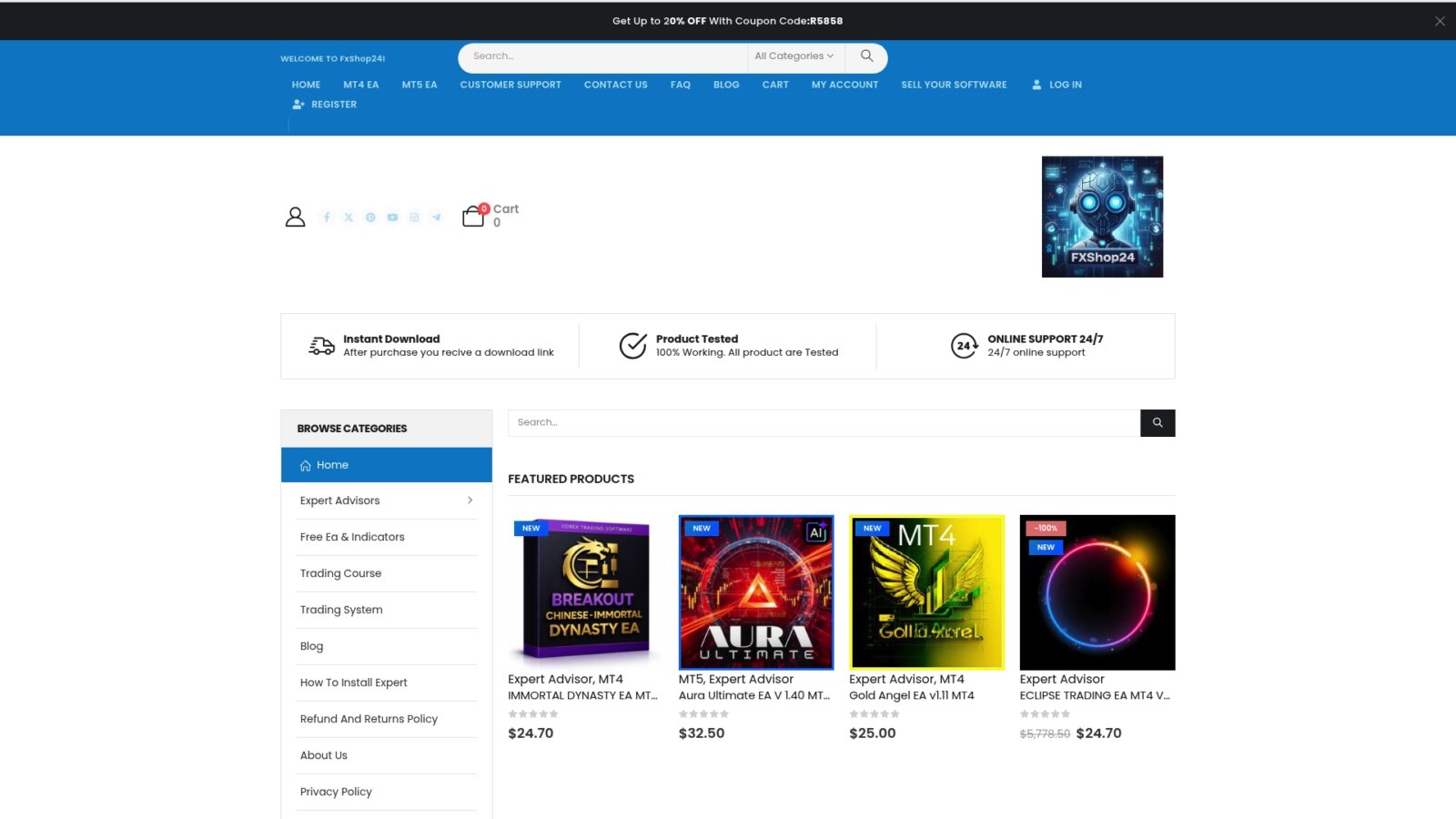
Every system in the Fxshop24 marketplace is documented with risk parameters, backtested performance data, and prop firm compatibility details. Traders can browse MT4 and MT5 automated systems by strategy type, including scalping EAs, trend-following systems, and gold-specific robots. Instant digital delivery and lifetime updates mean your tools stay current as market conditions shift.
FAQ
What is a gold trading tools list?
A gold trading tools list is a structured set of software, indicators, and data sources covering risk management, fundamental analysis, and market sentiment. Professional traders use all three categories together rather than relying on chart indicators alone.
What is the safest risk percentage per gold trade?
Most professional traders risk no more than 1–2% of account equity per trade. This rule, enforced by a position sizing calculator, preserves capital through losing streaks without requiring a perfect win rate.
What is the CME FedWatch Tool used for in gold trading?
The CME FedWatch Tool shows the market-implied probability of Federal Reserve rate changes at upcoming meetings. Gold traders use it as a primary macro filter because rate expectations directly influence real yields and gold’s price direction.
How do automated EAs help gold traders?
Expert advisors on MT4 and MT5 execute trades based on pre-set rules, removing emotional decision-making from the process. They enforce position sizing, stop-loss levels, and entry conditions consistently, which is especially valuable during volatile gold market sessions.
What is GEX and why does it matter for gold?
GEX, or Gamma Exposure, measures the net options positioning of market makers across price levels. High positive GEX suppresses volatility; negative GEX amplifies it. Knowing the current GEX regime helps gold traders set more accurate stops and profit targets before entering a position.